
The immediate trigger for this token’s flash crash was the massive collateralized position held by the WLFI team on the lending protocol Dolomite, which was on the verge of liquidation.
Written by Ma He, Foresight News
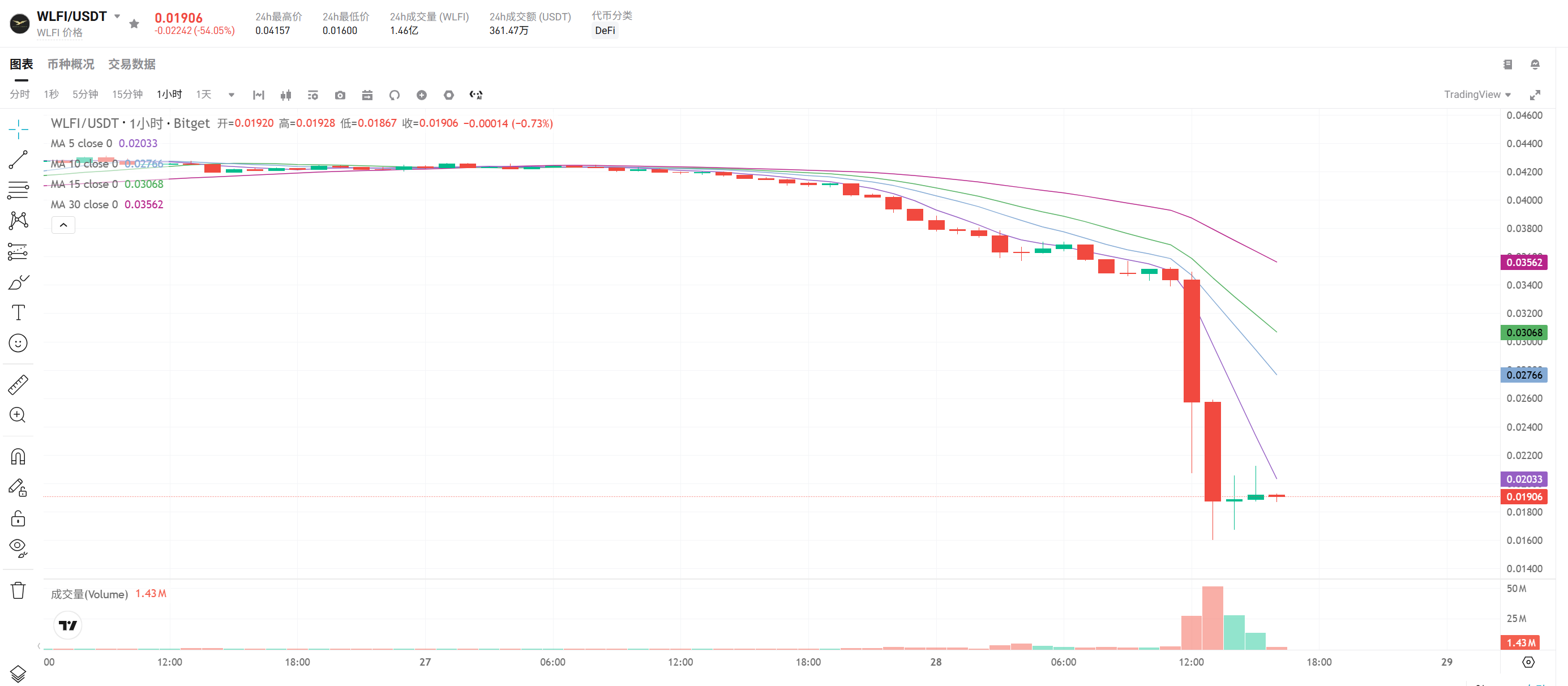
At approximately 12:00 on November 28, World Liberty Financial’s native token WLFI suffered a severe flash crash. Per market data from Bitget, WLFI plummeted sharply from around $0.04 to $0.016. As of press time, the price has rebounded to trade sideways around $0.019, posting a 24-hour drop of over 50%, with its market cap shrinking to roughly $600 million.
Panic then spread to the project’s stablecoin. At around 15:00 the same day, the depeg of the project’s stablecoin USD1 intensified: it briefly broke below the key $0.95 level, hitting a low of $0.946 (peaking at a 5.4% depeg deviation). It has since recovered to trade near $0.99, with a current market capitalization of $2.76 billion.
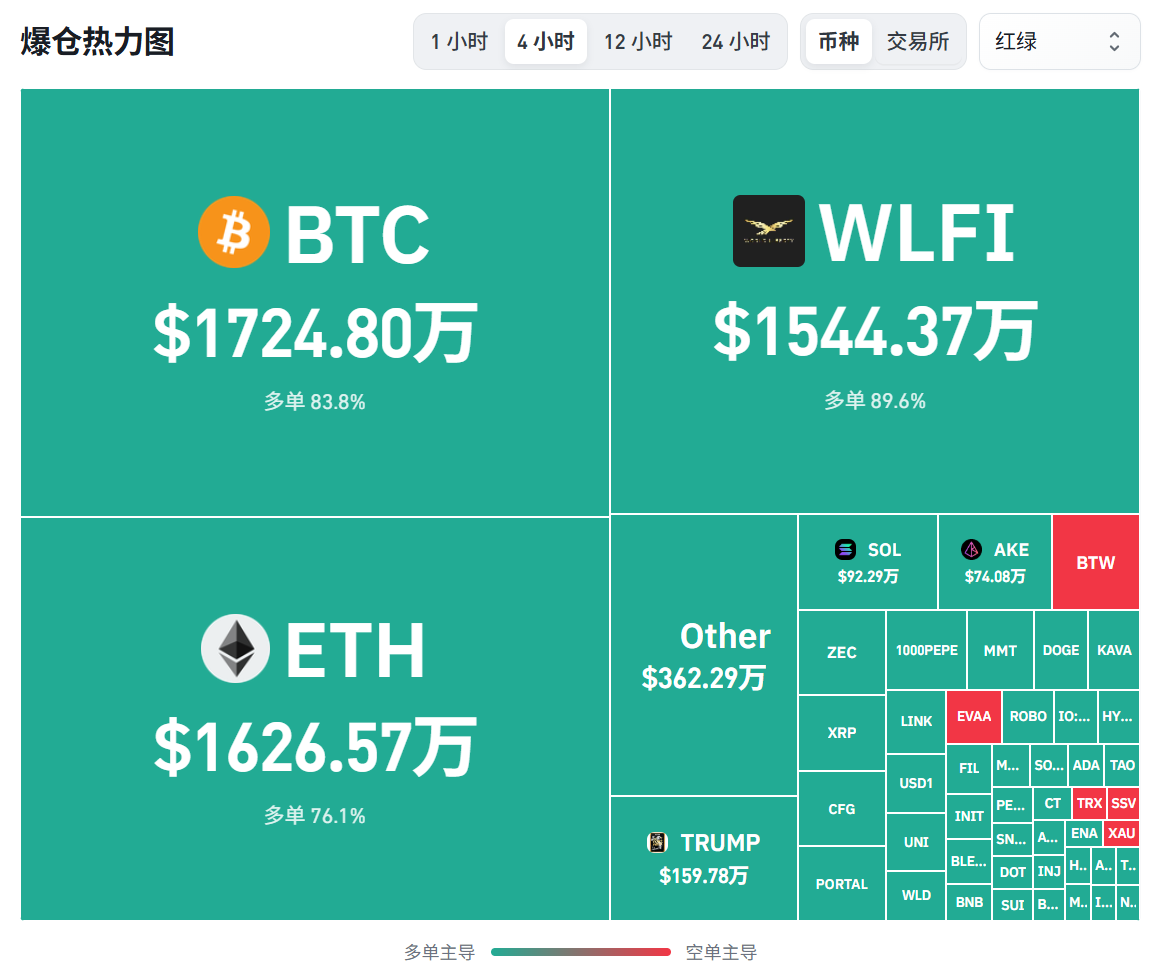
The derivatives market saw equally brutal liquidations. Per CoinGlass data, total network-wide contract liquidations for WLFI soared to $15.4437 million over the past 4 hours, with 89.6% of liquidated volume coming from long positions. The scale of liquidations rivaled that of BTC and ETH over the same period, and even USD1 appeared on the network-wide liquidation heatmap.
The spot flash crash of WLFI quickly broke through the support levels of WLFIUSDT perpetual contracts on major platforms such as Binance. As the gap from socialized losses in extreme market conditions exceeded the coverage capacity of exchange insurance funds, platforms were forced to activate the Auto-Deleveraging (ADL) mechanism. Sorted by the product of Return on Investment (ROI) and effective leverage, the mechanism forcibly liquidated top profitable short positions with ROI above 300% at the counterparties’ bankruptcy price.
Current contract funding rates have dropped deep into negative territory, reflecting extreme crowding in short positions. In this extreme market washout, high-leverage long positions were fully liquidated, the project team took a loss of nearly $20 million, and even profitable short sellers saw their late-session profits cut short by the ADL mechanism.
Team Dumps 12,100 ETH at a Loss to Stem the Liquidation Crisis
The immediate trigger of this flash crash was the massive collateral position held by the WLFI team on the lending protocol Dolomite, which was facing imminent liquidation.
Notably, Dolomite co-founder Corey Caplan is an official advisor to WLFI. Addresses linked to WLFI have staked approximately 5.1 billion WLFI on the protocol (accounting for nearly 19% of total circulating supply, based on current market value) to borrow large amounts of USD1. The liquidation price for this position, prior to margin top-ups, sat near $0.021. A break below this level would inevitably trigger cascading liquidations for the thinly traded WLFI token.
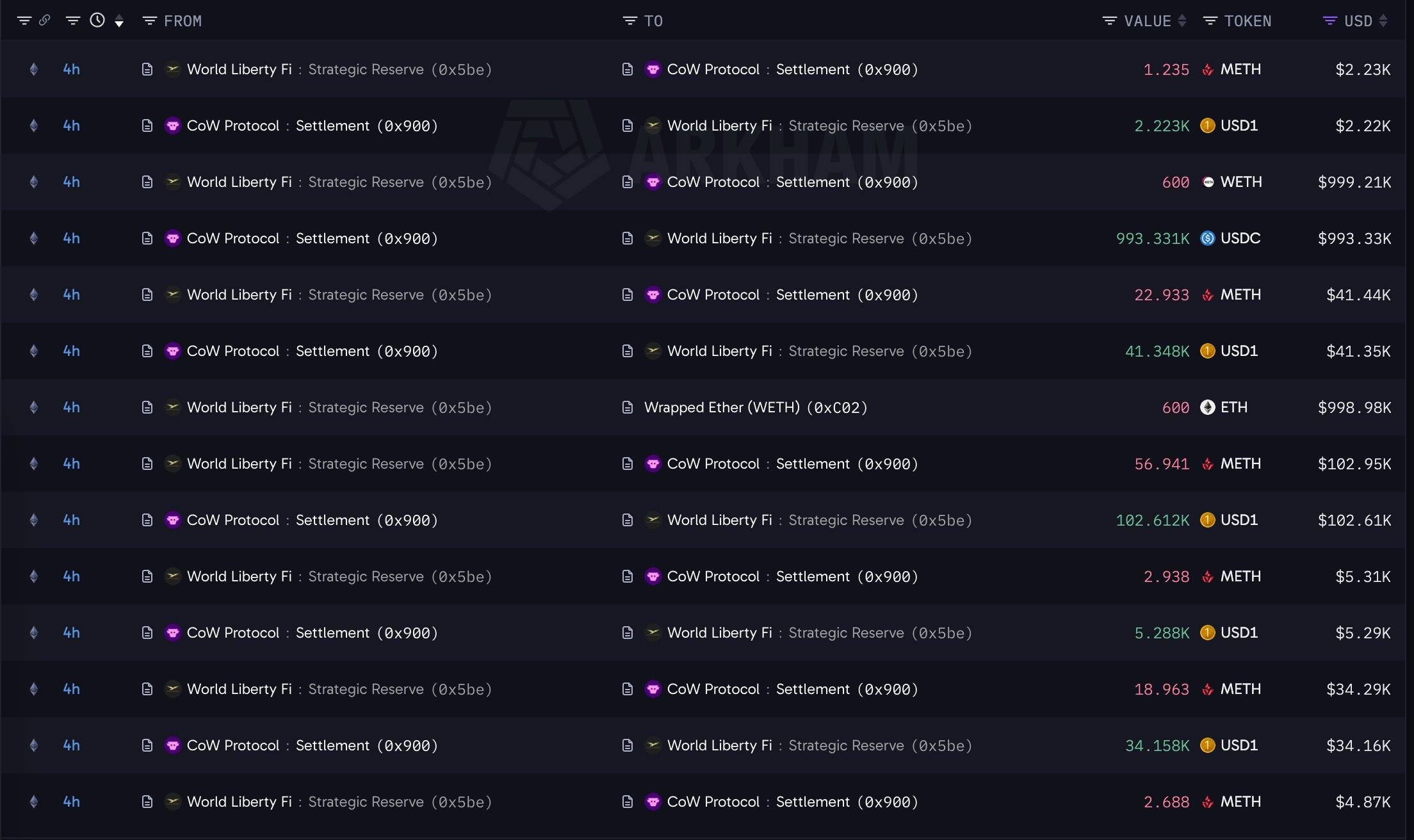
On-chain data from Arkham shows that to defend the liquidation line, WLFI’s strategic reserve wallet (an address starting with 0x5be) conducted an emergency staged sale of 10,600 ETH (including WETH) and 1,378 yield-bearing wrapped mETH tokens via CoW Protocol around the midday crash (between approximately 11:00 and 12:00). Given that mETH trades at a rate above 1 ETH, the total position was equivalent to roughly 12,121 ETH, generating about $20.06 million in proceeds that were swapped for 17.58 million USDC and 2.48 million USD1.
The team had originally built this ETH position at an average entry price of $3,244, but sold it off at an average price of only $1,655, directly converting unrealized losses into $19.26 million in realized losses. After the funds were deposited into Dolomite to top up margin, the position’s liquidation price was lowered to approximately $0.0118.
Even though the project team sold ETH rather than its native WLFI tokens, the market still voted with its feet.
Selling core strategic reserves at a 50% loss confirmed the team’s tight on-chain USD liquidity position. More critically, the full transparency of on-chain operations was effectively equivalent to showing the market’s short sellers the team’s hand: it not only exposed the new liquidation coordinate at $0.0118, but also sparked deep market scrutiny of the massive borrowing position: where did all the USD1 borrowed earlier against 5.1 billion staked WLFI actually go? How much usable hard-asset ammunition did the team actually have left? The cascading sell-off then fully erupted.
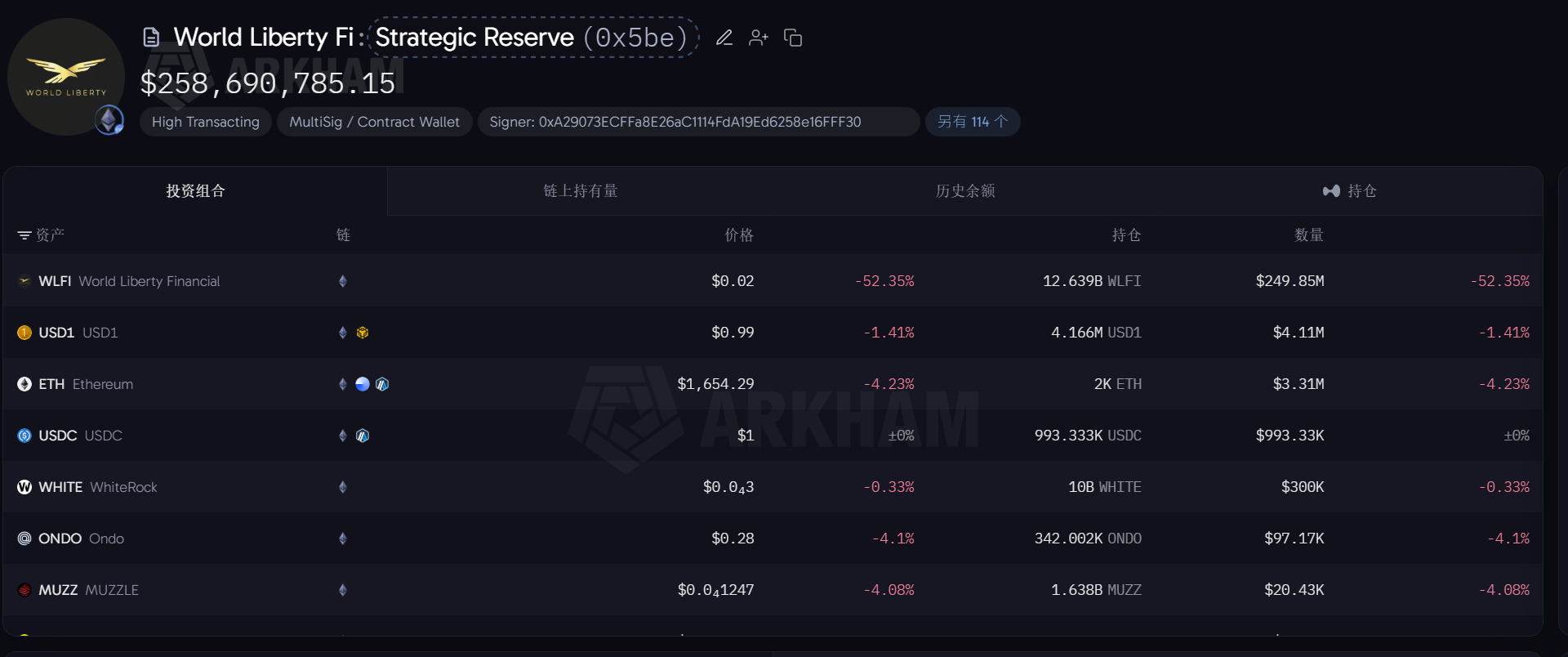
Real-time holdings data from Arkham laid out the harsh truth.
As of press time, the WLFI strategic reserve wallet (starting with 0x5be) shows total holdings of $258 million, but 96.6% of that value (roughly $250 million, or 12.639 billion WLFI) consists of the team’s own plummeting token. The remaining external hard-currency holdings on the wallet are severely depleted: only around 2,000 ETH (worth about $3.31 million) and 993,000 USDC remain, plus 4.166 million of the team’s own stablecoin USD1 (worth about $4.11 million).
This means that if WLFI continues to slide toward the $0.0118 liquidation line, the reserve wallet has almost no remaining tools to defend its position.
The Saturday Redemption Black Hole
Beyond the project team’s emergency response, the 5%+ depeg of the $2.76 billion market cap USD1 stablecoin over just a few hours stems from the dual pressure of liquidity mismatch and a structural trust crisis.
November 28 fell on a Saturday in the U.S., when traditional banks and U.S. Treasury custody channels were closed. Market makers could not conduct 1:1 fiat redemption arbitrage via the primary market, as on-chain liquidity pools lacked the depth to absorb concentrated panic selling pressure, creating the classic "weekend liquidity black hole".
Additionally, WLFI staked nearly 20% of its circulating supply on an advisor-linked protocol to borrow its own stablecoin, a move that essentially leverages high-volatility governance tokens to source stablecoin liquidity.
If WLFI breaks below the liquidation line and leaves Dolomite with unmanageable bad debt, market fears are that this risk would directly erode the underlying credit of USD1, prompting flight-to-safety capital to exit en masse.
Political Premium Collapses, Valuation Anchor Loosens
Over a longer time horizon, the sell-off of WLFI and other Trump-family concept assets did not happen overnight.
After the U.S. midterm elections concluded on November 3, with the Democratic Party winning back control of both the House of Representatives and the Senate, related assets such as the TRUMP token immediately plunged, and WLFI entered a weeks-long gradual downtrend.
WLFI’s high valuation was never built on a DeFi product moat; its core value driver was "political protection and regulatory privilege".
As the congressional balance of power shifted, the sword of Damocles of conflict-of-interest reviews and regulatory investigations hung over the project, and smart money had already exited on the back of this shift. When the valuation anchor of political premium fully loosened, today’s loss-making margin top-up was merely the last straw that broke the camel’s back.
Justin Sun Calls for Delisting of WLFI and USD1
As the market was still reeling from the shock, at around 15:00 the same day, Tron founder Justin Sun — who was once a key early investor and advisor to WLFI before publicly splitting with the project team over an asset freeze dispute — posted a scathing criticism on X. Sun claimed that the WLFI incident was just a repeat of practices including internal circular borrowing for cash-out, illegal insider selling, unlawful freezing of investor assets, and investor fraud. He also alleged that relevant team members were batch-deleting social media posts and communication records to cover up their alleged misconduct.
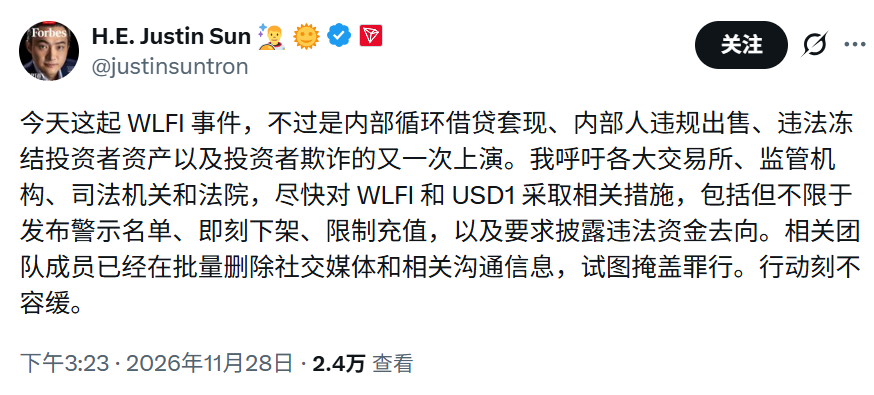
Sun further publicly called on all major exchanges, regulators, judicial authorities and courts to take immediate action, including "issuing alert notices, immediately delisting, and restricting deposits" for WLFI and USD1, and demanding disclosure of the flow of illegally obtained funds. As of press time, WLFI’s official team has not yet responded to these allegations.
While the project team’s margin top-up action delayed the immediate liquidation blast at the $0.021 level, the new WLFI defense line at $0.0118 remains squarely in the crosshairs of short sellers.
Until USD1 regains a stable peg, the team directly responds to market allegations, and publicly discloses the full loan ledger on Dolomite and the flow of reserves, this long-short battle over hidden liquidity positions and a credibility crisis is far from over.