
Profit margins have all but vanished in the altcoin market, while the mainstream crypto space is mired in cutthroat, hyper-competitive gridlock.
Written by Eric, Foresight News
On the evening of November 26, 2026, Beijing Time, CoinDesk cited sources familiar with the matter reporting that Auros, a Hong Kong-based crypto market maker founded in 2019, is gradually winding down its operations. Auros has yet to respond to the report, and the exact reasons and timeline for its shutdown remain unknown for now.
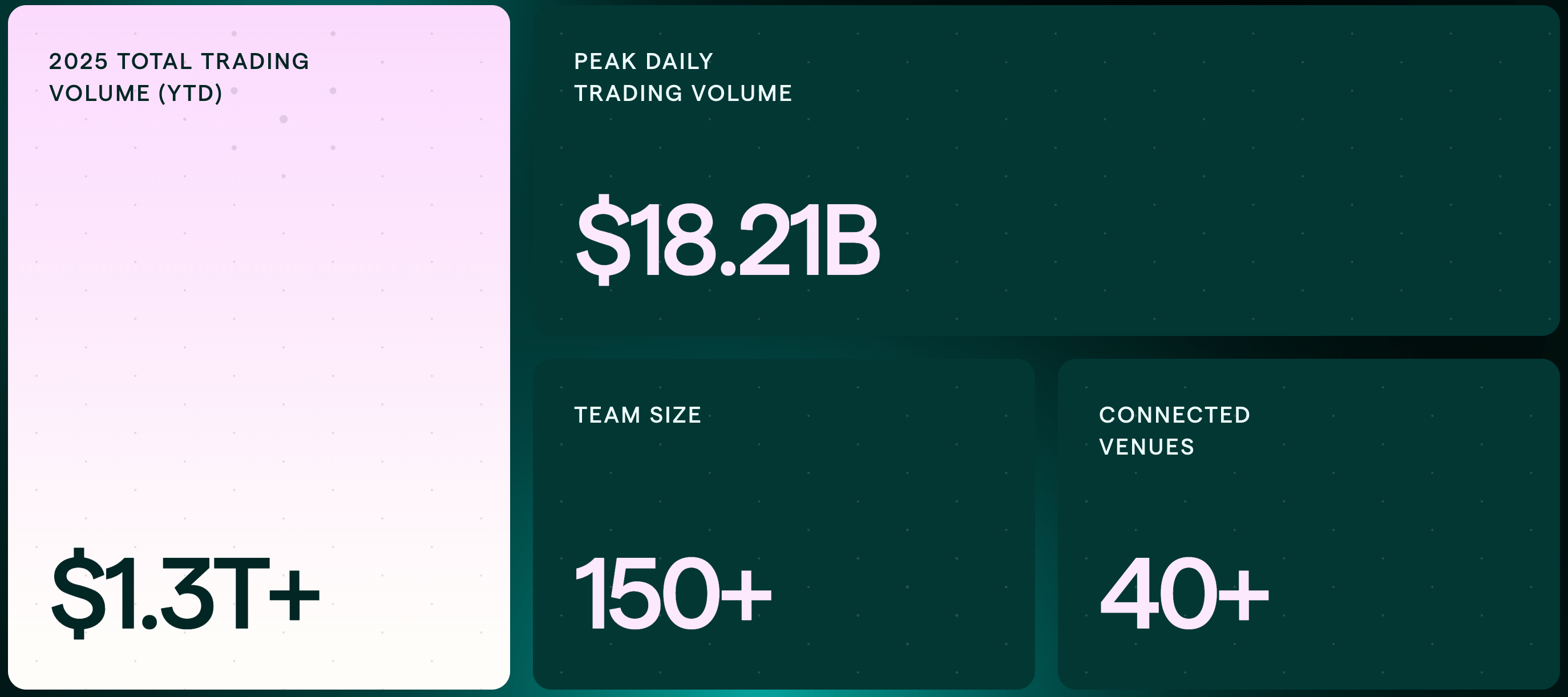
Per CoinDesk’s report, Ben Roth, co-founder and chief investment officer of Auros, noted in July 2024 that the firm accounted for an estimated 4% of global total crypto trading volume. Data from its official website shows that Auros recorded a total trading volume of $1.3 trillion in 2025, with a single-day peak of $18.2 billion.
Auros’ official X account was still posting updates as recently as November 17, and its website still listed open recruitment posts for tech and trading roles. However, multiple industry observers on X expressed no surprise at the news.
Andrei Grachev, partner at DWF Labs, noted that a number of crypto market makers have exited the market in recent months, as the sector currently operates with extremely thin margins and lacks diversified revenue streams. Grachev added that he expects the trend of market makers exiting the space to continue.
A user on X under the handle ProMint noted that Bit Digital, which previously invested $2 million in Auros, still recorded the full $2 million as the carrying value of its investment in financial reports covering the period ending September 30, 2026 — implying Auros has not experienced a major default event. However, Auros Ventures, the firm’s venture arm founded in 2024, made investments in oracle solution Pyth and Layer 1 network Berachain. Per ProMint, misjudged investment decisions may be one of the core reasons behind Auros’ shutdown.
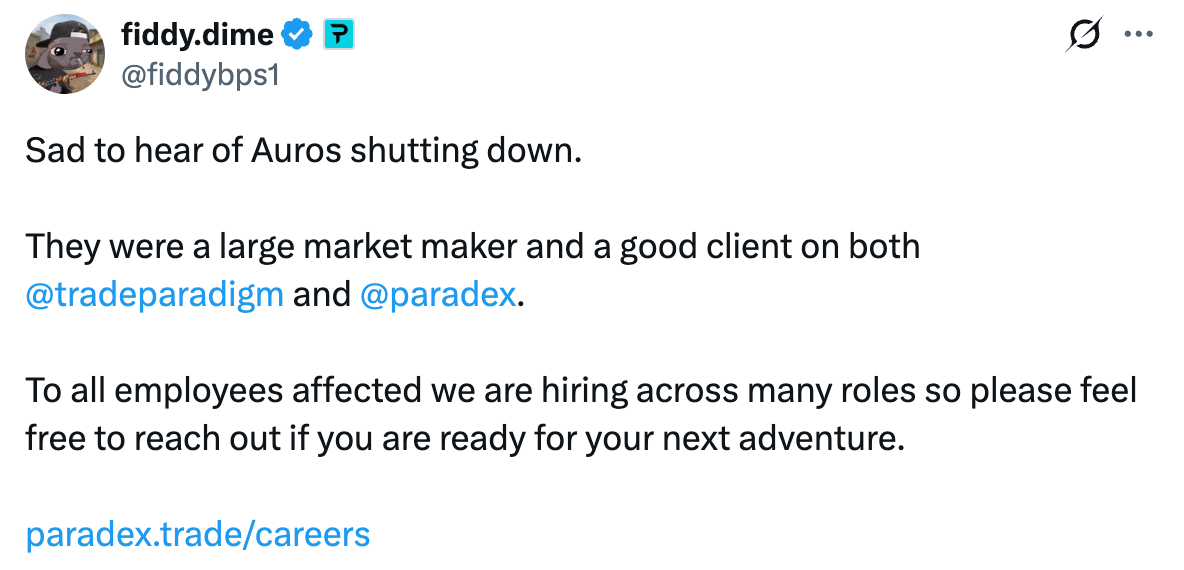
Anand Gomes, founder of institutional-grade crypto derivatives liquidity provider Paradigm (which shares its name with the well-known venture capital firm of the same name) and perpetual DEX Paradex, posted on X that Auros was a key client for both his businesses, and extended an open invitation for laid-off Auros staff to apply for open roles at Paradigm.
Crypto Market Makers Have Been in a Four-Year Bear Market
The abrupt collapse of FTX in late 2022 wiped out the capital of countless market makers, but Auros was one of the rare players that survived the crisis.
At the time of FTX’s collapse, Auros had approximately $20 million in funds locked in the exchange that it could not withdraw, and filed for bankruptcy restructuring in early 2023. Following the restructuring process, Auros closed a $17 million funding round led by VivCourt, an Australian high-frequency trading firm, and exited the bankruptcy restructuring procedure in March of that year. Bit Digital participated in that funding round, and Hughes Ching, co-founder of Bit Digital, joined Auros’ board of directors as part of the deal.
Beyond wiping out a subset of market makers, the FTX catastrophe also severely eroded market confidence in crypto, dealing lasting damage to surviving industry participants.
In the aftermath of the FTX incident, the U.S. tightened regulatory oversight of crypto trading, leading prominent market makers including Jump Crypto, GSR, and Wintermute to significantly scale back their U.S. market operations. Jump Crypto lost hundreds of millions of dollars in the FTX collapse; like GSR, it subsequently implemented headcount reductions ranging from 5% to 10% as part of its operational scale-down efforts.
A September 2023 Bloomberg report found that market makers’ profits dropped by roughly 20% to 30% in the wake of the FTX collapse. The primary driver of this decline was the need to reduce exchange counterparty risk: rather than holding assets directly on exchanges to deploy leveraged trading strategies, market makers shifted to holding assets via third-party custodians or intermediaries, which significantly raised operational costs.
Joseph, investment partner at Klein Labs, previously noted that modern market making operations are now required to maintain regular, up-to-date documentation for regulatory requirements including audit trails and granular trading records, with compliance costs potentially accounting for as much as half of total operational expenses.
Naturally, the prolonged bear market also took a heavy toll on the sector, but conditions did not improve even as the market entered a bull run. Per Andrei Grachev, a flood of institutional players entering the crypto market making space starting in late 2024 continuously drove down deal sizes, ultimately triggering a classic industry death spiral.
Citadel made a high-profile entry into crypto market making in 2025, announcing it would provide market making liquidity on major exchanges including Coinbase, Binance, and Crypto.com. Jane Street also saw significant growth in its crypto trading volume between 2024 and 2025. As Grachev noted, the entry of these traditional trading giants has made it increasingly unviable for mid-sized market makers to remain competitive. Large crypto-native market makers, as well as small boutique teams focused on niche long-tail altcoin segments, can still hold a foothold by leveraging accumulated expertise or specialized value propositions.
Market makers are also finding it increasingly difficult to turn a profit providing services for newly launched altcoins. Since 2023, most new projects have developed a far more sophisticated understanding of market making than they held during the 2021 bull market. As a result, projects are offering smaller amounts of tokens and dedicated capital to market makers, and their requirements have shifted from vague mandates to “maintain liquidity” to clearly defined, quantifiable performance metrics. This dynamic has forced many market makers to walk away from high-risk, low-return altcoin projects — and the total number of remaining high-quality projects is even smaller than the pool of market makers competing for access to them.
In recent years, exposure of underhanded practices by so-called “active market makers” like Gotbit that artificially inflate trading volumes has left the market making sector stuck in a vicious cycle: high-quality projects are already overcrowded with competing market makers, while low-quality projects offer no viable profit opportunity.
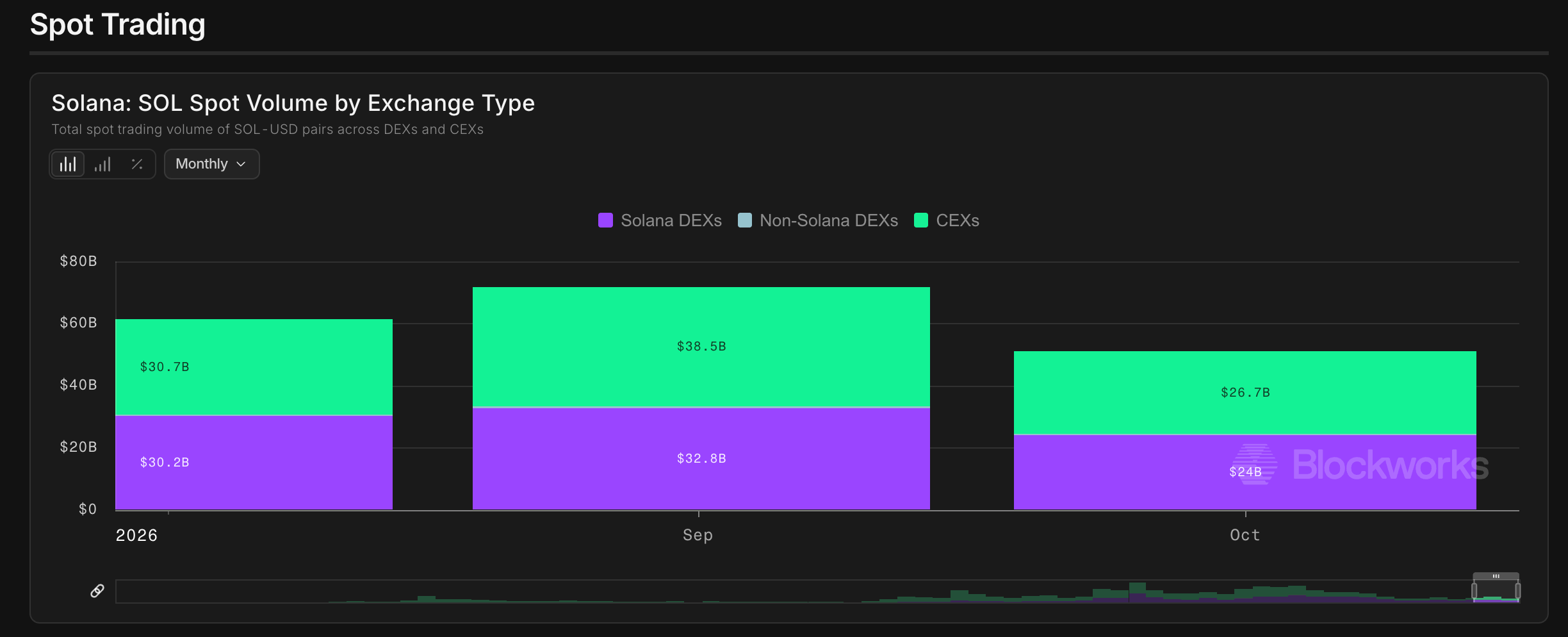
In the mainstream token segment, the liquidity of BTC and ETH on centralized exchanges remains unchallenged in the short term, but per Blockworks data, trading volume for SOL — often referred to as the industry’s third-largest crypto asset — is nearly evenly split between CEXs and DEXs. Furthermore, the rise of proprietary AMM (propAMM) mechanisms on Solana allows professional market makers to generate billions, or even tens of billions, in trading volume with just a few million dollars in deployed liquidity, pushing on-chain market making competition to unprecedented levels of cutthroat rivalry.
The October 11, 2025 market crash that triggered over $10 billion in single-day liquidations wiped out the CEX account balances of many market makers, and even caused order book liquidity on multiple exchanges to drop by more than 80% in the immediate aftermath of the sell-off. For crypto traders, the intense competition and ongoing survival-of-the-fittest dynamic among market makers — much like the wave of Web3 project closures seen over the past two years — is ultimately beneficial for the industry’s long-term development. At the same time, investors hope this competition remains healthy, to prevent monopolistic players from gaining the ability to directly manipulate market prices.