
16.61 billion MON tokens have passed their vesting cliff period, pushing the circulating supply up 1.8x.
Written by Ma He, Foresight News
On November 24, Monad — the high-profile project backed by a record $225 million in venture funding — marked the first anniversary of its mainnet launch. As 16.61 billion MON tokens (worth roughly $183 million at the current price of $0.011) completed their vesting cliff period and hit the open market in a concentrated unlock, market data from Bitget shows the price of MON broke below the key psychological support level of $0.01 during intraday trading, slumping to an all-time low of $0.0091.
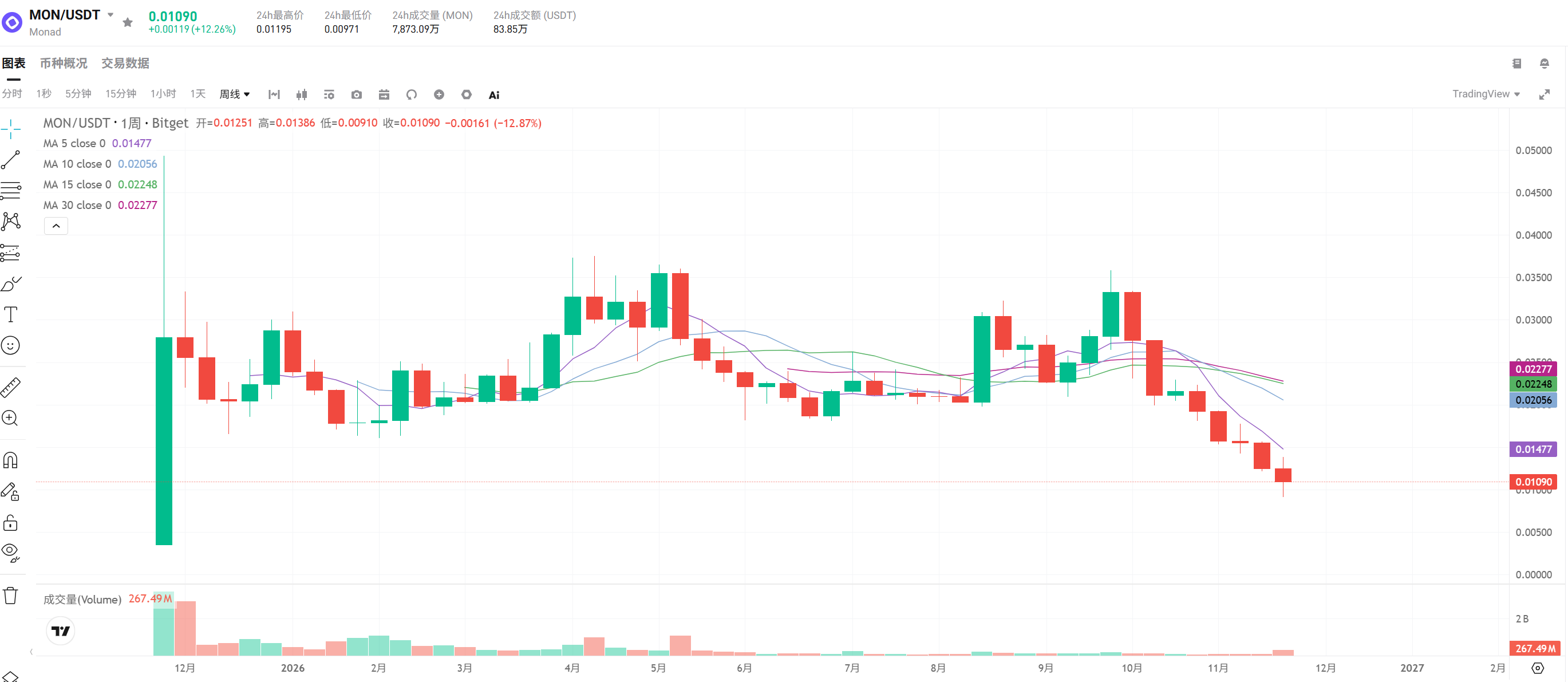
MON price trend (weekly chart)
As of press time, MON has rebounded to trade near the $0.011 level, but its current price is still 55.7% below the $0.025 public sale price, representing a cumulative drawdown of over 77% from its all-time high of $0.04876 recorded a year ago.
Will the so-called "last-generation L1" Monad face its own "hell moment"?
Circulating Supply Surges 1.8x After Cliff Unlock
The trigger for this sharp volatility was an extreme supply-demand imbalance shock. According to the tokenomics published by the Monad Foundation in November 2025, the initial total supply of MON is 100 billion tokens.
On the day of mainnet launch, a combined 10.8 billion tokens from public sales and airdrops entered public circulation. An additional 38.5 billion tokens were allocated to the Monad Foundation for ecosystem development under its management, while the remaining 50.6% (approximately 50.6 billion tokens) were held in locked supply, allocated to the core team (27 billion tokens), investors (19.7 billion tokens), and the Category Labs treasury (395 million tokens) respectively.
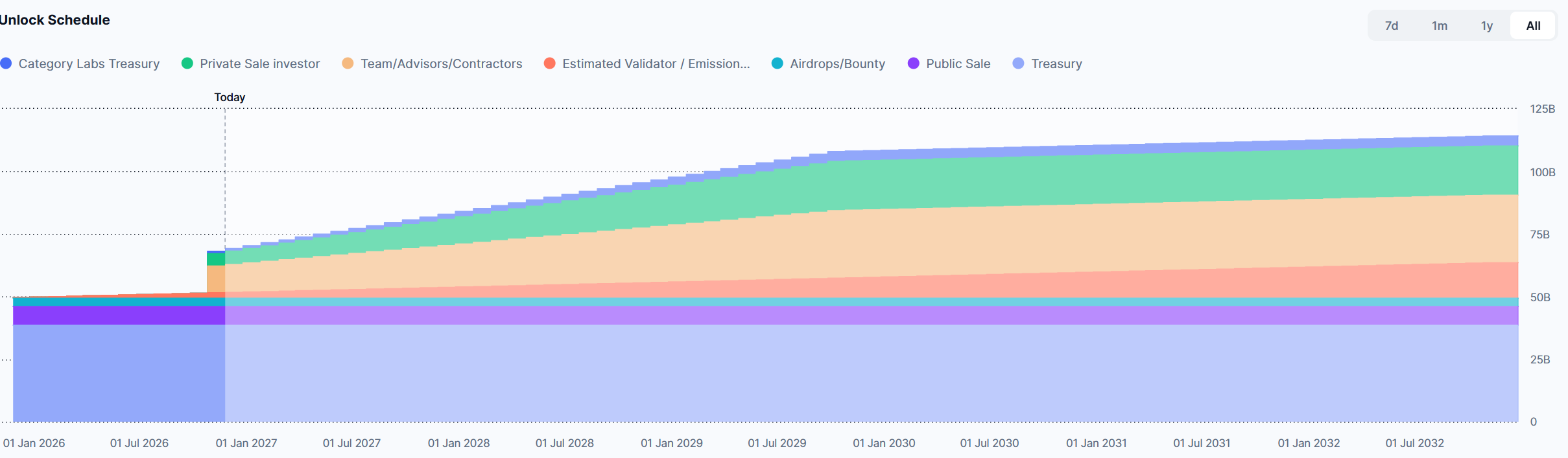
At the first-anniversary unlock milestone, the core team released 10.7% of the initial total supply (roughly 10.7 billion tokens) per the vesting rules. Meanwhile, the combined 23.65 billion tokens held by investors and the Category Labs treasury — which had completed the one-year cliff period — had 25% of their holdings unlocked in a single batch (roughly 5.91 billion tokens). In total, as many as 16.61 billion tokens were unlocked on that single day. As a result, the circulating supply of MON skyrocketed from 9.2 billion pre-unlock to 25.81 billion, marking a 1.8x expansion of the circulating supply base in one day.
According to CoinMarketCap data, MON currently has a circulating market cap of $286 million, with a fully diluted valuation (FDV) of approximately $1.26 billion.
Staking Yields for Locked Holders: 368 Million Tokens Queued to Exit Staking
Beyond short-term trading speculation, on-chain records reveal a more hidden rift in the project’s benefit distribution model. Data from block explorer MonadVision shows the network currently has a total staked volume of 22.3 billion MON, with a staking rate of around 22% of the current total supply and an annual percentage rate (APR) of roughly 7.4%. The network is jointly secured by active validator nodes including Backpack, Kraken, Figment, and Alchemy.
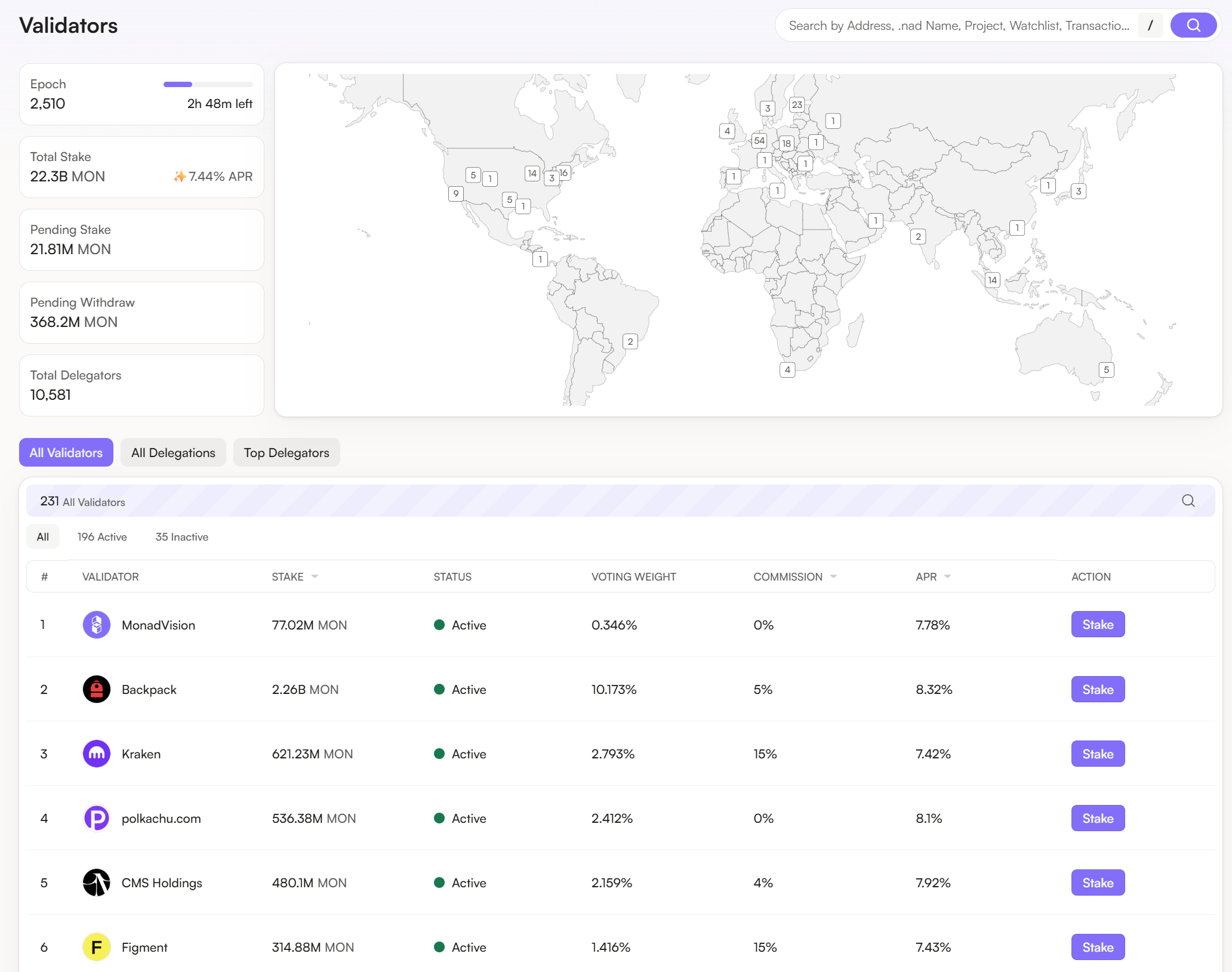
21.81 million newly staked tokens, 368 million tokens queued for staking exit. Source: MonadVision
A counterintuitive set of data points offers a cautionary reminder: before the latest unlock, the public market circulating supply was only 9.2 billion, yet total on-chain staked volume had already surpassed 20 billion.
This means that over the past year, the vast majority of staking rewards were effectively captured by the Monad Foundation via its Validator Delegation Program (VDP). The Foundation has earned more than 7% annual returns from on-chain staking using tokens nominally earmarked for ecosystem development. Meanwhile, the 16.61 billion team and institutional tokens just unlocked on the first anniversary now officially have the right to participate in staking to claim a share of network rewards.
CoinMarketCap data further confirms this dilution effect: the current total supply of MON has inflated from the initial 100 billion to 101.86 billion, with a maximum supply of 114.16 billion. Over the first year since mainnet launch, net new issuance totaled 1.86 billion tokens (worth approximately $20.46 million);
In contrast, the total cumulative token burn on the mainnet stands at only 87.94 million, which fails to cover even 5% of annual inflationary issuance. Early large holders have continuously lowered their cost basis by earning staking rewards on locked tokens, while secondary market buyers are left to bear the full cost of inflationary dilution.
Additionally, data from third-party block explorer MonadVision shows 368 million MON (worth roughly $4.05 million) are currently queued to exit staking, a volume nearly 17x larger than the amount of newly staked tokens.
Buybacks Without Burns: Why Is the Project Team Holding Back on Token Destruction?
Amid growing concerns over persistent inflation, the market once expected the project team to launch a "buyback-and-burn" mechanism, but Monad’s "burn" and "buyback" activities are completely disconnected. The roughly 87.94 million MON burned on-chain to date are all the result of automatic base gas fee burns enabled by EIP-1559 compatibility, and have no connection to the project team’s capital operations.
As long as on-chain transaction activity fails to pick up, protocol-level token burns will remain limited in volume.
On the capital front, the Monad ecosystem has launched two price support programs this year, but both adopt a "buy without burn" strategy. Core development team Category Labs expanded its authorized public market purchase quota to $80 million (valid through the end of this year), but purchased tokens are directly held as company reserves rather than being sent to a burn address;
The Monad Foundation also allocated up to $60 million in August to launch a "Limited Liquidity Program" for early investors, allowing institutions to resell their locked tokens at a discount. However, repurchased tokens remain subject to the original vesting schedule, so nominal total supply and fully diluted valuation (FDV) are not reduced in this process.
However, this early investor repurchase program ultimately saw "limited actual participation". For institutions that joined in low-cost seed rounds, even after the current price dropped by more than half from the $0.025 public sale price, they still hold substantial unrealized gains, so they naturally lack the incentive to exit at a discount.
Meanwhile, although the Foundation has stated it will not sell tokens directly via over-the-counter (OTC) channels, market scrutiny remains ongoing over its potential indirect token supply to the open market via mechanisms including the Validator Delegation Program (VDP), ecosystem incentive programs, and token lending to market makers — especially given the 38.5 billion ecosystem tokens under its control.
Three Years of Linear Sell Pressure Has Only Just Begun
The core reason the project cannot sustain its high valuation remains the hollowing out of real on-chain demand. Monad built its reputation on claims of "10,000 TPS parallel EVM", but as it marks the first full year of mainnet operation, MonadVision data shows the network has processed more than 1.25 billion cumulative transactions, with around 4.5 million total accounts and an average block time of 0.3 seconds. However, its real-time TPS only stands at around 98, with a 24-hour peak TPS of just 708.

An even more awkward state of the ecosystem is hidden in the project’s official documentation.
In Monad’s official "Tokens and Cross-Chain Bridges" list, almost all active on-chain assets are externally wrapped assets bridged in via cross-chain protocols including LayerZero, Chainlink CCIP, and Circle CCTP (covering USDC, USDT0, AUSD, USDe, cbBTC, WBTC, wstETH, and more). Under the natively issued assets category, only WMON is listed as a solitary entry.
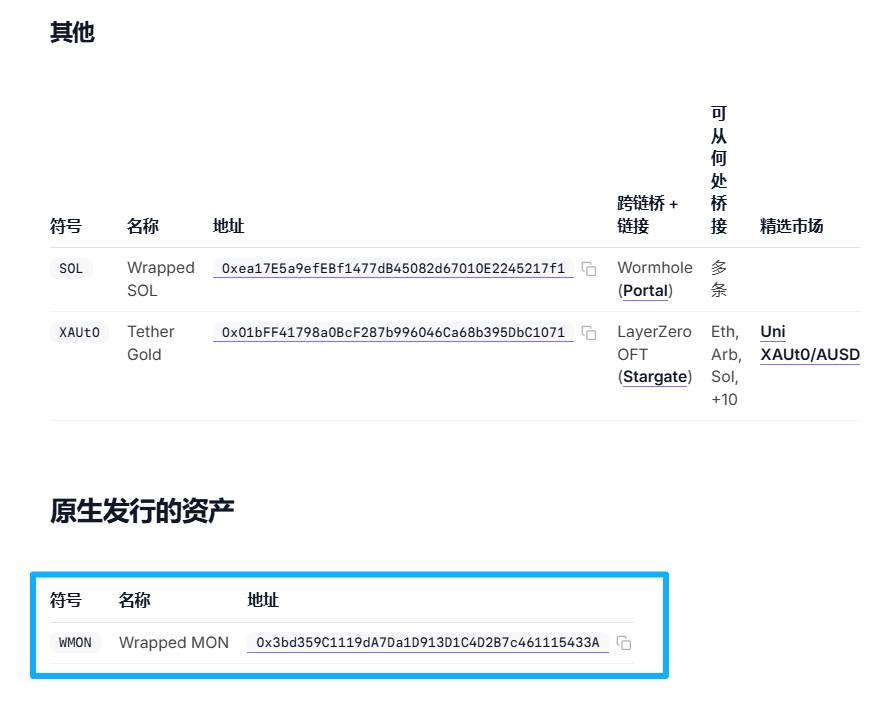
The lack of native killer dApps with high user retention means on-chain gas consumption cannot build a scaled competitive moat for the network.
For the secondary market, the sharp volatility seen on November 24 is far from the end of the story.
Per the official vesting schedule, after the cliff period, investors and the Category Labs treasury will continue linear vesting at a rate of 1/48 of their holdings per month, adding 400 million to 500 million tokens of new supply each month. The team’s remaining token holdings, worth roughly $179 million, will also gradually enter circulation over the next three years, only after both circulating unlock and vesting eligibility conditions are met, until the vast majority of these tokens are fully released by Q4 2029.
At a time when real application-layer consumption is far outpaced by the speed of inflation and token unlocks, what lies ahead for this "last-generation L1" is no longer the short-term pain of a single-day price crash, but a three-year-long liquidity endurance battle.