
Coinbase rolled out four emergency self-rescue initiatives in November alone.
Written by Ma He, Foresight News
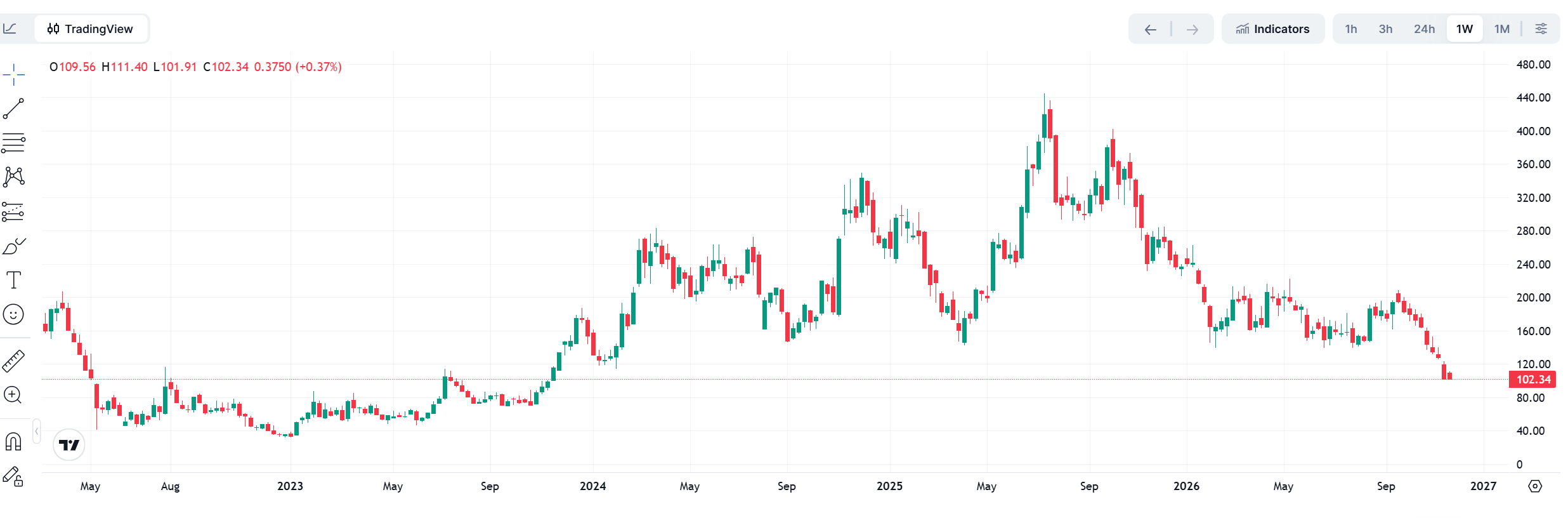
On November 25, Coinbase’s share price briefly broke below $102, marking a drop of more than 60%! ,(MISSING) from its annual high of $263. Compared with its all-time high of $444.6, the current slump has widened to 77%! ,(MISSING) such poor share performance has completely stripped away the gloss of its Q3 earnings report released earlier this year.
On the surface, Coinbase posted book net profit of $719 million in Q3 this year, but $715 million of that figure came from unrealized book gains on its invested crypto assets, accounting for a whopping 99.5%! .(MISSING) Stripping out these non-cash gains, net trading revenue plummeted 44% year-over-year,(MISSING) adjusted net profit nosedived 82%! to(MISSING) $77.7 million, and the company remained in a cumulative net loss position for the first nine months of the year.
What is even more unsettling for the market is that as of October 25, the opening period of Q4, the company’s trading revenue was only around $165 million, while its quarterly adjusted expenses are expected to rebound from $975 million in Q3 to above $1 billion.
The entire crypto industry is mired in a downturn, with Bitcoin posting a rare seven consecutive weeks of declines on the weekly chart, and its price still struggling below the $60,000 level.
With its legacy revenue engines stalling and no room for retreat, Coinbase rolled out a slate of emergency self-rescue moves across the whole of November.
$2 Billion Share Buyback: Market Support or Cover for Internal Share Dilution?
On November 25, CEO Brian Armstrong personally took to X to announce that the company has been repurchasing COIN shares within its authorized quota this quarter, arguing that crypto and AI are reshaping financial services, and the current market mispricing represents a prime window to deploy capital.

While the public rhetoric is firm, the balance sheet tells a more sobering story. According to its filed SEC documents, Coinbase repurchased roughly 38,000 shares in Q3 2026 at an average price of $139.91, spending only around $5.316 million. Its cumulative buyback of roughly 10.17 million shares has cost around $2 billion, and these holdings are now sitting on significant unrealized losses given the current share price of $102.
What is even more thought-provoking is the change in the company’s total outstanding share count.
Dragged down by heavy equity incentive costs, even after spending $2 billion in real capital over the recent period, the company has only offset 85%! of(MISSING) the new share issuances since Q4 2024. Its total outstanding share count has actually edged up slightly from 263 million in Q1 this year to 265 million in Q3.
On one hand, executives are systematically selling down their holdings for cash under SEC Rule 10b5-1 trading plans. On the other hand, the company is using shareholder funds to prop up the share price mid-slump to offset dilution. This buyback is less a value-oriented bottom-fishing play, and more a painkiller to steady market confidence.
Aggressive Push into Derivatives and Relaunch of Coinbase Pro
With spot trading fee revenue becoming unsustainable, Coinbase shifted its strategic focus to derivatives and professional trading in November this year.
After completing the integration of INTX and Deribit in October this year (the company had warned that trading volume would see short-term volatility during the migration period), its global compliant derivatives infrastructure serving both U.S. and non-U.S. customers began to roll out. On November 19, eligible non-U.S. users were the first to gain access to BTC and ETH options sourced from Deribit’s liquidity, while U.S. institutions can access the service via Coinbase Prime, and U.S. retail users remain on a waiting list.
Spot leverage capabilities were rolled out in parallel, with Coinbase Advanced opening spot margin trading. Major assets support up to 10x leverage (around 5x for other assets), with more than 10 types of collateral accepted, and margin accounts shared across spot and derivatives products. However, entry barriers for U.S. individual users are extremely high: they must meet the "eligible contract participant" threshold of holding $10 million in discretionary investment assets, with additional restrictions based on U.S. state rules and intended use. Before the end of 2026, Coinbase will also relaunch Coinbase Pro, integrating spot, futures, perpetuals, options, and stock trading into a single unified account.
These bold moves come with equally direct costs.
Over the past year, Coinbase’s global crypto trading market share has nearly doubled to 10.7%! ,(MISSING) yet its revenue has trended downward. The core pain point is that its most profitable segment — U.S. retail spot trading volume — has crashed by nearly 60% year-over-year. Now, to compete against large offshore exchanges and on-chain DEXs, whether through the zero-spot-fee Coinbase One tier, or low-fee derivatives and Pro products, every additional user acquired is eroding the high-fee moat that once generated easy profits for the company.
Proprietary Prediction Market Launch Planned for 2027
If derivatives represent a defensive play, prediction markets are the sharpest offensive tool in Coinbase’s arsenal.
The business now generates over $200 million in annualized net revenue, but during low seasons for sports events, prediction market activity remains heavily reliant on cyclical contracts such as crypto volatility products to sustain momentum.
What is truly noteworthy is Coinbase’s upcoming "burn the bridge" play once the market is established.
Currently, the product relies primarily on Kalshi to supply event contracts, but the revenue share cost is steep: in Q3, the company’s trading expense ratio unexpectedly spiked to 16.8%! ,(MISSING) of net revenue, a trend directly attributed to revenue shares paid to external exchanges driven by prediction market growth.
Now that Kalshi has helped validate its business model, Coinbase has decided to bring the entire value chain in-house.
Leveraging its 2025 acquisition of The Clearing Company and the registered clearing entity status of Coinbase Clearing obtained in September 2026, the company plans to launch its proprietary prediction market for U.S. retail and institutional users in the first half of 2027, according to Bloomberg.
Its more aggressive play is outlined in its product roadmap: building a "USDC-native, internally cleared" infrastructure. Once live, all margin collateral held in user prediction positions will stay on-platform as USDC, allowing Coinbase to earn prediction market trading fees on one hand, and collect interest on U.S. Treasury holdings on the other — a dual revenue stream.
The only immediate uncertainty remains the ongoing regulatory tug-of-war between state and federal authorities, as well as potential spillover risks from litigation related to Kalshi.
Base: Adding On-Chain Leverage to Wall Street Assets
The strategic calculations behind its on-chain push are far more sophisticated than they appear on the surface.
According to DefiLlama data, Base’s current total value locked (TVL) stands at $4.95 billion, remaining at a high level.

According to official data, cumulative trading volume of tokenized stocks on Base has surpassed $1 billion since launch, with new U.S. stock listings including Coca-Cola and Walmart added in November. While U.S. stock trading on Robinhood is already zero-commission, Coinbase’s real competitive edge lies in composability: a significant share of tokenized U.S. stocks are already being deposited into protocols such as Aave to be used as collateral.
Base is converting equities — which are illiquid outside Wall Street trading hours — into 24/7 on-chain collateral. This not only fuels demand for the chain’s native lending protocols, but also integrates with the Base App to support use cases including perpetual trading, prediction markets, payments, and automatic settlement for AI agents, putting Coinbase in direct competition with Robinhood for pricing power as an "all-asset exchange".
On November 22, Base lead Jesse Pollak noted in an interview that Base is still exploring the possibility of launching a network token, but is in no rush to move forward, as the team wants to avoid diverting focus from platform growth.
For now, Brian Armstrong has signaled that he will redirect more of his focus to customers and product development, with key performance milestones targeted for 2027. This move looks more like a request for a grace period from Wall Street amid a period of stalling performance.
The current $102 share price has already written off the company’s old growth narrative. Over the coming quarters, the critical question is whether Coinbase can leverage these new licenses, proprietary contracts, and on-chain assets to fill its profit gap before its retail spot trading revenue cow dries up completely.