
Abraxas' exit from Hyperliquid and withdrawal of nearly $1.2 billion worth of Bitcoin may look like a coherent strategic pivot, but behind the move lie separate risk-return calculations across its different funds.
Written by angelilu, Foresight News
On November 25, a HYPE redemption that had been pending for roughly a week was finalized, marking the end of Abraxas Capital's full round of position unwinding on Hyperliquid.
According to on-chain analyst Ember, tracking data shows that roughly 219,000 HYPE linked to Abraxas-associated wallets, worth about $13.25 million, was transferred to Binance after being credited to the accounts. Shortly after, the linked addresses withdrew 4,230 ETH worth approximately $7.09 million from Binance. Ember hypothesized that the associated HYPE may have been sold, though public on-chain transfer records cannot directly verify that the two transactions represent a linked conversion.
Per tracking data from Ember and fellow on-chain analyst MLM, the Abraxas-linked wallets they monitor had by this point closed all positions on Hyperliquid and withdrawn all remaining funds.
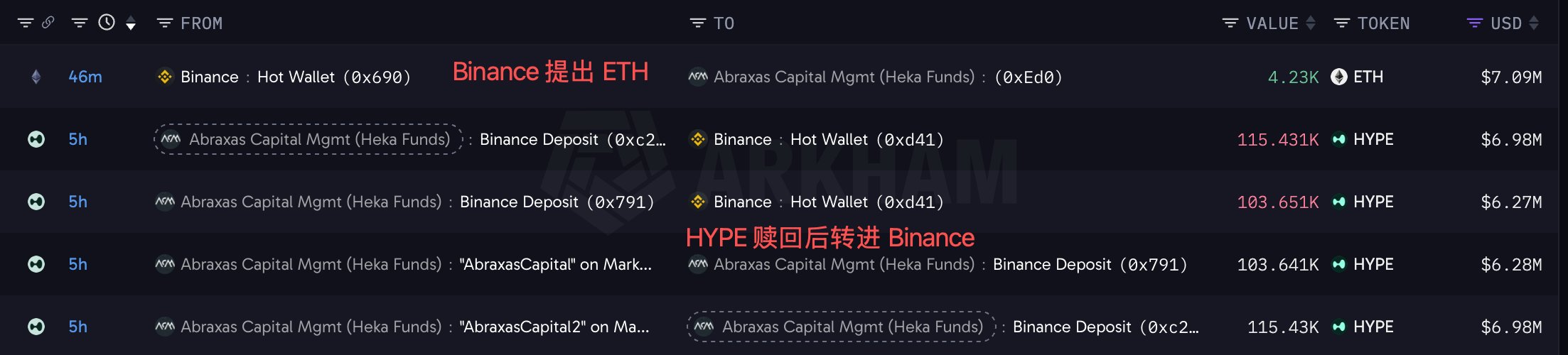
Recent moves from the London-based asset management firm extend far beyond its platform exit.
Abraxas-linked addresses have made large-scale crypto withdrawals from Binance and Kraken. As of November 24, Ember disclosed the cumulative withdrawn volume reached 19,820 BTC, with a notional value of roughly $1.182 billion. This came after an earlier API key leak incident at Lighter on November 16, where on-chain analysts traced the affected accounts to Abraxas.
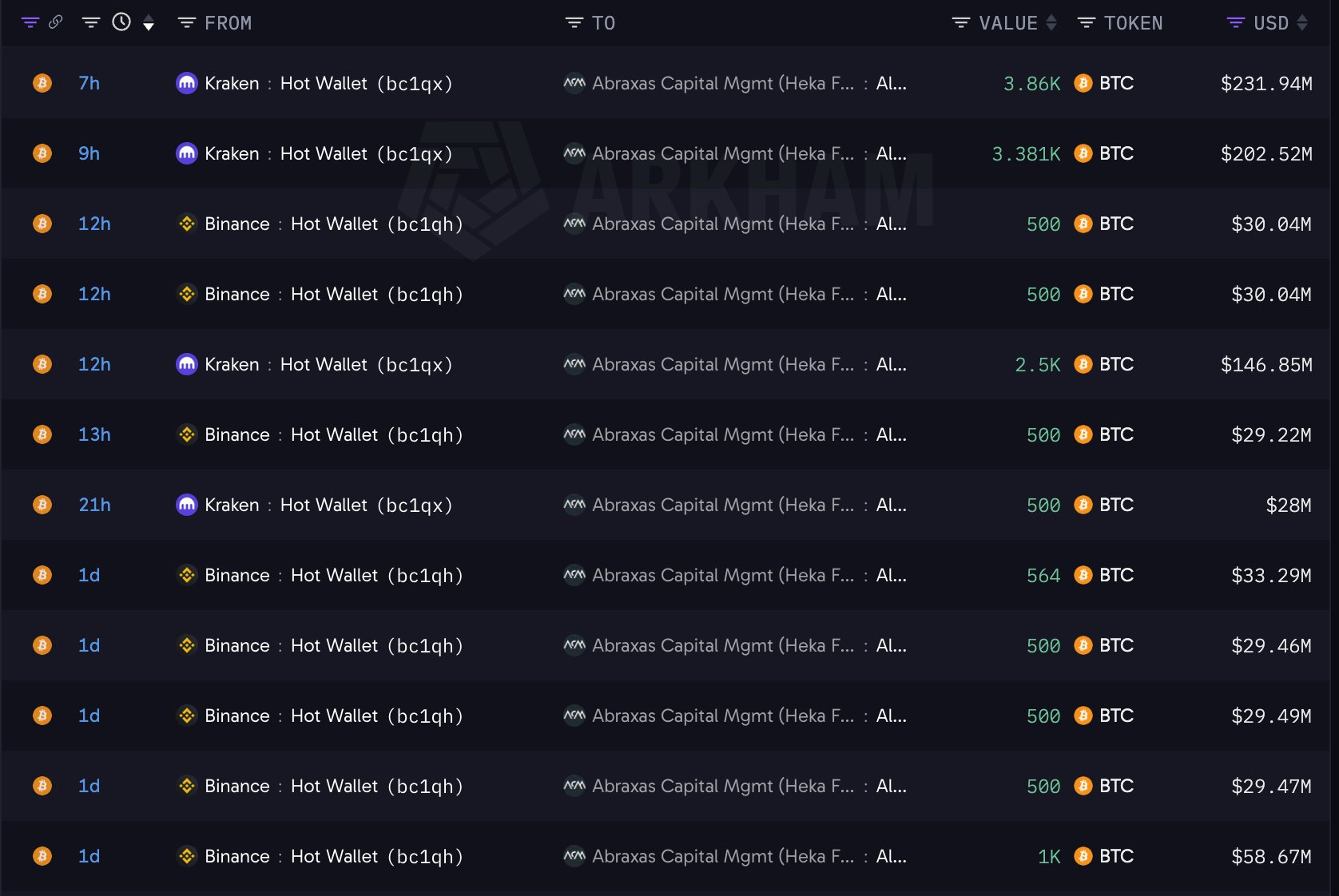
A security incident, shrinking short positions, and large Bitcoin withdrawals have intertwined across just a few days. Is the story that the firm, after suffering losses, exited on-chain trading platforms and reallocated its capital into Bitcoin and Ethereum? Or do these seemingly connected moves stem from entirely separate internal calculations?
Answering that question requires expanding the observed timeline, and understanding the underlying strategy behind every capital flow.
Built on Arbitrage: Learning to Price Risk First
To understand Abraxas, readers first need to set aside the common narrative of crypto whales making directional price bets.
Abraxas was founded in London in 2002, and entered the digital asset management space in 2017. It launched its flagship product, the Elysium Global Arbitrage Fund, in 2018 to run cross-market arbitrage strategies. Its 2022 offering, the Alpha Bitcoin Fund, provides direct directional exposure to Bitcoin, with the goal of outperforming Bitcoin across quarterly valuation cycles.
On June 17 this year, The Hedge Fund Journal announced the winners of its 2026 Digital Currency Performance Awards. Elysium was named the top-performing fund in the market-neutral arbitrage category for funds with over $1 billion in assets under management, with recognition covering the full 2025 calendar year, as well as the two-year, three-year, five-year, and seven-year periods ending in 2025. According to Abraxas’ official disclosures, the net-of-fee returns for the euro-denominated share class of Elysium were 16.64%!,(MISSING) in 2024, 11.56%!,(MISSING) in 2025, and 7.35%!,(MISSING) in the first nine months of 2026.
Abraxas specializes in market-neutral arbitrage strategies — for example, holding spot HYPE while hedging price volatility with an equal-sized perpetual short position, to earn funding rate payments and spread capture.
Research from Hyperdash tracking two Abraxas-linked wallets offers a window into its strategy: as of September 16, 2026, the two accounts had earned over $66 million in cumulative funding rate payments. Within its tracked HYPE positions, the volume of spot and staked HYPE closely matched the size of its perpetual short position. These funding revenues do not represent the net profit of the full strategy — final returns must account for financing costs, trading fees, and profits and losses from other positions — but they explain why such large short positions can be maintained long-term.
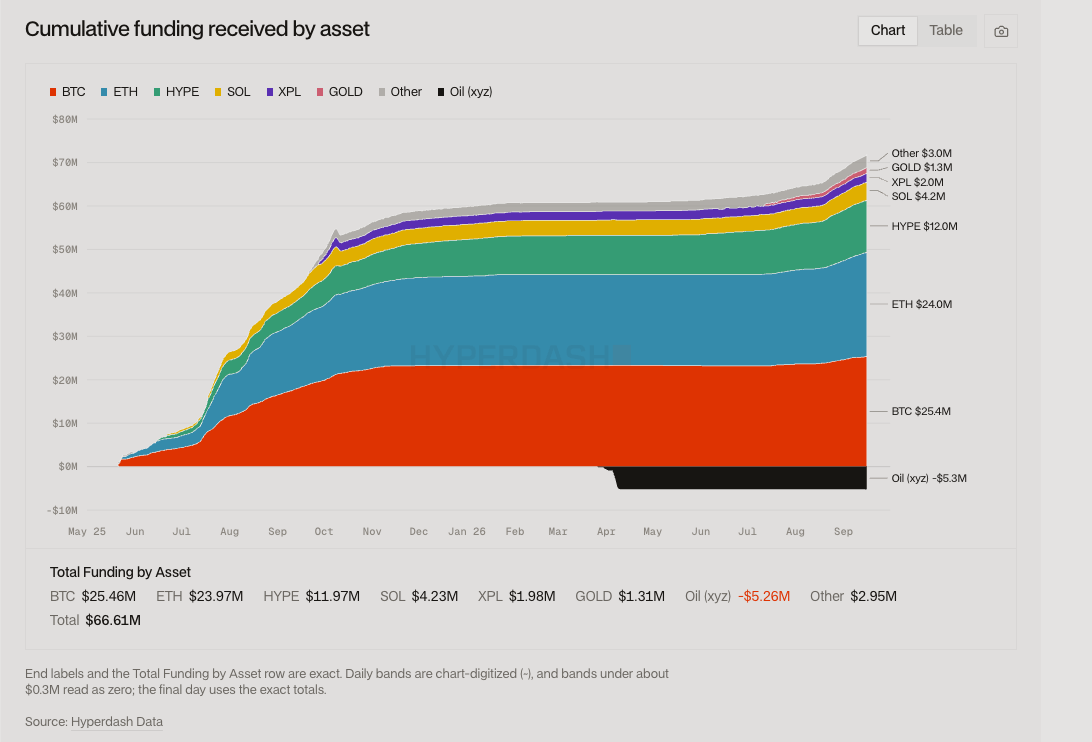
Framed against the current incident, closing out short positions may simply reflect the unwinding of a set of hedged trades, while Bitcoin withdrawals from exchanges may reflect adjustments to custody or asset allocation for existing holdings. Withdrawal records alone are not enough to conclude that Abraxas newly purchased $1 billion worth of Bitcoin during the recent market downturn.
Dodged Terra and Three Arrows Capital, Left a 2%!les(MISSING)son From the FTX Collapse
Abraxas’ flagship fund focuses primarily on market-neutral arbitrage, and its team has long taken a cautious approach to selecting trading opportunities and platforms. In an interview published by The Hedge Fund Journal on October 27, 2026, Carlo Zaffaroni, Abraxas’ head of trading, recalled that institutional-grade operating procedures, compliance protocols, and capital preservation practices helped the firm avoid fallout from events including the Terra Luna collapse, the Celsius insolvency, and the Three Arrows Capital implosion.
The Terra collapse is one of these events documented in the firm’s historical records. In its May 2022 fund newsletter, Elysium wrote that starting in late April, the team concluded that returns in DeFi were no longer sufficient to compensate for associated risks. Before the Terra and UST collapse, the team had already moved the majority of related capital back to centralized venues to continue pursuing arbitrage opportunities. For a cross-market arbitrage fund, the decision to exit a trade can stem from either narrowing profit margins, or a higher required return for taking on the same level of risk.
Abraxas founder Fabio Frontini noted in the same interview that in November 2022, a stablecoin trade involving FTX resulted in roughly 2%! of(MISSING) counterparty losses for the fund. Following this incident, Abraxas strengthened its due diligence processes for trading platforms.
Short Positions Had Already Started Shrinking Before the Lighter Incident
In the wake of the Lighter incident, a natural question emerged: did Abraxas unwind its short positions on Hyperliquid specifically because it suffered losses from the security breach?
Pulling the timeline back, however, shows that as of October 15, the two linked wallets tracked by Lookonchain held over $1.45 billion in notional short positions; by November 14, this figure had already fallen to roughly $572 million. The Lighter incident occurred on November 16, meaning the notional size of the wallets’ short positions had already declined significantly before the breach — though falling asset prices can also reduce the notional value of short positions.
At 18:11 Beijing time on November 16, roughly 10.39 million USDC was abnormally transferred out of Lighter’s Ethereum settlement contract. In a subsequent post-incident review, Lighter stated that a security vulnerability in the signing software used by one of its traders led to an API key leak. The platform tightened permission controls in the aftermath, requiring wallet signatures for all transfers into the public pool. Lighter also noted that after pausing withdrawals, its security committee refunded roughly 5 million USDC to affected traders. On-chain analyst MLM hypothesized that the affected accounts may belong to Abraxas, though Lighter’s post-incident review did not name Abraxas or disclose the final net losses for Abraxas or its affiliated funds.
Per Lighter’s explanation, the leaked API key did not have direct permission to withdraw funds to external wallets, but the attacker exploited the public pool structure to complete the fund transfer: first acquiring pool shares in an attacker-controlled account, then moving funds from the victim account into the pool, and finally withdrawing the funds by redeeming the pool shares. This adds an extra layer to risk assessment: beyond checking whether a key has withdrawal permissions, teams must also evaluate how the combined set of functions accessible to the key can be used to move funds.
After the Lighter incident, Abraxas’ two linked wallets accelerated the closure of multi-coin short positions on the separate trading platform Hyperliquid. Taking HYPE as an example, between 16:00 and 23:00 Beijing time on November 16, the wallets’ HYPE perpetual short position fell from roughly 1.128 million HYPE to 51,600 HYPE. Ember later tracked that Abraxas-linked addresses had transferred a cumulative 206 million USDC to Binance.
At the time, HYPE short positions were still earning positive funding rates, yet the linked wallets sold spot HYPE while simultaneously buying to close out short positions. On-chain data confirms that the pace of position unwinding accelerated, though Abraxas has not publicly explained the reason for the faster exit.
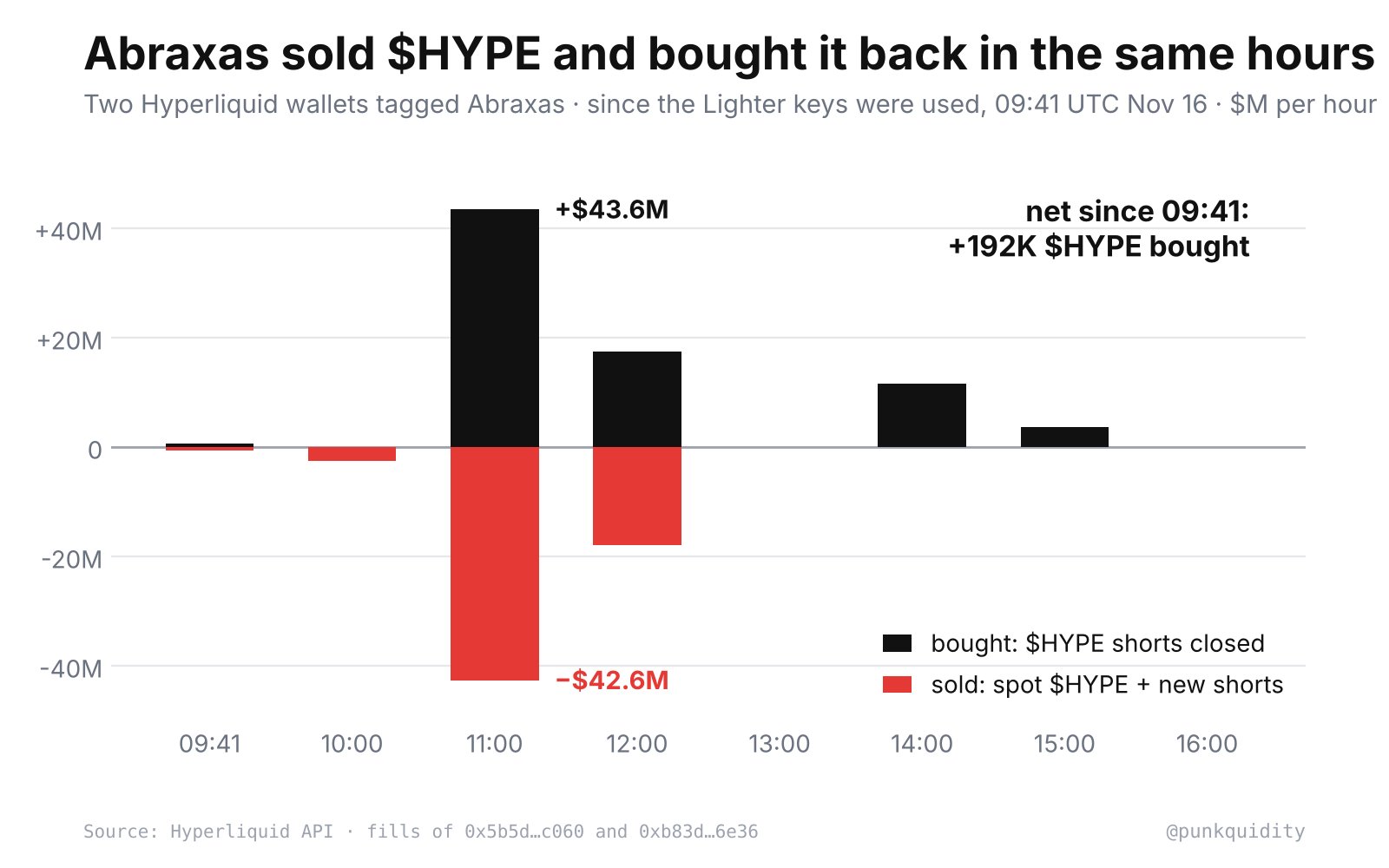
Hourly trading volume for the two Abraxas-linked wallets’ HYPE positions on Hyperliquid, November 16 chart
This echoes the position adjustments Elysium made ahead of the 2022 Terra collapse. At the time, Elysium determined that DeFi returns no longer justified associated risks, and moved the majority of related capital back to centralized markets. For fund managers, deciding whether to maintain a set of hedged trades requires evaluating not just expected returns, but also how much capital must be kept on the platform, and what level of operational risk is being taken on.
The Long-Awaited HYPE Redemption Arrived on November 25
The transfer of the final batch of HYPE marks a clear endpoint for this round of position unwinding.
Per Hyperliquid documentation, transferring assets back from a staking account to a spot account requires going through a seven-day unstaking exit queue. This means stopping trading, submitting a staking withdrawal request, and the final crediting and transfer of assets can all occur on different dates.
By November 25, Ember tracked that roughly 219,000 HYPE was transferred to Binance after the redemption was credited. The subsequent withdrawal of 4,230 ETH sparked new speculation about whether the HYPE had been converted to ETH. On-chain records can confirm the inbound and outbound transfers, but the execution of trades occurring inside the exchange remains undisclosed.
At the same time, screenshots of the two linked wallets published by Ember show the combined platform-side cumulative trading volume reached roughly $13.4 billion, with cumulative profit and loss of approximately +$529 million. MLM’s analysis notes that at least $67 million of this total came from funding rate revenues.
Returning to the initial question, these moves are temporally adjacent, but do not yet form a clear causal chain of “suffering losses, exiting on-chain platforms, and buying Bitcoin”.
The notional size of short positions on Hyperliquid had already declined before the Lighter incident; a large share of the previously withdrawn Bitcoin was sent to addresses tagged as belonging to the Alpha Bitcoin Fund, which by design holds directional exposure to Bitcoin.
Whether the withdrawals correspond to new Bitcoin purchases, and whether the security incident accelerated the pace of position unwinding, still requires further verification. The end result of the unwinding is becoming clear, but the meaning behind each capital transfer must be understood within the context of the individual wallet, fund, and strategy it belongs to. Capital held under the same institutional umbrella does not necessarily reflect a single unified market view.