
What was $7.95 billion in excess reserves as of the end of September has now dwindled to less than $3 billion.
Written by Eric, Foresight News
The recurring pattern of FUD targeting Tether during every crypto bear market cycle has made another appearance.
The root of this latest wave of FUD comes from S&P Global. In a report released on local time November 18, S&P Global rated Tether’s ability to maintain the USDT peg to the U.S. dollar a lowest-tier score of 5, the same rating it assigned at the end of 2025. The core drivers of this low rating are the further rising share of risk assets in Tether’s reserves and regulatory uncertainty in El Salvador, Tether’s headquarters jurisdiction.
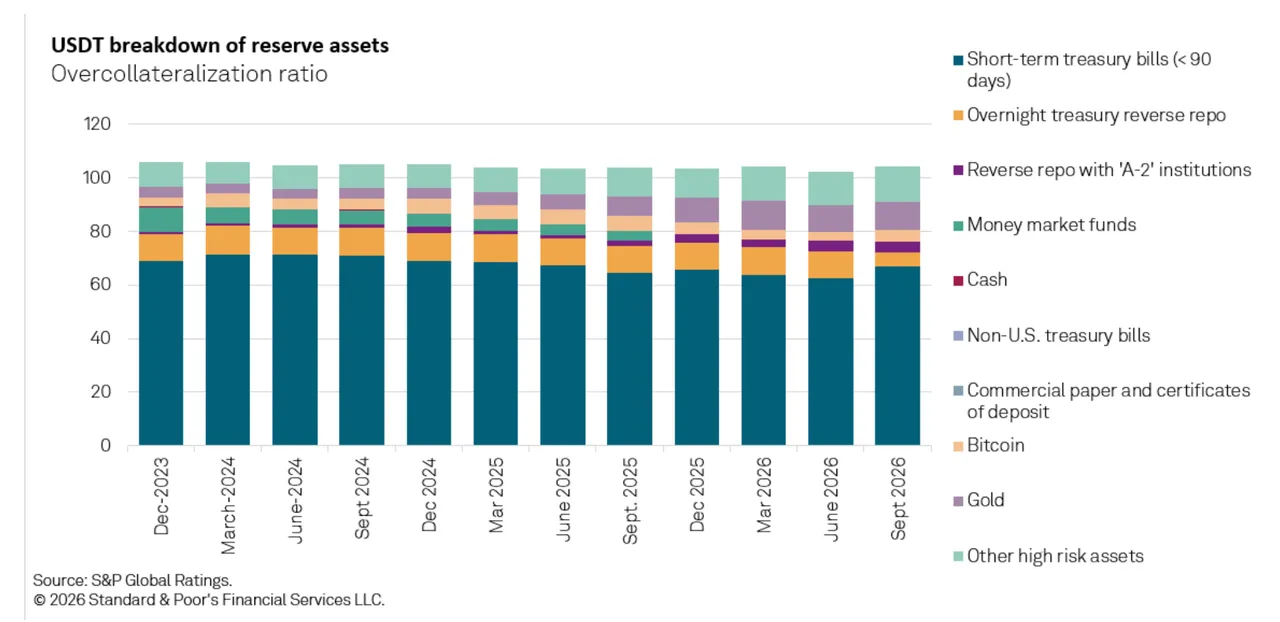
S&P Global stated that the share of risk assets in Tether’s USDT reserve pool — including gold, Bitcoin, publicly traded equities, secured loans, and corporate bonds — has risen to 28%, up from 24% a year prior. Additionally, per requirements from El Salvador’s National Digital Assets Commission (CNAD), 70% of Tether’s reserves must be held in assets that can be liquidated within 30 days. S&P Global views this regulatory framework as “relatively loose”, as it permits inclusion of comparatively higher-risk assets such as gold, Bitcoin, and loans.
S&P Global also noted that, unlike regulatory requirements in the U.S. and EU, CNAD does not mandate segregated reserve assets. The report states that without public disclosure of asset segregation arrangements, it is impossible to assess how these reserves are protected from potential corporate-level risks.
As it has done in past cycles, Tether pushed back firmly against S&P Global’s low rating. Tether argued the flaw lies in S&P Global’s assessment framework, not its reserve holdings, and cited the history of inaccurate ratings from agencies like S&P Global that contributed to the subprime mortgage crisis as proof that these rating agencies lack credibility.
Starting in March 2021, in response to market skepticism over the adequacy of its reserve assets, Tether began publishing reserve information verified by accounting firms. Even so, in the years that followed, Tether faced persistent scrutiny over the independence and professionalism of its auditors, as well as gaps in its disclosures. What sets this cycle apart is that even if every detail in Tether’s published disclosures is taken at face value, they still reveal material hidden risks.
According to Tether’s most recent report, published as of September 30, the company held total assets of $191.45 billion, against total liabilities of approximately $183.5 billion, with total assets exceeding liabilities by $7.95 billion.
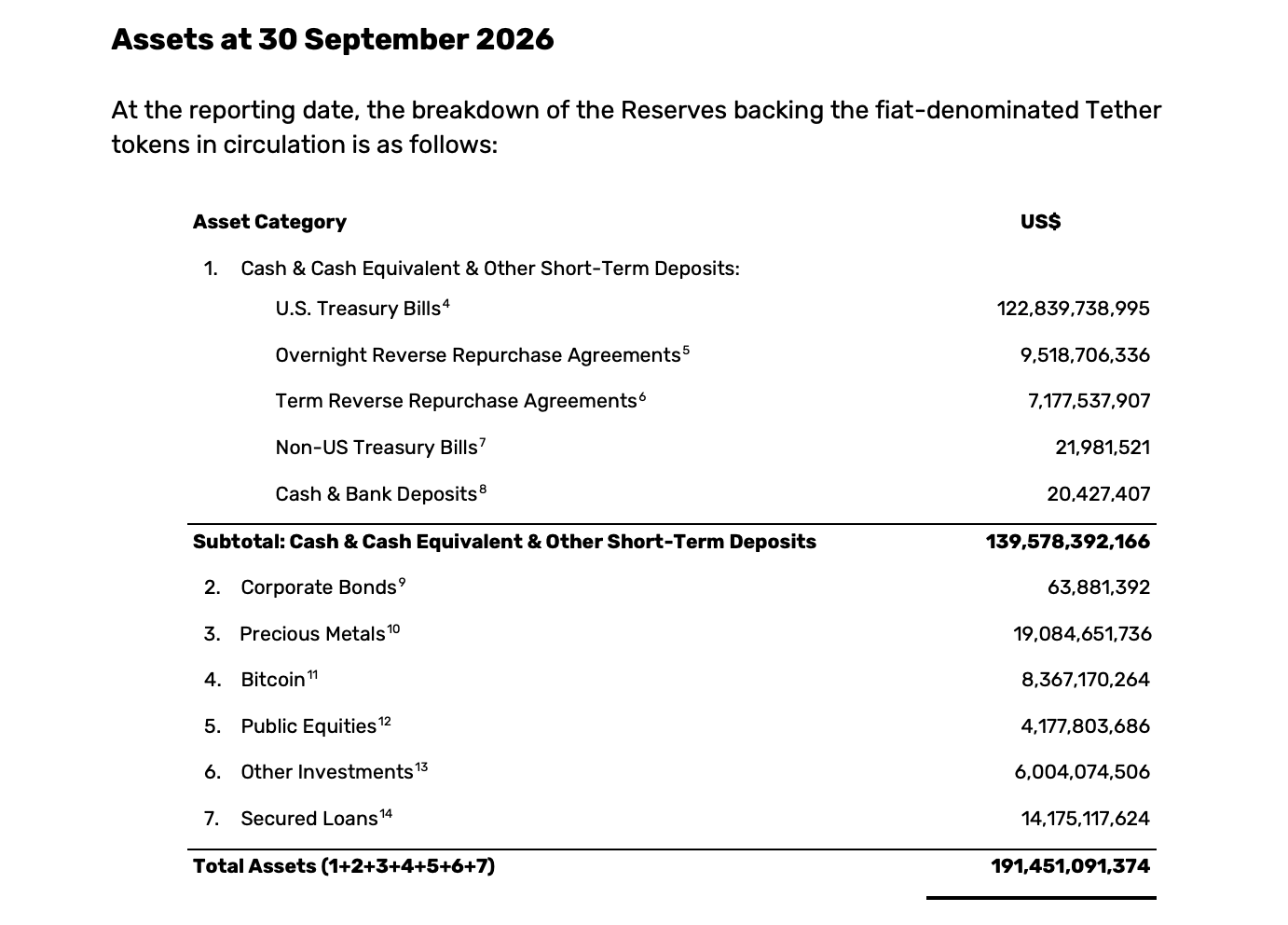
Of its $191.45 billion in total assets, cash and cash equivalents totaled approximately $140 billion, while assets including corporate bonds, precious metals, Bitcoin, publicly traded equities, investments, and loans collectively exceeded $50 billion. In other words, more than a quarter of its $190 billion equivalent asset pool remains continuously exposed to price volatility risk.
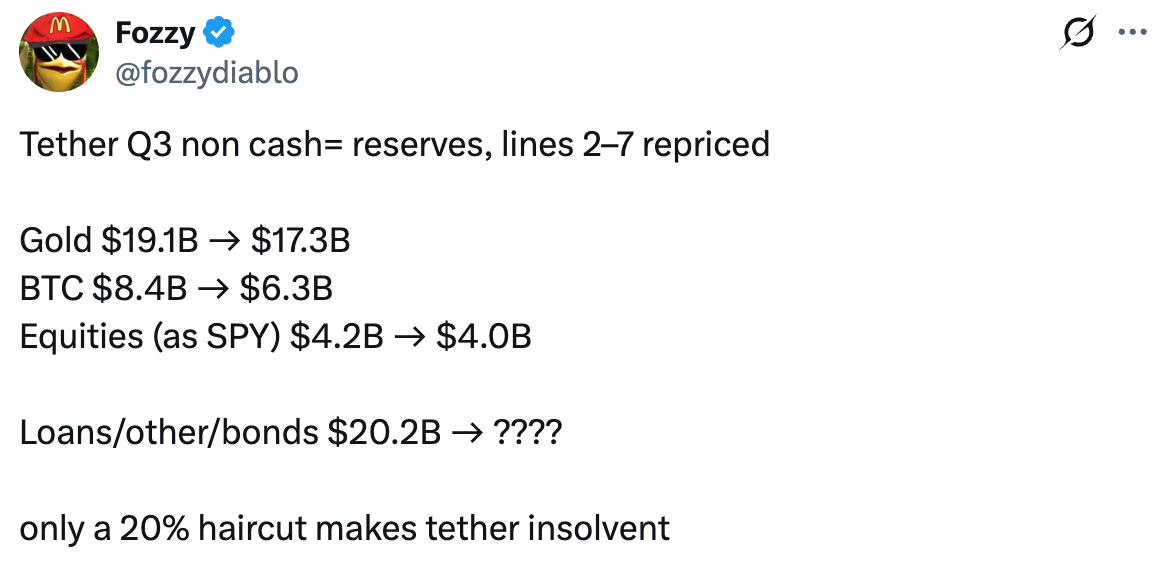
On November 19, a X user named Fozzy was the first to calculate that a roughly 20% drop in the total value of Tether’s risk assets would be enough to push its total assets below its total liabilities.
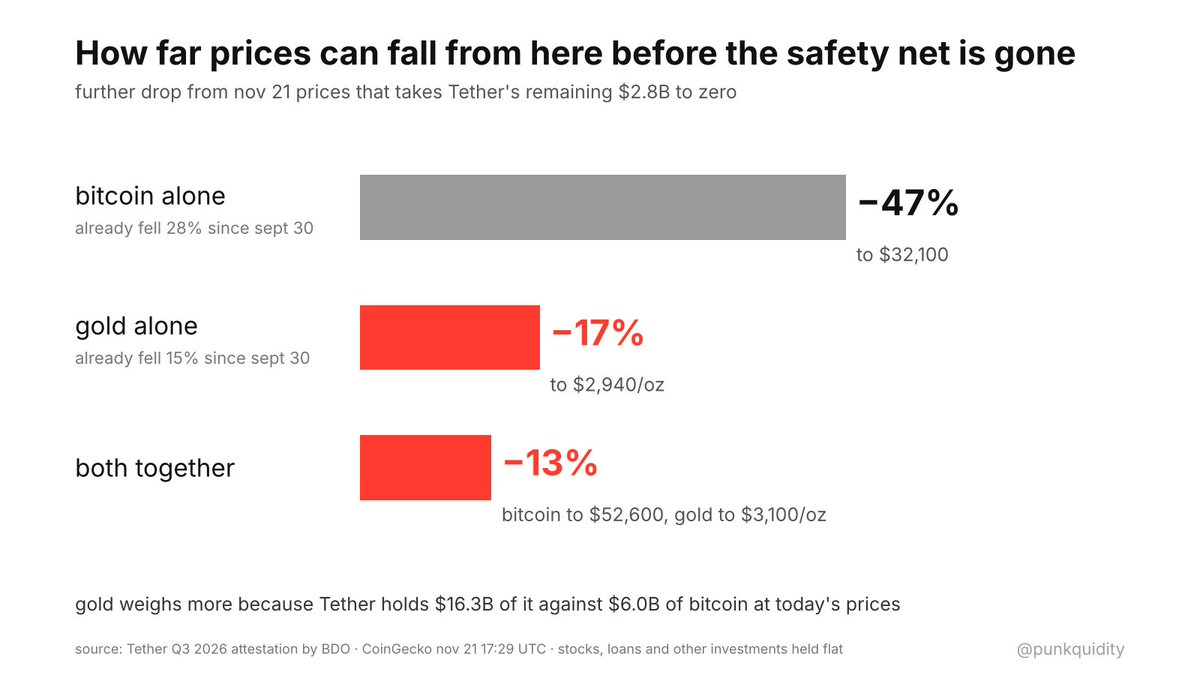
Two days later on November 21, punkquidity — the whistleblower who exposed the Sky stSUDS pool drain incident — published a lengthy post calculating that the $7.95 billion in excess reserves Tether held on September 30 had dwindled to roughly $2.8 billion by the time of his post. He noted that just a roughly 17% further drop in gold prices, or a synchronized 13% drop in both gold and Bitcoin prices, would push Tether into insolvency.
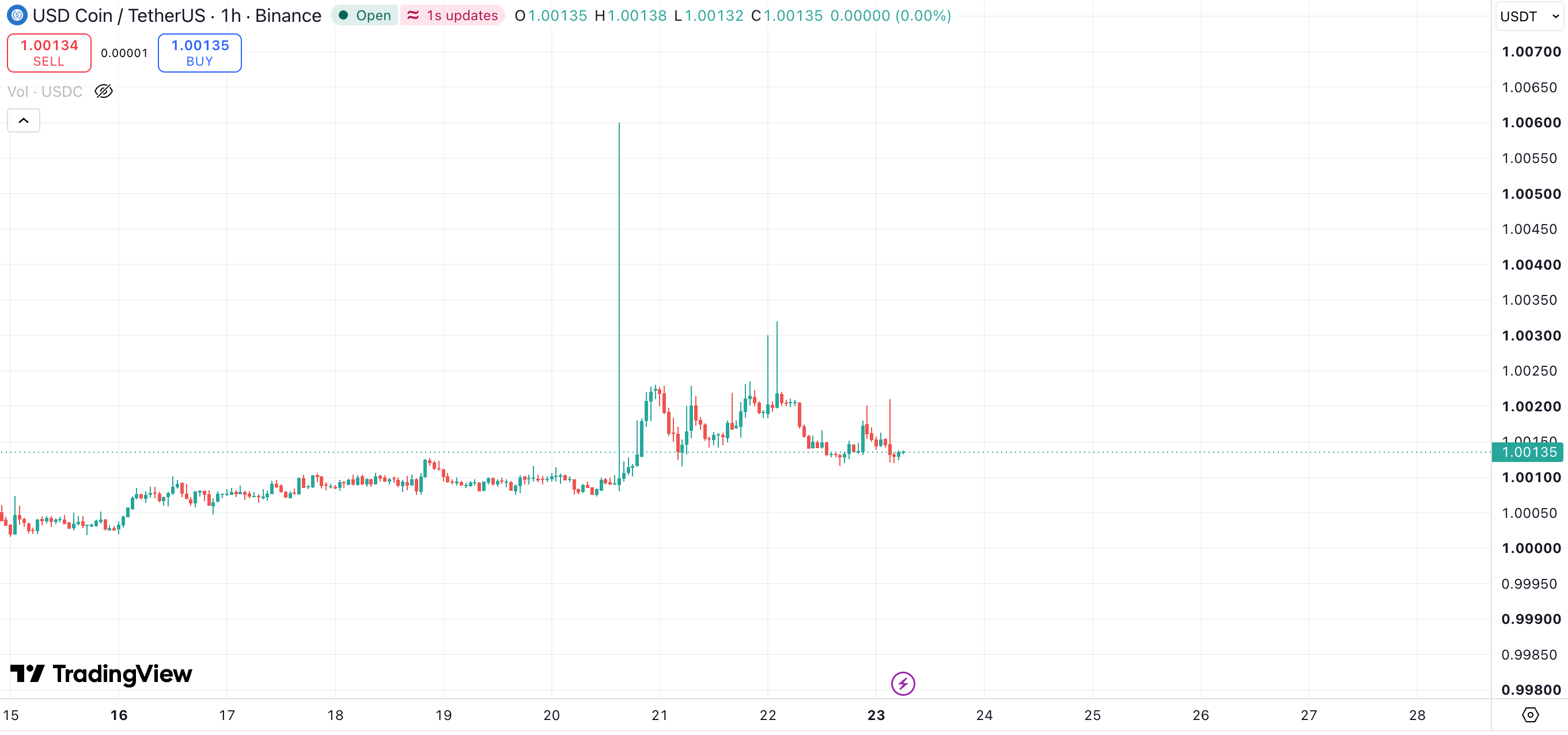
On the morning of November 21, the USDC/USDT pair on Binance briefly traded at a small ~0.6% premium, which has since largely returned to normal levels.
As this reporter has confirmed, Arthur Hayes publicly raised concerns on X as early as late November 2025 about Tether’s excessively high exposure to risk assets. Citing data from Tether’s published Q3 2025 reserve report, Hayes noted that a further 30% drop in gold and Bitcoin prices would be enough to push Tether into bankruptcy.
Notably, a commenter in that post thread pointed out that Tether had previously stated funds used to purchase Bitcoin and gold were sourced exclusively from retained profits and excess reserves, but figures in its reports show the total funds Tether has allocated to risk assets have clearly surpassed the scale of its retained profits and excess reserves.
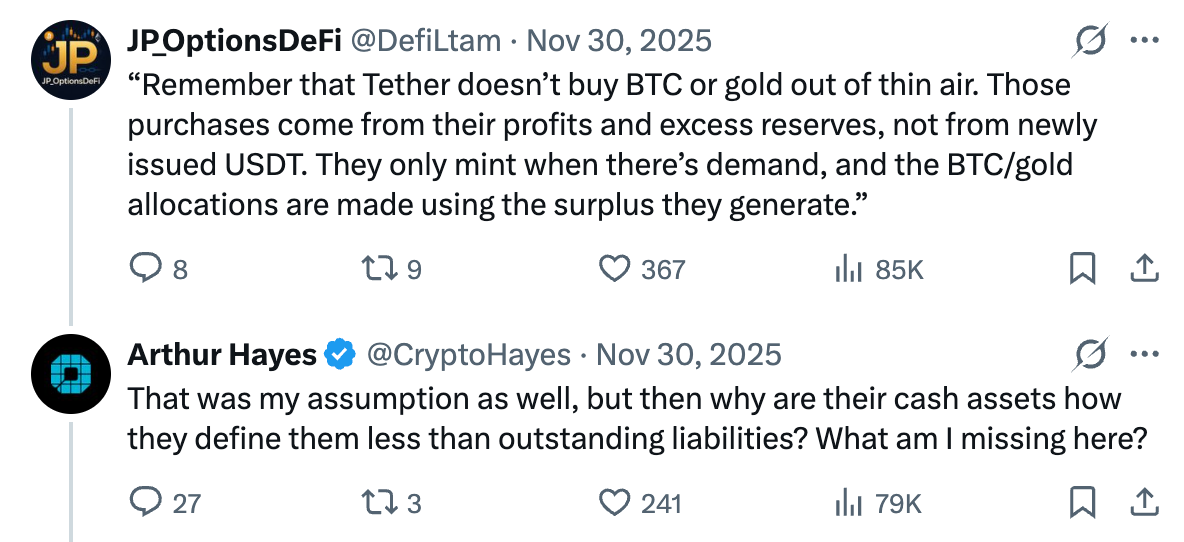
In response to that earlier criticism, Tether CEO Paolo Ardoino directly weighed in on the discussion, noting that the group holds additional equity buffers and ongoing profit streams, implying the market has no reason to doubt USDT’s redemption capacity.
While this issue has continued to gain traction on X over the past few days and drawn widespread skepticism, USDT’s market price has not shown significant volatility. There are also many voices on X arguing this FUD is overblown: for example, a commenter on a post by user Fuzzy pointed out the extreme insolvency scenario cited above would only materialize if a full-scale redemption of all reserves took place, and that Tether still has mechanisms in place to respond to extreme stress scenarios.
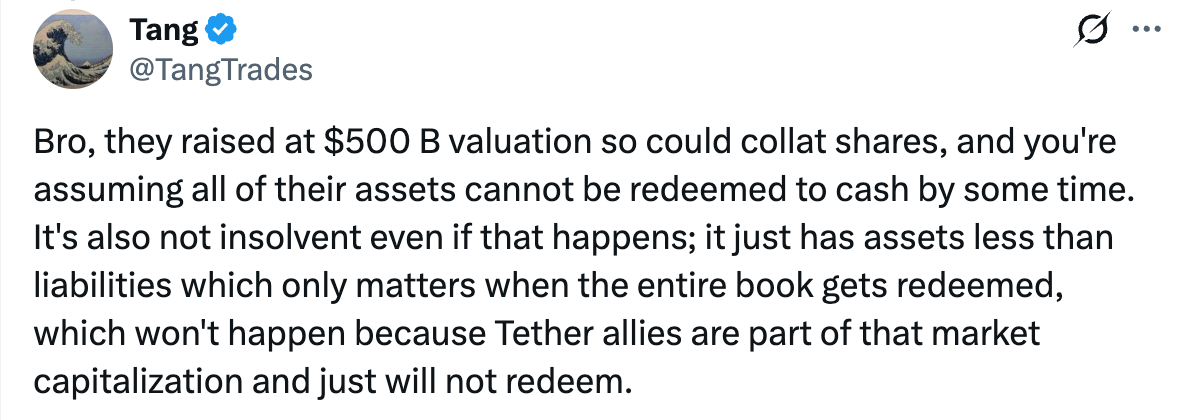
Tether supporters argue that even if the $7.95 billion buffer held at the end of Q3 is fully eroded or turns negative, this would only be a “paper” crisis, not an immediate liquidity crisis, given the extreme unlikelihood of a simultaneous mass redemption of more than $180 billion worth of USDT.
Tether’s investment strategy in recent years has indeed been highly aggressive, from expanding USDT adoption to making active investments in emerging technologies like AI. There is nothing inherently wrong with profitable companies choosing to reinvest their excess profits across industries, but given that Tether’s impact extends far beyond the crypto market into all corners of the real world, it still must hold the line on robust risk control.