
A jump-the-queue check drained a treasury co-managed by 150 people.
Written by Ma He, Foresight News
On November 21, cross-chain swap protocol Chainflip was attacked, with approximately $12 million worth of assets stolen from its LP liquidity treasuries. Following the incident, its native token FLIP plummeted from around $0.47 to $0.146, a drop of nearly 70%, and its fully diluted valuation (FDV) now stands at only $13.19 million.
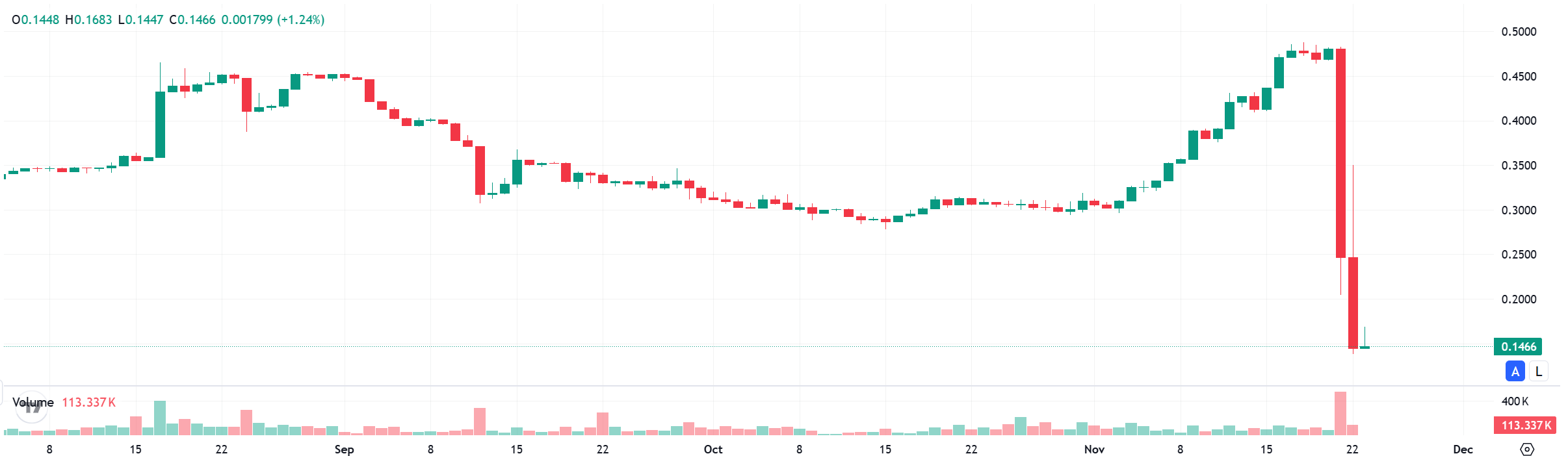
The official team later sent an on-chain message to the address holding the stolen Bitcoin, proposing a plan of "returning 90% of the assets and retaining 10% as a bounty", with a deadline set for 02:38 Beijing Time on November 24. As of press time, no funds have been received at the designated return address, and the protocol remains suspended for deposits, withdrawals, and swaps.
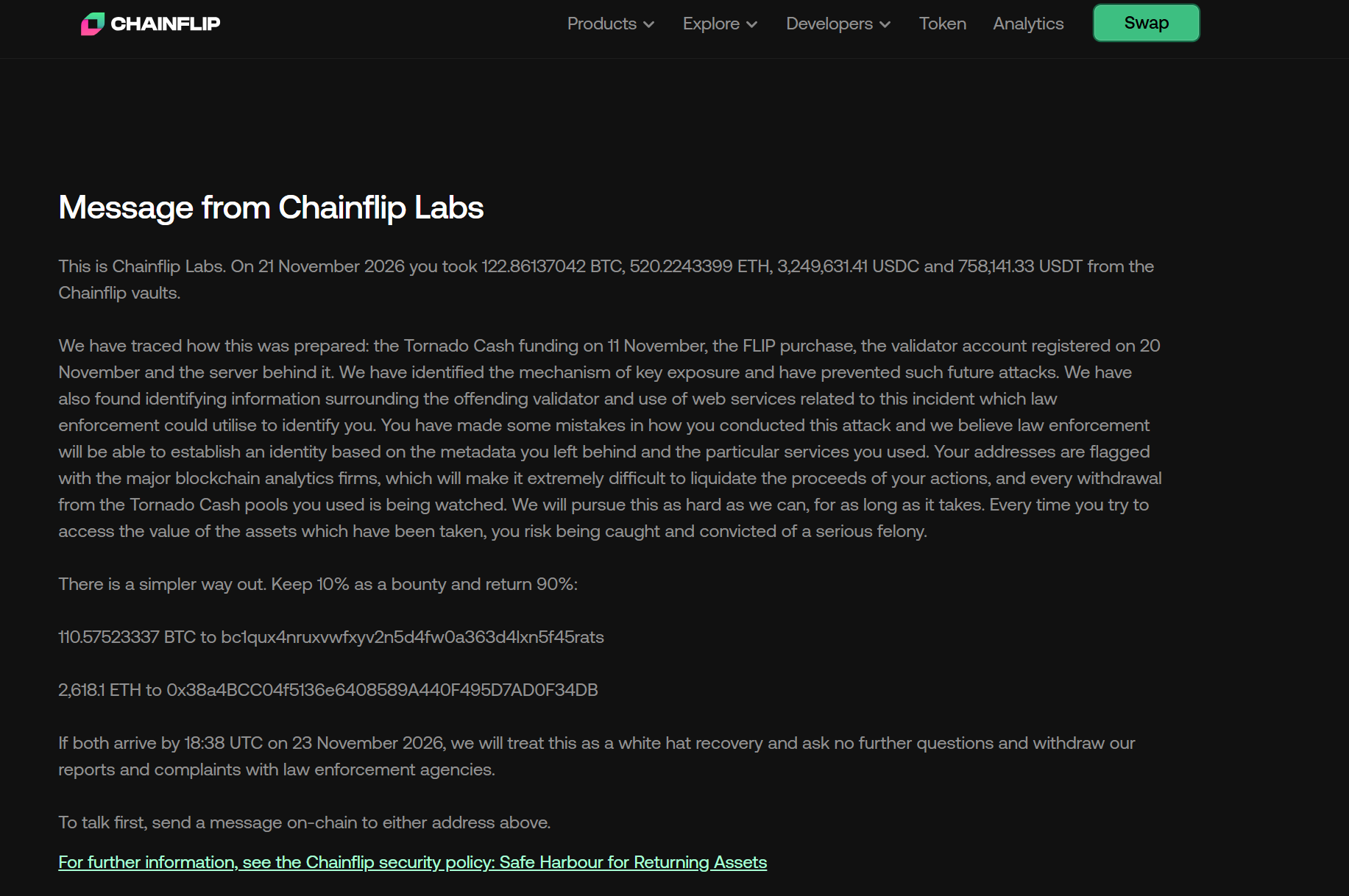
Chainflip Labs listed the specific losses in a public statement on its official website: 122.86 BTC, 520 ETH, 3.25 million USDC, and 758,000 USDT. The stolen Bitcoin accounts for around 60% of the total loss, valued at approximately $7.25 million at the time of the incident, while the stolen Ethereum and stablecoins totaled around $4.86 million.
Prior to this, security firms had only detected $4.86 million stolen from the Ethereum treasury, and even once reported that the Bitcoin treasury was unharmed. It was not until the official bounty ultimatum was issued that the public realized the Bitcoin treasury had been breached for 122.86 BTC even before the Ethereum side was attacked, pushing the total loss up 2.5 times.

According to DefiLlama data, Chainflip's total TVL was around $13.5 million before the hack. The $12 million stolen means over 88% of the protocol's total liquidity was drained.
A Jump-the-Queue Check Drained a Treasury Co-Managed by 150 People
To understand how absurd this hack is, we first need to look at how Chainflip normally manages its funds.
Users' real funds used for cross-chain swaps are all locked in Chainflip's treasuries deployed across various public blockchains. To prevent internal theft, the protocol is guarded by up to 150 validators, each holding a share of a key. Per protocol rules, at least 100 validators must sign off simultaneously to reconstruct the only valid master key, which authorizes the treasury to release funds.
The validators also collectively rotate to a new master key every three days.
In addition to verifying the master key, the Ethereum treasury has an anti-replay rule: every withdrawal instruction must include a unique sequence number (nonce).
Over the past three years, the treasury has processed a total of 299,677 withdrawals, with nonces strictly incrementing in order: right before the hack, the latest nonce was 314568, and the next legitimate withdrawal after the hack used 314569.
This is where the anomaly occurred.
According to a detailed report by Bitquery, at 15:10:59 Beijing Time on November 21, a brand new wallet created just 1 minute prior directly triggered the Ethereum treasury, submitting a withdrawal request to empty all its balances.
After cross-checking all nearly 300,000 transaction records over the three years, on-chain analytics firm Bitquery found that: this withdrawal request bore a genuine "joint master key signed by 100 validators", but the nonce on it did not increment from 314568 as required, but was a 39-digit number that appeared out of thin air (190262553...881278).
The protocol's treasury smart contract acted like a rigid bank teller: it verified the master key was genuine, then saw this 39-digit nonce had never been used before, and immediately released all funds, transferring all ETH, USDC and USDT in the pool to the hacker in one go.
This absurd 39-digit nonce became the most critical evidence in the investigation: a normal collaborative approval process by 100 validators could never produce a nonce that deviates from the sequential queue.
This means someone bypassed the normal validator voting process, and directly forged or obtained the master key outside the system.
Chainflip later admitted in an official announcement that its key was compromised, and that it has taken measures to prevent a recurrence, but has not yet disclosed technical details.
Plotted 10 Days in Advance: Hacker Completed the "Money Laundering Pipeline" in 10 Minutes
This hack was not an impulsive crime.
Tracking clues disclosed by the official team show that the hacker withdrew seed funds from the mixer Tornado Cash as early as November 11, then purchased FLIP tokens, and registered a validator node the day before the attack (November 20).
Bitquery disclosed part of the attack process in detail.
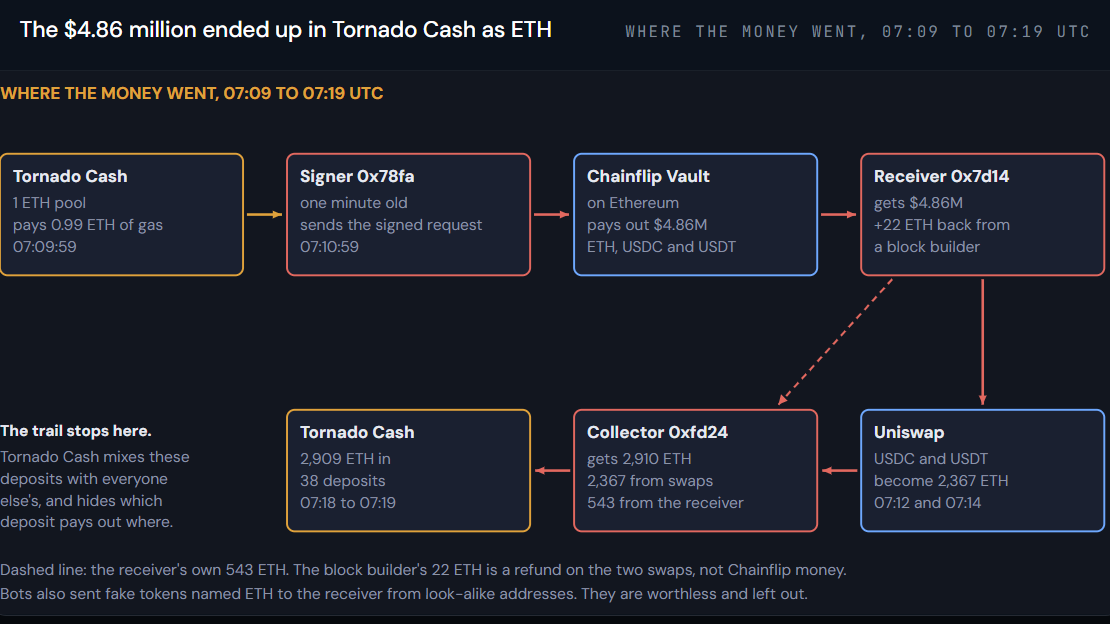
On the afternoon of November 21, about half an hour after stealing funds from the Bitcoin treasury, the hacker carried out a second-precision automated money laundering operation on Ethereum (all times below are Beijing Time):
- 15:09:59 (Gas Top-up): An empty wallet received 0.99 ETH from Tornado Cash as on-chain gas fees.
- 15:10:59 (One-Step Treasury Drain): The wallet submitted the withdrawal instruction bearing the "genuine master key + 39-digit nonce", and $4.86 million worth of assets (around 3.25 million USDC, 758,000 USDT, and 520.2 ETH) was instantly transferred to a second collection wallet.
- 15:12:59 – 15:14:23 (Fleeing Freeze Risk in 4 Minutes): The hacker knew well that the issuers of USDC and USDT (Circle and Tether) could blacklist addresses to freeze funds at any time, while native ETH cannot be frozen by any party. The second wallet dumped all USD stablecoins for 2,367 ETH via decentralized exchange Uniswap within 4 minutes, and directly transferred the ETH to a third collection wallet.
- 15:15:11 (Proceeds Consolidation): The second wallet transferred the originally stolen 520.2 ETH, along with around 22 ETH in transaction rebates returned by block builder Titan, to the third wallet, bringing the total balance to 2,910 ETH. Ironically, scam bots targeted the hacker within just a few minutes, sending fake tokens of the same names to their address in an attempt to "rob the robber", but they obviously failed to fool the pre-programmed script.
- 15:18:23 – 15:19:11 (Full Anonymization in 48 Seconds): As Tornado Cash only accepts fixed denominations, the third wallet split the funds into 38 transactions in three batches within 48 seconds (29 transactions of 100 ETH + 9 transactions of 1 ETH), depositing all 2,909 ETH into the mixer to completely break the on-chain fund flow.
From receiving the first gas fee to nearly $5 million disappearing completely into the mixer pool, the entire process took less than 10 minutes.
Bitquery's tracking also uncovered an awkward blind spot that the official team never mentioned: after the Ethereum treasury was completely drained at 15:10, the Chainflip network detected nothing wrong.
For as long as 1 hour and 42 minutes, validators continued to use the compromised old key to sign 63 more ordinary user withdrawals with sequential nonces as usual. It was not until 16:53:35 Beijing Time (13 hours earlier than the scheduled three-day key rotation cycle) that the protocol urgently switched to a new key and shut down completely.
In the early morning of November 22, the official team set conditions via an on-chain message to the address holding the stolen BTC: before the early morning of November 24, transfer 110.57523337 BTC to a designated address, and transfer 2,618.1 ETH to another address (the amount of ETH covers the value of the stolen stablecoins after conversion). If the funds are received on time, the act will be treated as whitehat, the team will not pursue further investigation, and will withdraw the law enforcement reports and complaints already submitted. The official team also warned that the relevant addresses have been marked by major on-chain analytics firms, subsequent withdrawals from Tornado Cash will be continuously monitored, and law enforcement has obtained identifying information related to validators and servers.
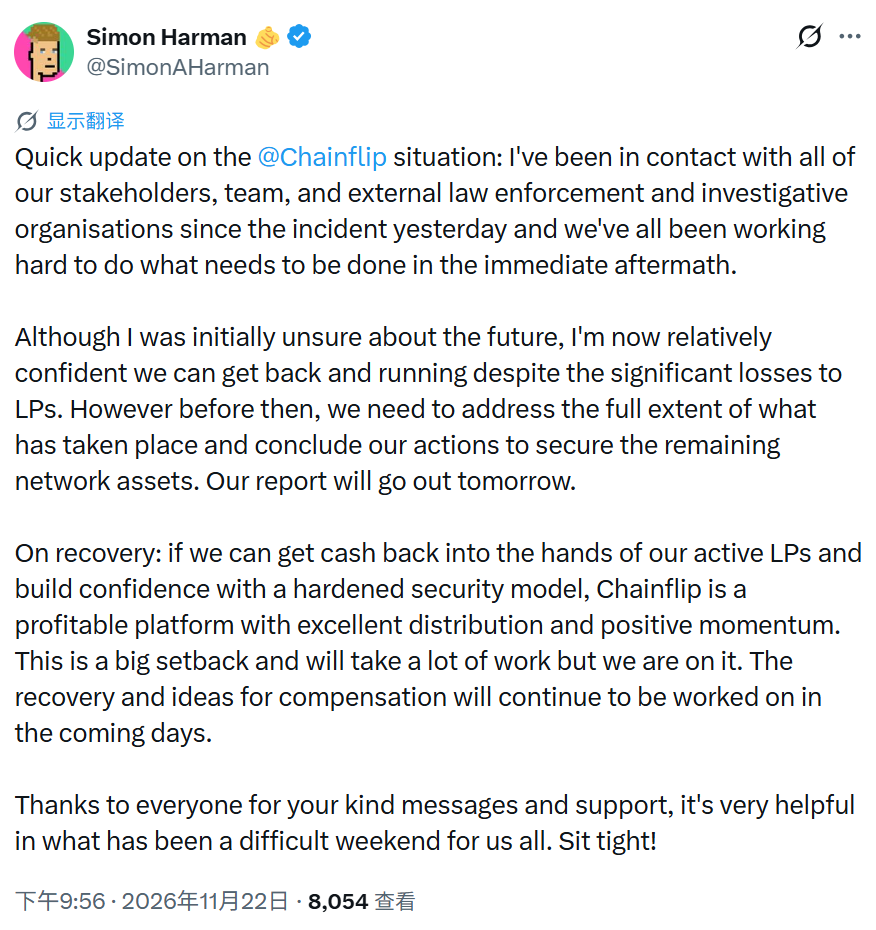
On the evening of November 22, Chainflip founder Simon Harman posted on Twitter that he has been in communication with law enforcement, investigators, and various stakeholders, and is "relatively confident" about the protocol resuming operation, despite significant losses suffered by liquidity providers. He mentioned that an incident report will be released on Monday, and compensation plans are still under discussion.
This is already the second treasury loss Chainflip has suffered in the past ten weeks.
On September 12 this year, attackers exploited a logic flaw in the memo parsing on the Tron side, causing six signed LP withdrawals to be paid repeatedly, stealing around 736,000 USDT. At that time, the official team passed a governance proposal to fully compensate affected LPs with surplus funds from the protocol treasury, and fixed the relevant check logic. The scale and nature of this November attack are different, involving treasuries and signature systems across multiple chains, and the official team has not yet announced similar user compensation arrangements.
For the $736,000 hole in September, the protocol could still use its own treasury surplus to cover the loss. But this time, Chainflip is facing a nearly unresolvable bad debt: the stolen assets amount to $12 million, draining over 88% of the protocol's total TVL, and after the nearly 70% price crash, the fully diluted valuation (FDV) of the entire FLIP token is now only $13.19 million.
In other words, the amount of funds the hacker took in one go is almost equivalent to the entire project's current total value.
Right now, less than one day remains before the bounty ultimatum deadline, and the return address has still received no funds.
Besides the question of "who will foot the bill for the $12 million hole", the market is more waiting for the official team to answer the core question in the upcoming incident report: how did a single new validator that just registered on November 20 bypass the "100-out-of-150 high-threshold signature scheme" and produce the genuine master key outside the system?
Before these questions are fully clarified, even if the protocol code is restarted, it is unlikely that market makers will dare to deposit native assets into its treasuries anymore.