
On the new global stage where cross-market assets flow around the clock, Binance has laid out its core AI trump card.
Written by ChandlerZ, Foresight News
Over the past decade, the underlying growth logic has been identical for both crypto-native trading platforms and traditional online brokerages: list more assets, and deepen liquidity in the split-second window of trade matching. Today, however, as stocks, ETFs, commodities and crypto derivatives are gradually converging into a single unified user account, the competitive moat built solely on asset expansion is hitting its ceiling. The core strategic battleground for global financial platforms has shifted dramatically upstream, to the long end-to-end journey that precedes a user pressing the "buy" button.
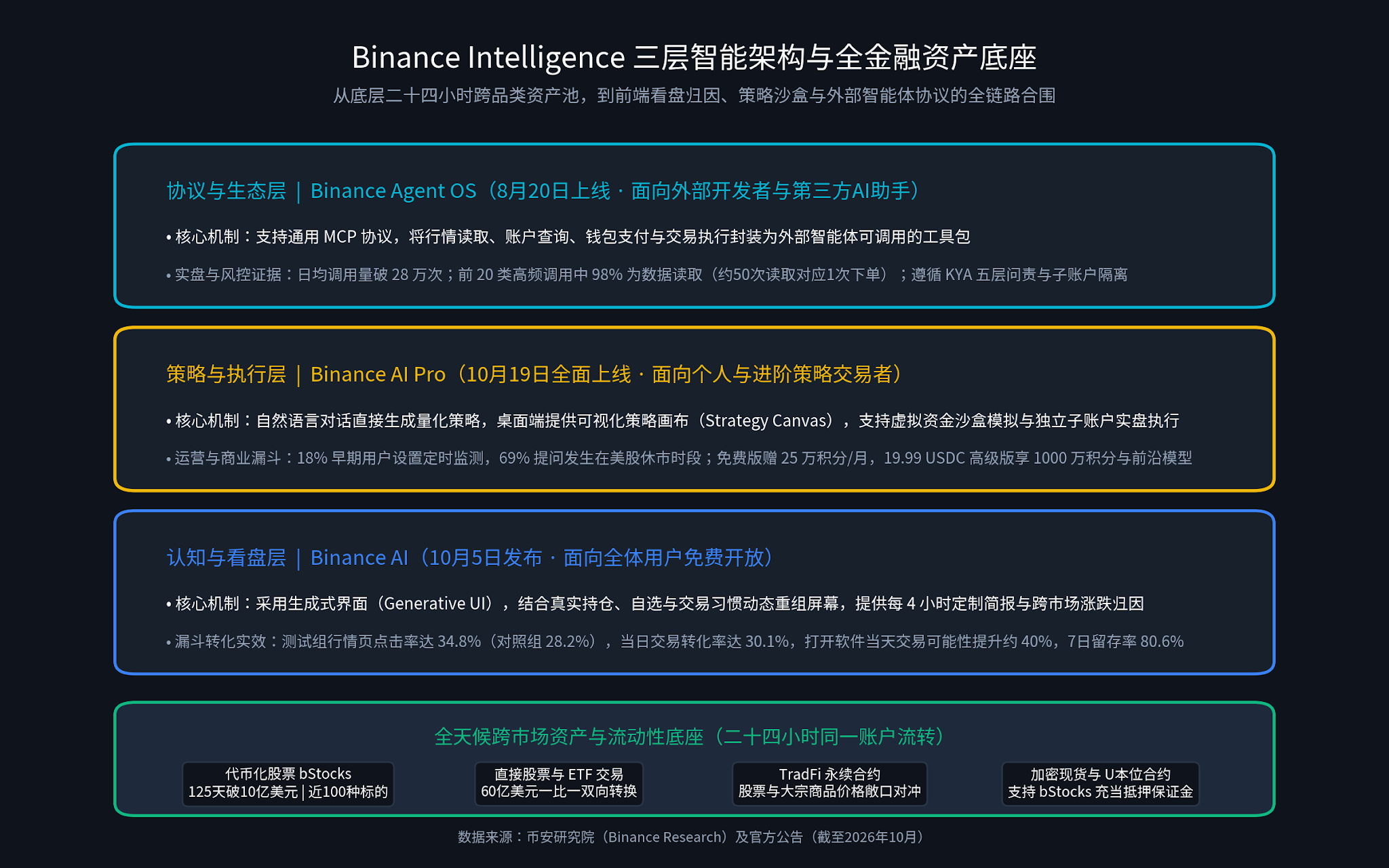
In October 2026, Binance delivered a set of key AI business milestones, bringing this strategic shift to the forefront. On October 5, Binance announced the launch of its full AI product suite, Binance Intelligence, which comprises three core offerings: the free, universally accessible Binance AI for all users; Binance AI Pro, which translates natural language prompts into executable trading strategies; and Binance Agent OS, the developer-facing infrastructure for building AI-powered applications.
On October 19, Binance AI Pro rolled out to all users globally across both the web platform and the Binance mobile app. Built as a finance-focused AI Agent, the tool lets users describe their trading ideas via natural conversation, which is then converted into a visualized, automated strategy workflow with zero coding required. Strategies can first be tested via simulated trading, and only deployed to live trading after explicit user approval. Every live strategy runs in a dedicated independent sub-account, where funds can only be transferred manually by the user.
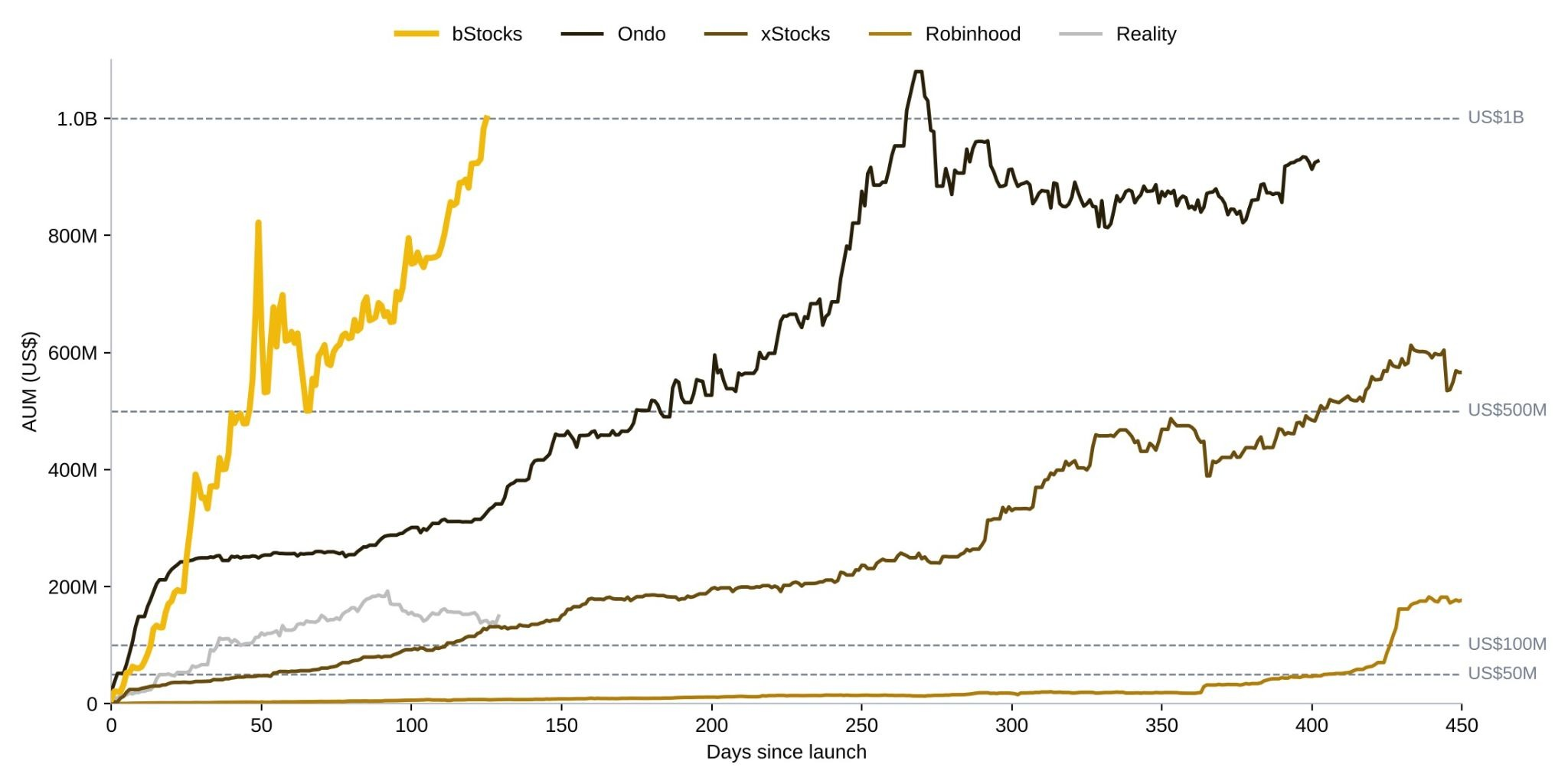
Just days before the full launch of AI Pro, Binance’s integration with traditional financial assets also crossed a critical scale threshold. Its tokenized stock product, bStocks, which launched on June 11 this year, surpassed $1 billion in assets under management within 125 days, with cumulative trading volume exceeding $40 billion.
The convergence of these two business lines in the same autumn paints a clear picture of Binance’s strategic masterplan for the new market cycle, and kicks off a new round of competition among trading platforms. On one side, Robinhood and Coinbase are rapidly packing AI agents, US stocks and perpetual futures into a single application; on the other, Binance is expanding its round-the-clock asset pool with tokenized equities, then rewriting the market monitoring, strategy testing and order placement workflows with its three-tier AI tool stack. At a moment when large language models are reshaping how people interact with financial markets, a full-scale positioning battle for the next-generation global asset trading entry point has already begun.
The Great Convergence of Global Assets: An AI Revolution in the Trading Suite
The speed at which traditional financial assets are being integrated into crypto-native accounts is faster than the market anticipated.
Since the start of this year, the global tokenized stock market has grown from roughly $700 million at the beginning of the year to over $3 billion by the end of September, making it the fastest-growing real-world asset (RWA) category in 2026. Amid this trend, Binance’s bStocks hit the $500 million scale mark in 46 days, and crossed the $1 billion threshold on day 125 — less than half the time taken by another major issuer in the space, Ondo (265 days), while the competing platform xStocks took 403 days to reach $500 million in scale.
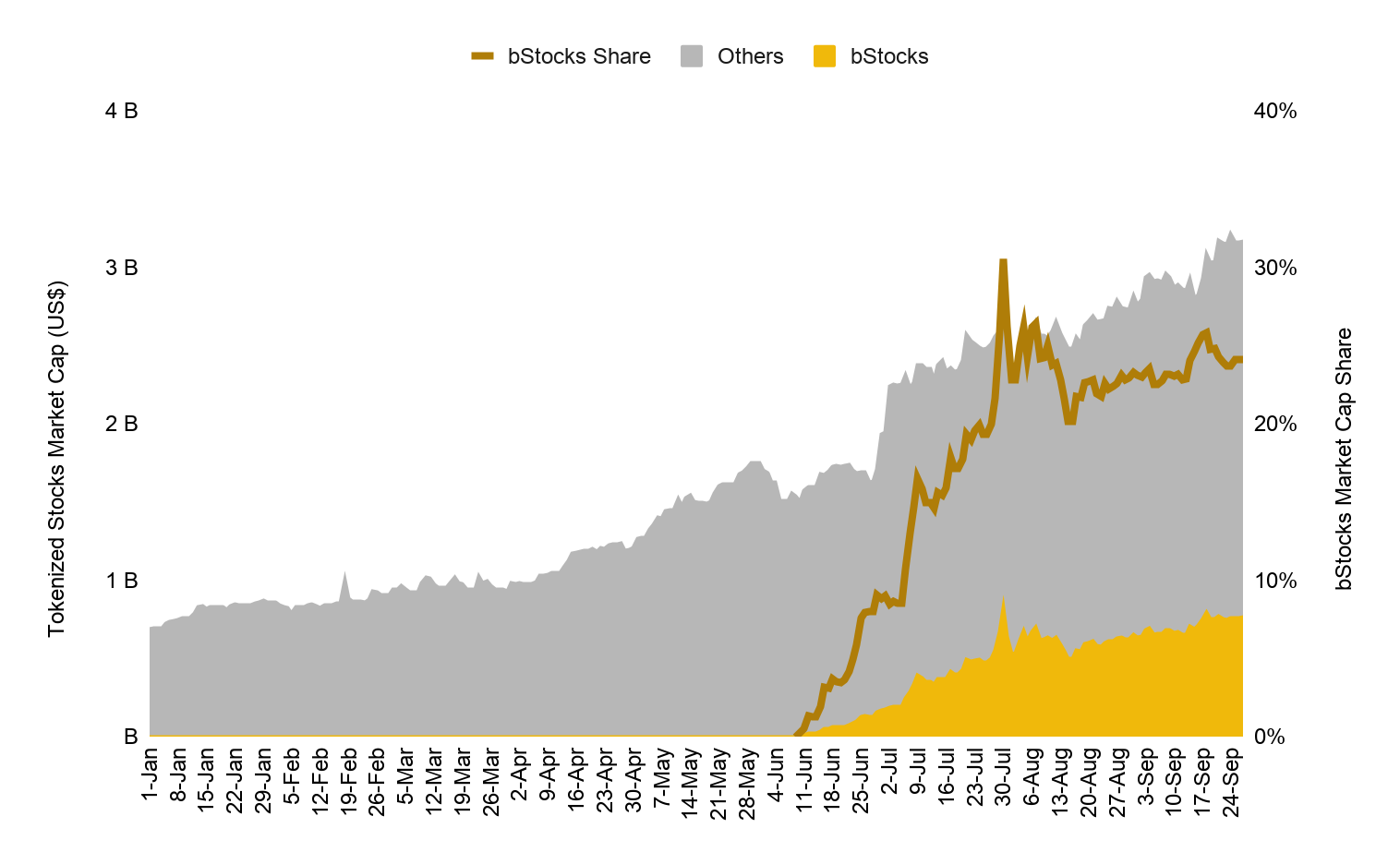
In just four months, bStocks’ underlying assets expanded from 5 to nearly 100 US stocks and ETFs, contributing over 60%! of(MISSING) the total growth of the global tokenized stock market over the same period, with its market share jumping from less than 1%! to(MISSING) 34.2%!.(MISSING)
Moreover, these assets tracking US equity economic exposure have been deeply integrated into round-the-clock trading at high frequency. Data shows the 1:1 conversion volume between direct equity holdings and bStocks has reached $6 billion, with roughly 56%! of(MISSING) trading activity occurring outside regular US stock market hours. As of October 19, the equivalent of approximately 17%! of(MISSING) bStocks under active management has been deployed in decentralized finance (DeFi) protocols for lending or liquidity provision. In terms of user demographics, Gen Z accounts for 46%! of(MISSING) total bStocks users, with 11.5%! of(MISSING) their trading activity taking place on weekends, significantly higher than the 6.9%! average(MISSING) across other age groups.
When nearly 100 US equity exposures, commodity contracts and crypto assets are all moving simultaneously in the 24/7 market, the traditional market monitoring software that has been used for over a decade immediately reveals its limitations. Faced with a public news feed ranked by popularity, average investors struggle to connect the dots in minutes: how an after-hours tech stock earnings report or a weekend macro update actually relates to their cross-asset positions spanning US stocks and Bitcoin.
To manage this cross-market complexity, Binance has translated its years of accumulated experience building over 100 AI models for internal risk control and compliance systems into the user-facing Binance Intelligence ecosystem.
The first tier of the stack is Binance AI, which has been rolled out for free globally since October 5. Ditching fixed, static software layouts, it uses generative interface technology to dynamically restructure on-screen content based on each account’s actual holdings, watchlist and user expertise level, consolidating charts, news, social sentiment and on-chain data into a single access point, and generating customized text and audio briefings every four hours.
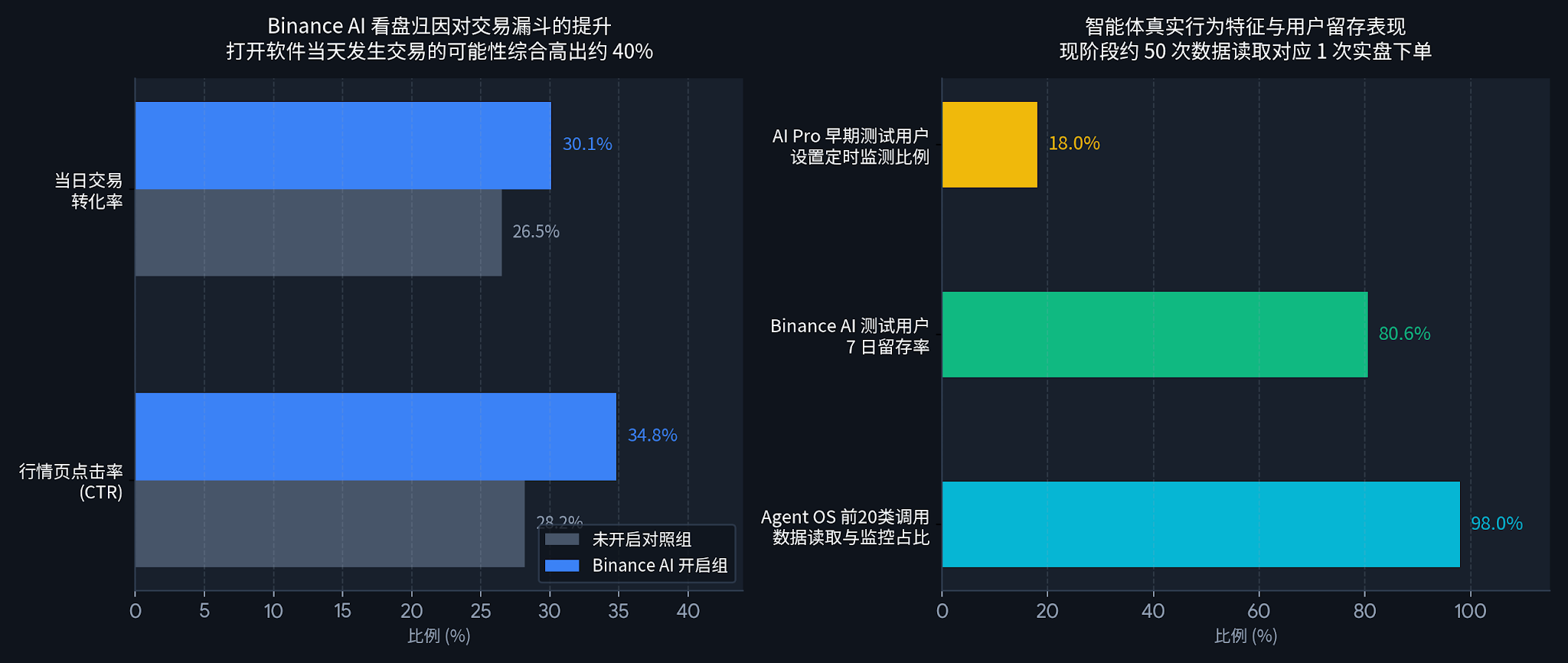
A/B test results from Binance Research, as of October 4, show the tool directly boosted conversion across the trading funnel: users in the test group had a 34.8%! higher(MISSING) market page click-through rate than the control group’s 28.2%!;(MISSING) same-day trading conversion rate rose from 26.5%! to(MISSING) 30.1%!;(MISSING) the overall likelihood of a user making a trade on the day they opened the app was roughly 40%! higher(MISSING), and the 7-day retention rate remained at a high of 80.6%!.(MISSING)
The next step after making sense of market trends is turning mental trading ideas into automatically running strategies — and Binance AI Pro is built exactly to solve the pain point of individual investors who lack coding skills. Users describe their target assets, buy/sell conditions and risk limits in everyday language in the chat window, and the system pulls data from Binance’s in-house market research resources and external data sources to automatically fill in missing parameters.
On desktop, AI Pro generates a visualized flowchart called a "strategy canvas" next to the chat window, where users can click any module to review details, adjust parameters or add/remove steps; on mobile, the entire strategy building and code generation process is completed entirely via conversation. Each user can run up to 10 concurrent strategies spanning simulated trading, live execution or signal alerts. Internal beta test statistics show 18%! of(MISSING) early test users have already used the tool to run scheduled monitoring or daily report tasks, with 69%! of(MISSING) user queries occurring during US stock market closures.
External AI Agents Push Platforms to Open Core Ledger Capabilities
If Binance AI and AI Pro are designed to improve the in-app user experience on Binance, then Agent OS — the developer infrastructure launched on August 20 this year — is built to respond to a more disruptive trend: a growing number of traders are moving away from traditional software interfaces to initiate workflows directly in external AI assistants.
This shift is also tied to how AI tools connect to external services: the Model Context Protocol (MCP) provides a standardized connection layer for AI applications to call external data and tools. For example, users can ask their AI assistant to query market data via relevant interfaces, read account information, or submit trade orders within pre-defined authorized limits. As tools like Claude, ChatGPT and coding assistants are increasingly used for investment-related tasks, the number of entry points for users to access information and operate their accounts is expanding.
Via Agent OS, Binance has opened market data access, account querying, order submission and wallet-related capabilities to external AI agents. When using the exchange’s MCP service, users need to scan a QR code to log in and complete identity verification. According to internal data, the peak daily call volume for the MCP service powering Binance’s centralized exchange business alone has reached 1.2 million times.
The agent service for Binance Wallet also requires QR code login and identity verification, with users able to authorize agents to interact with on-chain wallets within pre-set boundaries. Driven by Agent ID activity, the combined peak daily call volume for Wallet-related interactions and exchange MCP services can reach 50 million times. In terms of user scale, the number of participating users has exceeded 300,000; each Wallet user can create one Agentic Wallet, which is tied to identity verification to confirm the end user’s identity.
On the trading side, the number of agent-related trades has surpassed 1 million, with contributions coming from both Binance’s Web3 and centralized exchange businesses. In a live trading case disclosed by Binance, trader Crypto Eagle connected Agent OS to the external coding agent Codex, and issued an instruction to buy BNB with USDT via natural language. The order was submitted after user confirmation, and the system subsequently returned the average execution price, trading fees and updated account balance.
When external software starts interacting with real user funds, the boundaries of permission and liability immediately become the Sword of Damocles hanging over every financial institution. On this front, Binance and US online brokerages have adopted drastically different risk control approaches.
At the end of May this year, Robinhood launched an MCP protocol-based agent trading feature, allowing users to connect third-party agents to a dedicated segregated brokerage account. Robinhood later launched an in-app agent feature, where users can enable per-trade manual approval — an option that is turned on by default during setup, and can be adjusted by users as needed.
Binance, by contrast, has adopted a more prudent principle of limited agent autonomy. In October this year, Binance’s global policy team published a compliance framework report titled Know Your Agent (KYA), in response to the Monetary Authority of Singapore’s Runtime Security Framework (SAFR) launched in July this year, as well as the UK’s Financial AI Adoption Scheme. The report proposes that beyond traditional Know Your Customer (KYC) processes, the financial industry must build a five-layer accountability mechanism that strictly separates an agent’s right to provide analytical recommendations from its right to execute trades.
This principle is directly written into the underlying code of AI Pro and Agent OS. Within Binance’s system, agents used solely for market research are not granted trading permissions, and any strategy approved for live trading must run in a dedicated sub-account isolated from the user’s main account. Users must manually transfer funds into the sub-accounts; AI has no ability to move principal from the main account on its own, and is completely prohibited from initiating withdrawals to external addresses. Every change to a strategy’s parameters requires re-submission for manual approval, and users can trigger an emergency circuit breaker at any time to cut off all connections to external agents.
The Race to Build Full-Spectrum Financial Platforms in the AI Era
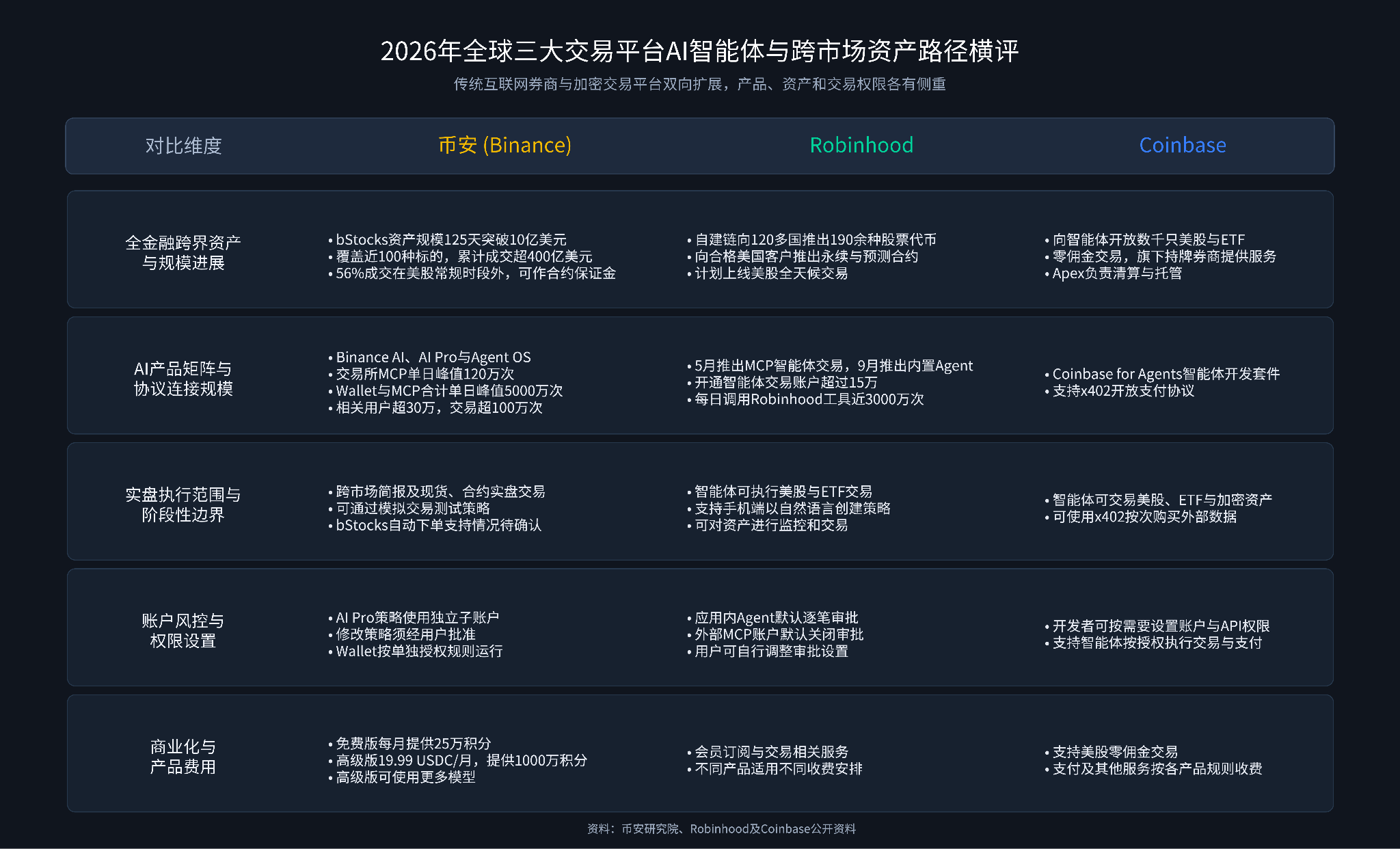
Zooming out, it becomes clear that Binance’s rapid series of moves in autumn 2026 is part of a larger two-way cross-border convergence among the world’s top trading platforms. Traditional online brokerages are aggressively expanding into crypto derivatives, 24/7 trading and on-chain tokenized assets, while crypto trading platforms are moving in reverse into equity assets and AI agent entry points.
The most aggressive player in this space is Robinhood. After launching derivatives contract-based stock tokens in Europe last year, Robinhood launched its self-developed blockchain mainnet on July 1, offering over 190 on-chain stock tokens backed 1:1 by real equities to wallet users in more than 120 countries worldwide. On September 29, Robinhood CEO Vlad Tenev announced that since third-party agent trading was opened in May, 150,000 customers have activated agent trading accounts, with nearly 30 million daily calls to Robinhood’s tools.
Another crypto giant, Coinbase, has made inroads through regulated US equities and machine-to-machine micro-payments. After launching its agent tools in June this year, Coinbase formally opened zero-commission trading for thousands of US stocks and ETFs to its agent services in late September, with clearing and custody handled by its licensed brokerage arm and Apex. More uniquely, Coinbase has tied stock trading to the x402 payment protocol it leads development on. The protocol leverages underlying internet payment status codes to let AI agents purchase external paid data on a per-use basis directly using USDC stablecoins in user accounts, without interrupting ongoing tasks, requiring manual credit card input, or managing encryption keys. As of September, the x402 protocol has processed over 230 million transactions worth more than $54 million in cumulative volume. Market data provider Massive has already integrated the protocol, letting agents buy real-time US stock data for a few cents and immediately place corresponding trades within the same closed loop.
In this multi-sided battle, Binance holds two trump cards that competitors will struggle to replicate in the short term. The first is its large-scale real liquidity and cross-scenario asset reuse. bStocks has not only generated $40 billion in trading depth over four months, but also allows users to use the tokens as contract margin, pushing the ratio of outstanding loans collateralized by deposited bStocks from 5.5%! at the(MISSING) end of June up to 46.2%! by(MISSING) mid-September. This level of capital reuse across spot markets, contracts and on-chain protocols within a single account is out of reach for traditional brokerages.
The second trump card is the commercialization funnel built on its 300 million user base. Binance has designed a clear point-based metering system: all users receive 250,000 free credits per month for building and testing strategies, while the premium tier, priced at 19.99 USDC per month, raises the credit allowance to 10 million, unlocks access to cutting-edge large language models including ChatGPT Sol, ChatGPT Astra and Claude Opus, as well as credit top-up capabilities via Binance Pay. High-frequency monitoring tasks and automated strategies continuously consume credits, naturally converting active traders into paid subscribers and building a stable software service revenue stream on top of traditional trading fee income.
From Individual Trades to Everyday Investing
Looking back from the vantage point of Q4 2026, the competitive dimensions of global financial trading platforms have been completely transformed.
In the past, there were clear dividing lines between platforms: investors went to brokerages to trade US stocks, to crypto exchanges to buy Bitcoin, and to dedicated code hosting platforms to write quantitative strategies. Today, these boundaries are dissolving all at once. bStocks’ accumulation of over $1 billion in assets in four months proves the speed at which on-chain infrastructure can support traditional equity exposures, while the launch of Binance Intelligence’s three-tier product stack marks Binance’s systematic move to take over the investment research and engineering work that takes place before a user presses the trade button.
Of course, this positioning battle around AI and full-spectrum finance has only just entered its deep end, but an irreversible trend is already visible on the table. As financial markets become 24/7 running precision machines, the era of relying solely on individual effort to trade is coming to a close. The platform that can use safer agents to help everyday users process cross-market complexity will be able to turn the reason users open the app from occasionally buying or selling an asset to managing their daily investment routine.