
Ahead of the upcoming congressional transition, Trump’s nominees for SEC and CFTC posts have attended confirmation hearings; the CFTC has operated for nearly a year with only its chair serving as a single commissioner.
Written by Sanqing, Foresight News
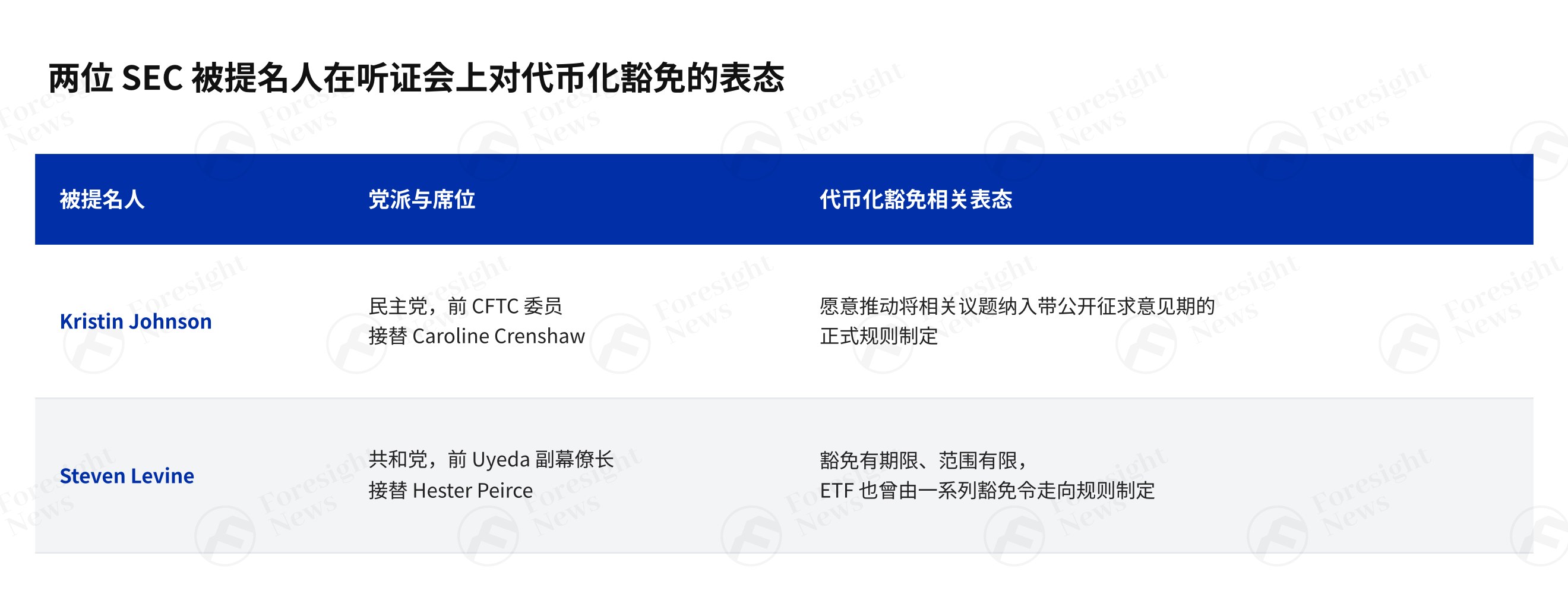
At 23:00 on November 19, the U.S. Senate Committee on Banking, Housing, and Urban Affairs held a confirmation hearing for Kristin Johnson and Steven Levine, President Trump’s nominees for SEC commissioner positions. The joint hearing reviewed five nominees across a short, largely uncontentious process, but the tokenized stock “innovation exemption” introduced by the SEC in September this year emerged as the central crypto-related topic posed to the two candidates.
Previously, at 4:00 on November 18, the U.S. Senate Committee on Agriculture, Nutrition, and Forestry held a nomination hearing for CFTC commissioner nominees Nathan Anonick and Matthew Rowland. Lawmakers’ questions focused heavily on prediction markets, with Democratic Senator Adam Schiff openly accusing CFTC Chair Michael Selig of misleading him during Selig’s 2025 nomination hearing.
The White House submitted all four nominees to the Senate in a single batch on November 12, with two candidates nominated from each major party. Johnson and Rowland are also the first Democratic nominees Trump has named to these two financial regulatory agencies during his second term.
Lawmakers Demand Formal Rulemaking Process for SEC Tokenization Exemption
On September 17, 2026, the SEC rolled out its “innovation exemption”, which allows qualifying Tokenized Securities Venues (TSVs) to trade tokenized versions of U.S. publicly listed company stocks without registering as formal exchanges. Under this framework, third parties can tokenize a public company’s shares without obtaining prior consent, with the company only permitted to raise an objection within 30 days of receiving formal written notice. Since the framework was launched, dozens of listed companies have filed formal objections.
On November 16, Democratic Senators Angela Alsobrooks, Catherine Cortez Masto, Mark Warner and Ruben Gallego sent a public letter to SEC Chair Paul Atkins, demanding that any permanent adjustment to tokenized securities oversight follow a formal rulemaking process with public comment solicitation. During the hearing, Alsobrooks directly asked both nominees whether they supported revisiting this policy.
Johnson responded that she would support advancing the relevant topic through a formal rulemaking process with a public comment period, particularly since the concerns raised have come directly from market participants and registered entities. She added that Congress mandates independent federal market regulators to set rules through public comment processes.
Levine, by contrast, noted that the exemption is time-bound and narrowly scoped, and pointed to ETFs as an example, arguing that many innovations start out with a series of exemption orders before eventually being formalized into binding rules.
In her written testimony, Johnson wrote that AI, tokenization, stablecoins and decentralized platforms have the potential to reduce costs and expand access, but also present tangible challenges around conflict of interest, data governance and accountability; she has long focused on strong governance, conflict of interest rules and customer asset segregation in digital asset markets. Levine’s written testimony did not mention crypto assets at all, only noting that U.S. capital markets are currently undergoing “transformative innovation”.
Cortez Masto also shifted the conversation to prediction markets, alleging that relevant platforms are illegally trading “security-based swaps” structured as stock-style perpetual contracts, with her criticism directly targeting the CFTC’s allowance of single-stock perpetual futures. Levine declined to take a position on the issue, while Johnson noted that the question raises key concerns related to committee jurisdiction and statutory authority.
CFTC Hearing Centers on Prediction Markets
Under the leadership of Chair Michael Selig, the CFTC has claimed “exclusive jurisdiction” over event contracts, with its proposed rules classifying prediction market contracts as swaps subject to federal commodity oversight, rather than activities regulated by state gambling laws. States argue these platforms constitute illegal gambling operations, while tribal nations worry they will undermine the gaming compacts they have negotiated with state governments. Currently, nearly 12 states and the CFTC are engaged in reciprocal litigation, with conflicting rulings from courts across the country, and the case may ultimately reach the U.S. Supreme Court.
During the hearing, Rowland referenced CFTC Rule 40.11, adopted in 2011, which prohibits registered exchanges from listing or clearing specific event contracts tied to gambling, terrorism, war and assassination. He stated he “fully understands” the concerns raised by states and tribal nations, but could not comment on ongoing litigation.
Anonick noted that the CFTC has the authority to determine whether a contract is contrary to the public interest, and that “gambling” is exactly the source of the dispute, describing the topic as “highly charged”. Democratic Senator Tina Smith pushed back during the hearing, arguing that this is a legal question, and that jurisdiction over sports gambling rests with states and tribal nations.
The sharpest exchange at the hearing came from Democratic Senator Adam Schiff. He stated that during Selig’s November 2025 nomination hearing, Selig had claimed he was a “blank slate” on sports event contract issues and would follow court rulings, only to later submit amicus briefs to courts and urge businesses to ignore rulings unfavorable to prediction markets. Schiff said he “could not recall ever being so openly and blatantly misled by a nominee”.
When asked whether a sports event contract tied to an NFL game is equivalent to sports gambling, neither nominee gave a direct answer, only stating they would fully uphold the final ruling of the Supreme Court. Rowland predicted the Supreme Court may issue a ruling on the issue in the next or subsequent court term.
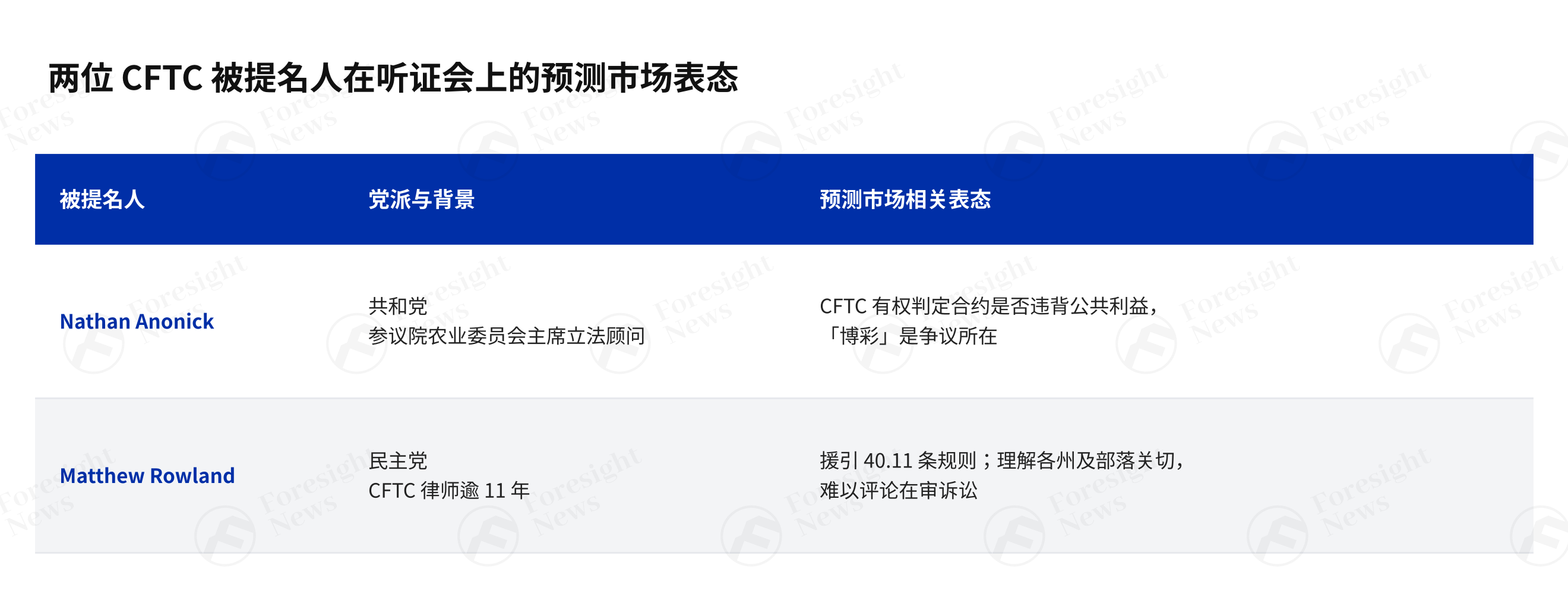
Crypto-related content appeared primarily in Rowland’s written testimony. He has worked as a CFTC attorney for over 11 years, previously served as a senior advisor to Johnson, and has participated in legislative work on crypto market structure. In his testimony, he cited the FTX collapse as an example, noting that the CFTC-regulated FTX affiliate did not file for bankruptcy during the collapse, and its customer assets were fully protected.
He wrote that new markets including event contracts, crypto derivatives and security futures are growing rapidly, and farmers are concerned that 24/7 trading and perpetual futures will impact hedging markets, making it necessary for the CFTC to revisit and strengthen customer protection rules. Anonick’s written testimony did not mention crypto assets at all, only stating that regulation needs to keep pace with evolving technology and market dynamics.
Race to Fill Commissioner Seats During the Lame-Duck Session
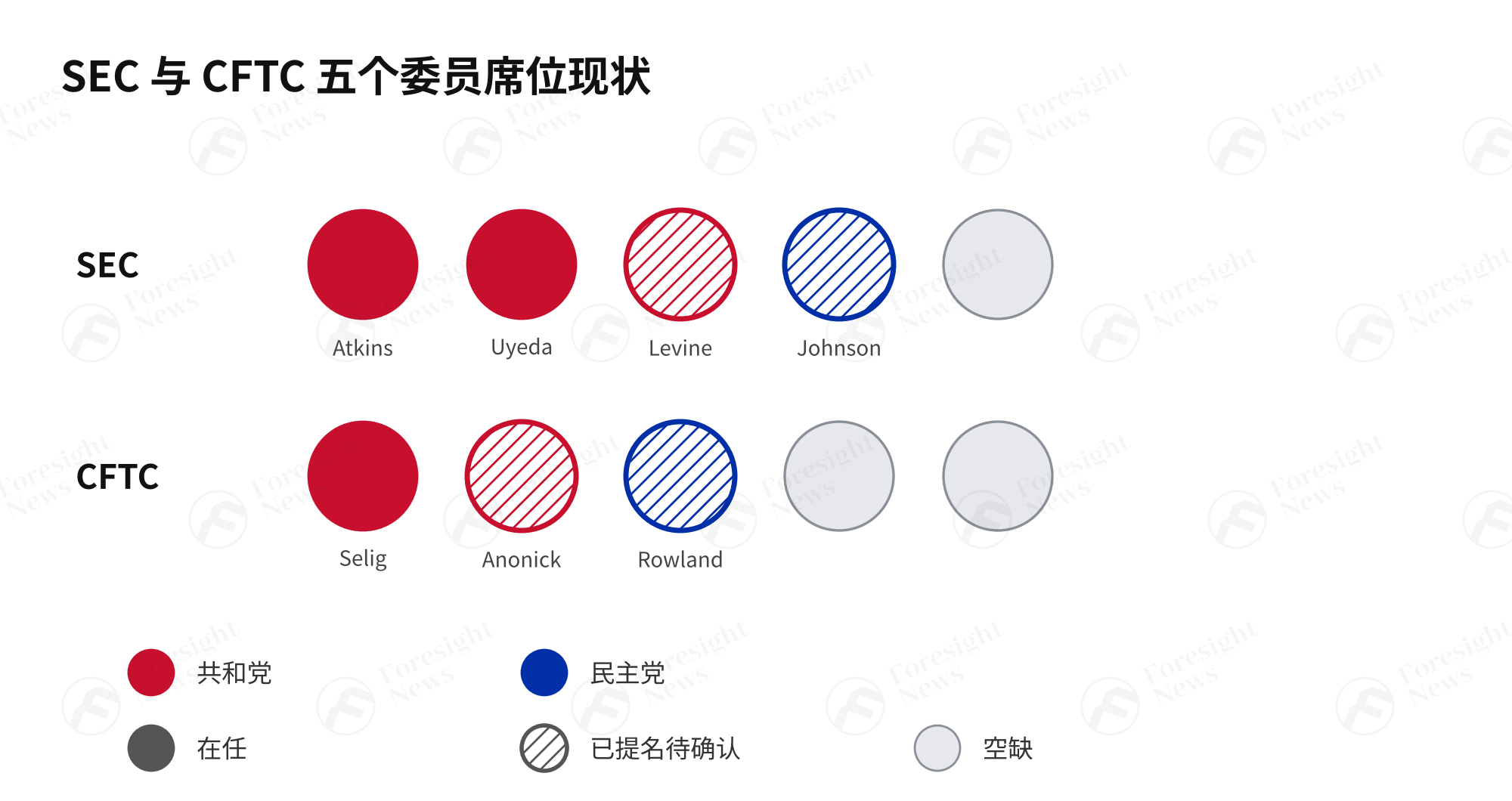
Both regulatory agencies are currently operating with understaffed commissioner teams. Of the SEC’s five available seats, only two are currently filled by Paul Atkins and Mark Uyeda; if Johnson and Levine are confirmed, the number of sitting commissioners will rise to four, creating a split of three Republican members and one Democratic member.
The CFTC’s situation is even more extreme, having operated for nearly a year with Selig as its sole sitting commissioner. In her opening remarks, Senate Agriculture Committee Ranking Member (Democrat) Amy Klobuchar noted that the CFTC as designed by Congress was never intended to be “an agency governed by a single person”.
Staff attrition is also a major issue. As noted by lawmakers during the hearing, the CFTC has lost roughly a quarter of its employees during Selig’s tenure, and both nominees stated they are willing to support appropriate staffing increases as needed. Even if both Anonick and Rowland are confirmed, two CFTC commissioner seats will remain vacant.
The timeline for confirming these nominees is also extremely tight. Democrats won control of both the House and Senate in the November 3 midterm elections, and the new Congress will be sworn in in January 2027. At that point, any nominations that have not completed the confirmation process will generally need to be resubmitted from scratch. All four nominees must first pass a committee vote before receiving full Senate confirmation.
On the legislative front, the CLARITY Act failed to advance in a Senate cloture vote on September 15, with a final tally of 49 votes in favor to 50 opposed. If the bill cannot be revived during the lame-duck session, it will expire alongside the end of the current Congress on January 3, 2027.
As of November 20, neither the Senate Agriculture Committee nor the Senate Banking Committee has announced a vote date for the four nominees’ confirmations.