
Coinbase’s 2027 ambition centers on the prediction market: building out its regulatory license portfolio on one hand, and pushing for aligned legislative frameworks on the other.
Written by angelilu, Foresight News
On November 20, Bloomberg reported, citing people familiar with the matter, that Coinbase plans to offer proprietary event contracts to U.S. retail and institutional clients in the first half of 2027.
A Coinbase spokesperson declined to comment on the first-half-2027 timeline, but the plan is far from unforeshadowed. Back on October 29, Coinbase Chief Financial Officer Alesia Haas confirmed during the earnings call that the company planned to launch a suite of proprietary event contracts, though no concrete timeline was provided at the time.

Coinbase has offered prediction market access via Kalshi since December 2025, while regulatory jurisdiction over certain event contracts in the U.S. remains the subject of ongoing debate. Why is the company choosing this exact moment to launch its own in-house offering?
Proven demand is already there, and rising costs are biting
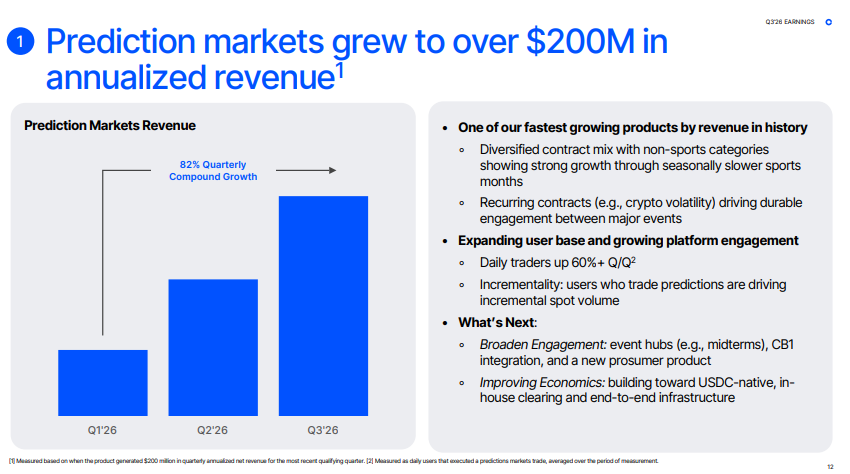
Coinbase has already validated robust market demand through its Kalshi integration. Customers place orders through Coinbase, while the underlying contracts are hosted on Kalshi’s markets. In Q3, Coinbase disclosed roughly $50 million in quarterly prediction market revenue, which annualizes to over $200 million based on the current run rate.
Haas explained the accounting treatment for this revenue stream during the Q2 earnings call. Total fee revenue from prediction markets is booked as trading revenue, while payments Coinbase makes to Kalshi are recorded as separate trading expenses. By Q3, Coinbase’s "other trading expenses" jumped to $45.04 million from $9.61 million in the same period last year. The company noted the increase was driven primarily by exchange fees related to its prediction market integration. While filings do not break out the exact amount paid to Kalshi, back-of-the-envelope calculations show that roughly 70 cents of every $1 in prediction market revenue was paid to Kalshi in the form of exchange fees. This is an upper-bound estimate, and the actual proportion may be slightly lower.
More critically, this cost burden arrives at a moment when Coinbase’s overall revenue structure is at its most vulnerable. Coinbase’s Q3 net revenue fell 34% year-over-year to $1.16 billion, trading revenue dropped 44% year-over-year to $590.2 million, and retail spot trading volume contracted 59% year-over-year. Prediction markets are one of the few product categories expanding against the broader trend: annualized revenue doubled from $100 million in Q2 to over $200 million in Q3, with daily active traders growing over 60% quarter-over-quarter. It is increasingly hard to justify the financial logic of "renting" a third-party exchange at a 70% fee rate for a product line that is still growing within an otherwise shrinking business portfolio.
Coinbase CEO Brian Armstrong already outlined his core takeaway in the company’s earnings materials: the company "has received CFTC approval to list its own prediction market contracts, which will improve our unit economics". Haas noted during the October 29 earnings call that Coinbase will continue offering contracts from its partners while rolling out a suite of proprietary products. She argued that Coinbase holds a competitive edge in crypto-asset-related event contracts: in Q3, over half of prediction market trading volume on the platform came from non-sports categories.
Commercial demand is already proven, and the regulatory pathway remains the other core determinant of whether Coinbase can scale its proprietary event contract business.
Coinbase is proactively pushing for federal regulatory oversight of event contracts
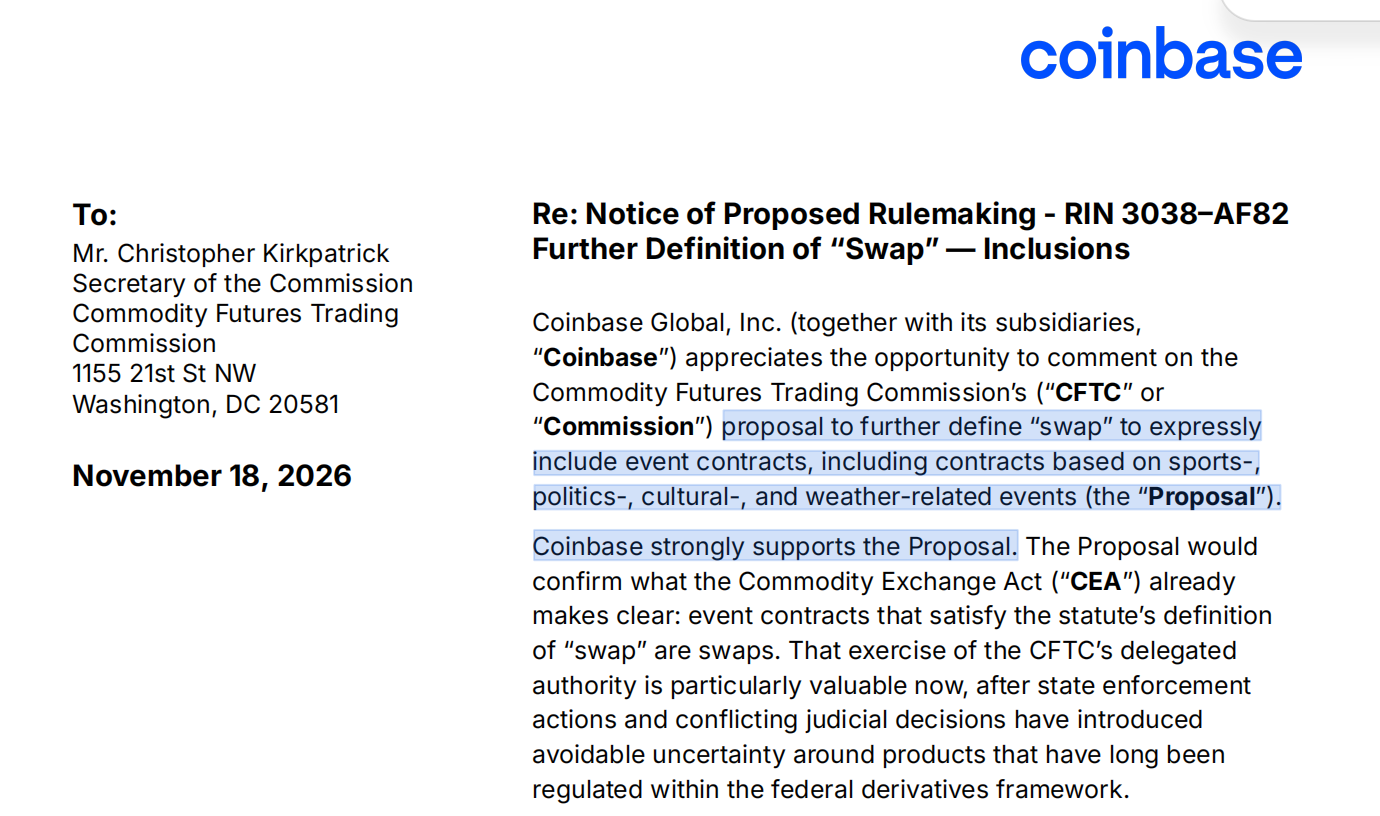
Another notable move came on November 18, when Coinbase submitted separate comment letters on two CFTC regulatory filings. The company supports the explicit classification of event contracts tied to sports, politics and other topics as swaps — a category of federally regulated derivatives — and backs the proposed carve-out for eligible traditional sports betting and casino games. The swap classification remains a draft rule, while the carve-out went into effect on October 19. Public comment on the draft rule closed on November 19. Coinbase also argued that the topics listed in the rule should be treated as illustrative examples only, leaving regulatory space for other event contracts including those tied to crypto assets. This action has given the market far more concrete visibility into Coinbase’s plans to build its own prediction market stack.
For Coinbase, regulatory jurisdiction directly shapes how many customers a given contract can be sold to. If the federal regulatory framework holds up, the same contract can be made available across more states, concentrating more buyers and sellers in a single market. However, federal appellate courts have issued conflicting rulings on sports event contracts, and 43 states including Ohio alongside Washington, D.C. have jointly called on the CFTC to withdraw the draft rule. The exact set of states where sports event contracts will be permitted remains to be clarified by regulators and courts.
What preparations has Coinbase made ahead of final rule implementation
When Coinbase first launched as a Bitcoin exchange, it grew by expanding in parallel with the gradual rollout of clear regulatory rules. In January 2015, Coinbase launched its Bitcoin exchange, initially serving customers across 24 U.S. states and territories. New York released its dedicated virtual currency licensing framework in June of that year, and Coinbase obtained its New York State license in 2017.
Turning back to its current prediction market buildout, Coinbase announced in December 2025 that it had signed an agreement to acquire prediction market startup The Clearing Company, framing the deal as a way to add specialized talent for building event contract products.
Beyond acquiring a dedicated team to build event contracts, Coinbase has also secured the necessary clearing qualifications to bring post-trade collateral management and settlement in-house. On September 28, Coinbase Clearing was registered by the CFTC as a derivatives clearing organization, eligible to clear fully collateralized futures, futures options and swaps.
Combined with its existing derivatives brokerage and contract exchange offerings, Coinbase now has affiliated entities covering the full value chain: order intake from clients, listing and matching on its exchange, and post-trade clearing. For prediction markets, this gives Coinbase a concrete operational choice: it can list some of its proprietary contracts on its own exchange, with post-trade settlement handled by its in-house clearing house.
Distribution-layer players can no longer operate as mere pass-throughs
Coinbase’s in-house buildout is far from an isolated move. Distribution-layer players have broadly realized they cannot remain mere pass-throughs, and Robinhood has already moved first. It launched a dedicated prediction market section via Kalshi in March 2025, and began routing a portion of order flow to its partially owned exchange and clearing house Rothera in June 2026, while retaining its integration with Kalshi. Of Robinhood’s $173 million in disclosed event contract revenue in Q3, $28 million already came from Rothera. While maintaining its external partnership, Robinhood is already generating revenue from its affiliated trading venue.
This also clarifies Coinbase’s core long-term calculation: the company does not want to tie its entire business critical path to Kalshi’s ongoing legal battles with state regulators. Once it secures the full set of licenses — FCM (Futures Commission Merchant), DCM (Designated Contract Market), and DCO (Derivatives Clearing Organization) — Coinbase can package "24/7 USDC settlement" and "crypto-native event contracts" into a durable competitive moat. For crypto-native event markets such as whether Bitcoin will break $100,000 by year-end, Coinbase’s home-field advantage is one Kalshi cannot easily replicate.
As such, building proprietary event contracts is not just a way for Coinbase to turn fees currently paid to Kalshi into its own revenue — it is a strategic positioning play to extend its value chain from a distribution channel up to the trading and clearing layers.