
From Bitcoin ETF Cost Basis to IBIT Holdings: Have Wall Street Giants Pulled Out Early?
Written by KarenZ, Foresight News
Wall Street may finally be getting a taste of the all-too-familiar feeling for crypto retail investors: being underwater.
When US spot Bitcoin ETFs received regulatory approval to list in early 2024, the entry of traditional financial players was once hailed as a key milestone in Bitcoin’s journey toward mainstream maturity.
Asset management giants including BlackRock and Fidelity brought Bitcoin access to standard brokerage accounts, allowing investors to purchase price-linked Bitcoin exposure without the need to navigate private keys, mnemonic recovery phrases, and on-chain transfers.
More than two years later, Bitcoin ETFs have absorbed tens of billions of dollars in capital, growing into a critical bridge connecting Wall Street and the crypto market.
But this time, ETF investors may no longer be the winners perched at the market peak, looking down on the rest of the ecosystem.
The $80,000 Cost Basis Line for Bitcoin ETFs
Let’s start with this rarely discussed cost basis line.
Data from CryptoETF.today shows that the 11 spot Bitcoin ETFs it tracks have an estimated average holding cost of $80,197. As of press time, Bitcoin trades at roughly $63,346, sitting about 20%! below the cost line. (MISSING) Model calculations based on this time point put the aggregate unrealized book loss at approximately $18.59 billion.
How is this cost basis line calculated? CryptoETF first converts the daily net creation and redemption volume of each fund into equivalent Bitcoin units, using the day’s Bitcoin volume-weighted average price (VWAP). For net creations, the newly added Bitcoin units and corresponding capital are counted; for net redemptions, the cost associated with the redeemed Bitcoin is deducted based on the fund’s existing average cost. Finally, the remaining estimated cost of each fund in the sample is summed, then divided by the total Bitcoin units held across all funds, to arrive at the average cost per Bitcoin.
It is worth noting that this model does not track secondary market share transfers on exchanges, nor does it deduct management fees paid in Bitcoin. In addition, due to the lack of initial holding cost data for GBTC prior to its ETF conversion, CryptoETF.today excludes GBTC from the cost estimation sample of the 11 funds.
As a result, this cost basis line cannot be directly interpreted as the average actual purchase price for all ETF investors.
BlackRock’s latest financial reports for IBIT offer another credible reference point. According to the Q3 2026 10-Q filing submitted by IBIT on November 6, as of September 30, IBIT held roughly 801,033 Bitcoin, with a book value cost of approximately $65.556 billion and a fair value of roughly $67.044 billion.
Dividing the book value cost by the number of Bitcoin held, the average cost comes out to approximately $81,839 per coin. This figure represents the book cost of the Bitcoin held by the fund as of that time, and is neither the individual purchase price for every IBIT holder nor a metric that can be used to calculate the profit or loss of any single institution.
This figure is not far from the roughly $80,197 currently estimated by CryptoETF.today, but the two metrics differ in measurement dates, covered assets, and cost calculation methodologies, so they cannot be directly treated as cross-validation of each other.
Some Add Positions, Others Pull Back
Quarterly holdings disclosures from institutions can help us clarify another key point: how much Bitcoin ETF exposure these institutions held ahead of the latest market downturn.
In mid-November, multiple US institutions successively submitted Form 13F filings to the US Securities and Exchange Commission (SEC), covering holdings as of September 30, 2026. Form 13F requires institutional investment managers above the reporting threshold to regularly disclose eligible securities holdings, including Bitcoin ETF shares.
While these data are as of September 30 and cannot reflect position changes after the recent Bitcoin price drop, they offer an important vantage point: which institutions had already significantly increased their positions ahead of the downturn? Which reduced holdings in Q3? And which chose to stay put?
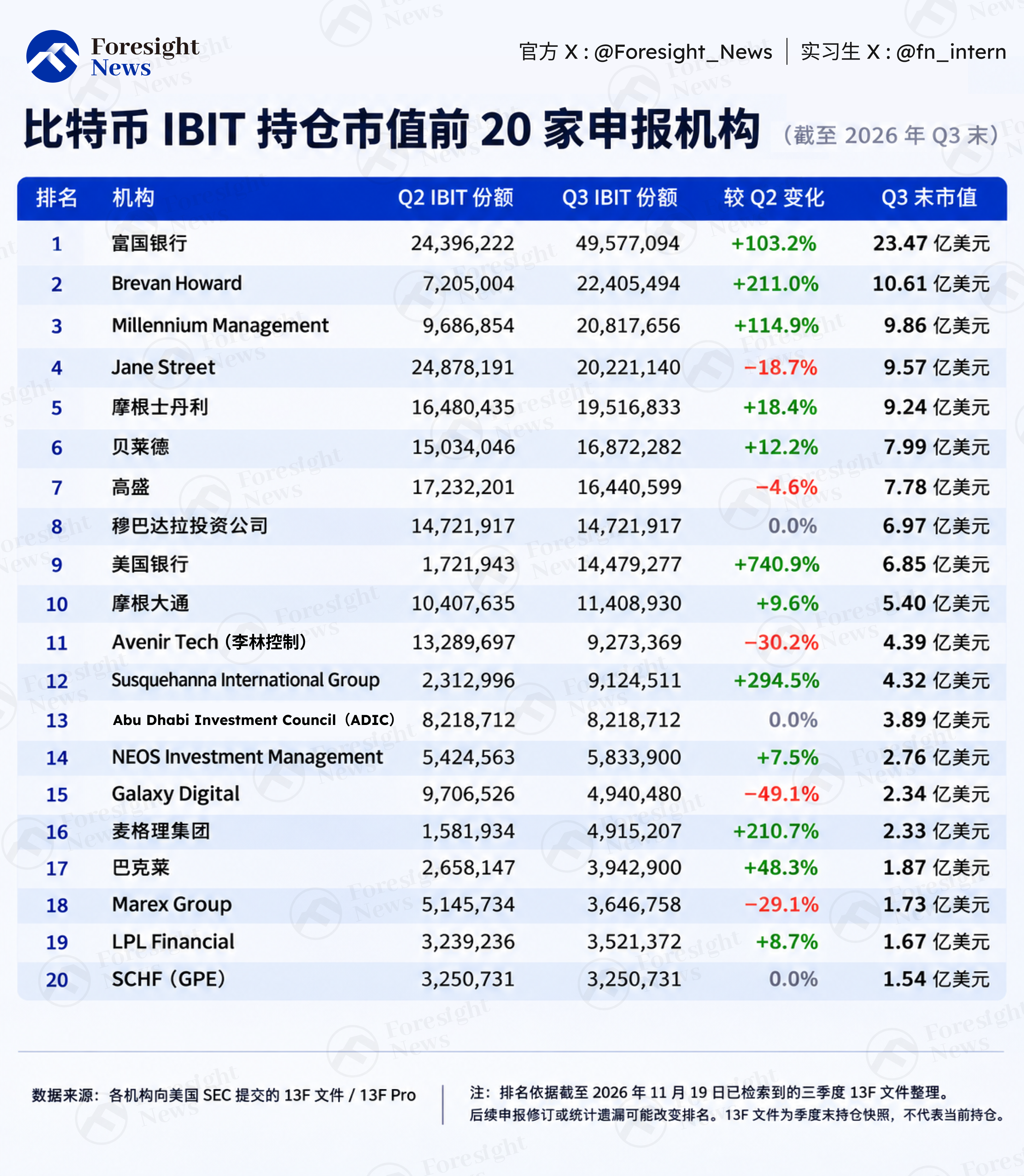
Let’s start with IBIT, BlackRock’s spot Bitcoin ETF. Form 13F filings as of September 30 show that among the top 20 reporting institutions by IBIT holding market value, 12 increased their shares from the end of Q2, 5 reduced their shares, and 3 held their positions flat.
First, let’s look at institutions that significantly increased their positions.
Among the 20 institutions tracked, Wells Fargo ranks first, holding roughly 49.58 million IBIT shares with an end-of-period market value of $2.347 billion. Compared with Q2, its IBIT holdings increased by approximately 25.18 million shares, a growth of 103.2%! , (MISSING) effectively doubling its position.
Bank of America (BofA) posted the largest growth in IBIT holdings among the 20 tracked institutions. Its IBIT holdings rose from roughly 1.72 million shares to 14.48 million shares, a 740.9%! increase. (MISSING)
Two prominent hedge funds also made notable moves. Brevan Howard grew its IBIT holdings from roughly 7.21 million shares to 22.41 million shares, a 211%! increase , (MISSING) with a Q3 end value of approximately $1.061 billion. Millennium Management boosted its holdings from roughly 9.69 million shares to 20.82 million shares, a 114.9%! increase , (MISSING) with an end-of-period market value of about $986 million.
In addition, Susquehanna International Group posted a roughly 294.5%! growth in IBIT holdings , (MISSING) Macquarie Group recorded a ~210.7%! increase , (MISSING) and Barclays grew its position by approximately 48.3%!. (MISSING) Morgan Stanley, BlackRock, and JPMorgan Chase also increased their holdings by 18.4%! , (MISSING) 12.2%! and (MISSING) 9.6%! respectively. (MISSING)
On the position reduction side, Galaxy Digital cut its IBIT share holdings by roughly 49.1%!<(MISSING)/strong>, dropping from about 9.71 million shares in Q2 to 4.94 million shares in Q3, a reduction of roughly 4.77 million shares.
Avenir Tech, founded by Li Lin, cut its IBIT holdings from roughly 13.29 million shares to 9.27 million shares, a 30.2%! drop<(MISSING)/strong>; Wall Street market maker and trading firm Jane Street reduced its position by 18.7%! , (MISSING) and Goldman Sachs cut its holdings by 4.6%!. (MISSING) That said, the changes in IBIT holdings for Jane Street and Goldman Sachs should not be viewed in isolation.
Over the same period, Jane Street grew its holdings in Fidelity’s FBTC from roughly 890,000 shares to 7.01 million shares, and also significantly increased its ARKB positions. Goldman Sachs, meanwhile, grew its FBTC holdings from roughly 106,000 shares to 5.478 million shares. Both firms reduced their IBIT exposure, but increased their positions in other spot Bitcoin ETFs.
Some other institutions chose to hold their positions steady. Abu Dhabi sovereign investment institutions Mubadala and the Abu Dhabi Investment Council both reported the same IBIT share holdings as they held at the end of Q2.
There is an important caveat to this data: Form 13F disclosures reflect the securities holdings managed by reporting institutions, and do not represent one-sided bets using the institutions’ own capital. Bank-reported holdings may include client assets; trading firms may also hold offsetting positions in options, futures, or other instruments. The number of long IBIT common shares held by an institution cannot, on its own, represent the institution’s net Bitcoin risk exposure.
13 Trading Days in November, 11 Consecutive Days of Net Outflows
Compared with the lagged quarterly holdings reports, daily ETF capital flow data offers more timely insights.
Data from Farside Investors shows that from November 5 to 13, US spot Bitcoin ETFs recorded net outflows for seven consecutive trading days, with total outflows reaching approximately $1.907 billion.
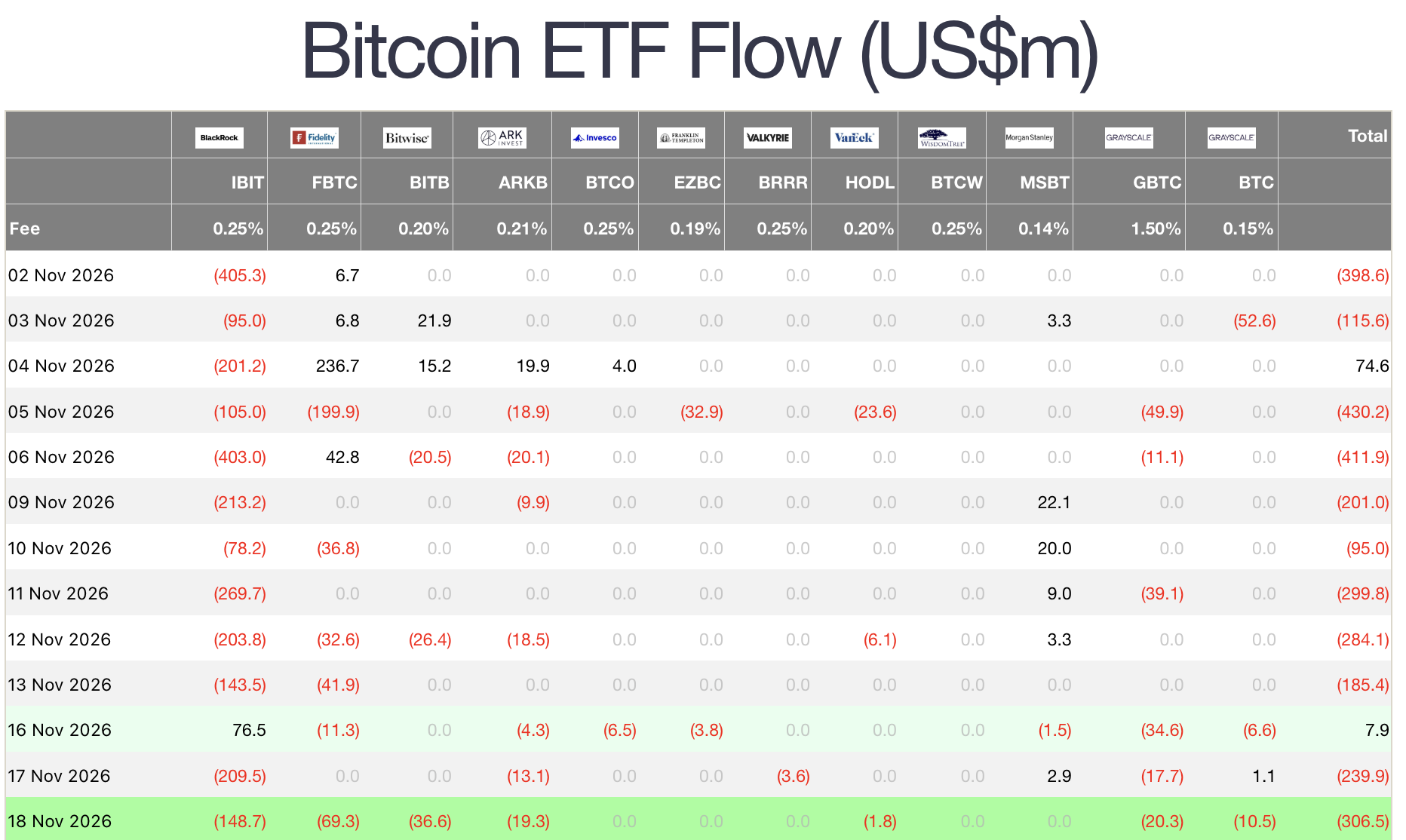
Source: Farside Investors
On November 16, flows turned to a net inflow of roughly $7.9 million: IBIT saw inflows of about $76.5 million, offsetting outflows from multiple other products.
However, this inflow did not last: on November 17 and 18, the market saw net outflows of approximately $240 million and $307 million respectively.
This indicates that alongside the falling Bitcoin price, the ETF market is indeed facing sustained pressure from capital outflows.
What is truly worth vigilance is the potential self-reinforcing loop between falling prices and capital outflows: as Bitcoin prices keep dropping, investors redeem their ETF shares, and the resulting asset adjustments may add further sell pressure to the market, impacting prices and liquidity. That said, this loop is not inevitable, and actual impacts depend on the scale of capital flows, market depth, and the mechanics of ETF creation and redemption execution.
Conversely, if net outflows from ETFs gradually slow after the price drop, or even resume sustained net creations, it will signal that there is still capital willing to take on Bitcoin exposure at lower price levels.