
To cover channel friction costs and hit the break-even point, ANT’s share price on its first trading day must stay above $87.15.
Written by Ma He, Foresight News
On November 19, Anthropic officially set its IPO offer price at $83 per share, above the previously disclosed $70–$78 range in its prospectus. The company also increased its total offering size from the originally planned ~825 million shares to 980 million shares, of which ~956.35 million shares are sold by the company itself, and ~23.65 million shares are sold by existing shareholders.

Based on this pricing, the public offering raises ~$81.3 billion, surpassing the ~$75 billion record set by SpaceX’s June listing this year to become the largest tech IPO in history. Its fully diluted valuation stands at ~$1.5 trillion.
This pricing outcome is highly aligned with market demand observed during the company’s roadshow.
Citing sources familiar with the matter, multiple media outlets reported that the order book was oversubscribed 6 to 7 times the planned share offering prior to pricing. The company specified in its prospectus that it aims to allocate up to ~20% of shares to retail investors, a proportion significantly higher than the typical 5% allocation for large tech IPOs. Meanwhile, seven major computing and chip providers (including Nvidia, Google, Microsoft, and others) will also participate in a ~$26 billion private placement at the same offer price, further expanding the total funding scale.
The company’s fundamentals support its premium pricing. According to its prospectus, revenue in the first nine months of 2026 has exceeded $33 billion, including ~$17 billion in the third quarter alone, representing a 12x year-over-year growth. The number of large clients (with annual spending over $100,000) has grown from ~1,500 at the end of 2025 to over 11,900 by the end of September. Compared to the ~$965 billion valuation after its Series H round in May, the public market pricing reflects a notable upward revision, though it still falls short of the higher price levels previously anchored by parts of the crypto market.
The company’s shares will begin trading on the NASDAQ under the ticker ANT today.
Binance and Bitget Have Closed Their Subscription Windows
Binance Wallet’s Anthropic IPO xStocks campaign allows minimum subscriptions of 100 USDC, with a total pool cap of 500 million USDC, plus a 5% service fee. On the evening of November 18, Binance Wallet announced that the subscription quota had hit the 500 million USDC cap and stopped accepting new requests, with eligible refundable funds to be returned to user accounts once the process is completed.
Bitget offers rANT tokens via its IPO Prime service across two rounds. The public round has a minimum entry of $100, a per-user cap of $25,000, a total pool cap of $200 million, and a 5% service fee. The VIP round has a per-user cap of $3 million and a 12% service fee. Its public round subscription closed at 16:00 on November 18, with total accumulated subscriptions exceeding $100 million and over 11,000 total participants.
Both rounds settle at the official IPO offer price, with service fees charged only on the actual allocated amount. Allocations in both rounds are distributed pro-rata based on subscription size, with no lucky draw mechanism. The VIP round has a pool cap of $1 billion, and Bitget states that tokens will be distributed within 3 to 5 business days after the IPO. rANT is backed 1:1 by real underlying shares, but holders are not granted shareholder voting rights.
What Are the Pricing Levels on Hyperliquid and Polymarket?
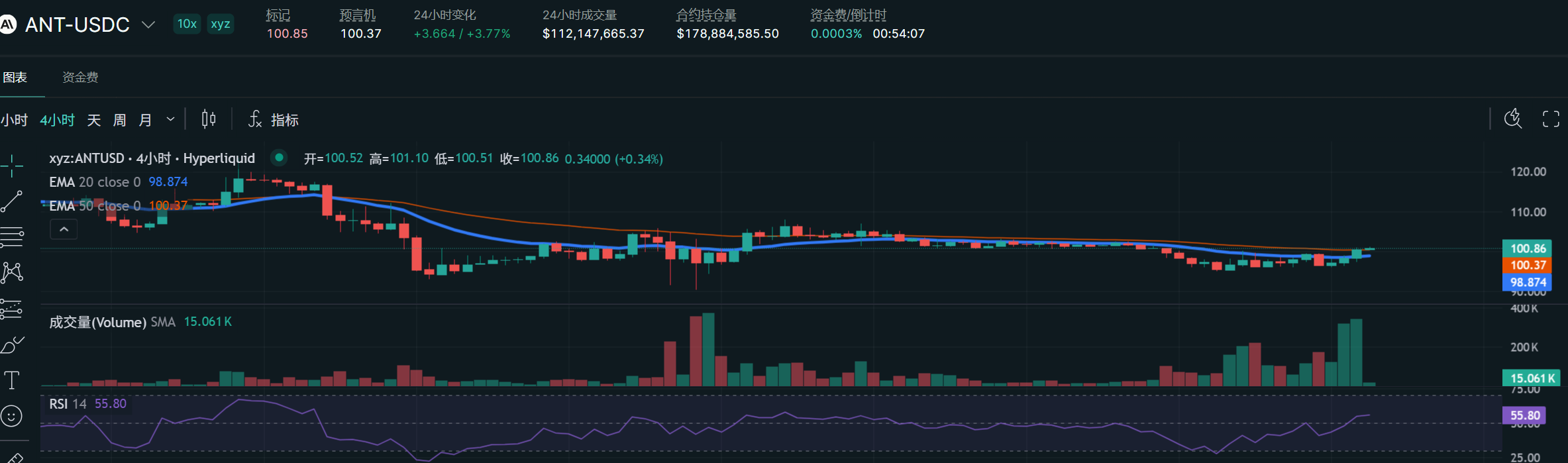
Prior to ANT’s pricing announcement, pricing in the derivatives market was significantly higher than Wall Street’s expectations. Pre-market perpetual contracts on Hyperliquid were trading at ~$96.93, implying a valuation of ~$1.7 trillion, ~24% above the top end of the IPO price range.
The premium did not narrow after the ANT offer price was announced. As of press time, the mark price of the ANT-USDC contract on Hyperliquid (listed by xyz) is ~$100.73, up ~3.6% in 24 hours, with 24-hour trading volume of ~$111 million and open interest of ~$179 million. At the $100.73 mark price, the premium to the $83 offer price is ~21%, corresponding to a valuation of ~$1.82 trillion.
Pricing in Polymarket’s closing market cap contract is more conservative.
It should be noted that this Polymarket contract settles based on the company’s ordinary market capitalization at the close of its first trading day, rather than its fully diluted valuation (FDV). At the same share price, ordinary market cap is lower than FDV, which accounts for potential shares from options, restricted stock units, and other instruments.
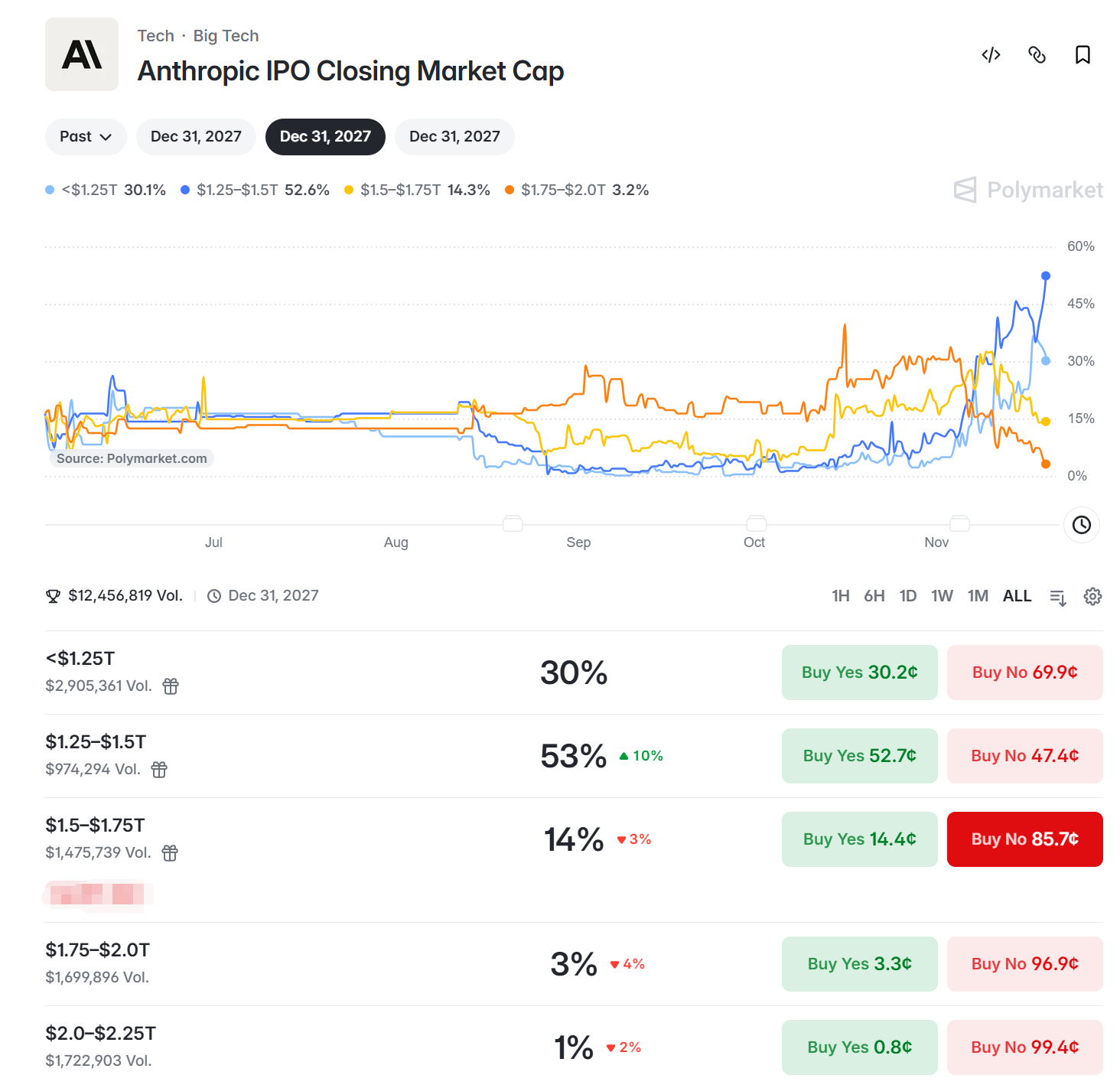
Latest data shows that market traders assign a 53% probability that the closing market cap on the first trading day will land between $1.25 trillion and $1.5 trillion, a 14% probability that it will fall between $1.5 trillion and $1.75 trillion, and a 30% probability that it will be below $1.25 trillion.
Judging from the historical accuracy of pricing anchoring, pre-market derivatives contracts carry certain forward-looking reference value.
Prior to SpaceX’s listing, Binance’s pre-market contract was priced at ~$162.5, while the stock’s first-day closing price was $160.95. Across the six previous pre-market contracts on Hyperliquid, the average gap between a stock’s opening price and the contract price from the prior night was within 25%.
Potential Return Calculations
First, calculate the cost basis. Assuming a $83 offer price, after adding the 5% service fee for both Binance Wallet and Bitget’s public round, the per-share cost comes to ~$87.15.
Based on this calculation, to cover channel friction costs and reach the break-even point, the first-day share price must rise above $87.15.
The table below is calculated based on a $10,000 actual allocation (valued at the offer price), after deducting service fees, with hypothetical first-day price scenarios.
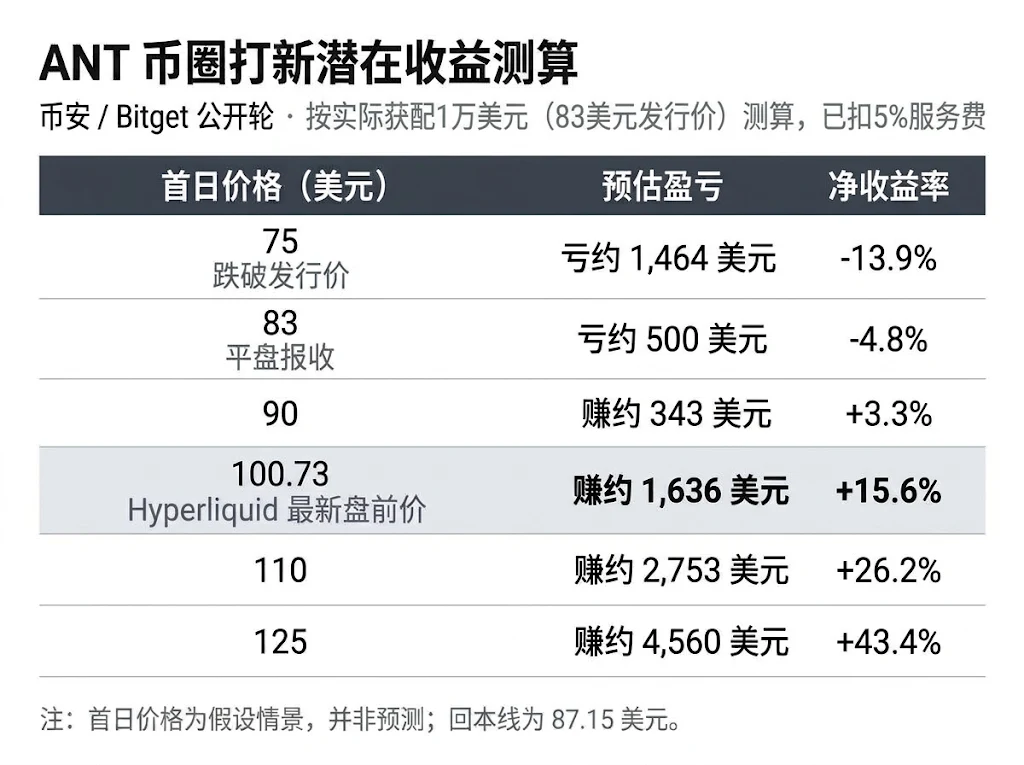
If the baseline scenario uses Hyperliquid’s $100.73 mark price, each $10,000 allocation would generate ~$1,636 in profit, with a net return of ~15.6%. If the stock only rises modestly to $90 on its first day, the post-fee profit would be only ~$343.
Another variable is the actual allocation ratio.
Binance’s subscription quota is fully subscribed, and it has not yet announced the allocation ratio. Bitget’s public round only has a $200 million total pool. Bitget states that historical allocation rates via its partner channels have ranged from 40% to 80% (for the VIP round), though historical data cannot be directly applied, as the actual rate depends on the total share allotment Bitget secures for this offering.
Assume a user subscribes for $10,000 but only receives 50% of the requested amount, i.e., a $5,000 allocation. If the price rises to $100.73 on the first day, the actual profit would be ~$818; if the price lands at $90, the profit would be ~$172.
Overall, the top-end $83 pricing has already priced in part of the secondary market premium, while the 5% service fee further raises the break-even threshold.
Hyperliquid’s latest pre-market price is ~21% above the offer price; if this premium holds on the first trading day, net returns would be around 15%. If market performance aligns more closely with Polymarket’s cautious expectations, post-fee returns will be very limited. The first hour after tonight’s opening will be the earliest test of these expectations.