
The new $30 million Series A round was led by Pantera, bringing the company's post-money valuation to $130 million
Written by ChandlerZ, Foresight News
On November 17, stablecoin payment firm Codex announced the close of a $30 million Series A funding round led by Pantera Capital, with participation from institutional investors including Dragonfly and Coinbase Ventures. Per a report from Fortune, Codex's valuation reached $130 million following this round of financing.
Founded in 2024, Codex provides cross-border payment and currency exchange services for enterprises, payment firms, and remittance institutions. Clients can exchange fiat currencies for stablecoins such as USDC and USDT, or convert stablecoins into local currencies to make payments to overseas vendors and customers.
The company initially planned to build a blockchain dedicated exclusively to processing stablecoin transactions, but later shifted its core business to stablecoin exchange and payments after identifying that clients care more about whether their funds can be converted into the currencies they need. Codex co-founder Victor Yaw noted that the company's annualized transaction volume has grown roughly 10x this year, reaching $25 billion. Earlier, fellow co-founder and CEO Haonan Li revealed in late October that the platform processes nearly $2 billion in monthly fund flow.
How do enterprises make cross-border payments via Codex?
When an enterprise makes an overseas payment, it usually needs to first convert funds into the currency required by the payee before routing the money through banks or payment institutions to its destination. Bank operating hours, settlement networks, and currency exchange channels vary by country, which means funds may be held up at intermediary steps, and both the paying and receiving parties will incur corresponding fees.
Codex aims to provide fiat-to-stablecoin exchange services throughout this process. Enterprises can purchase stablecoins using fiat currencies including the US dollar, euro, and British pound, or convert stablecoins back into local currencies. In addition to serving end-user enterprises directly, payment firms and remittance institutions can also integrate with Codex to offer these services to their own clients.
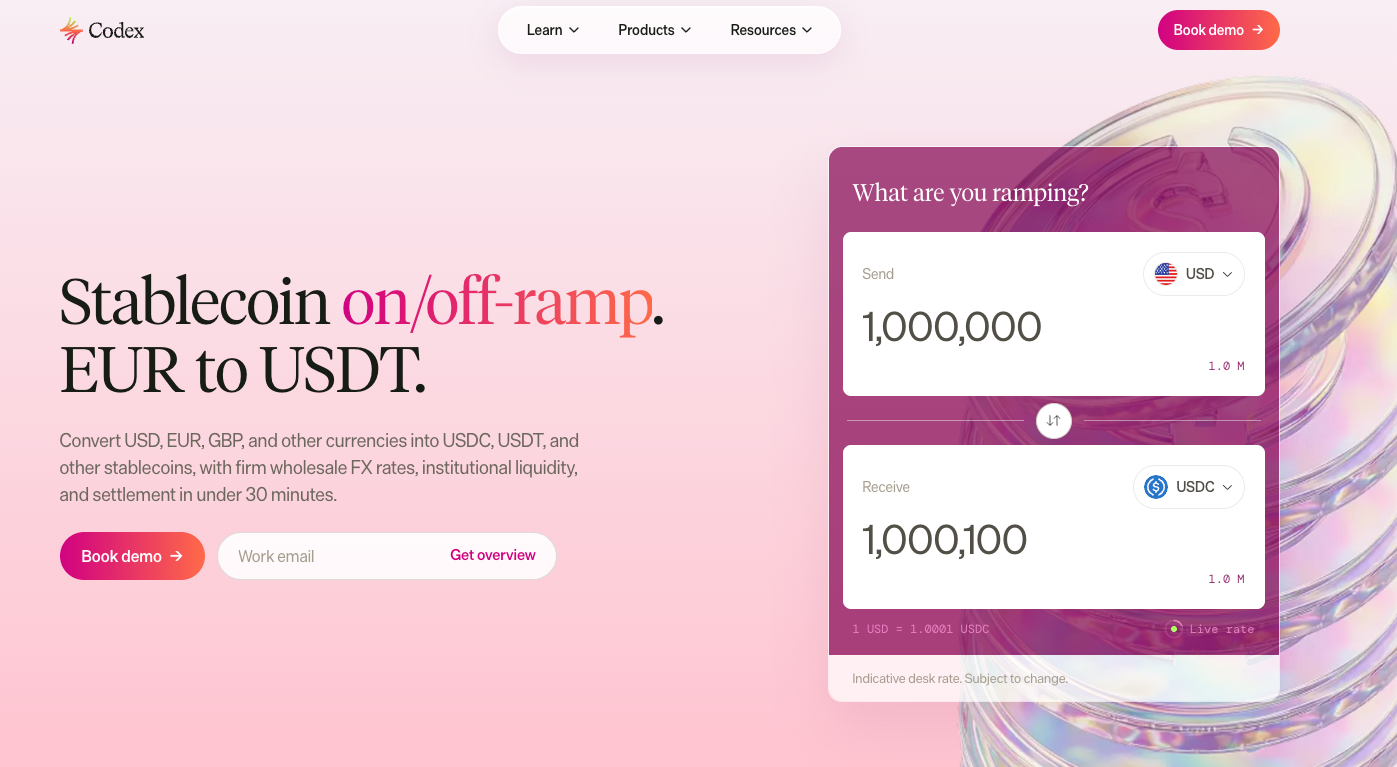
In addition, while stablecoins themselves can be transferred on blockchains, enterprises still rely on bank accounts and local currencies for their day-to-day operations. As a result, a cross-border payment requires more than just an on-chain transfer: it also needs arrangements for fund onboarding, currency conversion, and local currency settlement in the recipient's jurisdiction. Codex's local settlement markets listed on Circle's partner directory include Hong Kong, Brazil, and Nigeria.
Suppose an enterprise needs to make a payment to a vendor in Hong Kong. The company can first confirm the payment amount, request an exchange rate quote from Codex, then arrange for currency conversion and payment processing. Codex provides fiat-stablecoin exchange services, and also supports converting stablecoins into local currencies.
According to Codex, clients do not need to deposit a standby balance on the platform in advance to cover future exchange needs. After a client confirms a transaction, they still need to deliver funds as agreed, while Codex takes charge of arranging currency conversion and settlement. The company's official website states that clients can access quotes 24/7, and settlement for fiat-to-stablecoin conversions can be completed in as little as 30 minutes, though actual fund arrival will depend on payment channels and local settlement arrangements.
Beyond currency exchange, Codex also handles the transfer of stablecoins across different blockchains. For example, if a payment firm's client holds USDT on the Tron network, but the recipient requires assets on another network, the payment firm will need to arrange a cross-chain transfer. Codex states that its cross-chain service supports assets including USDC, USDT, and PYUSD, across networks including Ethereum, Solana, and Tron.
This service model relies on local banks, payment institutions, and liquidity channels. While stablecoins enable the on-chain movement of funds, the processes of moving fiat into and out of on-chain environments still require coordination with corresponding financial service providers.
Instant 1:1, Zero-Spread Exchange Between USDT and USDC
There is also demand for exchange between the two major dollar-pegged stablecoins. Both USDT and USDC are pegged to the US dollar, but they are issued by different institutions, leading to slight price discrepancies, as well as potential transaction fees and slippage for large-volume exchanges.
In July 2026, Codex publicly launched Codex Par, a product that provides payment firms with a two-way exchange interface between USDT and USDC. Per the company's introduction, a client exchanging 1,000 USDT will receive 1,000 USDC: Codex is responsible for sourcing liquidity for both stablecoins and processing settlement, so integrated payment firms do not need to pre-hold inventory of either asset.
That said, payment firms still need to pay for the service, with fees varying based on transaction volume. Fees can be charged per transaction, or billed via separate invoices. Payment firms can integrate the exchange function into their own products via API, or operate directly through Codex's backend dashboard.
Codex noted that Par has been in commercial use since early 2026, processing hundreds of millions of dollars in exchanges each month. The product supports USDC across eight networks, and USDT on Ethereum, Solana, Tron, and Polygon. For integrated payment firms, Codex can reference their completed customer identity verification records and conduct regular sampling audits. Every transaction must also pass on-chain and off-chain anti-money laundering screening.
Introduction to the Founding Team
Codex was co-founded by Haonan Li, Momo Ong, and Victor Yaw. Li previously worked in predictive research and quantitative finance early in his career, before joining Optimism, where he participated in Ethereum scaling and protocol economic design, and began focusing on the use cases of stablecoins for cross-border remittances.
Li and Yaw first met at the Singapore Armed Forces' infantry officer candidate school. Ong, a graduate of Princeton University, previously worked as a product manager at Meta and founded her own company. She initially joined Codex as an advisor before coming on board full-time.

In its early days, the company planned to build an Ethereum Layer 2 network dedicated to stablecoin transactions, and raised a $15.8 million seed round in April 2025 led by Dragonfly. Circle Ventures, Coinbase Ventures, and market makers including Cumberland and Wintermute also participated in this round.
Li later discovered that clients were more focused on how to convert their existing funds into the currencies they needed, so the company repositioned its core business to currency exchange and cross-border payments. In August this year, Codex's transaction volume surpassed $1 billion.
With this latest $30 million round, Codex has raised a total of $45.8 million across two funding rounds. The company currently has around 35 employees, with offices in Singapore, Hong Kong, London, New York, and San Francisco.
In October this year, Codex announced that its Canadian subsidiary has registered as a payment service provider with the Bank of Canada, and as a money services business with the Financial Transactions and Reports Analysis Centre of Canada (FINTRAC). The company plans to use part of the new funding to improve the automation of its exchange and payment platform, and continue expanding into markets across Asia, Latin America, and Sub-Saharan Africa.