
Indian police have frozen a Chinese user's Gate exchange account for nearly 16 months in connection with an investment fraud case, and have demanded the platform transfer the assets held in the account.
Written by Ma He, Foresight News
On November 17, prominent on-chain detective ZachXBT published a lengthy thread revealing that the Criminal Investigation Department (CID) of Andhra Pradesh, India, mislabeled the withdrawal address of the Merlin Chain cross-chain bridge on the Bitcoin mainnet as a scam-associated address during an investigation into a pig-butchering scam, which led to the account freeze of a Chinese user on Gate.
ZachXBT noted that he found no on-chain links between the user and the fraud scheme, yet an Indian court has already issued an order requiring Gate to transfer the funds in the account to the Indian scam victims.
In a follow-up post, ZachXBT added that the actual victim — the Gate account holder — has been unable to access his own funds for nearly 16 months.
The Case Traces Back to a Pig-Butchering Scam Targeting an Indian Woman
The case itself stems from a pig-butchering scam that occurred in May 2025.
According to a report by *The New Indian Express*, an Indian female victim lost approximately $1.5 million worth of crypto (BTC, USDT, DOGE, and SOL) through a fake investment platform. The CID registered the case and filed a chargesheet in March 2026, stating that it traced 15 Bitcoin transactions flowing to four accounts on Gate, and arrested 8 suspects in connection with the case.
Source: The New Indian Express
ZachXBT stated that the critical error occurred during the tracking of the fund flow path.
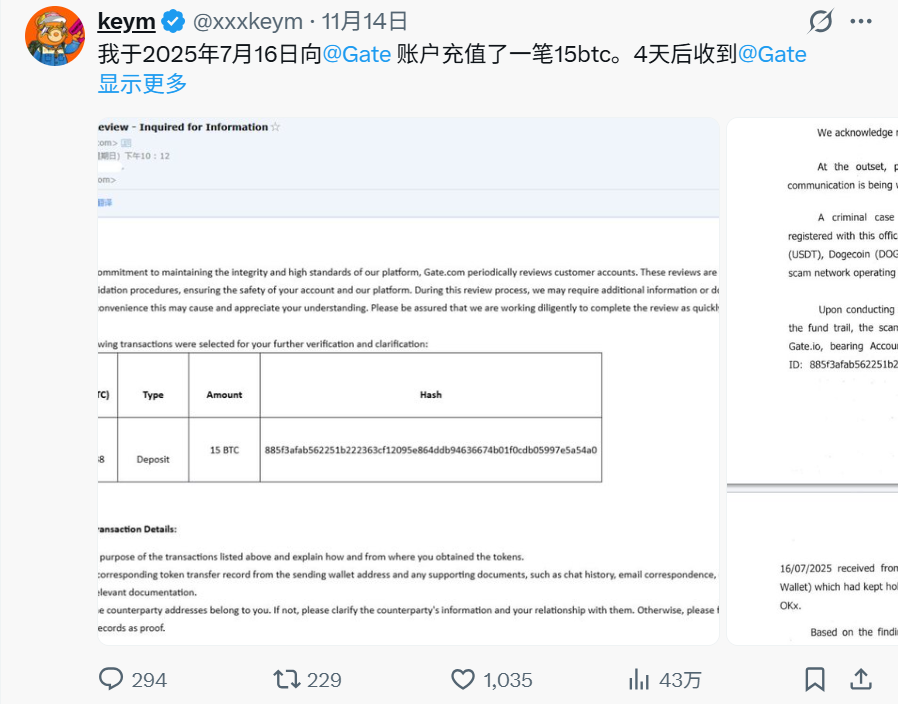
In July 2025, user xxxkeym deposited 15 BTC to the Gate deposit address (17mpajZ6Nq3dG3T6wUhaXxYF4Qy9HJnYx5), with a transaction hash of 885f3afab562251b222363cf12095e864ddb94636674b01f0cdb05997e5a54a0.
The source of the funds was an address controlled by xxxkeym (3NcBhqKnyo8dfzqfG1p5rbaKJFV8yLnx3u), which had withdrawn crypto from OKX and Binance as early as January 2023 and remained dormant for a long period until the July 2025 deposit.
Indian law enforcement never froze his OKX or Binance accounts — the actual source of the 15 BTC. ZachXBT pointed out that this fact alone reveals a critical flaw in their investigative reasoning.
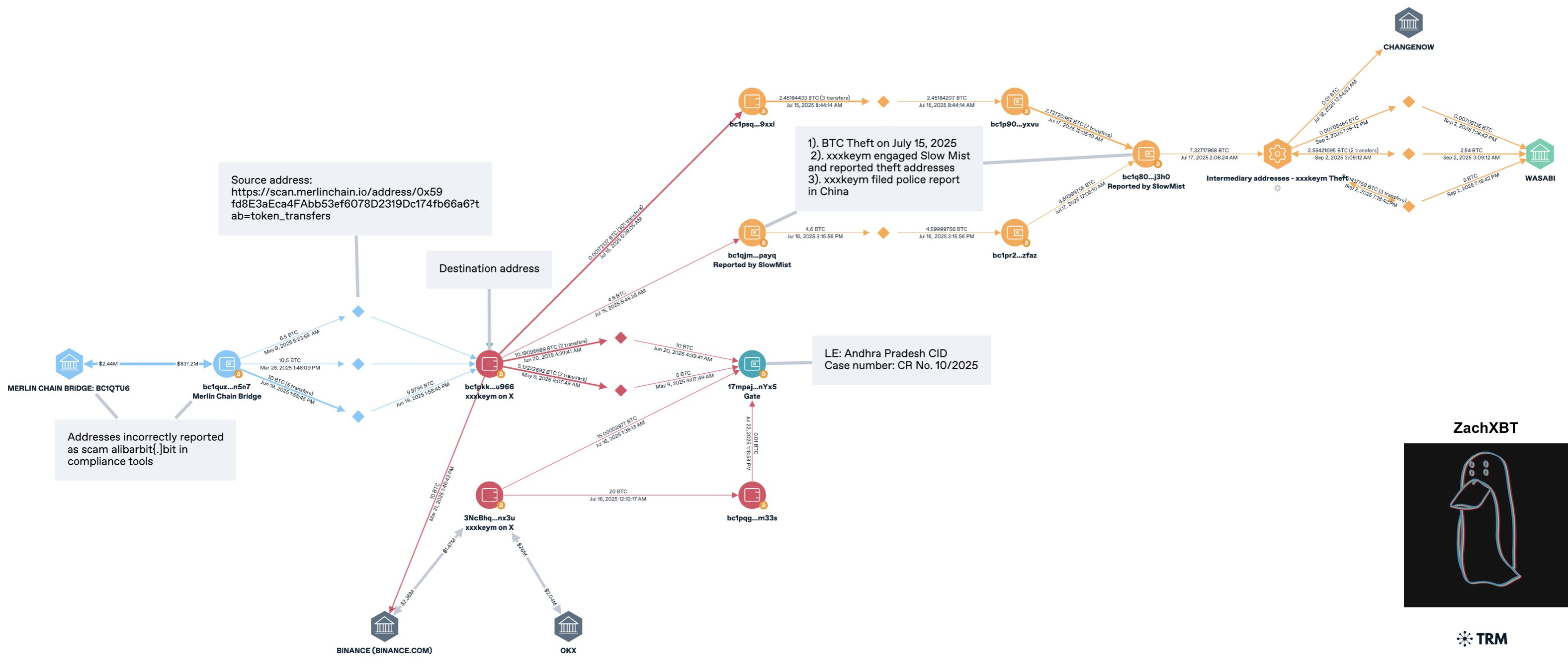
A more critical misjudgment concerns two other relevant inbound transfers to the Gate address.
The Gate address also received two transfers totaling 15 BTC from bc1pkkwqyxn3rm608ryuqg9hyqna0syq4jx5pxkr7pzg8n3usx6tyqfst5u966, which is also controlled by xxxkeym. Prior to these transfers, this address received three inbound payments from bc1quzwkggdf6ly06mrrnnled0qdr57w770k45n5n7 and bc1qtu66zfqxj6pam6e0zunwnggh87f5pjr7vdr5cd.
Indian law enforcement labeled these two addresses as linked to the alibarbit.bit scam.
ZachXBT stated this label is incorrect: these two addresses actually belong to the Merlin Chain cross-chain bridge, and most compliance tools have not properly tagged them.
Merlin Chain is a Bitcoin Layer 2 network, and users can transfer BTC between the Bitcoin mainnet and the Merlin network via its native bridge.
ZachXBT noted that the owner of the involved address is a regular user interacting with the Merlin Layer 2 network. He had bridged 50 BTC into Merlin as early as March 28, 2024 — more than a year before the alleged scam incident in May 2025. He subsequently made three withdrawals from Merlin, equivalent to approximately 10.1367 BTC, 4.907 BTC, and 9.9795 BTC respectively, and these withdrawal amounts perfectly match the Bitcoin outflows from the aforementioned bridge addresses in both timing and volume.
He also disclosed the specific transaction hashes and attached screenshots of the bridge activity to confirm there is zero on-chain connection between user xxxkeym and the theft incident.
However, according to multiple reports, the special court for CID cases in Guntur, India, issued a property return order (Crl.M.P. No. 298/2026) on October 30, 2026, requiring Gate Global Corporation to convert the crypto assets in the four accounts into USDT at market rate and transfer the funds to a wallet designated by the Indian complainant.
Gate’s Response: No Funds Transferred, Platform Requests Additional Evidence from Police
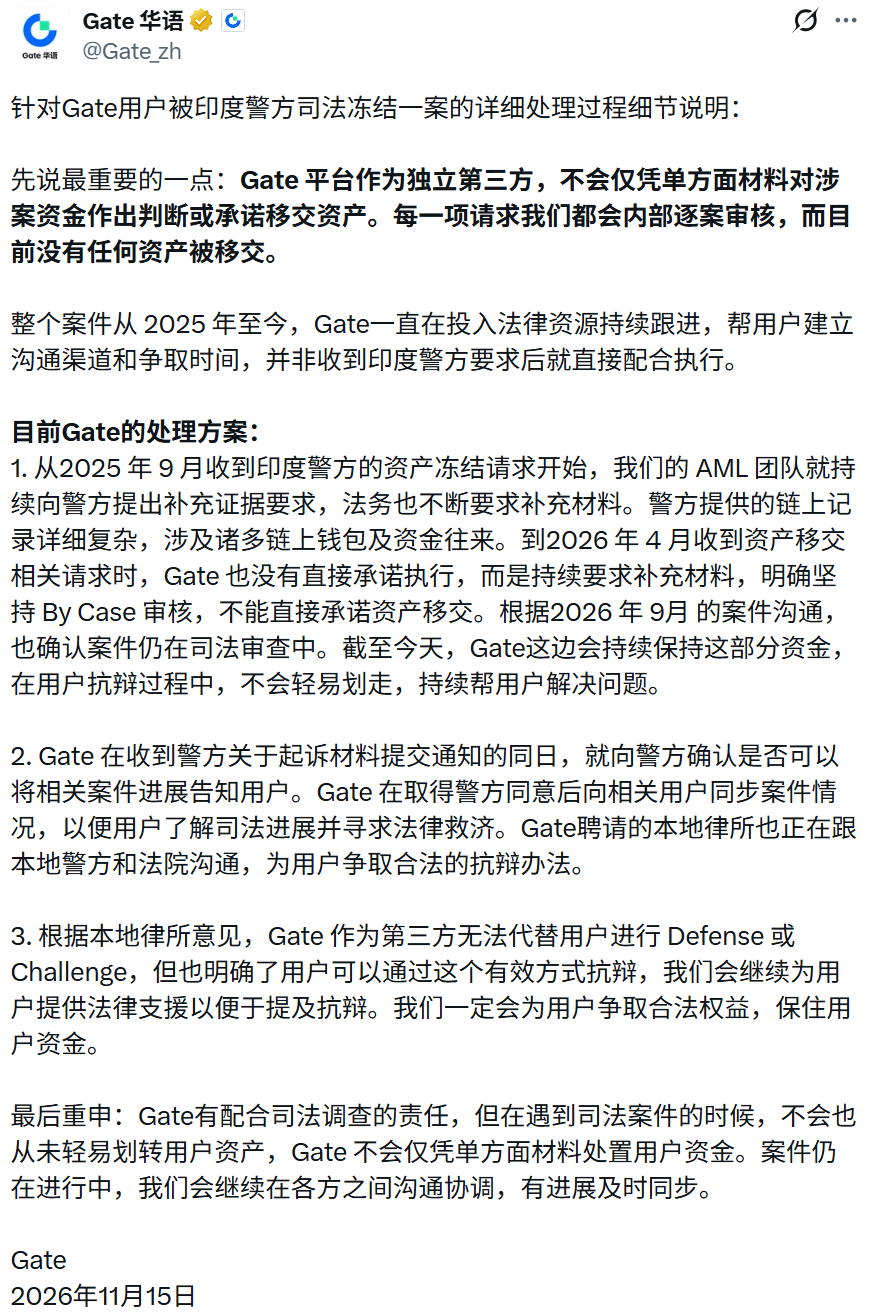
On November 15, Gate published a detailed statement noting that as an independent third party, the platform will not judge or commit to transferring assets based solely on one-sided submissions, and no assets have been transferred to date.
The platform stated that since receiving the freeze request in September 2025, its anti-money laundering (AML) team and legal department have continuously requested police to provide additional evidence, as the on-chain records are complex and involve multiple wallets. When receiving the asset transfer request in April 2026, the platform did not directly commit to execution, but instead continued to request supplementary materials and insisted on case-by-case review.
On the evening of November 17, Gate’s official team stated that after internal review, it found ZachXBT’s analysis highly valuable, but noted that Indian police had also provided more undisclosed materials which cannot be made public at this stage due to lack of authorization.
ZachXBT further noted in a follow-up that Gate should have directly rejected the request after identifying the tracking error, and that to his knowledge, Gate has no jurisdictional nexus with India, meaning it has no legal obligation to comply with Indian court orders. He questioned why the CID has repeatedly made major oversights in basic on-chain tracing. To date, the CID has not issued a public response to ZachXBT’s specific analysis.
User xxxkeym also spoke out, stating that throughout the process, Gate has cited confidentiality restrictions on case details as the reason for requiring him to communicate directly with Indian authorities, and that his lawyers’ repeated communications have seemingly had no substantive impact on the freeze or asset deduction process.
He added that his account held approximately $3 million worth of assets when it was frozen, but due to market downturns, the remaining value is now around $1.6 million.
These issues — unlabeled cross-chain bridge addresses, misjudgments by compliance tools, and insufficient evidence review in cross-border judicial assistance — are not uncommon in the crypto industry.
Pig-butchering scams are inherently difficult to trace, and errors often emerge when funds pass through multiple layers of bridges and mixing services. For ordinary users, even with clear, traceable fund sources, accounts may be frozen for long periods due to mislabeling by foreign law enforcement. How exchanges can balance compliance obligations and user asset protection when facing freeze and transfer requests from different jurisdictions has once again been pushed to the forefront of industry debate.
Habitual Self-Exoneration?
In the gray area where decentralized ledgers intersect with state sovereignty, this case has laid bare the passive position and underlying concerns of centralized exchanges amid cross-border judicial disputes.
For orders from foreign police forces, platforms often tend to choose the path of least resistance: mechanically executing asset freezes first without substantive cross due diligence, thereby shifting the entire heavy burden of proof onto ordinary users in a vulnerable position.
Before this incident gained traction, a female user had already waged a long rights protection battle with Gate after her account was compromised and assets were stolen and withdrawn. Even after the user provided clear evidence to prove her case, Gate failed for a long time to offer a reasonable, credible explanation to the public, which eventually sparked widespread public anger.
The combination of these two cases is likely not merely a sign of slow compliance processes, but rather exposes the platform’s habitual approach of seeking self-exoneration when facing external pressure.