
Pump.fun has integrated Polymarket into its mobile app, rolling out callout rewards to encourage users to try prediction trading, and further channeling the community of traders gathered around meme coins to a wider range of markets.
Written by angelilu, Foresight News
On November 17, Pump.fun announced the integration of Polymarket into its mobile app, opening access to prediction markets covering sports, world events, crypto assets and more for users in eligible jurisdictions. Alon, co-founder of Pump.fun, noted that this is "one of the largest app integrations" the team has ever rolled out. On the first day of launch, prediction trading is already supported by the platform's Callout Rewards program, with eligibility for bonus multipliers under the Diamond reward mechanism.
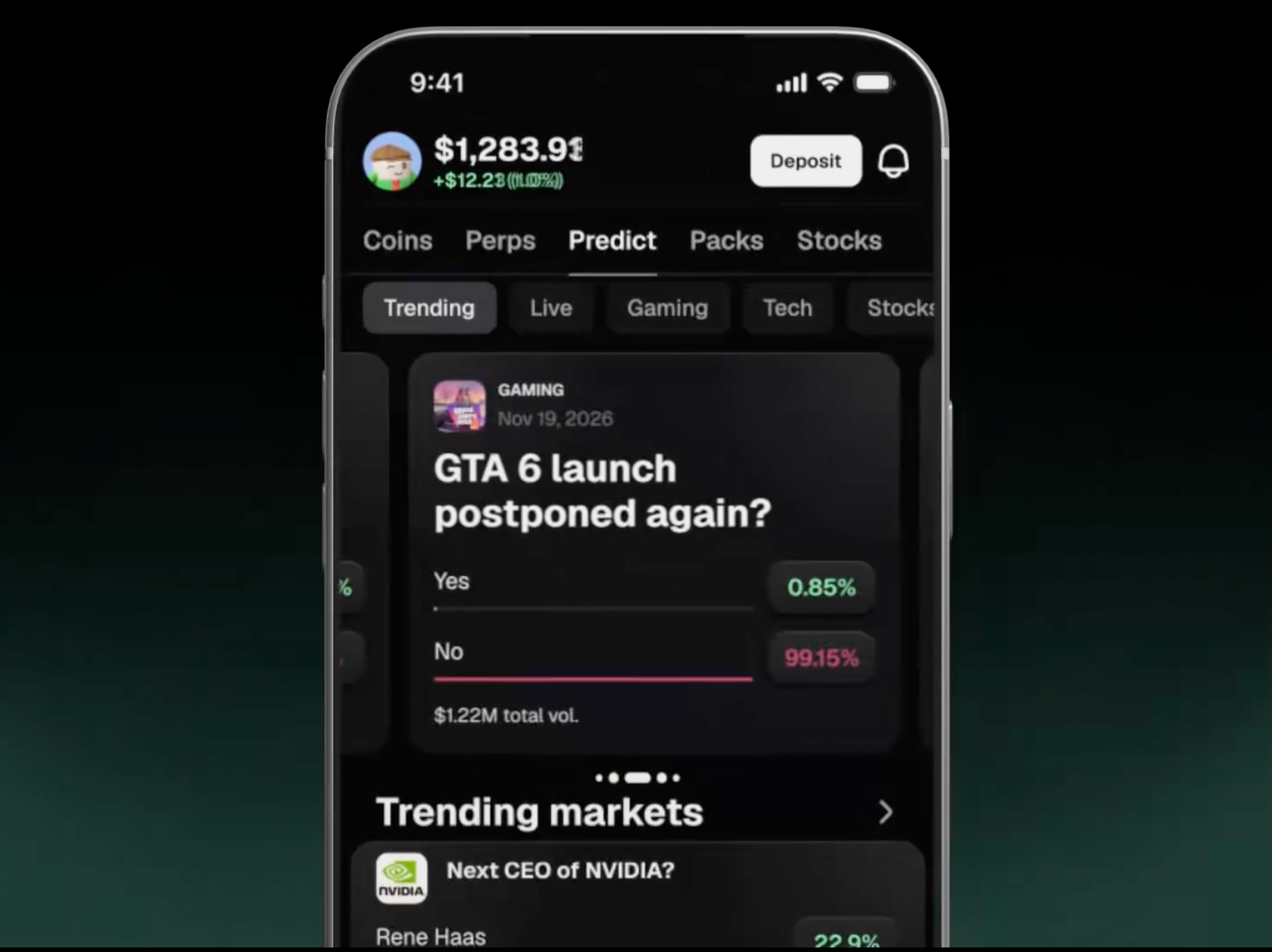
This update makes Pump.fun's expansion strategy far clearer. Its token issuance business has amassed a large base of traders, and the mobile app is steadily bringing perpetual contracts, tokenized stocks, collectibles, and event prediction products to these users. Pump.fun aims to extend its relationship with this user base: even when users drift away from meme coin cycles to follow sports matches, stock prices, or Bitcoin price movements, they can still execute all their trades within the same app.
From Token Issuance to Market Aggregation
A review of Pump.fun's product lines reveals two parallel expansion tracks.
The first track centers on its core token launch platform and PumpSwap, covering the full lifecycle of tokens from initial issuance to secondary circulation, with web interface, Terminal product, and mobile app serving as entry points for traders. This path builds on Pump.fun's proven core business: new token launches drive user attention, trading activity generates fee revenue, and the platform continuously iterates on order execution tools and asset discovery features.
The second track leverages third-party products to expand its tradable asset categories. It integrates Hyperliquid for perpetual contract trading; its tokenized stock feature allows users to buy and sell tokenized equities on Robinhood Chain directly in the app; Packs, supplied by third-party vendors, offer digital card packs where users unbox to obtain tokens representing physical collectibles, which can be sold or redeemed for physical items per platform rules. The newly added Polymarket integration further turns topics like sports and global events into tradable assets.
The markets, underlying assets, and operators behind these products are highly diverse, and Pump.fun’s core role is to onboard these offerings to its existing user base. This expansion model cuts down the heavy lift of building new markets from scratch, and shifts the app's competitive focus to user experience and trader community connectivity: why would users choose to enter these markets through Pump.fun, and what would make them return?
Alon’s answer leans heavily on social functionality. He noted in the announcement that new users can connect with traders across different asset classes, while existing users can discover opportunities in other markets through this integration. Facilitating cross-flow of users across different markets is a top priority for the team going forward.
Using Callouts to Bring Perspectives to New Markets
Prediction markets have a natural, direct connection to Pump.fun’s existing social features. Users form a judgment on a sports match or specific event, purchase the corresponding prediction contracts, and share their perspective via a Callout post, which other users can follow to navigate directly to the relevant market.
Pump.fun has included prediction trading in its callout reward program, giving users extra incentive to post their market perspectives. Eligible prediction-related Callouts qualify for bonus multipliers under the Diamond reward mechanism. The platform has not yet published the full calculation formula for prediction-related rewards, nor has it committed to fixed bonus payouts tied to prediction accuracy.
This arrangement helps new product categories gain initial traction via content and user attention at launch. Existing traders can bring their followers to the prediction market, while sports and event-focused traders can also enter Pump.fun's broader user network via content. The platform is aiming to embed the full user journey of "reading market perspectives → locating relevant markets → executing trades" within a single ecosystem. While rewards can drive initial trial, long-term user retention will depend on content quality and actual trading experience.
Prediction markets also come with specific usage requirements. The new feature is only available to users in eligible jurisdictions, with restricted access for users in regions including the U.S., the UK, and France. Per the platform's terms, event contracts and trading collateral are held in Polymarket wallets on the Polygon network, while market rules and outcome resolution are managed by Polymarket and its associated mechanisms. Users transferring funds from networks like Solana also need to complete cross-chain swaps. As a result, Pump.fun needs to make these steps, which differ significantly from its native token trading flow, as frictionless as possible for users.
Product Expansion: Is Revenue Keeping Pace?
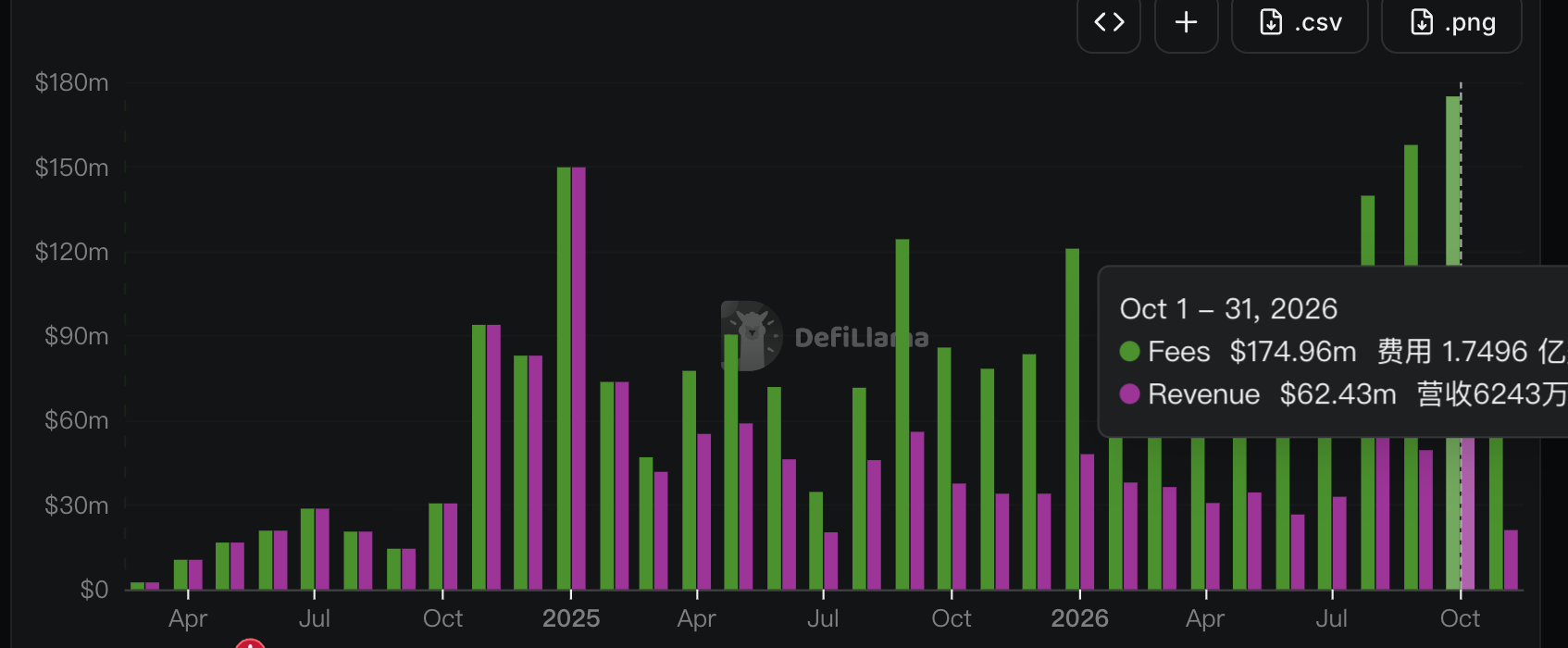
The revenue breakdown shows core existing businesses still contribute the majority of revenue. Per DefiLlama’s statistical metrics, total protocol revenue across Pump’s business lines reached approximately $62.43 million in October, of which the core token launch platform contributed around $44.46 million. In the first 16 days of November, total cross-business revenue stood at roughly $21.02 million, with the token launch platform generating $14.96 million of that. Average daily revenue for both segments dropped by around 35% month-over-month compared to October. The token launch platform made up roughly 71% of total revenue in both time periods, with its revenue scope also including on-platform web trading fees and other income streams.
The total value of fees paid by users is significantly higher than the revenue the platform retains. In October, Pump’s business lines collected a total of roughly $175 million in user fees, of which approximately 36% was counted as protocol revenue. As PumpSwap’s trading volume grows, and mechanisms like creator revenue share are rolled out, an increasing share of fees is allocated to participants such as liquidity providers and token creators, widening the gap between total collected fees and recorded protocol revenue. PumpSwap alone accounted for around 83% of this gap for the month.
Fee structures for different new product categories also vary. When users trade Hyperliquid perpetual contracts via Pump.fun, the platform charges a 0.05% fee on the notional value of each contract trade, which drops to 0.045% for users with a referral code. The fee is applied to both actively opened and closed positions. For Packs, fees are charged when users purchase card packs or actively sell collectibles, set at 0.45% of the pack price or sale proceeds, reduced to 0.40% for referral code users. For Polymarket event contracts traded through the new entry point, Pump.fun currently charges no proprietary trading fee, though users are still responsible for applicable Polymarket fees, network gas fees, and cross-chain swap fees.
For now, the more immediate value of the prediction market integration is expanding the app's use cases. Pump.fun has already proven its ability to gather traders around meme coins. Its next test is how far these user relationships can extend: whether users who follow meme coins will continue to trade other asset categories, whether users coming for event and sports content will stay on the app, and whether these diverse demands can gradually develop into stable, sustainable business lines.