
Fund flow paths and core permission questions surrounding the Lighter security incident.
Written by KarenZ, Foresight News
An attacker obtained the API key for a Lighter trading account, only to find they held no permission to directly transfer funds out of the account.
By all accounts, the exploit should have stopped there.
But in the security incident that hit decentralized perpetual contract trading platform Lighter on November 16, the attacker appeared to have found an alternative route: first close all open trading positions, then create a public pool, transfer funds from the victimized account into the pool, and finally complete the fund transfer by redeeming pool shares.
The permission controls originally designed to restrict outbound fund transfers may have been bypassed through a sequence of legitimate product functions.
According to analysis from the Korean crypto community relayed by 0xTria, founder of arb.sh, the incident involved two large market maker accounts on Lighter, with total affected funds reaching approximately 15.48 million USDC. The attacker is suspected of transferring assets by leveraging the leaked API key and the platform’s internal account mechanism, rather than directly targeting Lighter’s smart contracts.
Lighter’s latest investigation has confirmed the most critical detail of the incident: the event was triggered by an API key leak from a specific trader account, rather than an attack on the protocol or its underlying smart contracts.
Lighter’s latest statement has gradually clarified the root cause of the incident. But how exactly the attacker used an API key without direct outbound transfer permissions to pull off a tens-of-millions-of-dollars-scale fund transfer remains the most notable question surrounding the whole event.
Affected by the security incident, the price of Lighter’s native token LIT dropped sharply in a short period, posting a 24-hour decline of over 12% to trade at around $2.6 at press time.
No Withdrawal Permissions: How Were $15.5 Million Drained?
The incident first caught the market’s attention when an abnormally large USDC withdrawal was detected.
According to on-chain analyst MLM’s monitoring data, a previously low-activity address withdrew approximately 10.39 million USDC from Lighter, and quickly swapped the assets for ETH via CoW Protocol.
Subsequently, 0xTria shared analysis from a Korean trader on the incident, noting that the attack likely involved API key leaks from two large market maker accounts, rather than a flaw in Lighter’s core protocol itself.
Per this analysis, the two affected accounts are #714710 and #714723, with approximately 10.39 million USDC and 5.09 million USDC tied to them respectively, totaling around 15.48 million USDC.
It should be noted that Lighter’s latest statement confirmed an API key leak from a specific trader account, but did not verify the ownership of the two accounts cited by third parties, nor did it publish the estimated loss figure of around $15.48 million. As such, the reported number of affected accounts and total loss amount remain preliminary findings from third-party analysis.
So why would an API key leak lead to such massive fund losses?
For market makers and quantitative trading firms, API keys are an indispensable tool for automated trading. Trading programs can place orders, cancel orders, and adjust positions via APIs, without requiring manual operation from traders.
Per Lighter’s official documentation, standard API keys are authorized to execute transfers between accounts owned by the same user; transfers to accounts owned by other parties require an additional wallet signature. While secure withdrawals can be initiated using only an API key, the withdrawal destination can only be the account owner’s own L1 address.
As a result, the permission restriction here can be interpreted as: An API key alone cannot be used to directly transfer funds to an account owned by a different party.
According to the analysis relayed by 0xTria, The attacker exactly exploited the connection between this permission system and the platform’s public pool mechanism.
First, the attacker is suspected of using the compromised API permissions of the victim account to close all existing trading positions, releasing the margin reserved for trading operations.
Subsequently, the attacker used the victim account to create a 0% fee public pool, and deposited around $10,000 into the pool via an account under their own control, securing approximately 99.99% of the pool’s total shares.
It is worth explaining what exactly Lighter’s public pool mechanism entails. Per Lighter’s official whitepaper, a public pool is a special type of trading sub-account. The pool can execute trading strategies, while other users can deposit funds to purchase pool shares, and share trading profits and losses proportional to their held shares.
Put in simple terms, it is similar to a trading strategy account that allows other investors to participate. Who created the pool, and who owns the shares in the pool, are two distinct concepts.
Per the analysis relayed by 0xTria, while the attacker used the victim account to create the pool, they acquired the vast majority of pool shares through their own deposit.
This is where the critical step took place. The attacker is suspected of leveraging the victim account’s internal transfer permission to move USDC from the account into the pool in batches of around $1 million each, then cashing out the assets by redeeming the pool shares they controlled.
Why is this path potentially feasible?
According to 0xTria’s relayed information, Lighter’s trading API cannot directly transfer funds to other users, but internal transfers between accounts linked to the same L1 address may not require an additional signature. The public pool created by the victim account is also treated as an associated account under the platform’s account system.
From the author’s perspective, if the above analysis is accurate, the core of the issue may lie in the fact that internal transfers and pool share subscriptions are treated as two separate operation types. When the attacker moved USDC from the victim account to the public pool, the system may have only recognized the action as a balance transfer between associated accounts, rather than a formal pool share subscription, and therefore did not mint new pool shares for the victim account.
As a result, the total assets in the pool increased, but the vast majority of shares held by the attacker were not diluted, leading to a corresponding rise in the asset value tied to those shares. This would allow the attacker to access funds originally belonging to the victim account by redeeming their shares.
That said, this mechanism remains an inference based on the attack path described by 0xTria. Lighter has not yet disclosed specific technical details on whether internal transfers trigger the minting of pool shares.
Where Did the Funds Go? The Attacker Attempted Additional Withdrawals
0xTria’s early relayed analysis listed two affected accounts: #714710 with approximately $10.39 million tied to it, and #714723 with around $5.09 million. When rounded, these two figures add up to approximately $15.48 million, which matches the widely circulated estimate of “around $15.5 million in losses”. 0xTria later mentioned a total loss of around $17.5 million, but did not provide additional breakdowns or explain the discrepancy between the two figures.
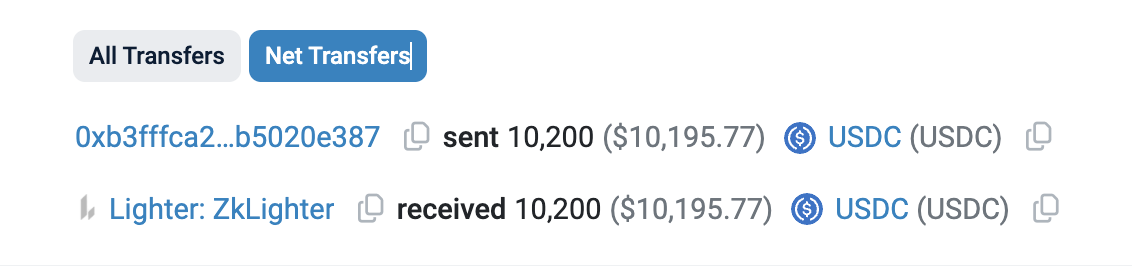
On-chain records show that at 17:35:11 Beijing time on November 16, the relevant address deposited 10,200 USDC to Lighter via Relay, which was credited to the account #769455 linked to the address.
At 18:11:47, the address called the withdrawPendingBalance function in Lighter’s main contract to claim pending funds, receiving approximately 10.3931 million USDC — around 36 minutes after the earlier deposit.

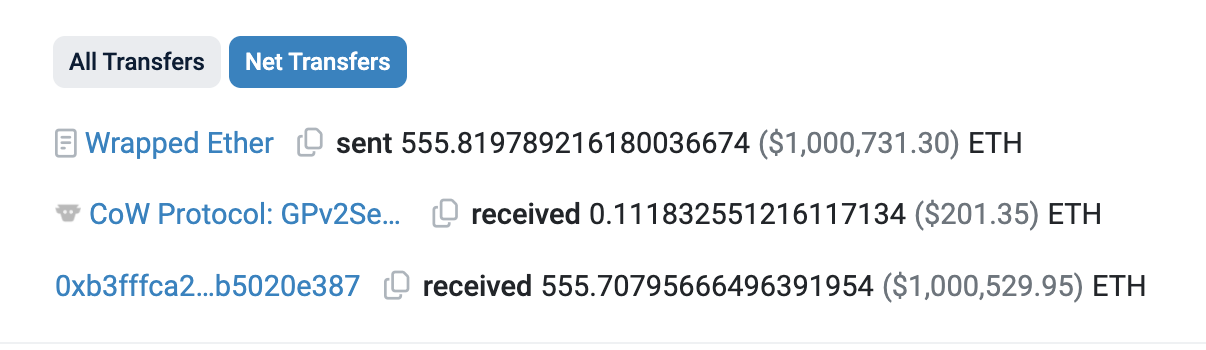
Between 18:13 and 18:17, the address completed five separate trades on CoW Protocol, swapping 10.36 million USDC for approximately 5,751.63 ETH/WETH.
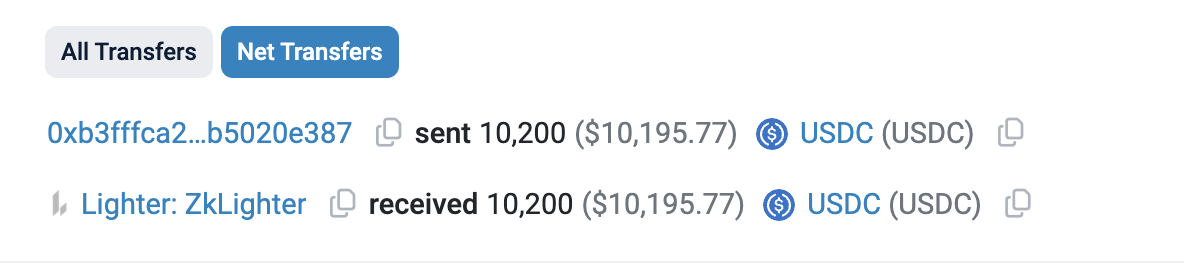
Two additional operations followed: at 18:21:35, the address deposited another 10,200 USDC to Lighter, which was also credited to account #769455.
At 18:46:23, the address swapped an additional 23,200 USDC for 12.84 ETH.
Across all six swaps, the address spent a total of 10,383,182.629682 USDC, receiving approximately 5,764.470028 ETH/WETH in return.
The funds were later split across multiple addresses. Per Bubblemaps’ tracking, a portion of the funds was transferred to Hyperliquid and converted to XMR1, which is wrapped Monero.
As for the identity of the victim, 0xTria suspects the affected accounts belong to Abraxas Capital, based on evidence that the initial funding for one of the compromised accounts came from a Hyperliquid wallet linked to the firm.
Lighter Was Not Breached, But Does That Mean No Security Issues Exist?
Lighter’s latest response attributed the incident to a trader API key leak, and stated that the protocol and its smart contracts were not compromised. This is the official current investigation conclusion, which still requires more complete evidence from follow-up technical reviews.
This conclusion also raises another question: why is it possible for a key without direct outbound transfer permissions to facilitate the transfer of value via the public pool mechanism?
If the third-party account of events is eventually verified, the core issue lies in the intersection of the two permission rules: internal transfers are validated based on account ownership, while pool redemptions are settled based on share holdings. When the nominal owner of a pool is different from the party holding the economic benefit of the pool, only checking whether a transfer goes to an owned account may not be sufficient to determine who ultimately claims the funds.
This does not mean a vulnerability in the contract code has been proven, but rather that security audits need to also cover the outcomes of combined function use cases.
Guardian Mode Activated: What Needs to Be Verified Next?
Lighter stated that it has activated Guardian Mode, under which the security committee will implement contract upgrades, prioritizing the recovery of funds involved in the attacker’s additional withdrawal attempt. Withdrawals remain temporarily suspended, with a goal to complete the upgrade and restore withdrawal services by the “end of the day” as stated in the official announcement.
Going forward, the first item to verify is the full list of affected funds: which assets have been transferred out, which are still in the withdrawal processing flow, and which have already been recovered.
Second, the full attack path needs to be disclosed publicly. Mainnet withdrawal transactions can prove that funds left Lighter, but cannot independently verify the preceding steps of position closing, pool creation, and share redemption. These gaps in evidence need to be filled by Lighter’s internal trading records and technical reports.
Finally, it is necessary to clarify what changes the contract upgrade introduces, and when withdrawal services will actually be restored. Only these concrete results can help users judge whether the risks have been brought under control.