
"Ethereum is going to be quite valuable."
Written by Eric, Foresight News
2017 marked the height of the roaring bull market across the cryptocurrency sector.
Jensen Huang, who has dominated front-page headlines across global media outlets in recent days, stated during Nvidia's earnings call that year: "Cryptocurrencies and blockchains are here to stay, and will grow to massive scale... GPUs are perfectly positioned to capitalize on this trend."
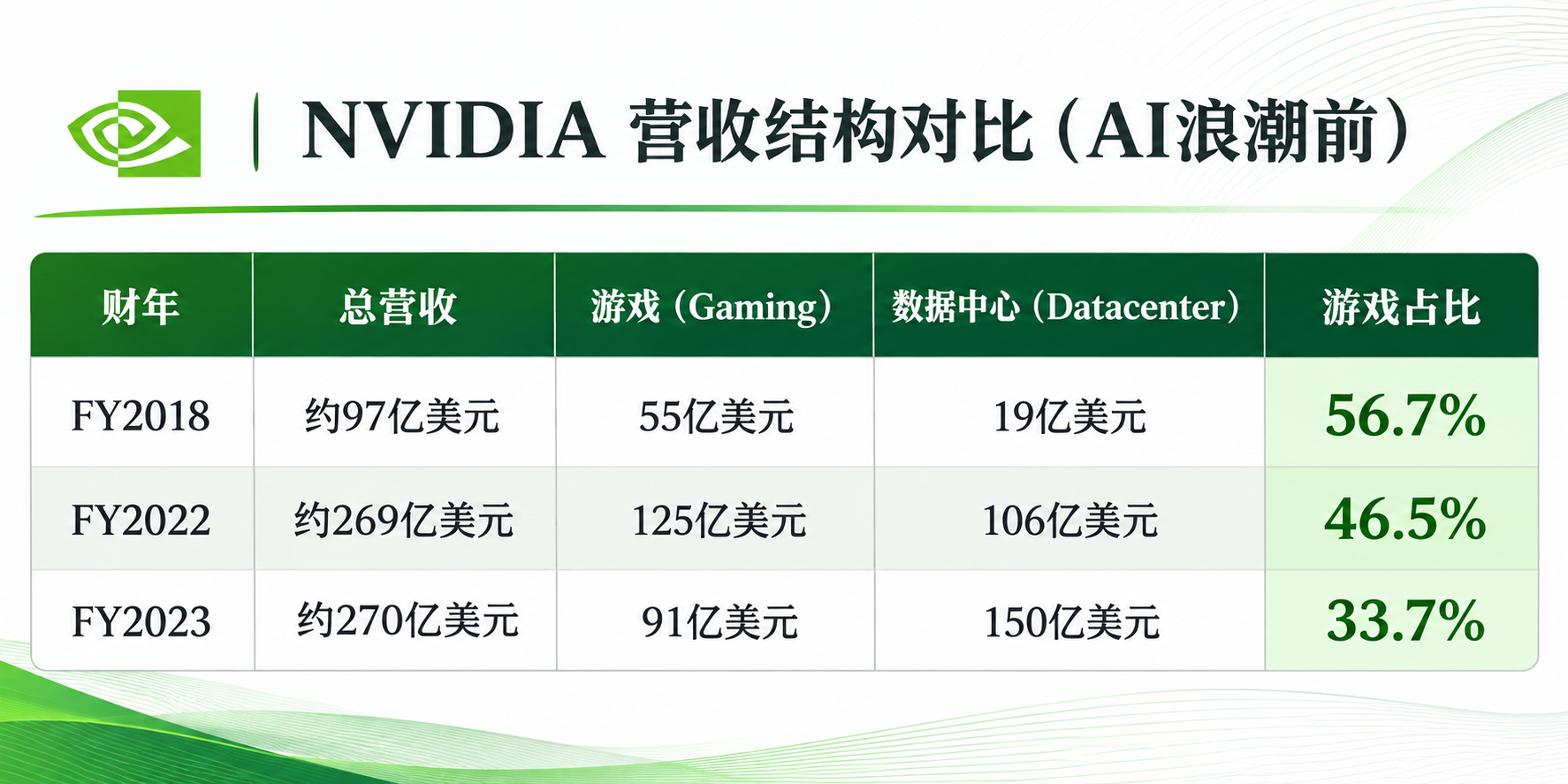
Per Nvidia's historical financial reports, it was not until 2023 that data center revenue from the company's chip business outpaced gaming revenue for the first time. Prior to that, gaming graphics cards and professional visualization tools remained Nvidia's core business lines. Even so, Ethereum mining, which made up a relatively small share of total revenue back then, repeatedly caused notable volatility in Nvidia's stock price.
The Ethereum Bear Market Wiped Out $20 Billion of Nvidia's Market Cap
In March 2018, shortly after Jensen Huang celebrated his 55th birthday, he appeared on CNBC's *Mad Money* program and echoed the remarks he made on the prior year's earnings call: "Cryptocurrencies are here to stay. The world will have a form of value exchange with extremely low friction and minimal costs, and this model will persist for the long term."
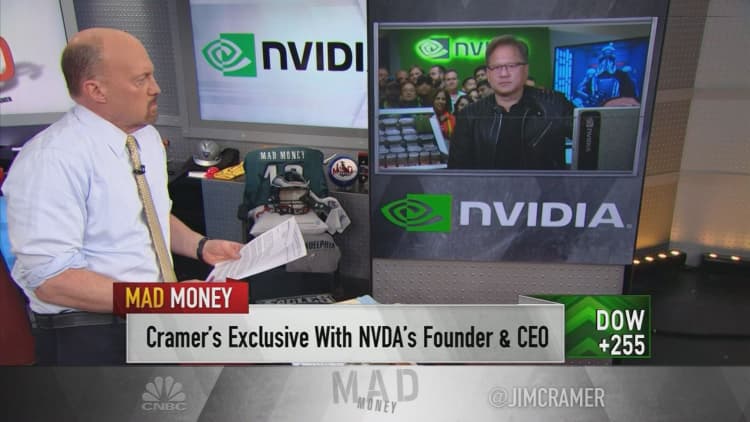
He added: "Blockchains are here to stay, and will emerge as an entirely new foundational form of computing. I expect blockchains and cryptocurrencies to become a key growth driver for GPUs."
Over those two years, the CEO of JPMorgan Chase publicly called Bitcoin a fraud, and noted the bank would fire employees who traded Bitcoin. Warren Buffett also repeatedly stated cryptocurrencies would meet a "terrible end". AMD, for its part, benefited to some degree from the mining business, but cautiously emphasized "mining will not be a long-term growth driver".
By today's metrics, Jensen Huang would rank as a "mini-Elon Musk" for his pro-crypto stances back then.
Benefiting from the rapid growth of its gaming and data center businesses, Nvidia's stock price surged 224% in 2016 and another 81% in 2017. But just as Jensen Huang was bracing for more upside from the cryptocurrency sector, a sharp downside shock arrived first. Cryptocurrency prices collapsed across the board in 2018: Bitcoin fell from nearly $20,000 to less than $4,000, while Ethereum plummeted from four-digit price levels back to double digits.
In August 2018, Nvidia released its mid-year financial report, showing revenue from crypto-related products plummeted to just $18 million from the $289 million recorded in the prior quarter. The company explicitly stated crypto-related contributions would be negligible for the second half of the year, and Nvidia's stock dropped roughly 5% in after-hours trading. In November of the same year, Nvidia released its Q3 earnings report, posting quarterly revenue that missed market expectations. More critically, the company issued guidance for the next quarter that came in far below Wall Street forecasts (approximately $2.7 billion, versus the $3.4 billion expected by analysts). On the earnings call, Jensen Huang explicitly attributed the miss to a "crypto hangover" that lasted longer and proved more severe than anticipated.
On the first trading day after the earnings report was released, Nvidia's stock fell by as much as 19% from the previous close. A mining business that contributed only a single-digit share of total revenue ended up wiping more than $20 billion off Nvidia's market capitalization in a single trading day.
From "It's All in the Past" to Dedicated Mining Hardware
In March 2019, during a press conference in Tel Aviv, the capital of Israel, Jensen Huang sought to draw a clear line between Nvidia and the cryptocurrency sector. He told reporters that Nvidia "never planned for cryptocurrencies; they came to us, and this phenomenon is now in the past." He acknowledged that crypto technology had inherent value to some extent, even expressing hope that the blockchain ecosystem would eventually shift to lower-compute-intensity algorithms, so that GPUs would no longer be the go-to hardware for crypto miners.
It was clear Jensen Huang had been burned badly by the extreme volatility of the crypto market. But just two years later, the trend reversed once again.
Starting in the second half of 2020, Ethereum prices skyrocketed, and Nvidia's gaming graphics cards once again became a high-demand commodity for miners. Demand for the RTX 30 series was so high that cards were effectively unobtainable, with gamers complaining they were priced out of the market. At the time, it was common to see news stories of entire internet cafes being rented out en masse exclusively for Ethereum mining. Yet lingering supply chain shocks from the prior bear market made it difficult for miners to source large volumes of hardware at stable prices, leading to skyrocketing retail prices and persistent stockouts on e-commerce platforms. Gamers either had no access to graphics cards, or ended up purchasing used "mining cards" that had been run to their limits by crypto operations. Social media was flooded with anger directed at Nvidia.
Jensen Huang realized simply pretending the crypto sector did not exist would no longer solve the problem. In February 2021, Nvidia officially launched the Cryptocurrency Mining Processor, or CMP series. These units were built exclusively for professional mining: they featured no video output ports, were optimized for airflow, and supported high-density deployments of multiple cards per rig.
This move was not necessarily a sign of Nvidia reconciling with the crypto sector, but rather an effort to avoid disruptions to its core business. Proof of this intent came in Nvidia's driver-level restrictions for the RTX 3060, where the company implemented the LHR mechanism to roughly halve the card's Ethereum mining hash rate, seeking to technically separate gamers and miners into two distinct hardware channels.
At that point, a single policy change from Jensen Huang was enough to send ripples across the Ethereum mining community. While Bitmain sold dedicated Ethereum mining rigs at the time, and AMD's graphics cards even delivered higher mining efficiency, Nvidia's hardware remained the top choice for miners thanks to its reliable supply chain and consistent product stability.
Market reaction to the CMP line was initially strong. In the first quarter of fiscal 2021, revenue from the CMP series exceeded $155 million. Nvidia optimistically projected CMP revenue would reach $400 million in the following quarter, though the company fell short of that target, posting actual CMP revenue of roughly $266 million in Q2. By Q3, that figure dropped instead of climbing, coming in at $105 million.
Across the entire product cycle, the CMP line generated roughly $526 million in total revenue for Nvidia. Canadian crypto miner Hut 8, for example, placed a $30 million order for CMP equipment from Nvidia. Later in the product cycle, Nvidia even launched the higher-end CMP 170HX, which delivered roughly 164 MH/s of Ethereum mining hash rate and was priced at over $4,000. However, supply of this model was extremely limited, making it more of an experimental product targeted at top-tier mining operations.
Along with the launch of its dedicated mining hardware, Jensen Huang’s stance on crypto shifted 180 degrees once again. During an interview with VentureBeat at Computex 2021, he gave an enthusiastic positive response when asked if he was excited about Ethereum's upcoming shift to Proof of Stake (PoS). In his view, Ethereum had already established itself as a reliable, trusted network, with a wide range of applications including DeFi running on its infrastructure, making the transition to PoS a natural evolutionary upgrade.
He noted Ethereum held significant long-term value, with the potential for drastically improved transaction throughput, and made no secret of his view that cryptocurrencies were here to stay. He added that while the hype around Ethereum might cool down a year later, crypto mining as an activity would not disappear. He also argued that Ethereum chose to run on GPUs because GPUs formed the world's largest programmable distributed supercomputer network.
In September 2022, the long-awaited Ethereum Merge that Jensen Huang had expressed excitement for was completed, and demand for GPU mining hardware collapsed overnight. Mining operations across the world shut down, and massive volumes of used graphics cards flooded the market, flipping the prior shortage of cards into a situation of oversaturated inventory. Nvidia's CFO was forced to acknowledge in subsequent earnings reports that the Ethereum Merge had negatively impacted demand for some of the company's products.
But starting in 2022, Nvidia's data center business had gradually grown into its core revenue driver, so the phase-out of its mining-related products had little material impact on the company. It was after this point that Nvidia formally parted ways with the crypto sector.
AI and Crypto
If not for the recent controversies surrounding Jensen Huang, we might well have seen a third reversal in Nvidia's stance on crypto in the future.
x402-based payments powered by stablecoins are now widely recognized as the best current solution for AI Agent payments, and "AI+Crypto" projects have carved out a solid niche in the current Web3 market. This March, at the NVIDIA GTC 2026 conference, All-In Podcast host Chamath Palihapitiya asked Jensen Huang for his take on Bittensor, which trains low-parameter large language models using distributed compute power. Huang responded that Bittensor is a modern iteration of "Folding@home", noting that open-source, decentralized models and closed-source models are complementary, akin to "A and B".
Jensen Huang's endorsement sent the TAO token surging more than 20% in a short window. Many users on X commented that they never expected Jensen Huang himself to inadvertently shill a crypto project.
As AI continues to evolve, stablecoins or other cryptocurrencies may indeed become the medium of exchange between agents in the silicon-based era. Jensen Huang, who would have been well-positioned to elaborate on this vision, will likely no longer speak on such topics in his capacity as Nvidia CEO, or from a stage built by Nvidia, even if he gets the chance to revisit the subject in the future.