
Stablecoins have seen $14.2 billion in outflows over the past 30 days, a December rate hike by the Federal Reserve is all but certain, leaving bullish positions under mounting pressure.
Written by Ma He, Foresight News
BTC has remained under sustained selling pressure recently. According to market data from Bitget, after hitting a recent peak of $87,000 in late September this year, BTC has trended steadily lower, falling below key support levels of $80,000 and $76,000 in succession, even dipping to a recent low of $72,732. At present, Bitcoin is trading sideways around the $74,000 mark. ETH has also retraced all the way from its September high of $2,800 to $2,005, narrowly missing a break below the critical $2,000 support line.
In addition, MSCI will remove Strategy and Metaplanet from its global indices based on a new screening methodology for non-operating companies on November 12, with the adjustment taking effect on December 1. This move has also put considerable pressure on the market.
According to data from CoinMarketCap, the market is currently gripped by widespread panic sentiment.
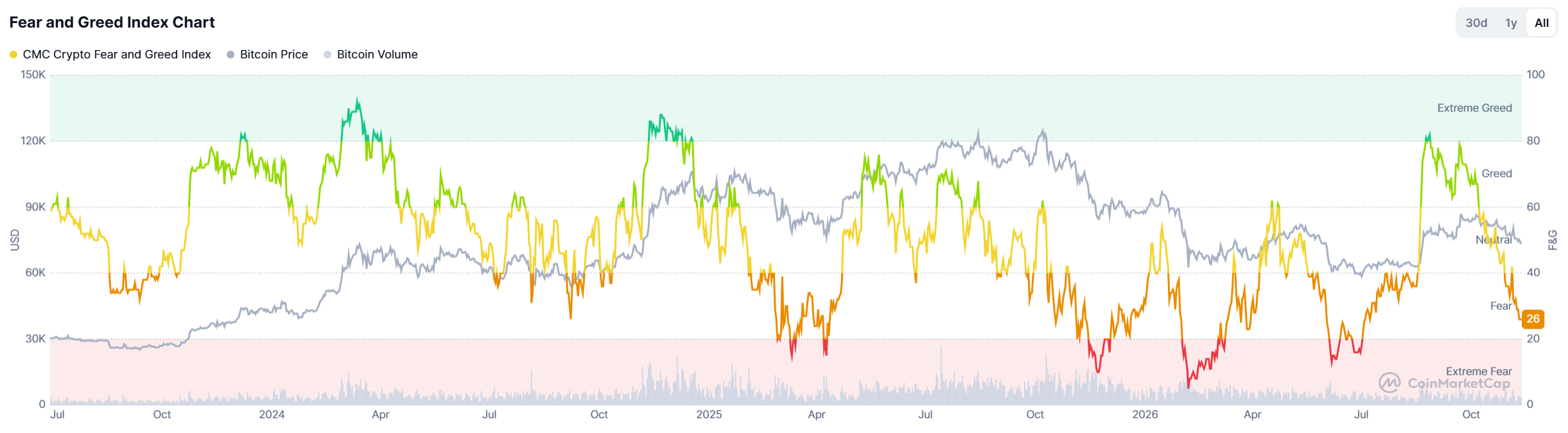
Why is the crypto market seeing feeble rebounds but steep, violent drawdowns?
Nasdaq Pullback and Jensen Huang's Personal Scandal
This sharp pullback in the crypto market is not an isolated event, but rather reflects severe macro-level co-movement with the U.S. tech sector, particularly the sudden black swan event in the AI space.
The Nasdaq entered a correction phase in early October this year, recording four consecutive weekly declines, which stoked concerns across the U.S. AI market.
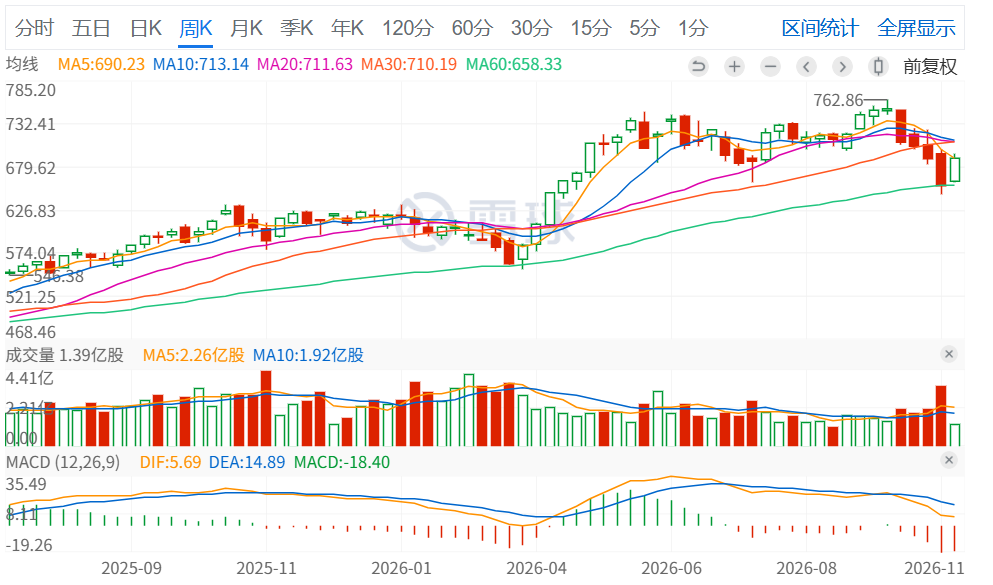
Weekly chart of the Nasdaq 100 Index ETF
Most recently, NVIDIA, the undisputed global bellwether for risk assets, was hit by a bombshell scandal.
NVIDIA founder and CEO Jensen Huang has admitted to an extramarital affair with a female executive (Alice Huang), and the NVIDIA board has urgently launched an independent review. More damagingly, as the company faces a class-action lawsuit from shareholders, The Wall Street Journal reported that the board is even considering removing Huang from his post, a move that caused NVIDIA's after-hours share price to plummet by as much as 8%!。(MISSING)
The personal ethics scandal of Jensen Huang, affectionately nicknamed the "Leather Jacket Guru", quickly escalated into systemic risk for the entire tech stock sector. Amid Wall Street's extreme concerns over national security risks and leadership instability at leading AI firms, panic spread rapidly across markets, triggering a new wave of tech stock selloffs.
As a high-beta correlated asset tracking the Nasdaq, BTC has become an ATM for institutional funds pulling capital out to seek safe havens.
Post-CPI Data: A December Fed Rate Hike Is All but Certain
The October U.S. CPI data released this week has reinforced market expectations for a December Federal Reserve rate hike. Headline CPI rose 0.4%! month-on-month in October, (MISSING) above the market forecast of 0.3%!; (MISSING) core CPI climbed 0.3%! month-on-month, (MISSING) also exceeding the expected 0.2%!. (MISSING) In the wake of the data release, traders' pricing for the magnitude of a rate hike at the December meeting has shifted notably to the right.
According to Polymarket data, as of November 12, market participants assign an 86%! (MISSING) probability of a 25-basis-point rate hike at the December Federal Reserve rate decision meeting, a roughly 10%! (MISSING) probability of a 50-basis-point or larger hike, and only around 3%! (MISSING) probability of rates remaining unchanged. The likelihood of a 50-basis-point hike was close to zero before the CPI release, but has risen rapidly since the data was published. A 25-basis-point hike remains the dominant market pricing scenario, but the possibility of a larger rate increase is now being factored in.
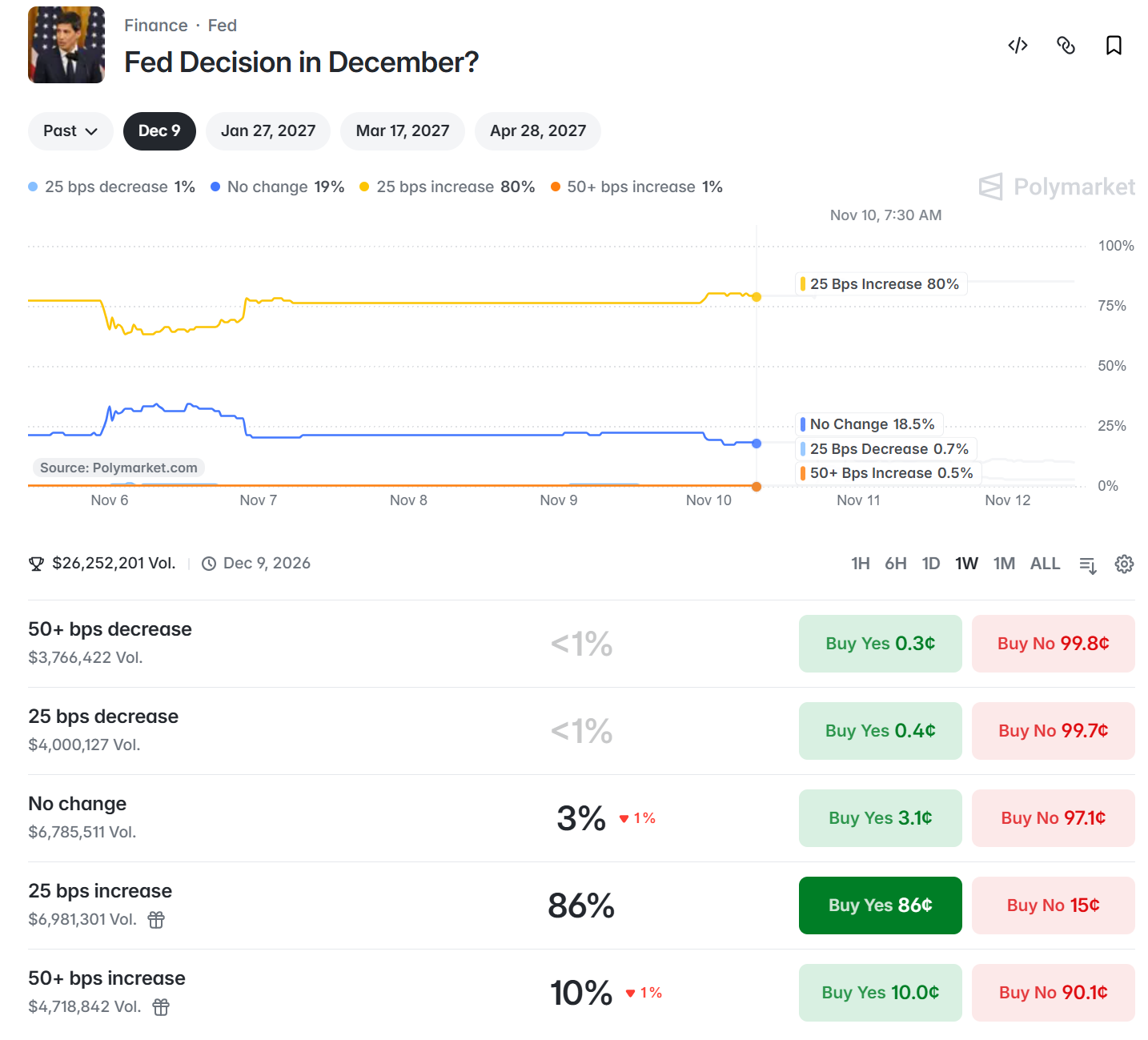
Federal Reserve Governor Christopher Waller previously stated that if the October core CPI reading came in at 0.3%! or (MISSING) higher, he would consider supporting a 50-basis-point rate hike at the December meeting. Following the release of the CPI data, the market's focus of discussion has shifted from "whether to hike rates" to "whether the hike will be 25 or 50 basis points". The current federal funds rate target range stands at 3.75%; a 25-basis-point hike would lift the range to 4.00%.
Rising rate hike expectations have put pressure on risk assets. U.S. Treasury yields have moved sharply higher after the CPI release, the U.S. dollar has strengthened, and equity markets have come under pressure. For the crypto market, higher interest rate expectations mean further tightening of liquidity conditions, and a corresponding decline in risk appetite. With stablecoin supply already contracting, if the Federal Reserve confirms its rate hike path in December, the incremental capital available for market deployment will become even more limited.
Stablecoin Supply Sees $14.2 Billion Outflow Over the Past 30 Days
The total market capitalization of stablecoins continues to decline. According to DefiLlama data, as of November 12, the total market cap of stablecoins across the market stood at roughly $286.9 billion, down 0.12%! (MISSING) from the previous day, down 1.47%! (MISSING) over the past 7 days, and down 4.82%! (MISSING) over the past 30 days.

Of this total, USDT's market cap is approximately $175.7 billion, accounting for 61.22%! of the stablecoin market; (MISSING) USDC's market cap is around $69.9 billion.
On-chain data provider Glassnode released a report on the same day showing that the combined supply of major stablecoins has dropped by $14.2 billion over the past 30 days, marking the largest monthly contraction since June 2022. Back then, the market experienced a nearly $30 billion 30-day supply contraction following the Terra collapse, after which Bitcoin fell to around $15,500 in November of that year.
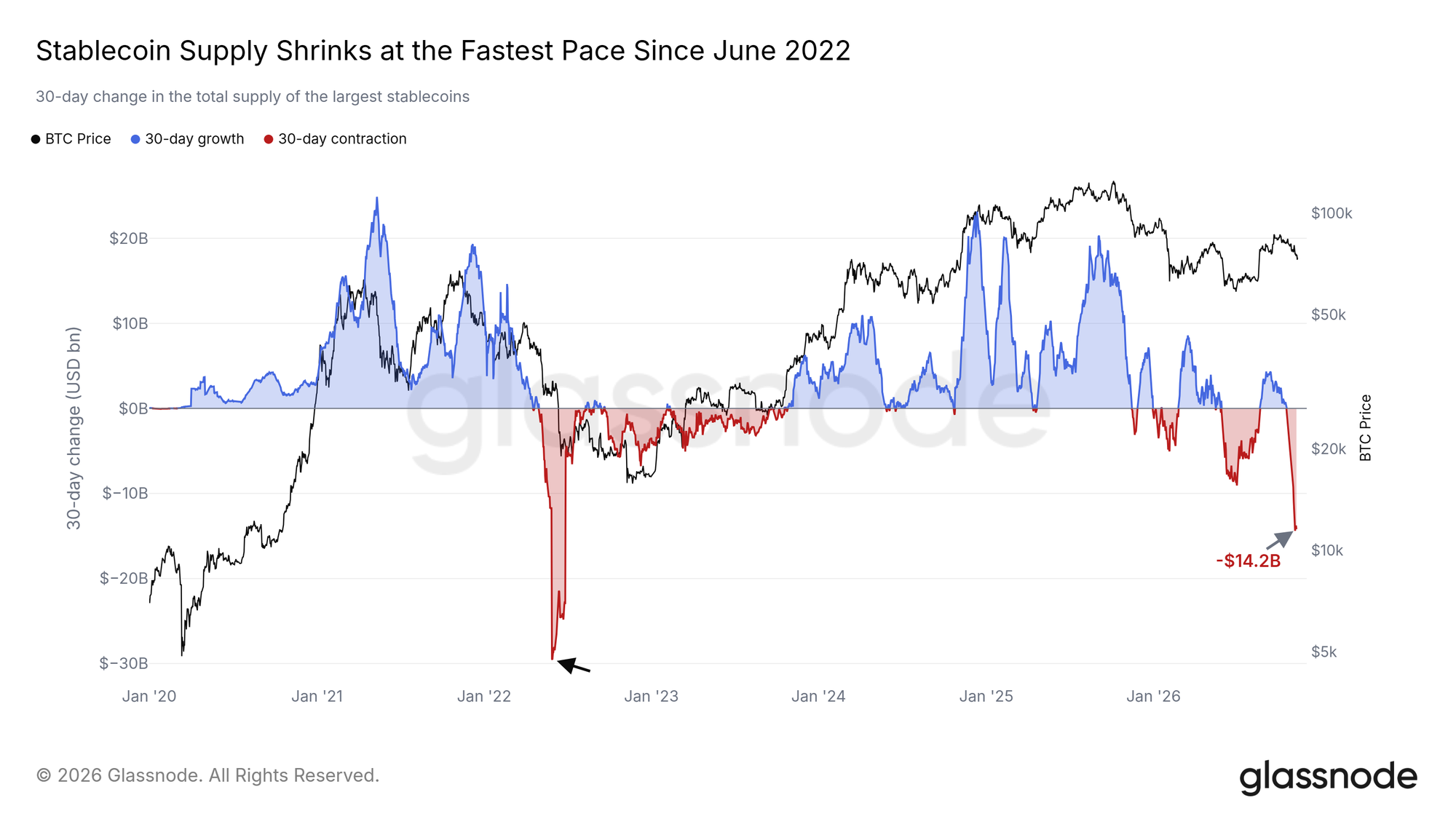
In its report, Glassnode noted that the supply decline indicates stablecoin holders are redeeming their holdings back to U.S. dollars and exiting the market, leaving less "fuel" available to drive a market rebound. At the same time, some smaller and mid-cap stablecoins are being redeemed at a faster pace, while a small number of tokens including RLUSD and USDe recorded modest growth, though the overall trend of net outflows remains unbroken.
The total supply of stablecoins has now fallen close to the $280 billion range, the lowest level since September 2025. Over a longer time horizon, stablecoin supply has contracted by a cumulative $21 billion to $23 billion since hitting a peak of roughly $315 billion in mid-May this year, representing a decline of nearly 7%!. (MISSING)
As the core settlement asset and primary source of liquidity for crypto trading, the ongoing contraction in stablecoin supply is moving in lockstep with pressure on spot prices and rising fear sentiment. In the absence of new stablecoin issuance and net inflows, the pool of U.S. dollar capital available for market deployment has narrowed further, weakening the incremental capital support needed to drive short-term rebounds.
Outlook for Price Action
Glassnode noted that BTC has now fallen below the $75,600 short-term holder cost basis (STH-CB). If price continues to break below $73,000, the market will enter a longer consolidation cycle.
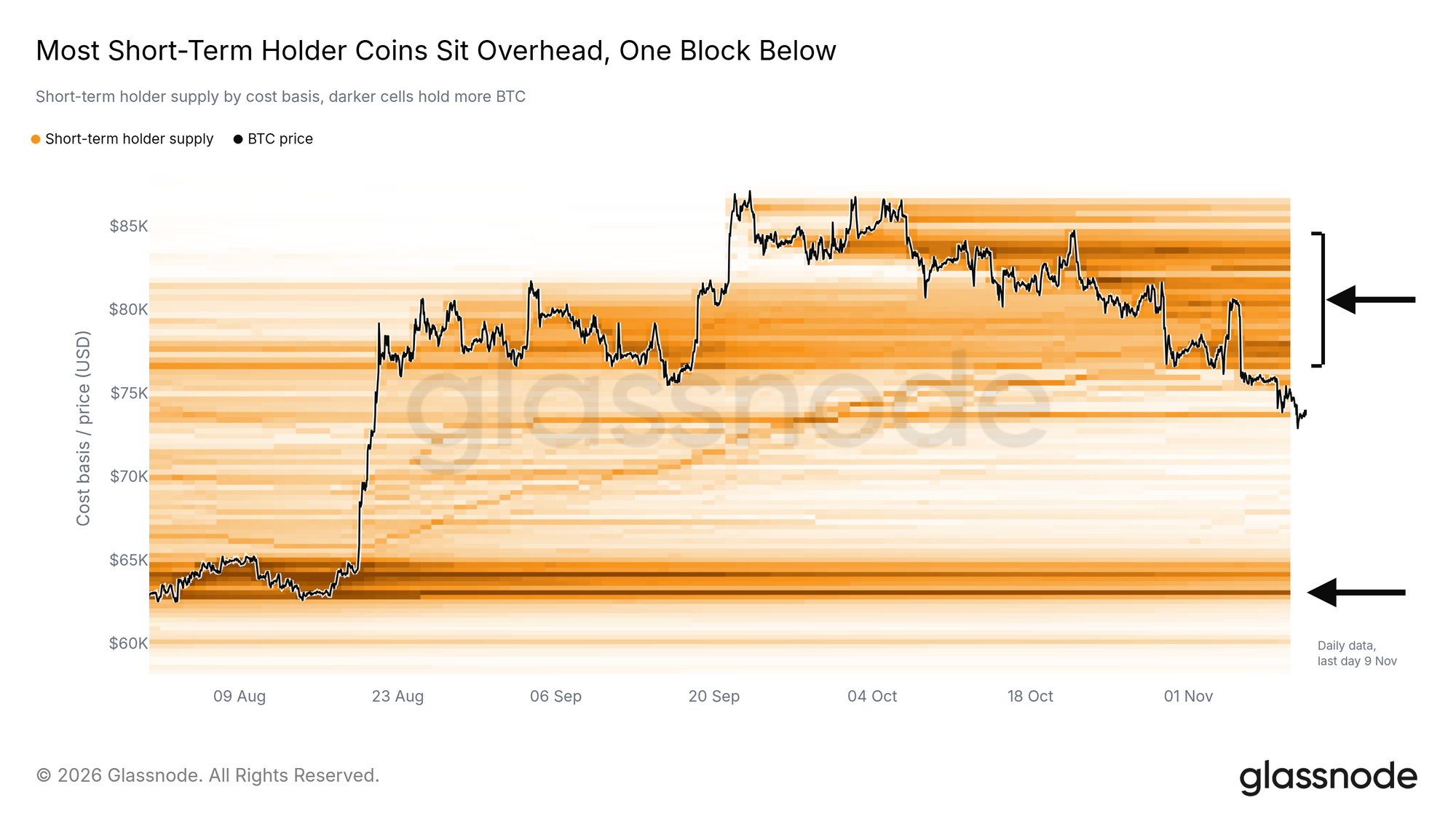
In addition, Glassnode stated that the largest cluster of Bitcoin liquidation levels is located near the $60,000 mark. These are long positions established by bulls ahead of the sharp price rally in early August, levels that price has yet to test.
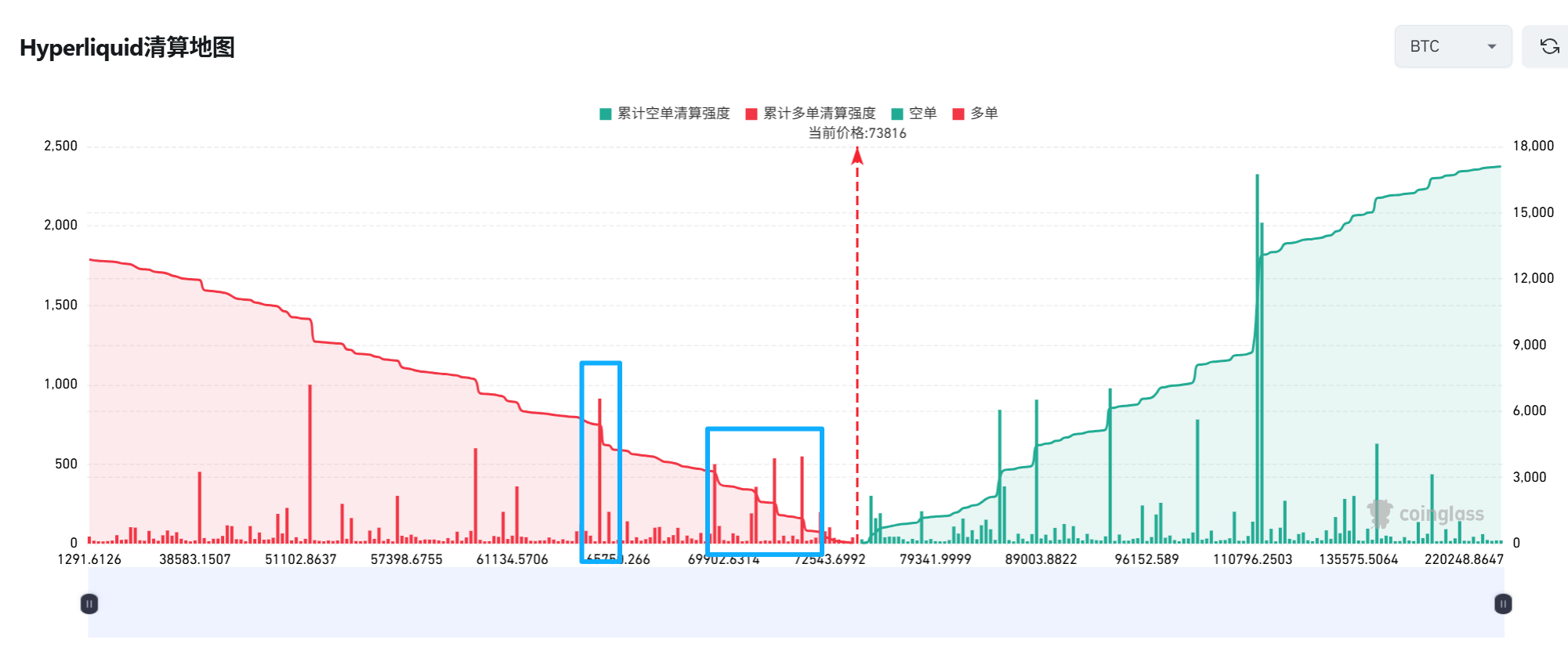
Liquidation charts from Hyperliquid show that large clusters of long positions are concentrated around the $70,000 and $65,000 levels for BTC. A break below these levels would trigger elevated liquidation intensity.
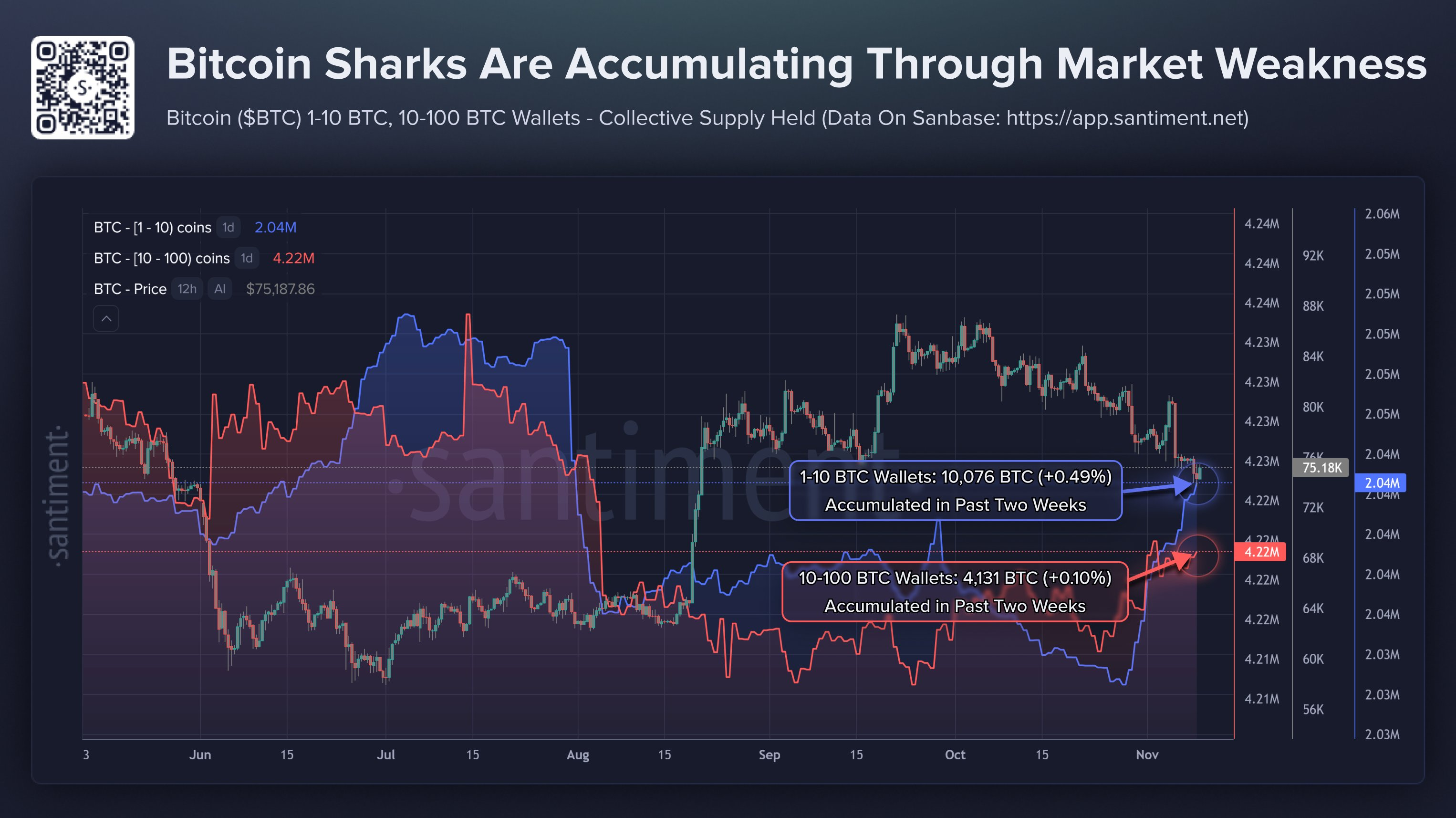
On November 10, on-chain analytics platform Santiment noted that wallets holding 1 to 10 BTC have accumulated 10,076 BTC over the past two weeks, while wallets holding 10 to 100 BTC added 4,131 BTC, for a combined increase of more than 14,000 BTC, during the period when Bitcoin price fell toward $75,000. "These types of wallets are generally more patient than retail investors, often accumulating positions during periods of market panic and selling after price rallies. If price stabilizes at $75,000 and these wallets continue to add to their holdings, it will strengthen the signal of a local bottom formation. If price breaks below the recent low and these wallets turn to sell, the signal will weaken."
On November 11, Santiment added that according to its analysis of social platforms including X, Reddit, and Telegram, the ratio of bullish to bearish comments for BTC, ETH, and XRP stood at 0.82:1, 0.88:1, and 0.49:1, respectively. Santiment believes that distinctly bearish retail sentiment may set the stage for a market rebound. If bearish comments continue to outnumber bullish ones, particularly among large-cap crypto assets, a market rally may be on the horizon.
Crypto market maker Wintermute noted in a post on November 10 that following the U.S. midterm elections, after Democrats regained control of both chambers of Congress, the market has begun reassessing the regulatory risks facing the AI industry, leading to a cooling of the AI trade that had been driven by favorable policy tailwinds from Washington. If the Federal Reserve raises rates during the correction in AI assets, tighter liquidity and falling risk appetite could simultaneously put pressure on the crypto market. U.S. spot Bitcoin ETFs recorded net outflows of $1.28 billion last week, the largest weekly outflow since June, erasing all year-to-date net inflows; only Wednesday saw positive net inflows for the entire week. At the same time, more than $1 billion worth of positions across the market were liquidated, with liquidation volumes for Ethereum exceeding those of Bitcoin.
Looking ahead, the market should remain cautious until Bitcoin reclaims the 50-week moving average. If Bitcoin closes below $73,000 on the daily chart, along with breaking below the 200-day moving average, the next key support level to watch is $68,000, and altcoins that saw sharp rallies in the prior cycle may face heavier selling pressure. A shift to a positive market outlook will only be possible if Bitcoin reclaims and stabilizes above $80,000 on the daily chart, while spot Bitcoin ETFs resume weekly net inflows.