
6 securities to be removed by MSCI under its non-operating company rule, while 4 firms including BNB Standard are newly added to the watchlist
Written by ChandlerZ, Foresight News
The long-running standoff between traditional financial index frameworks and crypto treasury models has finally reached a final verdict.
On November 12, MSCI, the world’s leading global stock index provider, officially released its final impact list for its Non-Operating Company rule. The listed giants set to be removed include Strategy (formerly MicroStrategy, famed for its massive bitcoin holdings), Japan’s self-styled “MicroStrategy-equivalent” Metaplanet, and Upexi, a firm with large Solana asset exposure. All related adjustments will take full effect after the U.S. market close on November 30.
Compared with the preliminary list released in early October, MSCI has expanded its review scope, bringing the total number of firms formally marked for removal to 6. An additional 4 listed companies focused on crypto tokens and emerging novel business models have been newly added to the watchlist, including the high-profile BNB treasury-focused listed entity BNB Standard.
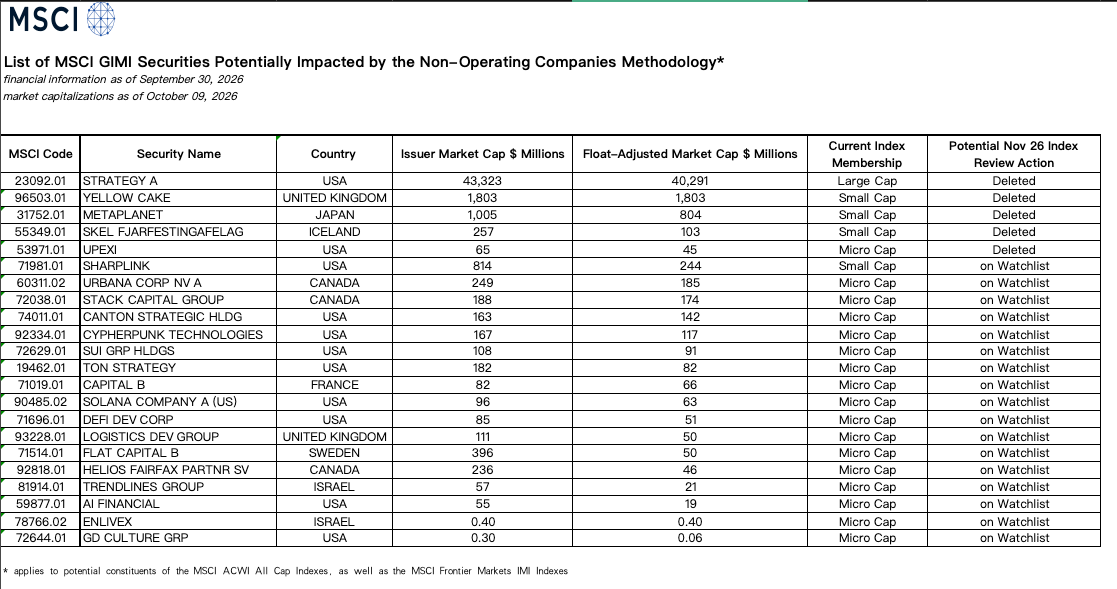
Meanwhile, two companies that previously appeared on the watchlist have dropped off the non-operating company list, only to be found on a separate removal roster for micro-cap stocks. This broader cleanout of fund-like, asset-holding U.S. listed firms under traditional index standards is quickly extending deeper into market segments.
6 Companies Facing Immediate Removal, as Strategy’s Challenge to Delisting Fails
As a financial services firm that builds global stock indices, MSCI’s benchmarks are used as investment references for a vast array of funds. Companies included in its indices receive capital allocations from funds tracking those indices; once removed, affected funds must adjust their positions accordingly.
The final list covers 25 securities in total, with 6 marked for removal and 19 placed on the watchlist. All 5 companies proposed for removal in the October preliminary list remain on the final removal roster.
- Crypto asset-focused firms: Strategy (MicroStrategy), Metaplanet (the Japan-based bitcoin treasury enterprise), and Upexi (a treasury firm with Solana and direct token exposure).
- Non-crypto asset-holding entities: Yellow Cake (a UK-based uranium investment firm), Skel Fjarfestingafelag (an Icelandic investment company), and Agronomics, a UK-based cellular agriculture technology investment firm which is the newly added 6th company on the final removal list.
MSCI’s review framework is not limited to the crypto sector, but crypto-linked firms are undoubtedly bearing the brunt of the impact.
Strategy is the largest company on the removal list. As of the U.S. market close on November 12 (Beijing Time), Strategy’s share price stood at $122.35, up 1.06% on the day, with a total market capitalization of approximately $51.7 billion. After MSCI published its final list, Strategy’s share price pulled back in after-hours trading, currently at $120.2, 1.76% lower than the regular session close. According to J.P. Morgan analysts’ estimates, once Strategy is fully removed from MSCI’s flagship stock indices, it is expected to trigger around $2.8 billion in capital outflows from passive index funds.
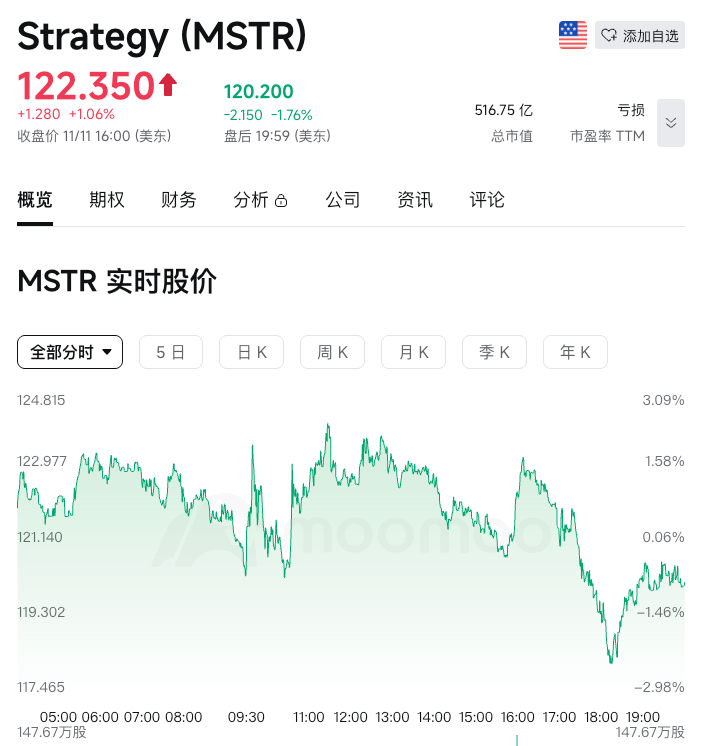
While the index adjustment does not require Strategy to sell the hundreds of thousands of bitcoin held in its treasury, it directly undermines the core liquidity flywheel that the company has built its business on: issuing shares and bonds to buy bitcoin, driving up share prices, and raising capital at a premium. Without the backstop of passive fund allocations, the valuation premium of Strategy’s stock and its refinancing costs are likely to face significant pressure.
Strategy had previously strongly opposed MSCI’s classification of it as a non-operating company, arguing that its bitcoin holdings business constitutes a core operating segment of the group, and claiming that traditional financial metrics fail to fairly evaluate its novel balance sheet model. But as the final ruling shows, MSCI has not yielded to the crypto leverage giant.
19 Companies Placed on Probationary Watchlist, as BNB Standard Leads 4 New Additions
Beyond the 6 securities marked for removal, another 19 securities are currently on the watchlist. Compared with the October preliminary list, MSCI has issued 4 new “yellow cards”, with the newly added entities including: BNB Standard, Streamex, APG Securities, and Quantum Solutions.
Among them, BNB Standard trades under the ticker BNC, and was formerly known as CEA Industries. The company allows investors to gain indirect exposure to BNB through its listed shares by holding BNB, while also operating retail and industrial equipment businesses.
Notably, BNB Standard (ticker: BNC), which holds BNB as its core reserve asset, has attracted particularly close market attention.
- The company, formerly CEA Industries, adopted the Strategy-style business model after its business transformation: it holds approximately 515,500 BNB through its listed entity (data as of the end of July), providing U.S. stock investors with spot BNB exposure free from compliance barriers.
- MSCI data shows that BNB Standard currently has a total market capitalization of around $220 million. Its inclusion on the watchlist means it has also entered the exclusion alert pool of traditional index providers, due to its heavy asset allocation to tokens and failure to meet operating cash flow requirements.
The other newly added firms on the watchlist operate in diverse sectors: U.S.-listed Streamex runs a commodity tokenization platform that has launched gold-linked tokenized products; Japan-listed Quantum Solutions operates businesses including AI computing power and gaming, and has previously run crypto asset treasury operations; APG Securities is a Vietnamese securities firm.
Companies that were already on the preliminary watchlist, including SharpLink, SUI Group Holdings, TON Strategy, Capital B, Solana Company, and DeFi Development Corp, remain on the final watchlist.
Other companies remaining on the watchlist include Urbana, Stack Capital Group, Canton Strategic Holdings, Cypherpunk Technologies, Logistics Development Group, Flat Capital, Helios Fairfax Partners, Trendlines Group, and AI Financial. Combined with the 6 aforementioned firms, a total of 15 companies have appeared on both versions of the watchlist.
Under MSCI’s new rules, companies first undergo an operating asset screening process. Failing firms then move on to a five-metric financial ratio screening: if at least four metrics trigger exclusion thresholds, the company may lose index inclusion eligibility. For existing index constituents, MSCI only removes a firm under this rule if it fails the screening for two consecutive annual reporting periods; firms that have not yet met removal criteria may be placed on the watchlist.
Previously, MSCI had implemented temporary measures for companies where digital assets account for at least 50% of total assets, restricting partial index weight adjustments for related securities. These temporary measures will be phased out as the new rules are implemented during the November index review cycle.
Why Did Two Shell Companies End Up on the Micro-Cap Removal List Instead?
A little-noticed detail in this latest list update is that two companies have mysteriously dropped off the non-operating company list — but this is not because they proved their eligibility and escaped removal.
The two firms are Enlivex, a biotech and prediction market token concept stock, and GD Culture Group, a NASDAQ-listed Chinese concept stock that had previously disclosed a bitcoin treasury plan. Both were on the watchlist during the October preliminary review, but were removed from the November final non-operating company list.
But a cross-check with the adjustment roster for MSCI’s Global Micro Cap Indexes, released on the same day, shows that Enlivex will be directly removed from the MSCI Israel Micro Cap Index, while GD Culture Group will be directly delisted from the MSCI United States Micro Cap Index.
MSCI did not explain the cross-listing logic across the two reports, but the reason is clear when reviewing the fundamentals of the two firms. Enlivex had previously received a NASDAQ delisting warning and was forced to conduct a 1-for-16 reverse stock split, while GD Culture has long faced extremely low liquidity and regulatory scrutiny. The most likely reason for their removal from the non-operating company watchlist is that their micro-cap market size or listed compliance status had already fallen below the minimum eligibility threshold for inclusion in micro-cap indices, meaning they lost basic index eligibility entirely before the non-operating company screening process could be applied.
Conclusion
From earlier temporary weight limits for crypto-linked firms, to the full implementation of the non-operating company rule at the end of November, traditional financial indices have reached a final reckoning with listed companies that have abandoned real business operations and turned into crypto-hoarding fund-like vehicles.
MSCI’s core rationale is straightforward: stock indices are tools for price discovery for the real economy and genuinely operating enterprises, not ATMs to provide passive incremental capital for closed-end token trusts with no real operating business.
As the November 30 implementation date approaches, the actual impact of passive capital outflows from Strategy will face its first real test. Meanwhile, the 19 treasury concept stocks on the watchlist, with exposure to BTC, BNB, SOL, TON, and SUI, have officially entered the countdown to potential index exclusion.