
6 securities will be removed by MSCI under its non-operating company rules, while 4 firms including BNB Standard are newly added to the watchlist
Written by ChandlerZ, Foresight News
The showdown between traditional financial index rules and the crypto treasury model has finally reached a final verdict.
On November 12, MSCI (Morgan Stanley Capital International), the world's leading global equity index provider, officially released its "Final Impact List of Non-Operating Companies". Listed giant Strategy (formerly MicroStrategy), which is famous for holding a large amount of Bitcoin, Japan's "MicroStrategy-equivalent" Metaplanet, and Upexi which holds Solana assets, are all on the final removal list. The relevant adjustments will take full effect after the U.S. stock market closes on November 30.
Compared with the initial list released in early October, MSCI's latest move reflects a tighter review framework: the number of companies earmarked for definitive removal has risen to 6, and an additional 4 listed companies engaged in crypto token businesses and new-concept models have been newly added to the watchlist, including the highly industry-watched BNB treasury listed entity, BNB Standard.
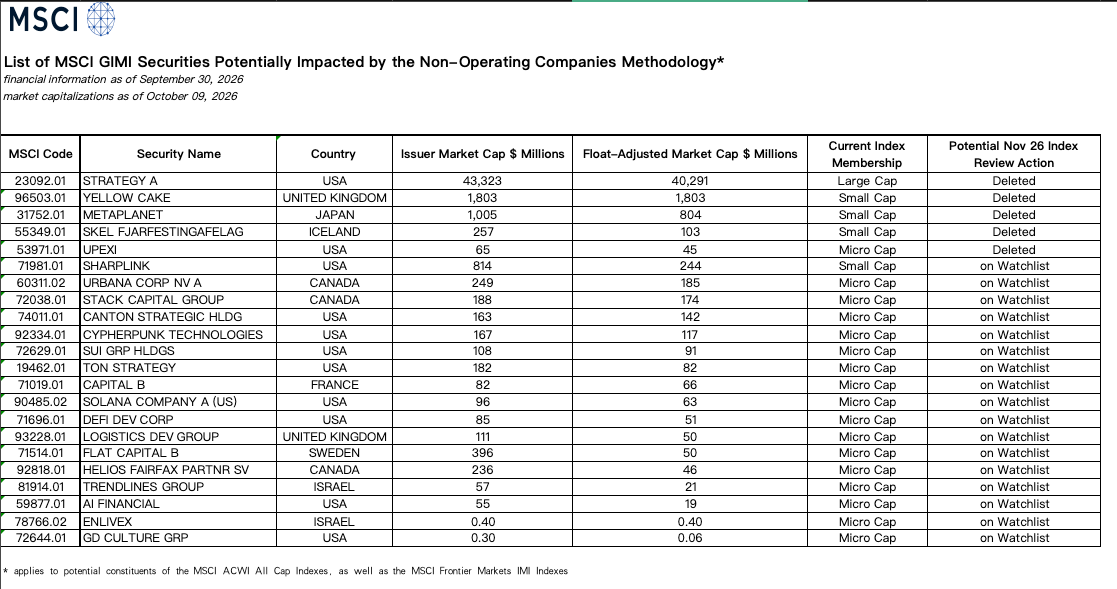
Meanwhile, two companies that previously appeared on the watchlist have quietly dropped off the list, only to be found on a separate micro-cap stock removal roster. This purge wave of U.S.-listed fund-like/asset custody companies under traditional index standards is rapidly spreading deeper into the market.
6 Companies Receiving Immediate Removal, Strategy's Defense Rejected
MSCI is a financial services company that compiles global equity indexes, which are used as investment benchmarks by a large number of funds. Companies included in the indexes can receive allocations from funds tracking the relevant indexes; once removed, related funds will need to adjust their holdings accordingly.
The final list covers a total of 25 securities, 6 of which are marked for removal and 19 for inclusion on the watchlist. All 5 companies earmarked for removal on the October initial list remain on the final roster.
- Crypto asset camp: Strategy (formerly MicroStrategy), Metaplanet (Japanese Bitcoin treasury firm), Upexi (firm with Solana treasury and token exposure).
- Non-crypto entities but in the same asset-holding category: Yellow Cake (UK-based uranium investment firm), Skel Fjarfestingafelag (Icelandic investment company), plus the newly added 6th company on the final list, UK cellular agriculture tech investment firm Agronomics.
MSCI's review rules do not only target the crypto circle, but the crypto sector has undoubtedly borne the brunt of the impact.
Strategy is the largest company on this removal list. As of the U.S. stock close on November 12 (Beijing time), Strategy’s share price stood at USD 122.35, up 1.06% on the day, with a total market capitalization of approximately USD 51.7 billion. After MSCI published the final list, Strategy’s share price pulled back in after-hours trading, currently sitting at USD 120.2, down 1.76% from the closing price. According to estimates by JPMorgan analysts, once Strategy is fully removed from MSCI’s flagship equity indexes, it is expected to trigger around USD 2.8 billion in outflows from passive index funds.
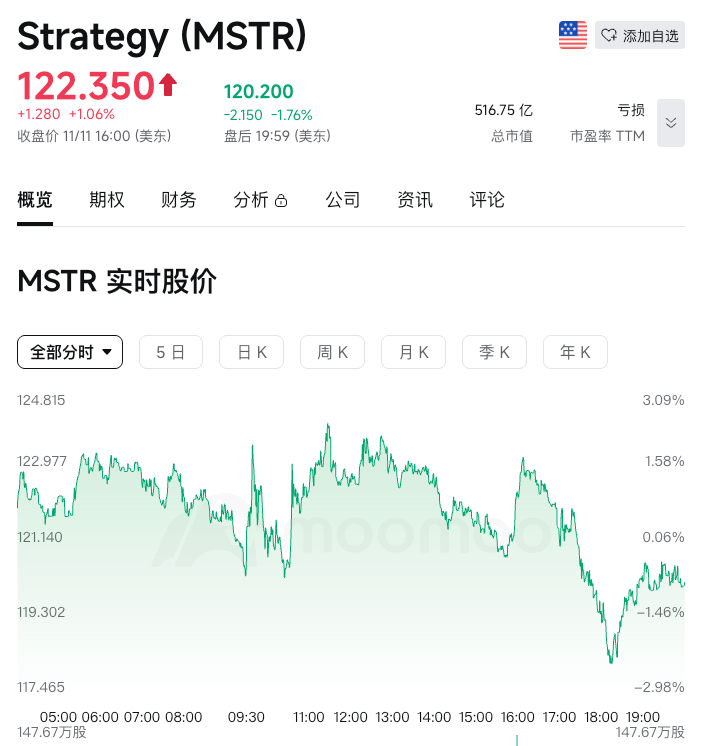
While this index-level adjustment does not require Strategy to sell off the hundreds of thousands of Bitcoin in its underlying reserves, it directly undermines the liquidity flywheel the company relies on to survive: issuing shares and bonds to buy BTC, propping up its share price, and then raising financing at a premium. Without the buffer of passive allocation demand, the valuation premium of its stock and its refinancing threshold will face significant downward pressure.
Strategy had previously strongly opposed MSCI’s classification of it as a non-operating company, arguing that its Bitcoin business is a core operating segment of the group, and claiming that traditional financial indicators cannot fairly evaluate its novel balance sheet model. But judging from the final outcome, MSCI has not compromised with the crypto leverage giant.
19 Companies Placed on Probationary Watchlist, BNB Standard Among 4 New Entrants
Beyond the 6 securities marked for removal, another 19 securities are on the watchlist. Compared with the October initial list, MSCI has issued 4 new "yellow cards" this round, with new entries including: BNB Standard, Streamex, APG Securities, and Quantum Solutions.
Among these new entrants, BNB Standard, with the stock ticker BNC, was formerly known as CEA Industries. The company holds BNB to allow investors to gain indirect exposure to BNB via its listed shares, while also operating retail and industrial equipment businesses.
Notably, BNB Standard, which uses BNB as its core underlying reserve asset (stock ticker: BNC), has drawn particularly widespread attention.
- The company, formerly CEA Industries, adopted a model mirroring MicroStrategy after its business transformation: holding approximately 515,500 BNB (as disclosed in end-July data) via its listed entity to provide U.S. stock investors with spot BNB exposure free from compliance barriers.
- MSCI data shows BNB Standard has a current total market capitalization of approximately USD 220 million. Its inclusion on the watchlist means it has also entered the traditional index provider’s exclusion alert pool, due to its heavy asset allocation to tokens and failure to meet operating cash flow requirements.
The other newly added watchlist companies operate across diverse sectors: U.S.-listed Streamex runs a commodity tokenization platform, having launched gold-related tokenized products; Japan-listed Quantum Solutions is engaged in AI computing power, gaming and other businesses, and has previously run crypto asset treasury operations; APG Securities is a Vietnamese securities firm.
Companies that were already on the watchlist, including SharpLink, SUI Group Holdings, TON Strategy, Capital B, Solana Company, and DeFi Development Corp, remain on the final watchlist.
Other companies remaining under observation include Urbana, Stack Capital Group, Canton Strategic Holdings, Cypherpunk Technologies, Logistics Development Group, Flat Capital, Helios Fairfax Partners, Trendlines Group, and AI Financial. Together with the 6 previously mentioned, a total of 15 companies have appeared on both versions of the watchlist consecutively.
Under MSCI’s new rules, companies first undergo an operating asset screening; those that fail the screen are then subject to a five financial ratio check. If a company hits exclusion thresholds for at least four of the checks, it may lose eligibility for index inclusion. For existing index constituents, MSCI will only remove a company under this rule if it fails the screening for two consecutive annual reporting periods; companies that do not yet meet removal criteria may be placed on the watchlist.
Previously, MSCI had applied temporary measures to companies where digital assets accounted for at least 50% of total assets, restricting certain index weight adjustments for related securities. These temporary measures will be phased out as the new rules are implemented during the November index review.
Why Did Two Shell Companies End Up in the Micro-Cap Removal Dustbin?
Amid this list update, a particularly subtle detail stands out: two companies have mysteriously disappeared from the non-operating company list, but this is not because they proved their compliance and escaped review.
The two companies are biotech and prediction market token concept stock Enlivex, and Nasdaq-listed Chinese concept firm GD Culture Group, which had previously disclosed a Bitcoin treasury plan. Both appeared on the watchlist during the October initial review, but have been removed from the November final non-operating company list.
However, a comparison with MSCI’s Global Micro Cap Indexes adjustment roster released the same day reveals that Enlivex will be directly removed from the MSCI Israel Micro Cap Index, while GD Culture Group will be directly removed from the MSCI U.S. Micro Cap Index.
MSCI has not explained the cross-reference logic between the two reports, but the rationale is clear when reviewing the fundamentals of the two firms. Enlivex had previously received a Nasdaq delisting warning and was forced to conduct a 1-for-16 reverse stock split, while GD Culture has long struggled with extremely low liquidity and compliance scrutiny. The most likely reason they were removed from the non-operating company watchlist is that their micro-cap market value or listing compliance status has already breached minimum thresholds, leading to an immediate loss of eligibility for inclusion in micro-cap indexes, making further non-operating rule review redundant.
Conclusion
From previous temporary weight restrictions on crypto asset holdings, to the final implementation of non-operating company rules at the end of November, the reckoning by traditional financial index providers against listed companies that have shed real business operations and turned into crypto trading funds is now a settled outcome.
MSCI’s core bottom-line logic is simple: equity indexes are tools for pricing real economy entities and genuinely operating companies, not ATM machines that supply passive incremental capital to closed-end token trusts with no actual operating business.
As the November 30 effective date approaches, the real impact of passive capital outflows from Strategy will face its first real-world test. Meanwhile, the 19 treasury concept stocks on the watchlist, spanning exposure to BTC, BNB, SOL, TON, and SUI, have officially entered the countdown to index exclusion.