
Compared with cat and dog-themed meme coins, US equities are clearly a far more attractive bet.
Written by Eric, Foresight News
On the evening of November 9 Beijing Time, Formation Securities filed a registration with the U.S. Securities and Exchange Commission (SEC), announcing plans to operate a tokenized securities trading venue on the Solana blockchain under the SEC’s five-year innovation exemption issued in September 2026. Trading is scheduled to launch in early 2027, with the first batch of listed tokenized stocks including shares of Exodus Movement, Forward Industries, and Galaxy Digital.
In October 2026, two major Solana DeFi protocols, Orca and Loopscale, announced their merger to form the entity Formation. At the time of the announcement, the founding team stated that Formation aims to deliver an end-to-end value chain for emerging assets covering issuance, financing, and liquidity provision, while expanding the universe of accessible assets and strategy options for capital allocators.
As the leading DEX on Solana from 2022 to 2023, Orca is once again taking an early lead in the tokenized equities space.
From Trading Venue to On-Chain Capital Network
Before meme tokens went mainstream, Orca stood out as one of the top DEXes on Solana, boasting strong performance in liquidity depth, token coverage, and other core metrics. Since its launch in 2021, Orca has recorded a cumulative trading volume of over $550 billion. Its core value proposition is the Whirlpools concentrated liquidity mechanism, modeled after Uniswap v3, which allows liquidity providers to customize the price ranges for their capital.
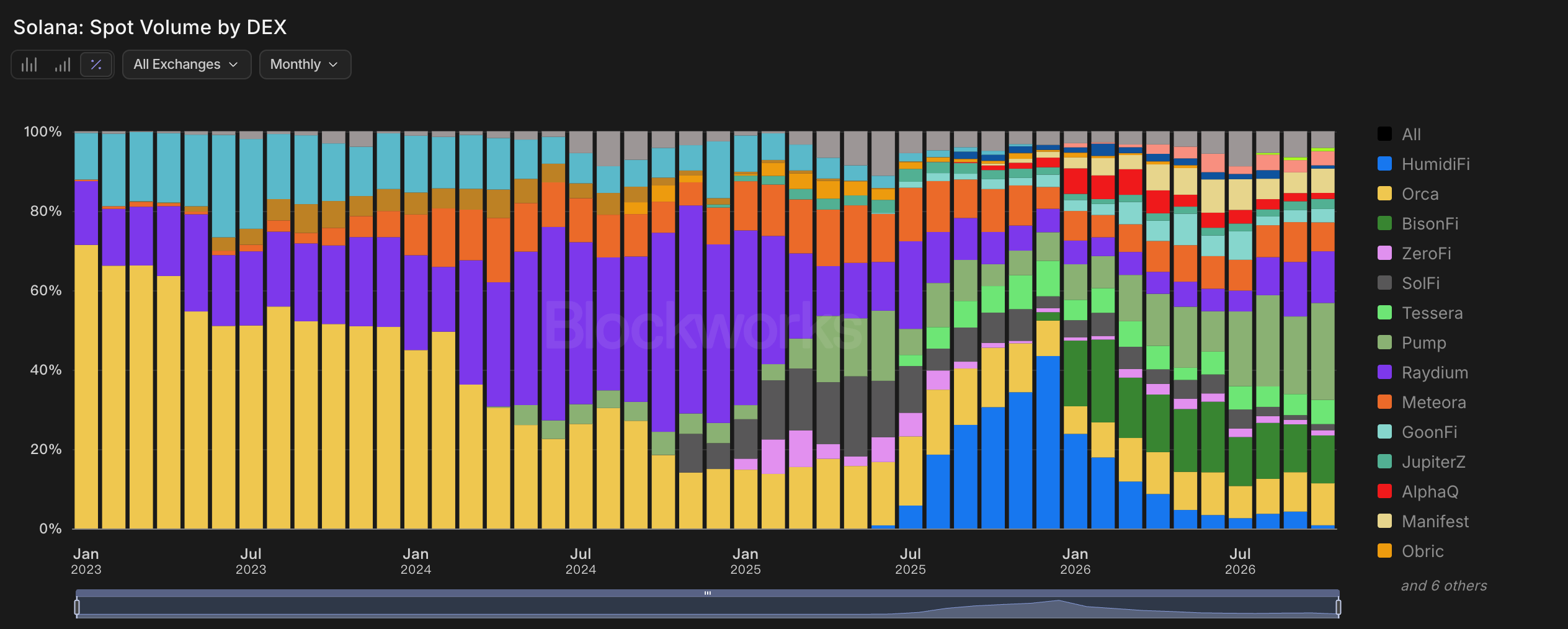
Per data from Blockworks, Orca held more than 50% of Solana DEX market share by trading volume as of February 2024, with its peak total value locked (TVL) exceeding $1.4 billion at the end of 2021.
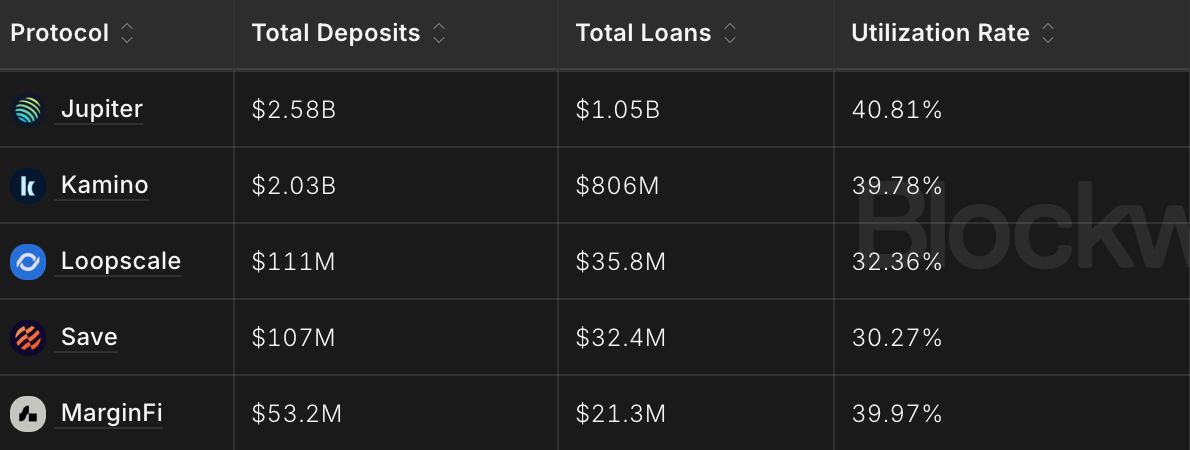
Loopscale, while not as prominent as Orca in the lending market, ranks as the third-largest lending protocol on Solana, though it lags significantly behind the top two players in key metrics. Unlike generic pool-based lending protocols such as Aave, Loopscale is a modular, order-book-based lending protocol that directly matches lenders and borrowers instead of relying on algorithmic pool logic. This structure enables support for fixed interest rates, fixed maturity terms, and over-collateralized lending.
Following the merger, the combined entity Formation is led by Loopscale co-founder Luke Truitt as CEO, and Orca’s Chief Strategy and Legal Officer Christopher Montagano as President.
Montagano noted explicitly that the company plans to partner with issuers to co-build the tokenized equities market, delivering an integrated network spanning capital formation to allocation for cutting-edge economic sectors including AI, robotics, defense, and energy. The initiative has already secured backing from institutions including Figure, Shinhan Asset Management, Superstate, R3, and Securitize.
Formation will not launch a new token, and will instead continue to use Orca’s native token ORCA, with no changes to token supply schedule, release terms, or even the existing xORCA staking mechanism. Prior to the merger, Loopscale had never issued a token, and only ran a points program. The merger announcement also noted that details on how Loopscale points will be converted into tokens are expected to be published by the end of the year.
Judging by ORCA’s market performance, the news of the Loopscale merger and the push for compliant tokenized US stock trading has barely moved the token’s price. As of press time, ORCA is trading at roughly $1.35, with a fully diluted valuation (FDV) of just over $100 million.
Operating Framework Under the SEC Innovation Exemption
The core regulatory basis for Formation Securities’ operations is the SEC’s five-year innovation exemption. Under this framework, eligible tokenized equities can conduct conditional secondary market trading on approved venues via permissioned automated market maker (AMM) liquidity pools. This design strikes a balance between regulatory sandbox requirements and technological innovation: on one hand, trading venues must meet SEC compliance obligations; on the other hand, the core advantages of blockchain technology, including 24/7 trading and atomic settlement, are fully preserved.
Specifically, tokenized stocks listed on the Formation platform will carry the same voting and dividend rights as traditional underlying shares. Investors can trade these assets 24/7 using eligible assets including stablecoins, with on-chain atomic settlement. On the distribution side, the tokenized stocks will be offered to verified investors via distribution channels including Superstate, Formation Securities’ proprietary platform, and Alpaca, as well as custody partners including Anchorage and BitGo.
Based on current information, Formation has no plans to fully integrate Orca and Loopscale. The two DeFi protocols will continue to operate independently, with their original crypto service lines running as normal. The Formation entity may primarily serve as the unified outward-facing brand for partnership and communications, leveraging the two protocols as the underlying infrastructure for compliant tokenized US stock trading.
However, unlike projects that simply list tokenized stocks on existing DEXes and lending markets, Formation’s business scope extends upstream to cover the tokenized stock issuance process, marking its entry into the traditional finance space.
Practical Headwinds for US Equities Tokenization
While the regulatory framework provides a sandbox window for tokenized securities experiments, not all US-listed companies appear to support this shift.
Previously, under the same SEC innovation exemption framework, OKXICE, a tokenized securities platform launched as a partnership between OKX and Intercontinental Exchange (ICE), faced widespread opposition from issuers. The platform initially planned to list shares of around 62 companies, but over 80% of these firms — including Microsoft, Alphabet, Goldman Sachs, McDonald’s, NVIDIA, Tesla, Amazon, and Apple — formally submitted objections.
Listed companies have four core concerns: First, since the tokenization platforms are operated by third parties, issuers worry investors may mistakenly assume the tokens carry official endorsement from the company. Second, the impact on share prices, liquidity, and volatility remains unquantified. Third, third-party platforms collect fees while issuers bear potential risks, creating an asymmetry between control rights and revenue rights. Fourth, the 24/7 trading mechanism may lead to fragmented price discovery, while the on-chain exercise path for shareholder rights (such as voting and dividend entitlements) remains unclear.
It is worth noting that the framework operates on a "default consent" rule, meaning issuers are deemed to agree if they do not raise an objection within 30 days of being notified. The fact that large listed companies actively opted out en masse demonstrates that the current third-party-led model faces severe pushback from issuers. This also reflects that market participants’ caution around tokenization stems not from the technology itself, but from misalignment between business models and the distribution of rights and responsibilities.
Unlike OKXICE’s third-party platform model, Formation has explicitly adopted a strategy of "co-building with issuers", which may help mitigate issuers’ trust deficit to some extent. By ceding partial control of platform governance, ensuring equal shareholder rights, and delivering transparent on-chain settlement, Formation aims to build a more collaborative ecosystem for tokenized securities.
An Attempt to Expand Market Boundaries
Formation represents a milestone for Solana ecosystem projects as they move toward building institutional-grade financial infrastructure. Through the merger of Orca and Loopscale, the platform aims to combine DEXes’ liquidity advantages with on-chain lending’s capital allocation capabilities, exploring a viable path for US equities tokenization within the SEC innovation exemption framework. Compared to the mass issuer pushback faced by earlier third-party platforms, Formation’s co-building model, equal-rights design, and transparent on-chain settlement may offer a more sustainable commercial paradigm for the rollout of tokenized securities.
In the long run, tokenized securities are expected to enable more efficient price discovery, 24/7 global access, atomic settlement, and integration with the on-chain DeFi ecosystem, driving the modernization of capital markets. But realizing this vision depends not only on mature technical infrastructure, but also on rebalancing the rights, responsibilities, and interests across regulators, issuers, and trading platforms. Formation’s experiment can serve as a reference point for the on-chain transformation of global securities markets.