
The New York Stock Exchange (NYSE) will settle stocks on its own proprietary chain built on Avalanche technology, while the Avalanche Foundation has also acknowledged that ecosystem value will not automatically accrue to AVAX.
Written by Sanqing, Foresight News
On November 9, *The Wall Street Journal* reported that the NYSE will use only Avalanche to settle tokenized stocks on its upcoming 24/7 tokenized securities trading platform. On the same day, Ava Labs announced that Avalanche will provide core ledger technology for the clearing firm associated with this NYSE-linked platform, a move also confirmed by NYSE's pre-market briefing.
This platform will operate as an Alternative Trading System (ATS), targeting a Q4 launch, and is still pending regulatory approval. Following the announcement, according to Bitget market data, AVAX peaked at 9.01 USDT, was trading at 8.627 USDT at press time, representing a 6.86% 24-hour surge! (MISSING)
Trading and Settlement Architecture
Per the framework disclosed on November 9, the platform retains NYSE's existing Pillar engine for order matching. Once trades are executed, the platform's clearing firm will conduct instant settlement on the Avalanche ledger, and investors can make deposits using stablecoins.
John Nahas, Chief Commercial Officer of Ava Labs, revealed in an interview that the NYSE is not settling transactions on Avalanche's public mainnet, but is operating a regulatorily customized blockchain built on Avalanche's underlying technology.
One week prior, on November 2, the NYSE announced its issuance-side arrangements: in addition to existing partners Securitize and tZERO, it added Broadridge, Computershare, Equiniti and Superstate as transfer agents, bringing the total number of partners to six. The tokens traded on the platform fall into two categories: those issued by custodial institutions and those issued directly by the underlying issuers, both of which are fully fungible with traditional stocks. Holders are entitled to the same dividend and voting rights as traditional stockholders.
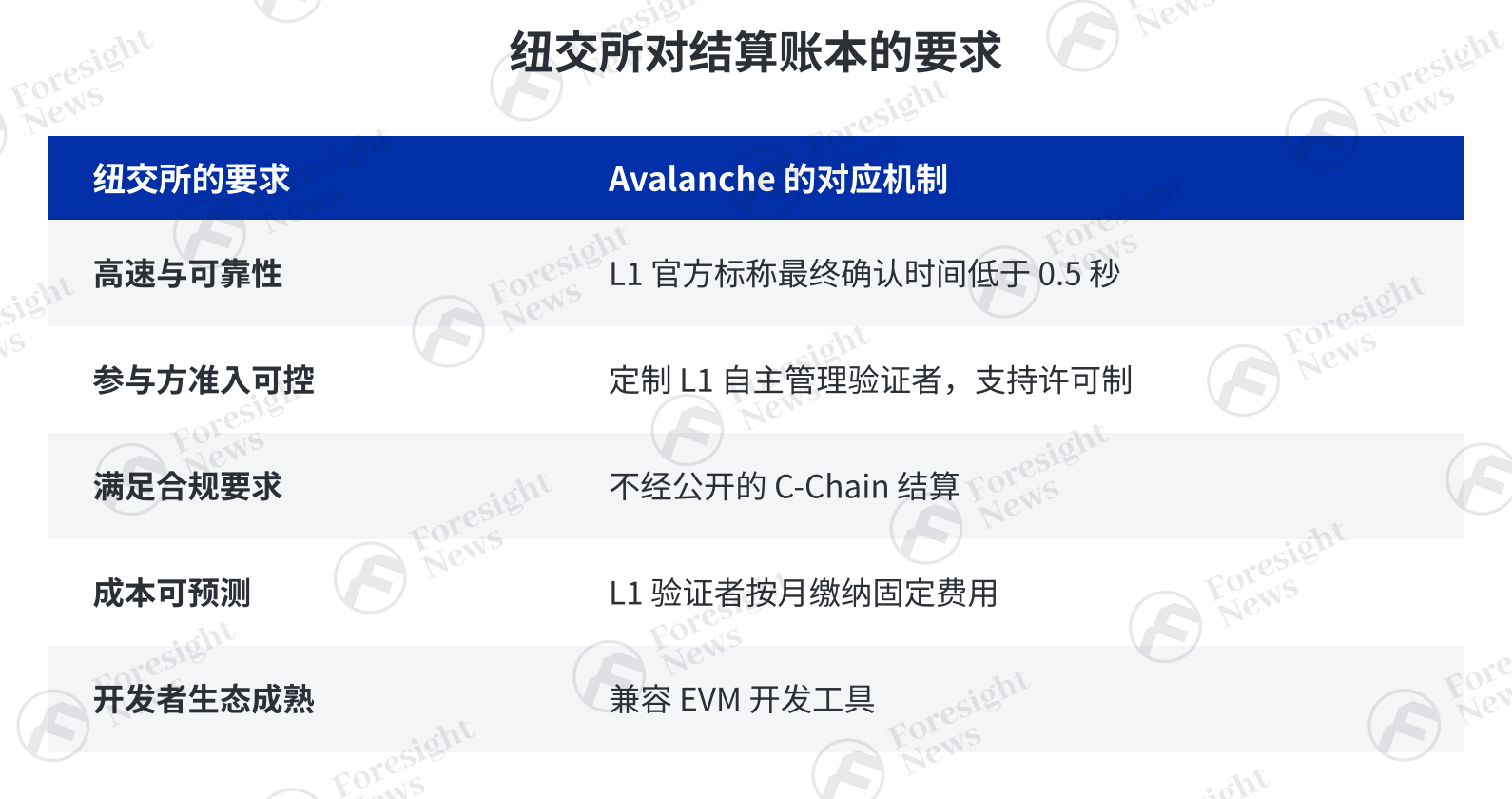
Dennis Lee, Head of Digital Issuance at NYSE, stated that the platform supports stocks issued across multiple chains, but the ledger used for transaction recording and settlement must be fast, reliable, capable of controlling access for participants, offer predictable costs, and be supported by a large developer community — all criteria that Avalanche meets. Under this structure, stock issuance is decentralized across multiple transfer agents and blockchains, while settlement is consolidated uniformly onto the NYSE's own dedicated chain.
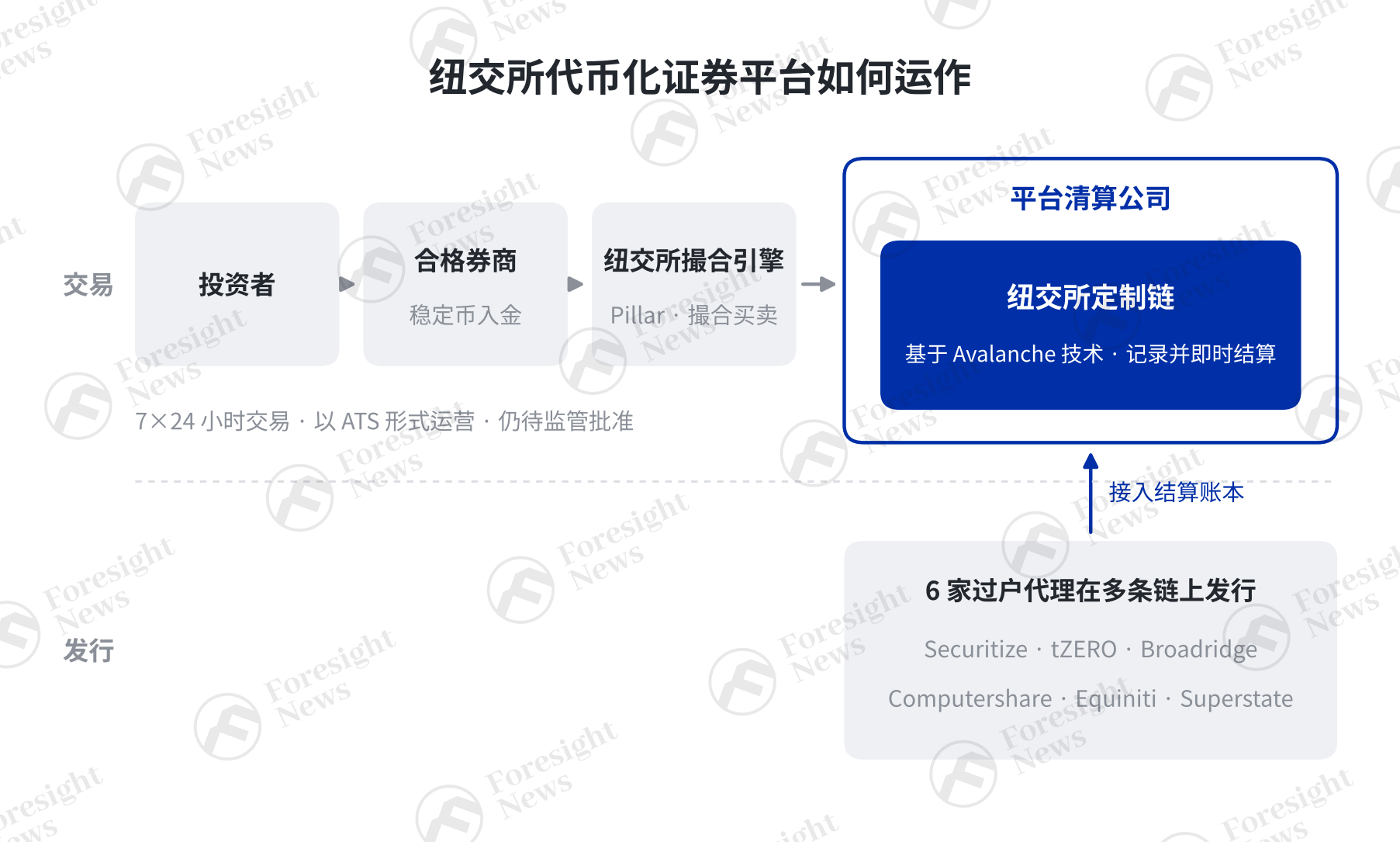
The NYSE first announced the development of this platform and its pursuit of regulatory approval on January 19. On August 31, its parent company, Intercontinental Exchange (ICE), signed a Memorandum of Understanding (MoU) with tZERO. At the Avalanche Summit in September, Ava Labs President Charley Cooper revealed that the NYSE had been testing Avalanche for around a year, but did not announce a selection at that time. Cooper confirmed during the November 9 episode of NYSE Live that this deployment is for production use, rather than another pilot program.
Compliance Access Controls and Customized L1 Model
In its January announcement, the NYSE stated the platform would be capable of supporting multiple chains for settlement and custody, but by November, it had narrowed its scope to use only Avalanche. Kevin Tyrrell, Chief Product Officer of NYSE, noted that the organization tested multiple vendors before making the selection, prioritizing speed, throughput, and the ability to support permissioned networks and compliance requirements. Nahas added that the two parties completed reviews across technical, commercial and ecosystem dimensions over more than a year before finalizing the selection.
Of the criteria Dennis Lee outlined, participant access control is the most critical. Participants in stock settlement must go through a rigorous onboarding process, while the C-Chain on Avalanche's public mainnet is a permissionless network open to any user, which cannot meet this requirement.
The NYSE's customized chain aligns with the self-hosted L1 model (formerly known as Subnets) launched by Avalanche after the Etna upgrade (ACP-77). Institutionally built L1s operate independently from the Avalanche mainnet, manage their own validator sets, and can be configured as permissioned networks. Validators for these dedicated L1s do not need to stake 2,000 AVAX to become mainnet validators, and only need to pay a fixed monthly fee — a structure that also meets the requirement for predictable costs.
Regarding the common concern that self-hosted chains tend to be siloed from the external ecosystem, Ava Labs CEO Emin Gün Sirer noted in the announcement that this dedicated infrastructure can still connect to the broader asset and liquidity ecosystem, and all L1s on Avalanche can interoperate with each other via native cross-chain messaging.
Per data from rwa.xyz, as of November 9, the total value of distributed RWAs (freely transferable between wallets) on Avalanche reached $1.43 billion, the total value of represented RWAs (only recording ownership on-chain) hit $11.4 billion, and the network's stablecoin market capitalization stood at $795 million.
The Avalanche Foundation is Also Exploring Value Capture Pathways for AVAX
Neither Ava Labs' announcement nor the NYSE's statement mentioned any use case for the AVAX token in settlement, transaction fees, or staking. Under Avalanche's customized L1 mechanism, the only direct revenue tied to AVAX comes from ongoing validator fees for these dedicated networks.
Per Avalanche's official documentation, when an L1 has fewer than 10,000 validators, each validator pays approximately 1.33 AVAX per month, which is then burned — though this fee is not tied to the number or total value of settlements conducted on the L1. Transaction fees within the L1 can also be denominated in any token specified by the network operator.
On July 30, when the Avalanche Foundation published its economic research agenda, it acknowledged that value created across the ecosystem does not automatically accrue to AVAX, which secures the underlying network. Matias Antonio, Chief Investment Officer of the Foundation, noted that this is a core issue the organization is working to address.
Per estimates released by the Foundation on August 12, among all on-chain economic activities it tracks, the current primary channel for AVAX value capture is C-Chain transaction fee burns, which have totaled approximately $23.5 million since the start of 2024 (excluding L1 validator fees). Revenue sharing for L1s is still under research, with no finalized mechanism in place.
The most recent monthly data in the Foundation's estimate is for June: nominal GCP (the on-chain equivalent of GDP) generated on Avalanche reached $3.1 million, returns to holders of assets such as tokenized funds totaled $2.7 million, and returns earned by issuers from reserve assets hit $6.9 million. The Foundation noted that the latter two categories currently contribute almost nothing to AVAX's value capture.
The improvement pathways the Foundation has identified include ACP-283 for gas price adjustment via validator voting, ACP-67 for a protocol-owned stablecoin, and revenue sharing for applications and L1s, all of which are currently in the research phase.
Under the existing mechanism, settlement activity on the NYSE's customized chain also falls outside of AVAX's value capture scope, with only the validator fee component tied to AVAX. Meanwhile, the C-Chain — the current primary value capture channel — itself generates relatively low fee revenue: per DefiLlama data, Avalanche C-Chain fees totaled only around $26,500 on November 9.
On the day the announcement was made, the Avalanche Foundation posted on X that it will track the platform's activity and its role within the broader Avalanche economy via its economic research agenda.
The NYSE targets launching this platform in the fourth quarter, and will still need to secure regulatory approval before going live.