
The "seppuku" clause, cancer disclosure and termination: Why is a former Ethereum Foundation employee suing?
Written by angeli lu, Foresight News
A mission statement from the Ethereum Foundation (EF) is now serving as the contested backdrop for an employment lawsuit filed in U.S. federal court.
On November 4, Kayleen Fulton, former head of the EF Protocol Support Team (known in the community by the moniker Nixo), filed suit in Colorado against six parties including EF affiliated entities, EF manager Bastian Aue, and Vitalik Buterin. The case has drawn concentrated media coverage in recent days. Nixo is the sole plaintiff; the 53 employees who co-signed the open letter referenced in the case are not co-plaintiffs.
The court filing lays out two key unresolved questions: Why did management terminate the two organizers of the joint employee letter just 10 days after formally acknowledging signatories’ alignment with the EF’s mission direction? And did the cancer diagnosis Nixo disclosed ahead of her termination, plus her note that she may need to take medical leave for future treatment, factor into the decision? Nixo contends both elements are connected to her firing, though all allegations remain to be adjudicated by the court.
Why is the "seppuku" clause featured in the EF's mission statement?
The EF board published the EF Mandate on March 13 to formalize the Foundation’s mission and decision-making principles. The document emphasizes censorship resistance, open source, privacy, and security, and clarifies that the Foundation acts as one participant in the Ethereum ecosystem, and does not speak for or exert control over the entire network.
The provision that sparked employee pushback was a section titled “Source Seppuku License”. The section notes that software authors, maintainers and other contributors who fail to uphold their commitments or alter the license “should end their lives by the sword”. Per the filing, 79 EF employees voted in support of removing this text ahead of the final version’s release, but the language was ultimately retained as part of an embedded illustrative graphic in the document.
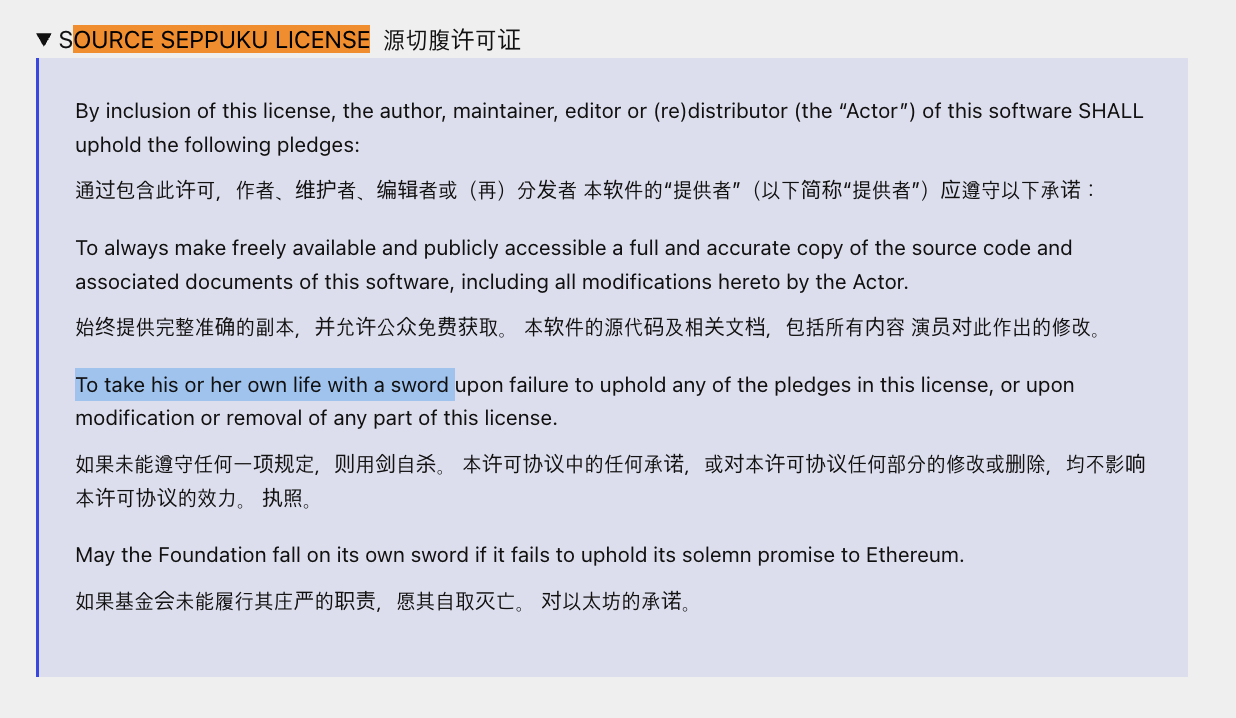
The “seppuku” phrasing is the most eye-catching element of the controversy, but it alone cannot explain the subsequent terminations. What turned the document into a formal employment dispute was the subsequent requirement for staff to submit a formal alignment statement: per the filing, Aue required all employees to submit a form by a set deadline on March 20, formally committing to the direction laid out in the Mandate, with non-submission deemed a voluntary decision to leave the EF.
Management later clarified the meaning of the contentious language. When one employee asked if submitting the form would mean they were actually required to die by suicide, Aue responded that the text was part of the document’s intentional artistic expression, and was not meant to be taken literally. The form later added a note that employees’ signatory commitments had no connection to a literal “seppuku” requirement. The core of employee opposition gradually shifted to two concerns: why the contentious text was retained in the final document, and why staff were given such a tight deadline to formalize their alignment.
Two joint letter organizers were terminated even after management acknowledged the petition
On March 25, the letter organized by Nixo and her colleague Trent Van Epps gathered 53 signatures from staff in the protocol department, roughly half the department’s total headcount. The signatories stated their support for the overall direction of the Mandate, confirmed their willingness to continue working at the Foundation, but noted they could not in good faith submit the formal alignment confirmation under the existing conditions. The signatories also explicitly stated they had no intention of resigning.
Two days later, Aue told staff he interpreted the joint letter as feedback about dissatisfaction with the process and required form, and acknowledged the signatories’ separate commitments to the document’s core content. He also noted that if given the chance to redo the process, he would have handled many parts of the rollout differently. Per the filing, all 53 signatories retained their positions at the time.

The contentious "Source Seppuku License" text was retained in the final document as part of an embedded illustration
The filing notes that the final version embedded the full clause as a small image with a glitch effect, meaning the word “seppuku” does not appear in the searchable PDF text layer, though the sentences in the associated speech bubble remain searchable. The plaintiff uses this detail to emphasize that the EF changed the presentation of the clause, but retained its full original text.
On the morning of April 6, Aue notified Trent and Nixo of their termination in separate calls spaced roughly 30 minutes apart. Nixo stated that Aue acknowledged her strong past performance during the call, but said he had “lost confidence” in her, without providing a more specific reason. She bases her claim that the two letter organizers were terminated in connection with their leadership of employee dissent on this sequence of events. The timeline makes this allegation worth scrutiny, but is not on its own sufficient to establish that unlawful retaliation occurred.
A parallel timeline relates to Nixo’s health condition. Nixo stated that she notified management in writing of her cancer diagnosis on March 24; the email explicitly noted that she had not yet applied for leave or workplace accommodations, that she was still able to fulfill her job duties, but that her upcoming treatment plan might impact her work down the line. She was terminated 13 days later. In her filing, she alleges her employer failed to properly honor her rights to medical leave, and made an adverse employment decision based on her diagnosis and anticipated future treatment needs. The court will separately examine the connection between these allegations and her termination.
What has Vitalik said? How is the community reacting to the controversy?
Per the court filing, Vitalik, as an EF board member, participated in discussions around the Mandate. On March 5, he told staff the document was still being revised, particularly to adjust sections that had sparked widespread concern. After the contentious language was retained in the final version, the filing quotes him as saying the Foundation could have chosen less offensive phrasing, but that such phrasing would not have matched the mindset they wanted to convey at the time.
Nearly a month after the termination, Nixo spoke with Vitalik on May 1; the filing notes the second half of the conversation was recorded. Per the filing’s account of the exchange, Vitalik raised concerns about what kind of internal interaction the EF should encourage: if staff can secure desired outcomes simply by “making a fuss”, other employees may adopt the same approach to push for organizational change. He also noted that in hindsight, management should have given staff several weeks, rather than just a few days, to decide whether to formally affirm alignment with the Mandate.
These remarks reflect Vitalik’s concern about organizational decision-making being pressured by internal advocacy, rather than a direct admission that Nixo was fired for signing the joint letter. Nixo cites the remarks as evidence supporting her retaliation claim; how much Vitalik knew about the specific personnel decision, and how involved he was in it, remains to be clarified through further evidence. No public response from Vitalik addressing the lawsuit has been found in publicly available materials to date.
Members of the crypto community have offered differing takes on the controversy. Gabriel Shapiro, a prominent crypto-focused lawyer, argued in a public post that it is reasonable for an organization to require employees to confirm alignment with its mission direction, and that the “seppuku” phrasing should not be taken as a literal suicide requirement. Internal employee discussions cited in the filing, however, show that some staff’s dissatisfaction went far beyond literal interpretation of the text: their core concerns were why their opposition did not change the final document, and whether employees could raise objections without fearing for their jobs. Shapiro’s views are personal commentary, and do not represent the EF’s formal defense in court.
Lawyers for the EF’s Singapore-based affiliated entity denied in a May response letter that Nixo experienced unlawful conduct or retaliation, and asserted that her separation agreement was valid; the letter is currently cited and presented through the plaintiff’s court filing.
This lawsuit centers on a single termination, but raises a longer-lasting question: as an institution that has operated in the Web3 space for years, how can the EF ensure its employment decisions are held accountable when it develops its mission, requires staff to affirm alignment, and addresses internal dissent? Decentralization as a philosophy can guide network development, but it does not automatically provide employees with clear, accessible channels to file grievances.
A more reliable approach is to formalize these processes before conflicts arise: employees should be able to question decisions without being deemed to have resigned; terminations should come with explainable, auditable reasons; matters related to health conditions and medical leave should follow clear, documented procedures; and in cross-border employment relationships, employees should be clear on who their employer is, and who is accountable for employment decisions. Whether these arrangements work depends on whether they actually bind management, rather than being merely written into a mission statement.