
Its ecosystem lineup is extensive, but the real test is only just beginning.
Written by KarenZ, Foresight News
On November 9, Elysium, the Layer 2 network built by Kinetiq for the Hyperliquid ecosystem, launched its mainnet as originally scheduled.
Hyperliquid already hosts HyperCore and HyperEVM natively — why is a dedicated Layer 2 still needed? This question is arguably far more noteworthy than the 100ms block time Elysium advertises.
As designed for the Hyperliquid ecosystem, HyperCore powers core financial functions including spot and perpetual contract order books, while HyperEVM provides developers with an Ethereum Virtual Machine (EVM)-compatible smart contract environment. The two modules share the HyperBFT consensus mechanism and support direct, native interoperability.
A high-speed trading engine, however, does not mean its smart contract execution environment can meet every use case demand. HyperEVM follows a progressive scaling roadmap, and its current throughput still imposes meaningful constraints for applications that require continuous quote updates and frequent trade execution. For professional market makers in particular, who may need to adjust quotes multiple times per second, execution speed and transaction costs are both critical decision factors.
Elysium is built explicitly to address this unmet scaling demand: it adds a high-performance execution layer that further connects to HyperCore's market data and order book. Its goals go beyond faster smart contract execution, to include supporting token issuance, improving spot market liquidity, and funneling more trading demand onto the Hyperliquid network.
From Liquid Staking to Building a Hyperliquid Layer 2
Kinetiq, the team behind Elysium, is no out-of-nowhere infrastructure startup.
Kinetiq first entered the Hyperliquid ecosystem as the builder of the HYPE liquid staking protocol. Users can stake HYPE via Kinetiq to receive kHYPE, a liquid token representing their staked position, which lets them earn staking rewards while deploying kHYPE across other DeFi applications to boost capital efficiency.
This core business has already cemented Kinetiq's critical position within the Hyperliquid ecosystem.
According to DefiLlama data, as of November 9, Kinetiq ranks first among liquid staking protocols on Hyperliquid L1, with a total value locked (TVL) approaching $800 million — a clear lead over the second-place stHYPE, which holds roughly $170 million in TVL, accounting for about 82%! o(MISSING)f the category's aggregate TVL. Historical kHYPE data shows its TVL once reached a peak of around $2.3 billion in September 2025.
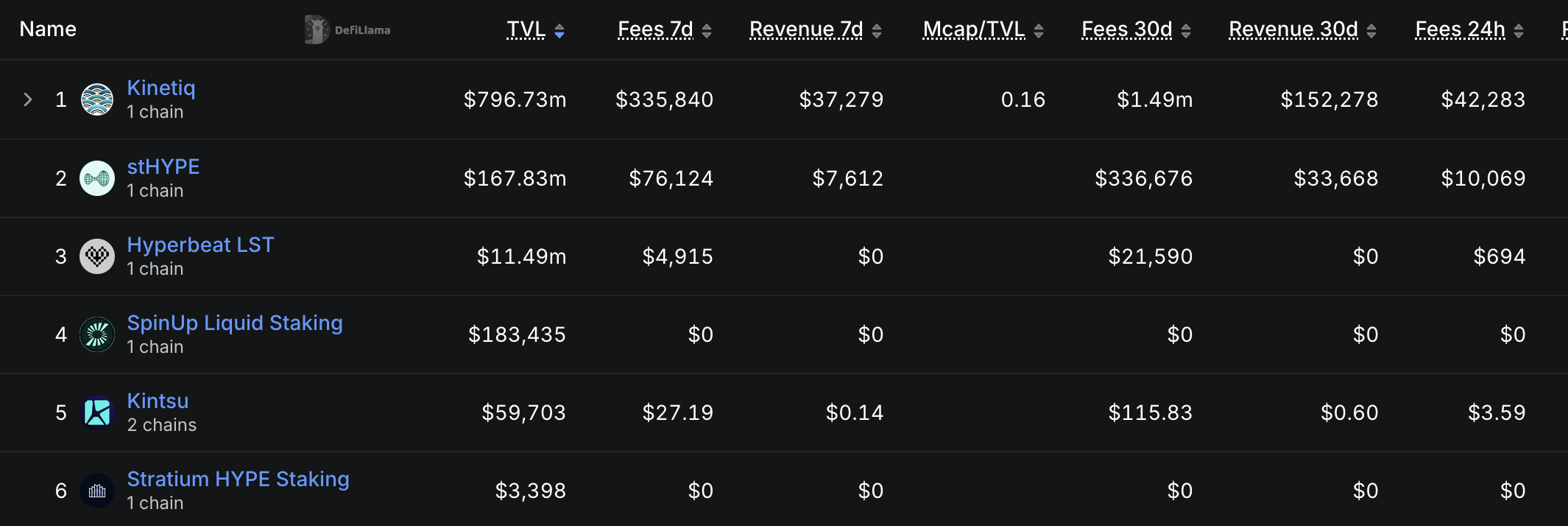
Liquid staking leaderboard on Hyperliquid L1: Source: DefiLlama
The team later launched Markets.xyz, expanding its business into trading markets. Markets.xyz is an on-chain trading platform built on Hyperliquid that supports spot and perpetual contract trading across crypto, stocks, stock indices, forex, and commodity markets. Its associated perpetual markets are built using Hyperliquid's HIP-3 mechanism, designed to bring more traditional financial asset price exposure to 24/7 on-chain trading markets.
kmHYPE was launched as a complementary product to Markets.xyz. Users can stake HYPE to earn kmHYPE, which lets them participate in supporting the operation of relevant HIP-3 trading markets and share associated revenue. Per DefiLlama data, as of November 8, kmHYPE holds roughly $38 million in TVL.
In parallel, Kinetiq launched Launch, a product that leverages liquid staking mechanisms and fundraising models to help third-party teams raise the HYPE staked assets required to deploy HIP-3 markets, reducing the pressure on deployers to source staked collateral entirely on their own.
From kHYPE to Markets.xyz, and then to Launch, Kinetiq's business has gradually expanded from staking services to trading and market infrastructure. The launch of Elysium marks its further entry into the underlying smart contract execution layer.
This expansion path reflects clear cross-business alignment: liquid staking helped Kinetiq aggregate HYPE assets, Markets.xyz and Launch connect a portion of these assets to trading markets, while Elysium seeks to provide greater execution headroom for token issuance, professional market making, and other high-frequency applications.
If Elysium can attract enough developers and trading activity, Kinetiq will be positioned to build synergy across its staking, trading, and infrastructure product lines.
Kinetiq's public core team includes pseudonymous co-founder Omnia (@0xOmnia), co-founder and CTO Justin Greenberg, and co-founder and co-CEO Magnus Lai.
In terms of funding, Kinetiq announced a $1.75 million seed round in October 2025, with investors including Maven 11, Susquehanna, IMC Trading, Flowdesk, Chorus One and other institutions. Compared to many infrastructure projects that raise tens of millions of dollars, Kinetiq's disclosed funding size is relatively modest.
How Does Elysium Operate, and What Problems Is It Built to Solve?
Elysium is designed to add dedicated execution capacity on top of HyperEVM. It uses the Arbitrum Orbit tech stack, with infrastructure provided by Conduit, and supports settling transactions back to HyperEVM. Transaction fees are paid in HYPE, which is bridged 1:1 from HyperEVM to be used as the network's native gas token.
Elysium's published specifications include 100ms block times, roughly 300ms user-perceived transaction receipt latency, and an execution throughput target of 300 Mgas/s.
For context, HyperEVM produces small blocks roughly once per second, with each block able to hold about 3 million gas. Larger blocks are produced roughly once every 60 seconds, carrying about 30 million gas per block. Calculated against HyperEVM's small-block execution rate, Elysium's target throughput is roughly two orders of magnitude higher.
The value of this speed, however, must be evaluated against real-world use cases.
Elysium's official documentation highlights PropAMM, an automated market making mechanism operated by professional market makers. Unlike traditional AMMs that rely on fixed pricing formulas, PropAMM relies on professional market making strategies to continuously adjust quotes in response to external market changes.
As envisioned by Kinetiq, Elysium aims to let market makers update quotes 5 to 10 times per second at low cost. If this capacity holds up under real network load, market makers will be able to adjust prices and inventory risk more promptly, improving liquidity for asset trading.
This is exactly where Elysium connects to Hyperliquid's spot market.
HyperCore already has a native spot order book, but building persistent, sufficiently deep buy and sell order depth for new tokens is no easy task. In its August announcement, Kinetiq noted that compared to its perpetual contract markets, Hyperliquid's spot trading segment still has significant room for growth.
Elysium has therefore designed a more end-to-end token development pathway: new tokens are first launched on Elysium, where they build initial liquidity via AMMs, then leverage PropAMM to upgrade market making capacity, before optionally listing on HyperCore's spot order book and further expanding to perpetual contract trading via the HIP-3 mechanism.
It is important to note this is an optional technical and product pathway, and does not mean all tokens will automatically gain access to HyperCore's spot market or qualify for perpetual contract listing.
In addition, Elysium plans to build direct connectivity to HyperCore. Per its roadmap, roughly four weeks after mainnet launch, the network will roll out an ArbOS upgrade to integrate native HyperCore market data read interfaces, as well as a fast write path for submitting transaction orders via keepers.
This means smart contracts on Elysium will soon be able to directly access HyperCore's state including order book depth, prices, balances, and positions, rather than relying entirely on third-party oracles to relay this data.
In parallel, relevant applications will be able to interact with HyperCore via a dedicated trade execution path, a capability that is particularly critical for automated trading, market making, and strategies that require simultaneous exposure to both spot and perpetual contract markets.
Elysium's Tokenomic Design: No New Native Coin — How Will KNTQ Accrue Value?
The most notable element of Elysium's tokenomic design is that it will not launch a standalone gas token, instead continuing to use HYPE, while tying a portion of its generated revenue to KNTQ.
Additionally, per Kinetiq's official website, Elysium plans to allocate 25%! o(MISSING)f sequencer fees to application developers, use 50%! o(MISSING)f fees to repurchase and burn KNTQ, and allocate the remaining 25%! t(MISSING)o the Kinetiq treasury.
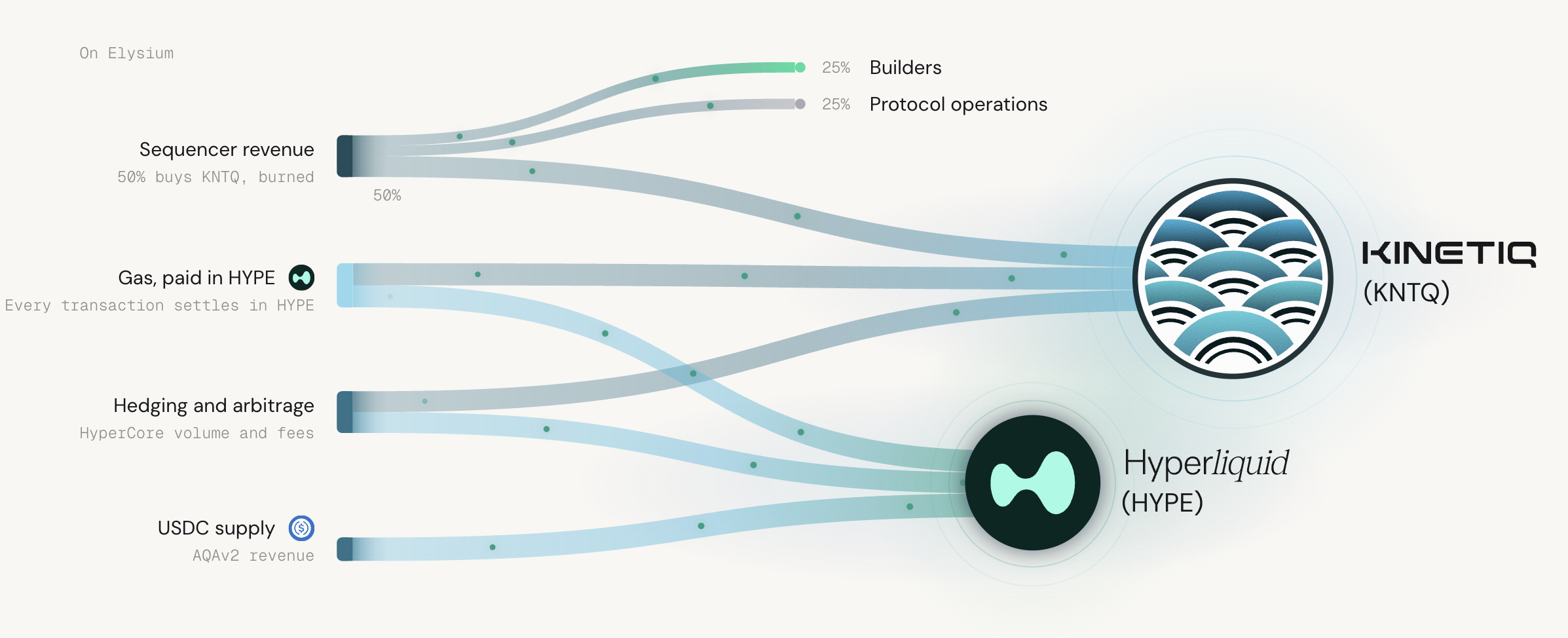
This design aims to address three concurrent goals: how to attract developers, how to sustain infrastructure operations, and how to build an economic link between KNTQ and the new business line.
Of these, the developer revenue share is particularly noteworthy. Elysium allocates a portion of sequencer revenue to applications, which they can use for user incentives, fee rebates, and other activities — all designed to give applications ongoing incentives to drive trading demand to the network.
Its Ecosystem Lineup Is Impressive, but the Real Test Has Only Just Begun
Before launching its mainnet, Elysium had already announced a wide range of ecosystem partnerships and integration plans.
Per Elysium's official ecosystem page, the network has listed over 120 projects and infrastructure providers, spanning DeFi, launchpads, NFTs, gaming, cross-chain bridges, and core infrastructure. The lineup includes both established projects such as Uniswap, Pump.fun, 0x, and OpenSea, as well as trading tools, wallets, and infrastructure providers including GMGN, Bitget Wallet, OKX Wallet, Wormhole, and QuickNode. That said, this listing does not mean all of these projects are already live on the Elysium mainnet.
Like other newly launched mainnets, Elysium has also attracted a cohort of token issuance platforms. Its ecosystem page lists 29 launchpads, including Ascend, Montra, AkaFun, Boxa and others. Some of these platforms had already launched token issuance and trading activity even before the Elysium mainnet went live.
Looking at recent market data, e/cc — a token launched on the Ascend platform — has a market capitalization of roughly $5.93 million, with 4 other tokens launched on the platform holding market caps between $100,000 and $1 million. Montra's native platform token has a market cap of roughly $5 million, with 8 of its launched tokens falling in the $100,000 to $1 million market cap range. Boxa's native platform token has a market cap of roughly $1.5 million, with 3 of its launched tokens in the same market cap range. The AkaFun ecosystem is relatively quiet, with only one launched token holding a market cap above $100,000.
These platforms may be one of the earliest sources of high trading volume for Elysium, but they also bring inherent challenges. New token launches can generate short-term activity, but are often accompanied by low liquidity, bot trading, and short-term speculation. If projects fail to attract sustained market demand post-launch, trading volume may quickly drop off.
The network's technical limitations also require clear framing.
During its initial launch phase, Elysium uses a centralized sequencer and permissioned validation set, with plans to gradually introduce permissionless fraud proof mechanisms in the future.
For data availability, Elysium uses the AnyTrust model, but in its initial phase, a single data availability server operated by Conduit supports the network, rather than a multi-member data availability committee. Per official documentation, if the data availability server becomes unavailable, the system can fall back to posting full transaction data to HyperEVM.
In addition, standard Optimistic withdrawals on Elysium require a roughly 5.5-day challenge period, a timeline that should not be confused with the network's sub-second transaction receipt latency.
More importantly, Elysium is not an official Layer 2 backed by Hyperliquid Labs or the Hyper Foundation. Kinetiq explicitly stated in its initial announcement that it is an independent team building on the Hyperliquid ecosystem, and has received no special official support.
This status means Elysium must prove its value through its own product capabilities, developer relations, and real user demand, rather than relying solely on its existing influence within the Hyperliquid ecosystem to drive success.
Mainnet launch is only the starting line. Far more meaningful metrics will be the long-term retention of applications, capital, and trading volume on the network. For a Layer 2 focused on high-performance trading, sustained liquidity and real trading demand may matter far more than more impressive-looking performance specifications.