
The total scale of Tether's reserve assets has climbed to $191.451 billion, representing a net increase of $3.7 billion from the $187.75 billion recorded at the end of Q2.
By Ma He, Foresight News
Recently, Tether's independent assurance report for Q3 2026, signed by an institution under BDO Italy, was officially released. As of September 30, 2026, the total reserve assets of Tether's El Salvador-based issuance entity (Tether International, S.A. de C.V.) reached approximately $191.451 billion, a net increase of $3.7 billion from the $187.75 billion at the end of Q2; total liabilities stood at roughly $183.496 billion, of which net liabilities from issued digital tokens amounted to $183.47 billion.
The "excess reserve buffer" (i.e. net equity), which represents the gap between assets and liabilities, surged from $4.11 billion at the end of June to approximately $7.955 billion in just three months, marking a quarterly increase of $3.84 billion.
In the official filing, Tether also disclosed that it generated $1.5 billion in net operating profit in Q3, bringing its cumulative operating profit for the first nine months of the year to $4.5 billion.
$132.4 Billion in US Treasuries as Core Ballast, Bank Cash Holdings Drop to Only $20.43 Million
Throughout the history of the crypto market, whenever market confidence teeters on the brink, the sufficient redemption capacity and transparency of underlying reserve assets have repeatedly come under intense market scrutiny.
For USDT holders, high-liquidity US Treasuries remain the first line of defense for their redemption confidence.
As of September 30, Tether directly held $122.84 billion in US Treasury bills (T-Bills) with a weighted average duration of less than 90 days, a substantial increase of $7.88 billion from the end of Q2. Combined with $9.519 billion in overnight reverse repurchase agreements fully collateralized by US Treasuries (the fair value of the underlying US Treasury collateral stood at $9.509 billion), Tether's total direct and indirect exposure to US Treasuries reached $132.4 billion, accounting for 69.1% of total assets!。(MISSING)
However, a close look at the cash and cash equivalents sub-account reveals Tether made a notable position reallocation in Q3.
While increasing its direct holdings of US Treasuries, Tether's scale of overnight reverse repurchase agreements was cut in half from $18.63 billion at the end of Q2 to $9.519 billion, shrinking by $9.11 billion in a single quarter. Adding in $7.178 billion in term reverse repurchase agreements, $21.98 million in non-US Treasury bills, and only $20.43 million in cash and bank deposits, the total "cash and cash-like assets" in Q3 reached $139.578 billion, representing a slight decrease of $1.06 billion from the $140.64 billion at the end of Q2.
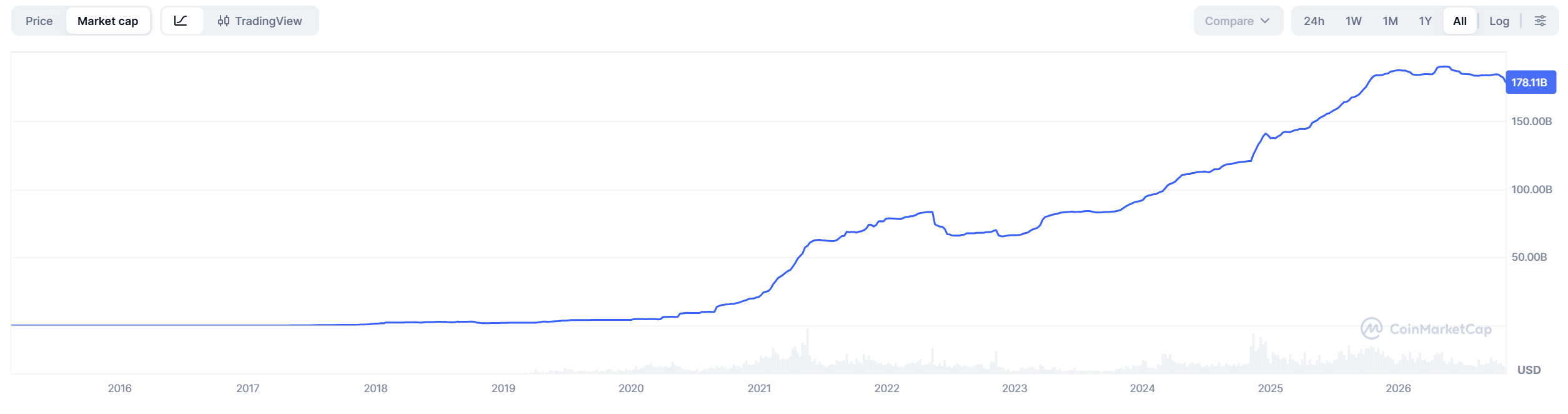
Latest data from CoinMarketCap shows that USDT currently has a market capitalization of $178.1 billion, with its issuance size declining consistently since hitting an all-time high.
The Bitcoin Holding Puzzle: Reserve Holdings Cross 100,000 BTC, CEO Reveals Group-wide Actual Control of 150,000 BTC
Since cash-like assets shrank by $1.06 billion, where did the extra $3.84 billion in buffer from the quarter come from? The answer lies in the fair value revaluation of Bitcoin.
According to the BDO report, the valuation of Bitcoin in Tether's reserve vault jumped from $5.8 billion at the end of Q2 to $8.367 billion at the end of Q3. Calculated based on the Bloomberg closing reference price of $83,621.23 per BTC on September 30 disclosed in the report's notes, the amount of Bitcoin held in Tether's reserve pool has increased from approximately 98,930 BTC at the end of June to 100,060.36 BTC.
This means Tether made a net purchase of roughly 1,130 BTC for its reserve vault in Q3, and the quarterly BTC price rally of as high as 42.6%! (MISSING) directly contributed approximately $2.47 billion in unrealized book gains, accounting for over 60% of the quarterly growth in excess reserves.
The truly earth-shattering news broke days after the earnings release. At the Plan ₿ Forum in Lugano, Switzerland, Tether CEO Paolo Ardoino made a rare disclosure that Tether itself actually holds approximately 150,000 BTC (worth over $11.5 billion at early November market prices). Why does the BDO report only reflect 100,060 BTC, leaving a discrepancy of roughly 50,000 BTC from Ardoino's statement?
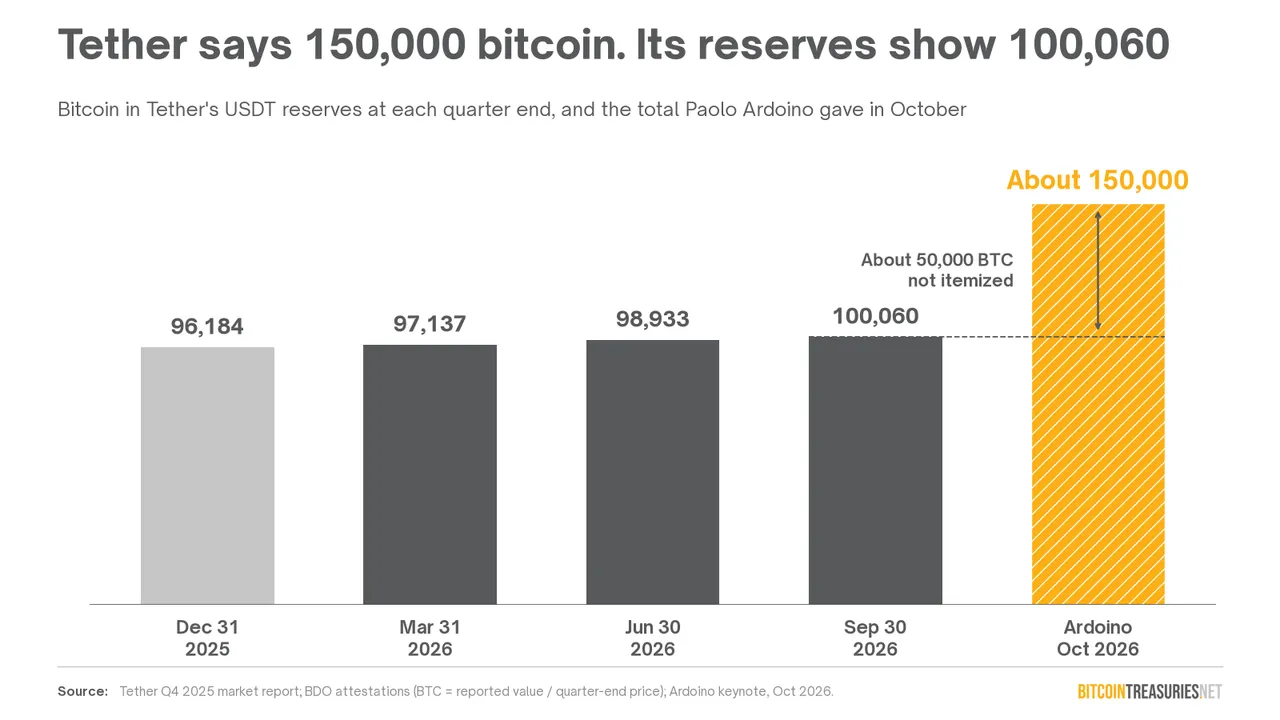
The reason for the discrepancy is that BDO only reviewed the statutory reserve pool of the El Salvador-based issuance entity, while the remaining approximately 50,000 BTC are held off-balance sheet under the group's proprietary investment entities such as Tether Investments.
Reduces Gold Holdings by 3.4 Tons, Non-cash Assets Reach $51.873 Billion
Compared with its expanded Bitcoin holdings, Tether's moves in precious metals are quite subtle. At the end of Q3, the valuation of its LBMA-standard physical gold bars edged up slightly from $18.84 billion to $19.085 billion. However, when divided by the period-end calculated gold price of $4,157.41 per ounce, its actual physical gold holding stood at 4.5905 million troy ounces (approximately 142.8 tons), a quiet decrease of about 3.4 tons from the 146.2 tons held at the end of Q2.
Meanwhile, other non-cash assets in the reserve pool continue to expand: over-collateralized secured loans increased from $13.45 billion to $14.175 billion, other investments rose from $5.24 billion to $6.004 billion, listed equity holdings (including indirect exposure to gold and Bitcoin) grew to $4.178 billion, plus $63.88 million in corporate bonds.
As of the end of September, total non-cash assets in the reserve reached $51.873 billion.
While the $7.955 billion buffer raises the maximum tolerable drawdown for this batch of risk assets from 8.7%! at the end of June (MISSING) to 15.3%! , (MISSING) it also creates a structural paradox: the buffer used to backstop these risk assets is itself propped up by bull market gains from Bitcoin and gold. The report also disclosed that the company is still facing a class action lawsuit in New York courts related to the Bitcoin price decline between 2017 and 2018, for which no provision has been set aside to date.
Once the crypto market experiences a sharp correction, this mark-to-market-dependent buffer will shrink in tandem.
Expanding Footprint: Dual-track Framework for Hash Power and Compliance
Beyond its financial report, Tether is accelerating its transition away from being a purely stablecoin issuer.
Ardoino revealed at the Lugano event that Tether and its partners have built a world-class Bitcoin mining operation with a total hash rate exceeding 50 EH/s.
For its core stablecoin business, Tether is implementing a "domestic and overseas dual-track system": on one hand, it is scaling back its offshore footprint, confirming in the BDO report notes that it has stopped redemption services for 5 legacy blockchains including Omni and EOS, as well as the euro stablecoin EURt, concentrating USDT issuance on 13 independent public blockchains including Ethereum, Tron, and Solana, and announcing it will cease redemption obligations for the offshore RMB stablecoin CNHt starting February 20, 2027.
On the other hand, it is partnering with Anchorage Digital to launch the OCC-chartered compliant stablecoin USAT in the United States to capture the local institutional market.
In hacking incident responses, Tether has also been actively serving as an "on-chain law enforcer".
Between the end of October and early November this year, Tether froze $1.5 billion in USDT related to the Binance theft case, and also cooperated to intercept over $4.5 million in involved USDT from the hacking incident targeting Brazilian exchange Mercado Bitcoin.