
Slop Cash enables open-source projects to pay for work completed with AI assistance, but how much contributors can earn, and what benefits SLOP holders can access, will ultimately depend on the platform’s real-world operations.
Written by angelilu, Foresight News
The costs of using AI to write code are already well-defined: subscription fees, model usage charges, and the time spent on repeated revisions. But when it comes to letting AI earn money on your behalf, core questions remain for many products: who will foot the bill, and on what grounds should payment be made?
Open-source projects offer a potential solution: work completed with AI assistance can earn compensation as long as it is adopted by the project. Slop Cash’s approach is to allow open-source projects to allocate dedicated budgets, where contributors submit code built with AI tools, and rewards are distributed per set rules once maintainers accept the submitted work. This connects developers’ work records on GitHub directly to compensation.
Slop Cash was co-founded by Shaw Walters and Drew Pierson. Shaw, the creator of elizaOS, leads the project’s technical development, while Drew serves as CEO, with prior experience contributing to projects including Arweave, Avalanche, and Orderly Network.
In addition, Slop Cash will launch its native token SLOP via token issuance platform Umia. The auction will open to eligible wallets at 1:00 a.m. Beijing time on November 6, launch public bidding at 1:00 a.m. on November 8, and conclude at 1:00 a.m. on November 11.
Reverse-Engineering Hyperliquid: A Case Study on How Slop Cash Rewards Contributors
The Hyperliquid node reverse-engineering initiative launched by Shaw is a specific use case hosted on Slop Cash. Previously, Shaw reverse-engineered Pump.fun’s smart contracts, but received a cease-and-desist letter from Bracket Company, Pump.fun’s parent firm, demanding he stop related activities and refrain from making the code public.
Shaw’s choice of high-profile projects such as Pump.fun and Hyperliquid also serves as a promotional entry point for Slop Cash: it attracts developers with the reverse-engineering topic, then guides them to join the platform via contribution tasks and reward mechanisms.
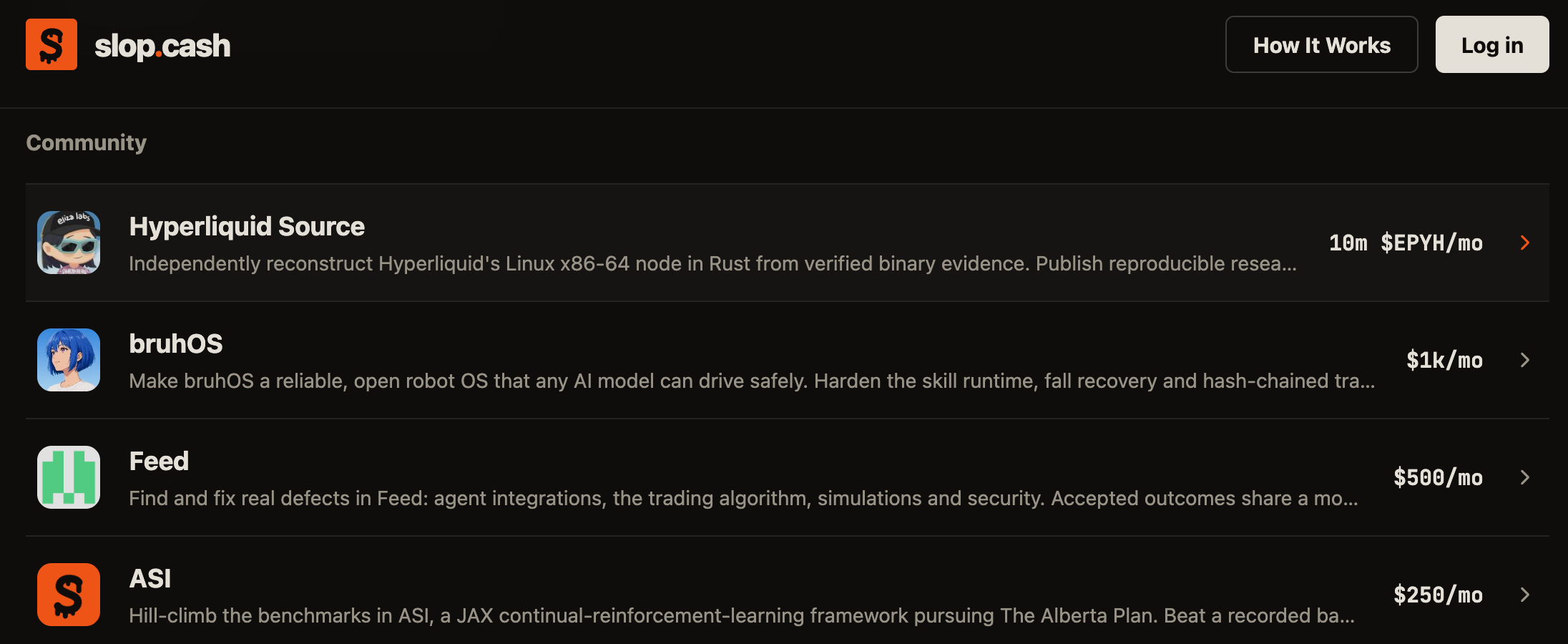
The platform has listed Hyperliquid Source as a community project, inviting contributors to analyze node programs, reconstruct code, and validate results, with a stated monthly reward pool of 10 million EPYH. Repository notes clarify that this is an independent research effort, and a runnable or functionally equivalent node has not yet been built. EPYH is not affiliated with HYPE, Hyperliquid’s native token.
Slop Cash’s operating mechanism works as follows: contributors can use AI to complete code modifications and testing, then submit change requests (known as Pull Requests, or PRs) via GitHub. Open-source project maintainers decide whether to accept submitted work; Slopbot, Slop Cash’s automated scoring tool, will evaluate the scope and value of accepted work to assign scores, which maintainers can adjust. Valuable code reviews can also earn score credits.
This mechanism requires contributors to bear upfront time and tool costs. AI generating code is only the first step; submitted work must solve the project’s real-world problems to qualify for compensation.
Slop Cash has previously disclosed actual payment data: 6,005 USDC was distributed via 72 transfers in September this year. Official records note that this batch of funds was transferred directly by project creators, without going through the full review and settlement flow that was initially designed. The current funding arrangement has shifted to treasury contracts, where project parties deposit funds, approve rewards, and then execute payments.
Since then, the payment mechanism has been under adjustment. The "14-day public review" noted in early introductions has been revised in current repository documentation: within 72 hours after the end of each month, responsible parties will adjust allocations, then finalize the recipient list, with no public review required. The funding arrangement has also shifted to project treasury contracts, where project parties deposit funds, approve rewards, and then record and execute payments.
How Can Regular Users Participate, and Are There Airdrop Opportunities?
The first step for individual participants is to select a project on the official website, review what types of work are accepted, reward terms, and funding status, then complete modifications using their own AI programming tools, and submit work to maintainers via GitHub. There is no requirement to purchase SLOP upfront to participate in these tasks.
The official website features both projects with stated monthly reward pools, and projects that only track contribution points. Contributors should first confirm whether their planned modifications fall within the reward scope, and whether reward funds are fully allocated, before deciding how much time to invest. For first-time participants, small, clearly scoped bugs that can be easily reproduced are the easiest to take through the full process of fixing, testing, and submitting for review.
Beyond code contributions, Slop Cash has also trialed content contribution incentives. The official introduction page notes that in October, review rewards were set up for tutorials, explainers, videos, or support Q&A, with eligible content earning 1 to 8 points.
Turning to airdrops, the official token allocation table lists a contributor allocation of 2 million SLOP, accounting for 2% of the total supply, which will be unlocked at TGE.
Some low-barrier point-earning tasks have already concluded. Current rules clearly state that as of October 24, users no longer earn points for registering or linking their X accounts. Points are non-transferable, non-redeemable, and do not entitle holders to payments or platform access. The only confirmed participation method at this stage is to complete work accepted by projects, then earn rewards per applicable rules; there remains an information gap on whether new contributors will be eligible for SLOP allocations.
What Benefits Do SLOP Token Buyers Receive?
Open-source projects fund rewards for contributors, while Slop Cash raises capital for platform development by selling SLOP. Token holders can participate in governance decisions on how platform funds are allocated and what fee structures are implemented, but granular details such as whether code is adopted and how much contributors earn are determined via each project’s internal review. Contributors do not need to purchase SLOP upfront to participate and receive compensation.
SLOP has a fixed total supply of 100 million tokens, with no built-in inflation or arbitrary supply increases. Of the total supply, 45% is allocated for the token auction, 14% for ecosystem development and contributor programs, 10% for the core team, 10% as performance reserves, 9% for protocol-owned liquidity, 8% as treasury reserves, 2% for contributors, and 2% for issuance platform Umia. All auctioned tokens will be unlocked in full at TGE; 20% of the auction proceeds will be paired with liquidity allocations to establish a Uniswap v4 pool held by the project treasury, with the remaining funds deposited into the project treasury.
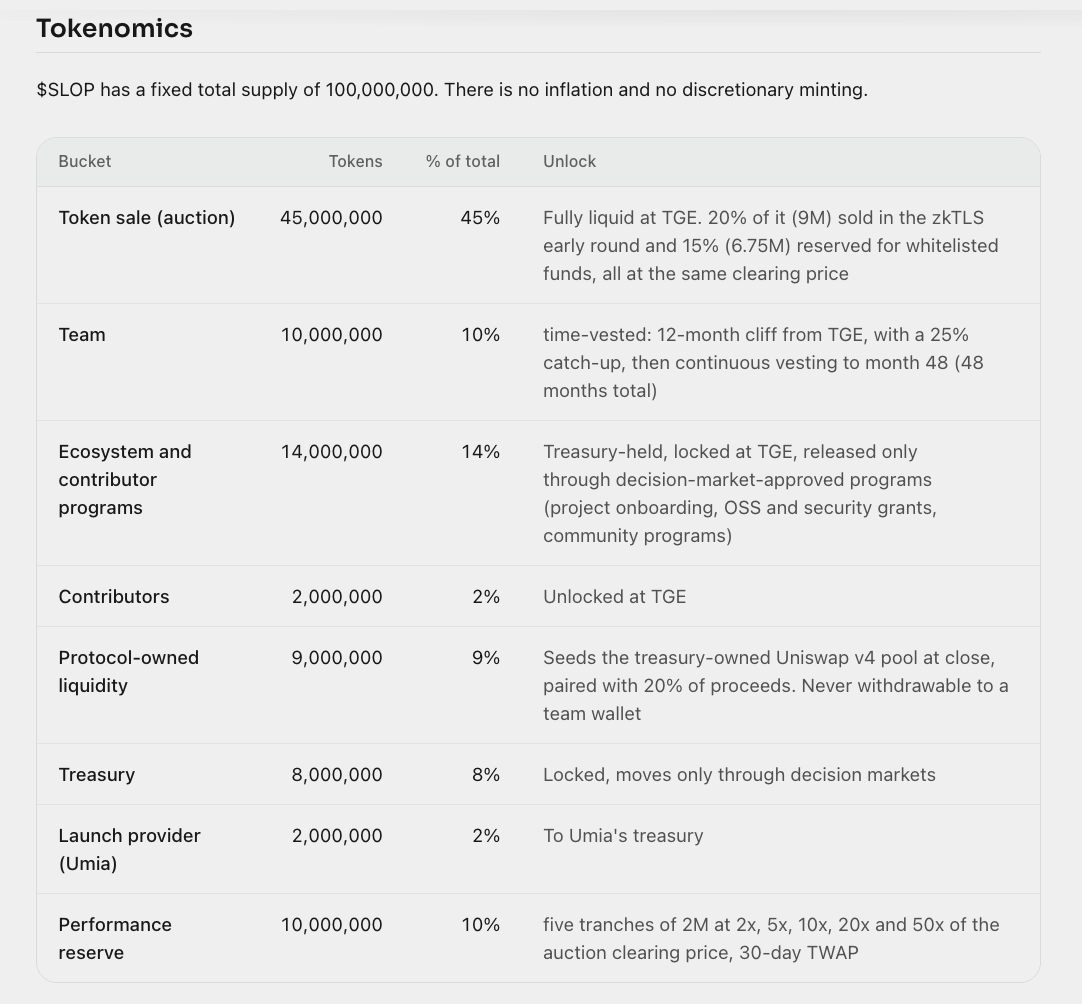
The 10% team allocation will be locked for one year, at which point 25% of the allocation will be unlocked, with the remaining portions released linearly over time until the 48th month after TGE. An additional 10% performance reserve is split into five tranches of 2 million tokens each, with unlock triggers set when the token’s 30-day time-weighted average price reaches 2x, 5x, 10x, 20x, and 50x the auction clearing price, respectively. This design ties a portion of team incentives to token price performance, but the unlock metrics are not directly linked to platform revenue or actual payment volumes.
Beyond fundraising, the platform plans to generate revenue via service fees. The current reward fee rate listed in the repository is 2%: for example, on a 100 USDC reward, the contributor receives 98 USDC; a 2% fee is also charged for withdrawing unused funds. Based on this fee rate, processing $1 million in rewards would generate $20,000 in fee revenue, before deducting operational costs.
For SLOP buyers, the investment calculus is more complex: product use does not require holding the token, user growth will not necessarily translate to direct token purchase demand, and concrete arrangements are needed to define how platform revenue benefits token holders.
For Slop Cash itself, the model of exchanging open-source contributions for compensation is not unprecedented. Platforms such as Algora have long supported setting bounties for GitHub tasks, with bonuses paid once code is merged. Slop Cash, by contrast, aims to combine AI-assisted development, contribution scoring, and on-chain reward pools to create a revenue path for AI-assisted development. Whether the platform can achieve sustainable growth will depend on which teams are willing to continue allocating budgets, how much compensation contributors actually receive, and how much revenue the platform can generate from these flows.