
Official data shows the platform has surpassed 30 million user accounts, but its boom from U.S. midterm election trading has peaked, and state-level gambling regulatory crackdowns are looming.
Written by: Ma He, Foresight News
Recently, U.S.-based regulated prediction market platform Kalshi closed a $1 billion Series G funding round, reaching a post-money valuation of $40 billion. The round was co-led by Sequoia Capital and Wellington Management. Other participating investors include Baillie Gifford, Morgan Stanley Investment Management, Coatue Management, and a16z.
Kalshi co-founder Tarek Mansour declined to comment on whether and when the company will go public, only noting that "relevant discussions have taken place". However, his social media post revealed the latest valuation is anchored to the platform's ~$4 billion in annualized total revenue, translating to a price-to-sales ratio of roughly 10x. Mansour also wrote that the funding will be primarily allocated to: leveraged event contracts, single-stock perpetual futures, and computing power price markets.

This marks Kalshi's second multi-billion-dollar funding round in less than six months. In May this year, the platform closed a $1 billion Series F round led by Coatue, with a post-money valuation of $22 billion. Growing from $22 billion to $40 billion, its valuation has risen by nearly 82%! in roughly five months. (MISSING)
Annualized Trading Volume Surpasses $1 Trillion, User Accounts Top 30 Million
Kalshi disclosed its latest operational metrics alongside the funding announcement.
The company stated that its total annualized trading volume has exceeded $1 trillion, spanning categories including prediction markets, commodities, crypto, and perpetual futures. Annualized revenue from non-sports trading categories has crossed the $1 billion mark, with over 30 million registered platform users, accounting for more than 75%! of (MISSING) the liquidity share across the entire U.S. prediction market sector.
Kalshi's commodities trading vertical, launched only three months ago, has already crossed $100 million in annualized trading fees. Its crypto vertical has hit $140 billion in annualized trading volume, while political event trading has surpassed $8 billion in annualized volume. Since launching perpetual futures products several months ago, the platform has recorded $83 billion in cumulative trading volume across these contracts, with over 500,000 unique traders participating.
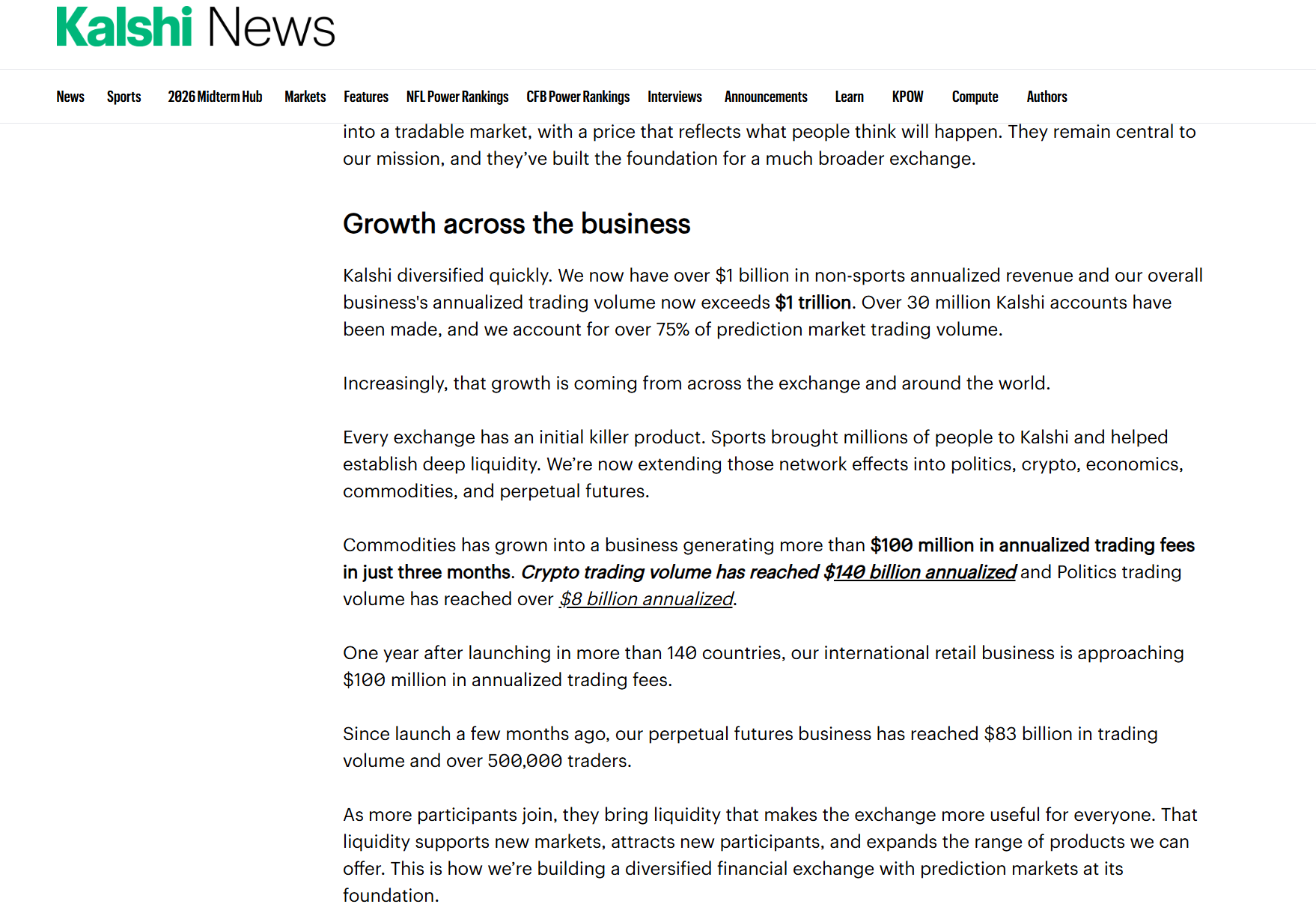
On the institutional side, roughly 500 active institutional entities were present on the Kalshi platform as of September this year. Excluding market makers, these institutional players account for ~25%! of (MISSING) total platform trading volume. The platform's international retail business, launched around a year ago and now covering over 140 countries, is approaching $100 million in annualized trading fees.
The exponential growth in core operational metrics may signal that Kalshi is moving past its initial identity as a lightweight platform for sports betting and political event trading, making tangible inroads to become a fully licensed, multi-asset comprehensive derivatives exchange.
The company has already launched perpetual futures for crypto, stock indices, and metals this year, and is partnering with institutions such as S&P to expand its index-linked product suite. According to official statements, future product launches will include single-stock perpetual futures, computing power markets, and more, alongside expanded sales and distribution capabilities targeted at hedge funds, proprietary trading firms, and traditional financial institutions. International expansion will prioritize Latin America and Europe.
Yet behind Kalshi's massive funding rounds and aggressive expansion, significant controversies are brewing.
Data Controversies and Business Rivalry
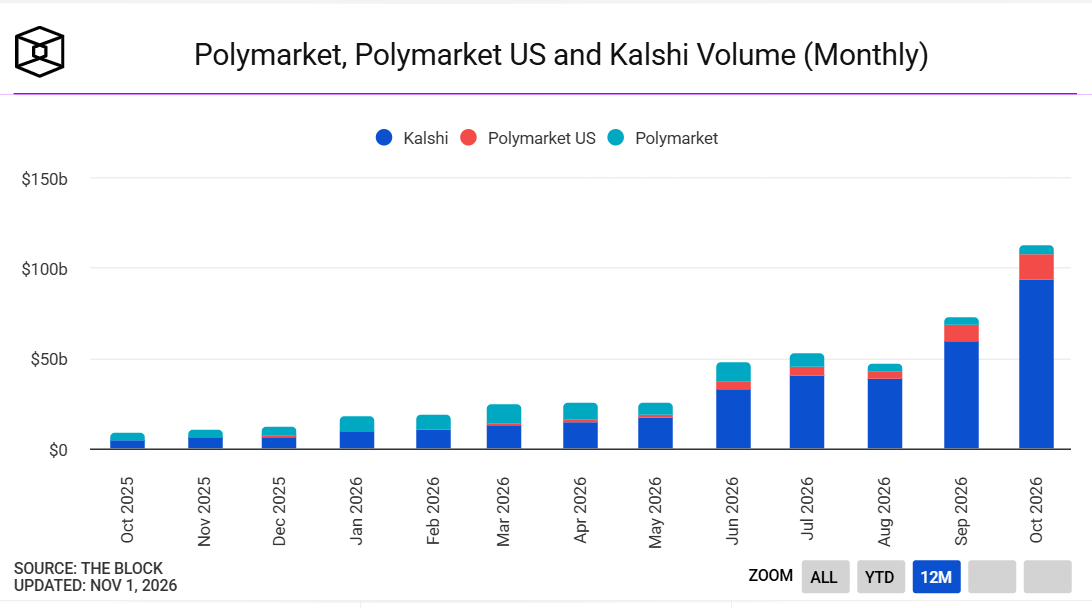
According to latest data from The Block, over the past 30 days, Kalshi has recorded $93.36 billion in monthly trading volume, leading both Polymarket and Polymarket US by a wide margin.
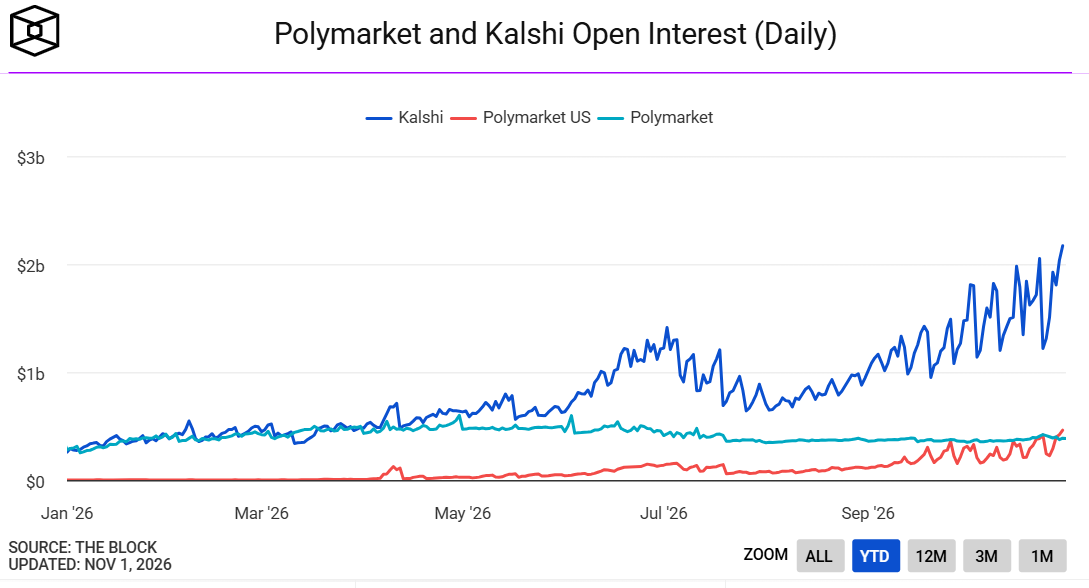
Additional data on open interest (OI) also shows Kalshi holding a significant lead over Polymarket in trading volume.
Notably, some of Kalshi's previously released performance metrics have faced public scrutiny.
On September 20, Kalshi's crypto lead IcoBeast.eth shared a chart showing that Kalshi recorded $363.9 million in crypto trading volume, capturing 96.7%! of (MISSING) market share, far outpacing Polymarket's $12.3 million in volume.
Shortly after, Beni, a former quantitative trader and current co-founder of Stealth Neolab, published a long public post with a core, uncompromising claim: Kalshi is fabricating its crypto trading volume, and he has evidence to prove it. He pointed out that ETH perpetual futures on the platform recorded $539 million in 24-hour trading volume, but held only $3.1 million in open interest (OI), resulting in an absurd volume-to-OI ratio of 174x. He also noted that repetitive, identical $5,500 trade orders accounted for 58%! of (MISSING) total trading volume over a full four-day period.
Kalshi responded that prediction markets and crypto perpetual futures are separate product verticals, but the controversy did not subside, and at one point spread to scrutiny of its event contract offerings.
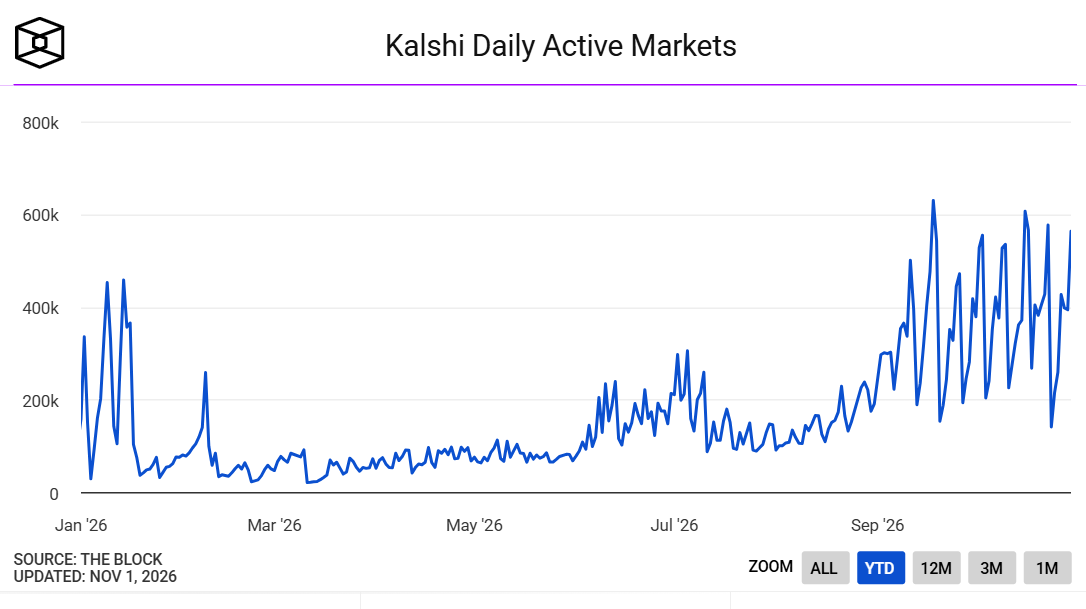
Even so, Kalshi's count of daily active markets has stagnated.
While Kalshi positions regulatory compliance as its core competitive moat, its daily active market count has oscillated repeatedly over the past year, only sitting slightly above the 400,000 level recorded in January this year, even after a September uptick.
Polymarket is also currently preparing for its own new funding round.
In early September this year, Bloomberg reported that Polymarket had appointed its first-ever Chief Financial Officer, Warren Jenson. The report added that Polymarket is targeting $1 billion in new funding, led by venture capital firm 1789 Capital, which would bring its valuation to $21 billion. Donald Trump Jr. is a partner at 1789 Capital, and also serves as an advisor to both Polymarket and Kalshi.
In June this year, The New York Times also reported on the intense corporate rivalry between the two platforms.
Internal Polymarket documents compiled a file of more than a dozen cases where the company believes Kalshi engaged in "too coincidental" overlap in product launches, marketing campaigns, and platform design. Polymarket's head of markets Matthew Modabber told the New York Post that Polymarket planned a free food distribution event in New York on February 12 this year, only for Kalshi to launch a nearly identical coupon promotion roughly nine days in advance. Polymarket had originally scheduled an announcement for its perpetual futures product on April 21, but roughly one hour before the planned launch, tech outlet The Information reported that Kalshi was preparing to launch an identical product.
Modabber also claimed that Kalshi backer Paradigm has an office in Manhattan's SoHo district located directly across the street from Polymarket's headquarters, with unobstructed line of sight to parts of Polymarket's floors, and even potentially to employee computer screens. In response, Polymarket installed privacy window films on select office windows in spring 2026.
Both Kalshi and Paradigm later dismissed the claim as ridiculous.
Criminal Charges Filed
Behind Kalshi's aggressive expansion, the jurisdictional rift between federal regulatory authority and state-level governance has become a Damocles' sword hanging over its business empire, with its sports-related event contracts serving as the core point of litigation.
Multiple U.S. states argue that these contracts are effectively unlicensed sports betting operations, which should be subject to local gambling regulations. Kalshi, by contrast, maintains that its event contracts, offered under its status as a CFTC-designated Contract Market (DCM), qualify as "swaps" under the federal Commodity Exchange Act, falling exclusively under CFTC jurisdiction and immune from state law interference.
Circuit courts have so far issued conflicting rulings on the litigation. Some circuits, such as the Third Circuit Court of Appeals, have leaned toward upholding federal regulatory priority. Others, including the Ninth Circuit Court of Appeals, have ruled that sports event contracts are more closely aligned with sports betting, and should not be treated as federally protected swaps. Sports organizations including the NFL have submitted amicus curiae briefs in support of states' push for the Supreme Court to review the relevant regulatory questions.
In October, Bloomberg reported that the Utah Attorney General's office filed criminal charges against prediction market platform Kalshi, as well as its co-founders Tarek Mansour and Luana Lopes Lara, alleging they illegally promoted online gambling in the state. The charges include one second-degree felony of illicit pattern of activity, 12 third-degree felonies related to online gambling promotion, and one misdemeanor for general gambling promotion. The state also filed a civil forfeiture lawsuit in state court seeking damages ranging from $30 million to $60 million.
State prosecutors stated that undercover agents, while confirmed to be physically located in Utah, were able to place 12 sports event bets through the Kalshi platform. Kalshi called the action "an outrageous overreach of authority", noting it would defend itself in court.
The same month, the U.S. Commodity Futures Trading Commission (CFTC) filed a suit in the U.S. District Court for Utah, seeking to block the state from taking regulatory action against prediction market platforms.
None of these disputes have been fully resolved, and a final Supreme Court ruling may be required to clarify the regulatory boundaries for sports event contracts.
With the midterm election trading boom peaking, and state-level gambling crackdowns looming, Kalshi may need to lock in deep ties with Wall Street institutional players, before its core legal legitimacy is reshaped by judicial rulings, to secure a genuine window of breathing room.