
Starting from SAFU holdings, public reserves, and historical profits, this article breaks down the reimbursement math behind the estimated $6.3 billion in stolen assets.
Written by angelilu, Foresight News
On October 30, Binancerevealed that the preliminary loss from the security incident reached roughly $6.3 billion, stating that it would draw on the SAFU fund and corporate funds to fully cover all user losses. The critical follow-up question is: how large are these two funding pools, and can they replenish the siphoned-off assets in a timely fashion?
Previously, Binance disclosed that roughly $3 billion in funds had been verified as frozen. If these assets are fully recovered in the end, there remains a gap of around $3.3 billion to be covered via other channels, based on the $6.3 billion preliminary loss estimate. Before the recovery process is completed, Binance also needs to prepare sufficient available funds to meet user withdrawal demands once withdrawals are resumed.
Where will this funding come from? The publicly disclosed information about Binance's SAFU fund, proof of reserves, and wallet inventory offers several leads for further investigation.
The $1 Billion SAFU Fund Converted to Bitcoin Saw Only Limited Value Appreciation
Binance established the SAFU (Secure Asset Fund for Users) to cover extreme events such as hacking attacks. This is the most readily identifiable pool of protective funds earmarked for this reimbursement effort.
On February 12 this year, Binance completed its plan to convert around $1 billion in stablecoins into Bitcoin, disclosing that SAFU holds 15,000 BTC. Calculated based on the price of roughly $67,000 per BTC at the time the conversion was completed, the fund was worth approximately $1.005 billion at that point.
Assuming SAFU still holds 15,000 BTC, the fund is estimated to be worth around $1.155 billion based on today's price of $77,000 per BTC. This represents an increase of roughly $150 million, or about 14.9%!。(MISSING), from the level at the time the conversion was completed.
Binance has previously committed to replenishing SAFU back to $1 billion if its value falls below $800 million. Based on the aforementioned holdings, the trigger price for this commitment works out to roughly $53,300 per BTC. Even calculated at this year's lowest BTC price of $57,802, the fund would still hold a value of approximately $867 million, which has not yet hit the replenishment threshold. As such, this article temporarily uses the original holdings for valuation purposes; it remains to be verified whether Binance has proactively added funds to SAFU, or whether the fund has already been drawn on in response to this incident.
Even if the full $1.155 billion from SAFU is allocated to reimbursement, and the full $3 billion in frozen assets is eventually recovered, there remains a gap of around $2.145 billion to be covered by other funding sources.
There is indeed some buffer revealed in the Proof of Reserves
Beyond SAFU, Binance's Proof of Reserves page also discloses the amount by which held assets exceed the net balance of user accounts for selected assets.
As of the time of writing, the latest publicly available snapshot is dated 00:00 UTC on October 1, 2026. In this snapshot, "net account balance" refers to the net value of user assets calculated by Binance per its Proof of Reserves methodology, while "on-chain wallet balance" refers to the amount of crypto held in wallets that back these user assets. Subtracting the former from the latter shows how much the public reserves exceeded the net user account balance at the time of the snapshot.
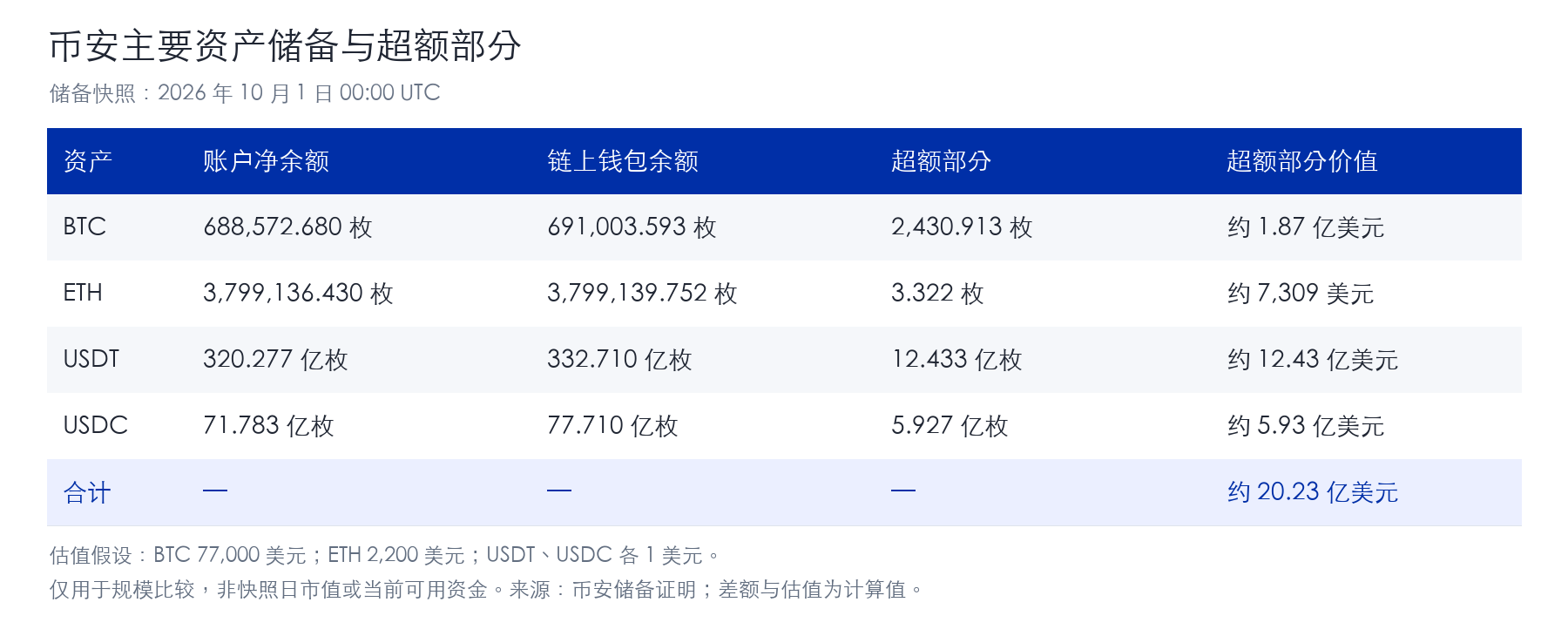
Of this excess, the combined surplus of USDT and USDC totals around $1.836 billion; BTC has a surplus of 2,430.913 units, worth approximately $187 million at $77,000 per BTC. The held ETH balance, by contrast, is nearly exactly matched to cover the net user account balance.
This article also compiled data from Binance's publicly downloadable wallet files for October 1, confirming that the balances of BTC, ETH, USDT, and USDC are fully consistent with the figures on the reserves page. However, these figures reflect the state of the platform at the start of the month. User deposits, withdrawals, trading activity, and internal platform transfers over the nearly one-month period since then may have all changed the size of this surplus.
Binance also notes on its reserves page that the amount of excess assets held under the Proof of Reserves addresses does not represent the total value of the company's proprietary assets. As such, these figures can demonstrate a portion of the reserve buffer, but cannot act as a substitute for the company's full financial statements.
While On-Paper Figures Approach $6.3 Billion, Funds Must Actually Be Available to Cover Losses
According to Binance's official disclosures, SAFU is an emergency fund earmarked for extreme scenarios, and is reported separately from user asset reserves.
If we value SAFU at $1.155 billion, add the $1.836 billion combined excess of USDT and USDC from the start-of-month snapshot, the $187 million BTC surplus, and the roughly $3 billion in frozen assets, the mechanical sum of these figures comes to around $6.178 billion, which comes close to matching the preliminary disclosed loss.
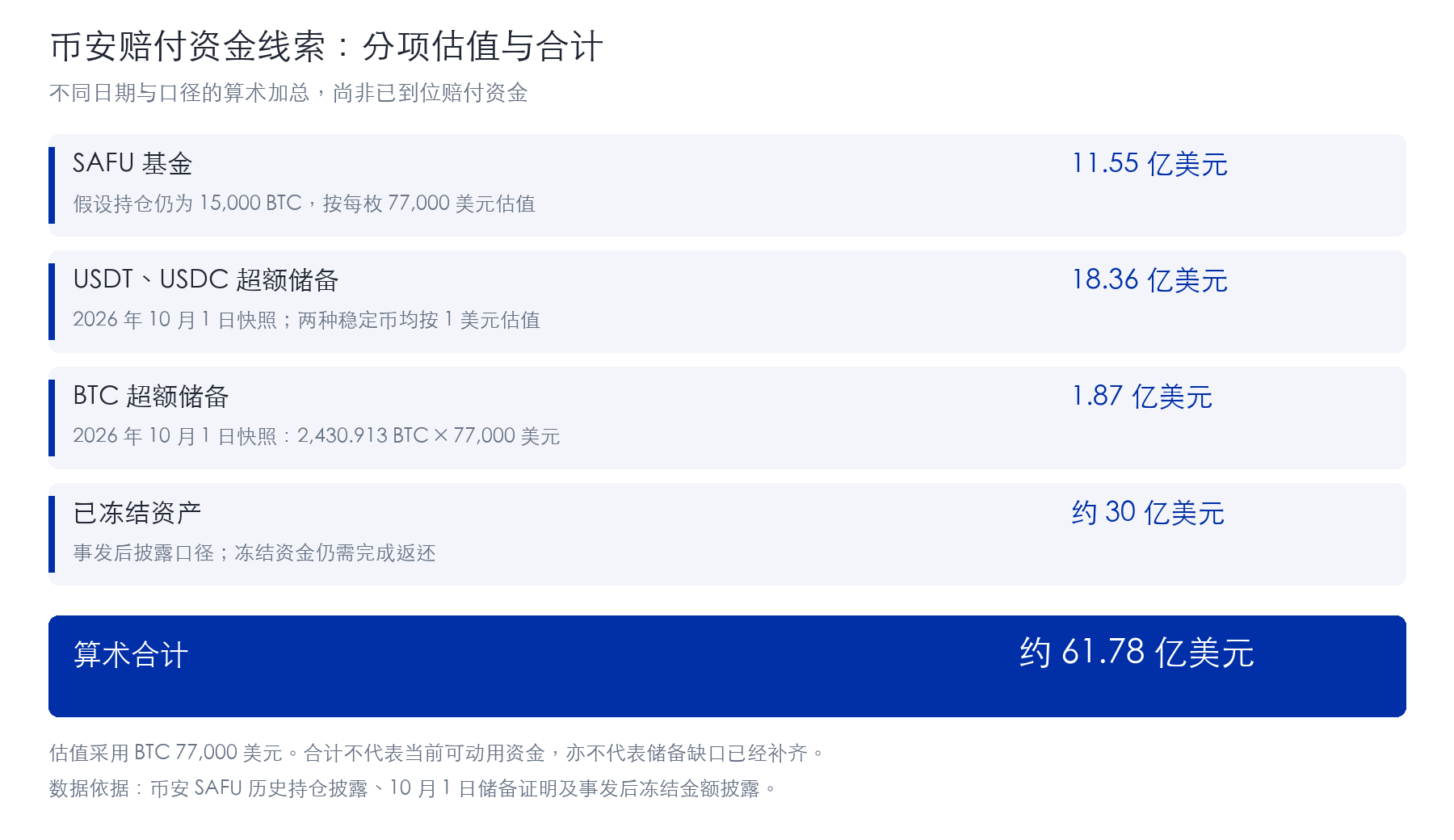
However, this arithmetic exercise can only be used to contextualize the scale of the gap. The $6.178 billion figure is simply the arithmetic sum of several public data points: SAFU is valued based on previously disclosed holdings, excess reserves are pulled from the start-of-month snapshot, and frozen assets are counted from post-incident tracking. This combined total has not undergone full reconciliation for consistent timestamps, address coverage, and actual fund availability, and cannot be treated as equivalent to reimbursement funds that Binance has fully ready to deploy.
The largest time gap among these figures comes from the frozen assets.
Freezing funds can stop attackers from further siphoning off assets, reducing the scale of unrecoverable losses; however, Binance must still complete the corresponding asset recovery procedures before it can regain control of these frozen funds. If withdrawals are resumed first, the platform will need to use other available funds to meet user demand.
Internal fund transfers can resolve partial liquidity turnover issues. For example, moving funds from cold wallets to hot wallets can top up balances available for withdrawals. But after the platform's total asset value is reduced due to the attack, simply shifting funds between its own wallets cannot fill the gap in the total asset pool.
To fill this loss gap, Binance will need to either recover stolen assets, inject its own proprietary funds, or secure external funding support. The company's final choice of channels and the share of burden each will carry remain the subject of incomplete public disclosure.
Historical Profit Accumulation May Form Another Layer of Financial Buffer
Beyond SAFU and public reserves, Binance may also draw on proprietary funds accumulated from years of operations. Exchanges generate continuous fee revenue, and after deducting operating costs, any profits retained within the company can serve as a funding source to cover losses.
Binance has previously disclosed partial profit figures in the past. In December 2020, then-Chief Executive Officer Changpeng Zhao told Bloomberg that Binance's 2019 profit was roughly $570 million, and that it expected full-year 2020 profit to reach $800 million to $1 billion. These historical disclosures show that even when its business was much smaller, Binance already had the capacity to earn hundreds of millions of dollars in profit annually.
Markets have in the past estimated Binance's profit scale by analyzing quarterly BNB burn amounts. Under the original rule that linked burn amounts to 20%!挂(MISSING) of quarterly profit, research institutions could multiply the burn amount by 5 to derive the corresponding profit figure. In its 2019 research, 21Shares used this method to estimate Binance's 2018 profit at approximately $447 million, while explicitly noting that this was only an estimate of the company's financial performance.
As burn rules were adjusted over time, this observational method gradually became invalid. In December 2021, Binance announced the introduction of BNB Auto-Burn, which automatically calculates burn amounts based on parameters including BNB price and quarterly block production, explicitly stating that this mechanism is independent of revenue generated by BNB trading on Binance's centralized exchange. As a result, the burn values worth hundreds of millions or even billions of dollars in recent announcements can no longer be converted to Binance's profit via a fixed multiplier, nor do they reflect how much actual cash the company has spent.
Peer exchange financial reports can provide a reference point. Coinbase's 2025 full-year net profit was approximately $1.26 billion, compared to $2.579 billion in 2024. This shows that large crypto trading platforms can accumulate billion-dollar-scale profits during profitable years, and retained operational earnings can form an important financial buffer beyond dedicated emergency funds.
However, there is insufficient basis to treat Coinbase's profit level as the lower bound for Binance's earnings. Beyond trading volume, actual fee levels, business revenue mix, operating costs, and investment gains and losses all impact final profit. Coinbase's data can help contextualize the profit scale of the industry, but how much available funds Binance has actually accumulated for reimbursement purposes still requires the company's official financial disclosure.
In addition, the personal wealth of Binance founder Changpeng Zhao is viewed as a potential source of support by market observers. Forbes estimated his net worth at approximately $114.6 billion as of October 29, 2026, with wealth sources including equity stakes in Binance and BNB holdings. Changpeng Zhao stepped down as Binance CEO in 2023 but retains his shareholder status. This net worth figure includes valuations of equity and token holdings, and the scale of immediately accessible cash is not publicly disclosed. If these funds are to be used to support the current reimbursement effort, concrete capital contribution arrangements will be required, and the personal assets cannot be directly counted as part of Binance's existing protective funds.