
Alipay has denied supporting virtual currency transactions and related services, stating that claims from third-party platforms alleging users can purchase crypto via Alipay are false and unauthorized. This response targets the RMB trading function launched by Peer, a P2P fiat channel project.
Written by ChandlerZ, Foresight News
On October 29, Alipay posted on Twitter stating that it does not support virtual currency transactions or related services, and that claims alleging it supports crypto purchases on third-party platforms are false and unauthorized. The platform reminded users to stay vigilant to protect their funds and account security.
Prior to Alipay’s statement, P2P fiat channel project Peer had announced on Twitter that it now supports buying and selling USDC with RMB via Alipay.
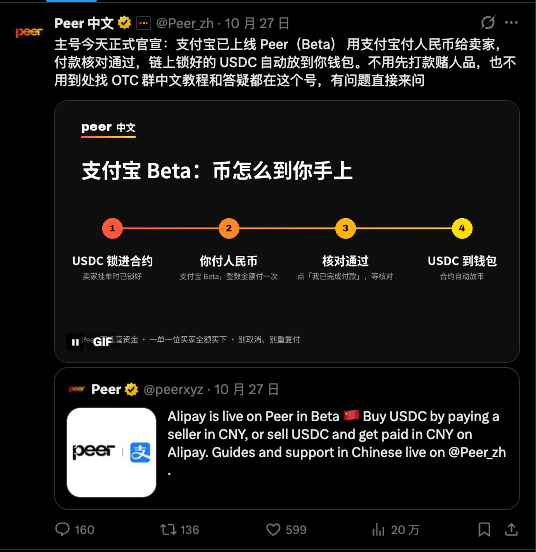
Peer’s Chinese-language account shared an example sell order: per its introduction, a seller received RMB 702 after selling 100 USDC on the platform, while selling the same 100 stablecoins via Binance OTC merchants would have yielded roughly RMB 663 at the time.
The RMB 39 price gap has drawn significant attention to Peer’s Alipay-powered trading feature. Higher quotes are naturally attractive to users looking to convert stablecoins to RMB. However, whether a trade can be completed smoothly, and the actual final amount a user receives, ultimately depends on the quotes posted by both buyers and sellers as well as associated fees.
Peer noted that its Alipay-based RMB-denominated USDC trading feature is currently in a testing phase. Per its disclosed data, 45 buyers have completed 107 related orders totaling approximately US$7,094 since August 21.
How Can Personal Transfers Be Converted to On-Chain USDC?
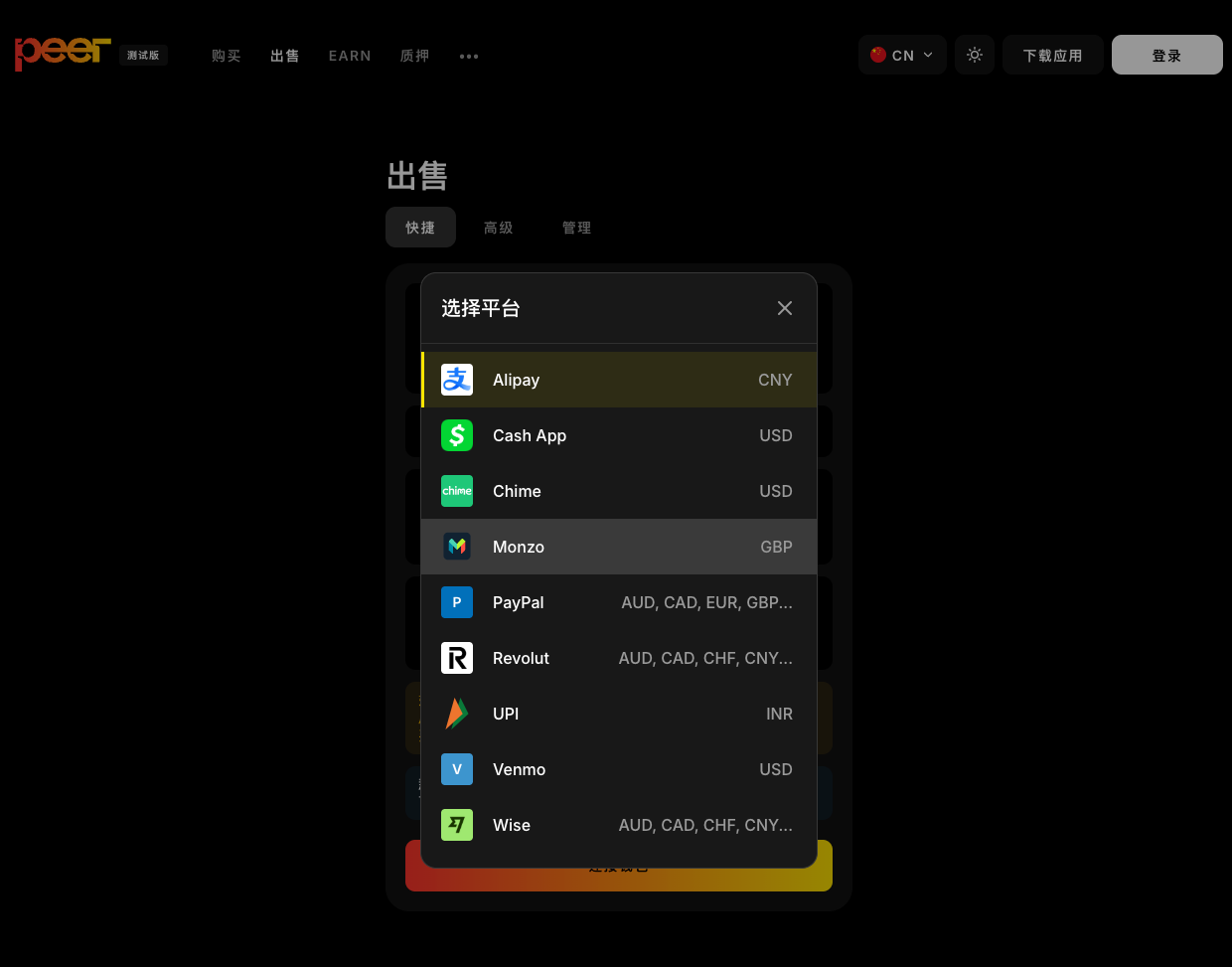
Peer is a P2P trading project connecting fiat payment rails to crypto assets, previously known as ZKP2P. The project received early support from the Ethereum Foundation’s Privacy and Scaling Explorations (PSE) team, and later deployed on Base, the network incubated by Coinbase. Beyond Alipay, Peer also supports payment channels including Cash App, PayPal, Venmo, Revolut, and Wise.
Per the project’s explanation, taking USDC sales as an example: sellers first deposit the USDC they plan to sell into a smart contract on the Base chain, then set their preferred payment method and ask price. Once a buyer accepts the order, they transfer RMB directly to the seller’s Alipay account. Peer verifies the payment details, and once the information matches the order terms, the smart contract releases the escrowed USDC to the buyer’s wallet.
In this flow, RMB funds are transferred directly from the buyer’s Alipay account to the seller, while Peer’s smart contract handles the escrow and release of on-chain USDC. After a buyer completes payment, the system verifies payment details. Some seller workflows support automatic verification, releasing funds immediately once payment is confirmed, without requiring manual step-by-step operation from sellers.
Payment verification is the technical foundation of this workflow. Peer initially developed payment verification solutions based on zero-knowledge proofs (ZKPs), and later introduced Trusted Execution Environments (TEEs) to handle parts of the verification process. Put simply, the system cross-checks payment details in an isolated environment and generates proof that can be validated by the smart contract. The contract then decides whether to release USDC based on the proof and pre-set order terms.
This automatic coin release mechanism removes the step of buyers having to wait for sellers to manually confirm payment, and also reduces the risk of sellers refusing to release USDC after receiving fiat funds.
This process is analogous to Alipay’s early escrow service on Taobao: back then, buyers transferred payment to Alipay for safekeeping first, and the funds were only released to sellers after buyers confirmed receipt of goods, to mitigate risks arising from mutual distrust between the two parties. C2C trading on crypto exchanges also typically works by platforms temporarily locking sellers’ crypto assets, before buyers and sellers complete payment and confirmation, with platforms able to intervene to resolve disputes if they arise.
Peer also aims to solve the mutual distrust problem between buyers and sellers, but its escrow and verification model differs from traditional platforms. Sellers’ USDC is locked in a smart contract, while RMB funds are transferred directly to the seller’s account. Once payment details are verified, the contract releases funds per pre-set terms. While the smart contract provides asset escrow and the verification mechanism confirms payment information to complete trades, this setup does not guarantee the safety of the source of received funds. The system only checks if a payment occurred, and whether the transferred amount and recipient details match the order terms. It is impossible to trace the original source of the RMB funds solely based on payment records.
What Kind of Funds Might Sellers Receive When Selling USDC?
When selling USDC on Peer, sellers receive RMB transferred directly from buyers via Alipay. Since sellers usually cannot trace the prior flow of these funds, if the funds are linked to illegal activities such as fraud, the receiving account may face restrictions, and the already released USDC may be difficult to recover.
Third-party payment is a high-risk scenario: scammers buy USDC from crypto sellers, while simultaneously luring victims to transfer money elsewhere, providing victims with the crypto seller’s receiving account information. After the seller sees the funds arrive and releases the USDC, the receiving account may be traced back as part of the investigation when the victim reports the case to police.
Additionally, payment institutions may implement risk control measures based on account usage, and authorized bodies such as public security bureaus may legally freeze funds or accounts involved in illegal cases. For account restrictions imposed by payment institutions, users can verify the reason directly with the payment provider; for judicial freezes, users need to consult the authorized body that imposed the freeze to understand the handling procedures.
Peer has showcased completed trades with higher price quotes than other channels, but higher prices do not help sellers verify the source of incoming funds. Even if the platform adds user verification requirements in the future, it cannot guarantee that the upstream source of every payment is legitimate.
For users buying USDC, they need to pay attention to the assets they receive: “dirty USDC” linked to theft, fraud, or money laundering may face scrutiny when transferred to exchanges or other service providers. Additionally, USDC issuer Circle can restrict on-chain addresses from sending or receiving USDC under specific circumstances; once an address is added to the restriction list, related assets may be untransferable.
Beyond Payment Verification: Account and Regulatory Risks
Beyond fund source risks, users also need to consider how their payment account information is used in the verification process. Peer’s web flow requires browser extensions and payment account verification. Security research team TLSNotary has pointed out that when using TEE-based verification, payment account session information and payment response data are decrypted and processed in an isolated environment, with security depending on hardware isolation, running code, and verification mechanisms. Users should fully understand the required permissions and data processing practices before installing third-party extensions and enabling account verification features.
Mismatches between payment and verification may also occur during trades. If a buyer has already transferred funds but verification is not completed as expected, how to release on-chain assets and process fiat refunds needs to be resolved on a case-by-case order basis. Alipay has clearly stated that the relevant services are unauthorized; even if personal transfers can be completed, this does not mean such trades are endorsed by Alipay.
For users based in mainland China, such trades also implicate relevant regulatory rules. In February 2026, the People’s Bank of China and seven other national authorities jointly issued a notice classifying services including fiat-to-virtual-currency exchange as illegal financial activities, and requiring financial institutions and non-bank payment institutions to prohibit services such as fund transfer, clearing, and settlement for such activities. The notice also clarifies that civil legal acts related to virtual currency investment that violate public order and good morals are invalid, with losses borne by the participants themselves; cases involving suspected illegal or criminal activities will be handled in accordance with the law.
If a user’s account has already been restricted, they should keep all records including order details, transfer receipts, and chat logs, and verify the reason for the restriction via official Alipay channels. For cases involving judicial freezes, users should consult the authorized body that imposed the freeze to understand the relevant procedures. Users should never trust strangers claiming they can unfreeze accounts for a fee.