
A portion of the protocol's revenue will be used to programmatically purchase its native token CHIP.
Written by Ma He, Foresight News
On October 28, the USD.AI team published a detailed article outlining its adjusted protocol revenue distribution framework. Under the new framework, all net interest margin (NIM) generated from sUSDai — the protocol's yield-bearing deposit receipt — will be allocated to programmatically purchase the protocol's native token CHIP, after deducting the operational costs of the CHIP Foundation.
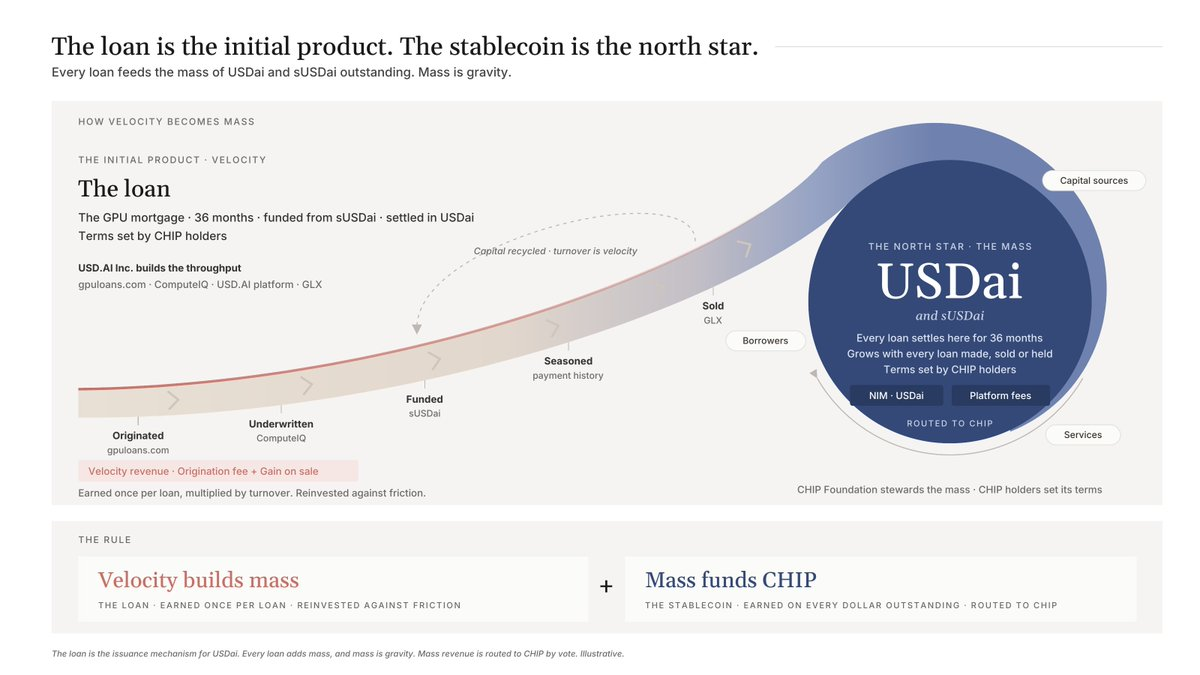
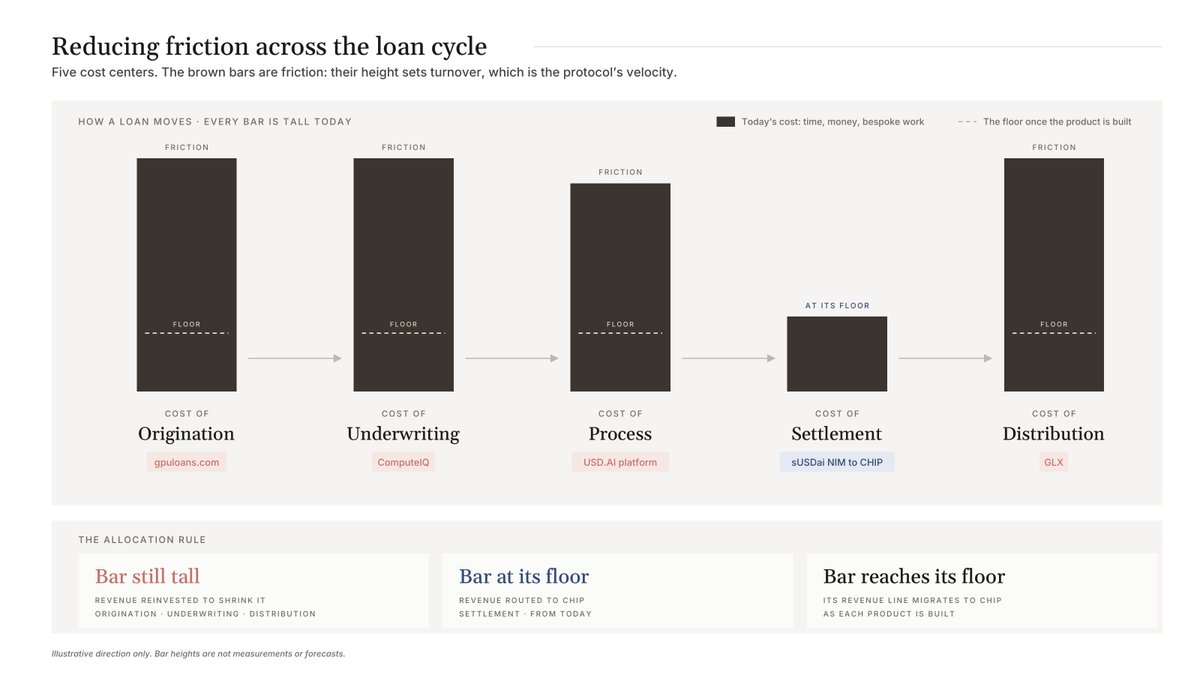
In addition, the majority of origination fees and proceeds from loan sales via GLX (GPU Loans Exchange, a loan distribution platform) will be reinvested by USD.AI Inc. to cut the costs and turnaround time of origination, underwriting and distribution processes. Of the sale proceeds, 40% will be channeled to a yield reserve, which will be used to top up sUSDai's net annualized return to CHIP's benchmark interest rate threshold of 7% following loan sales, without exceeding that level. The USDai net interest margin mechanism is not yet activated, and will only be launched upon a governance vote by CHIP holders.
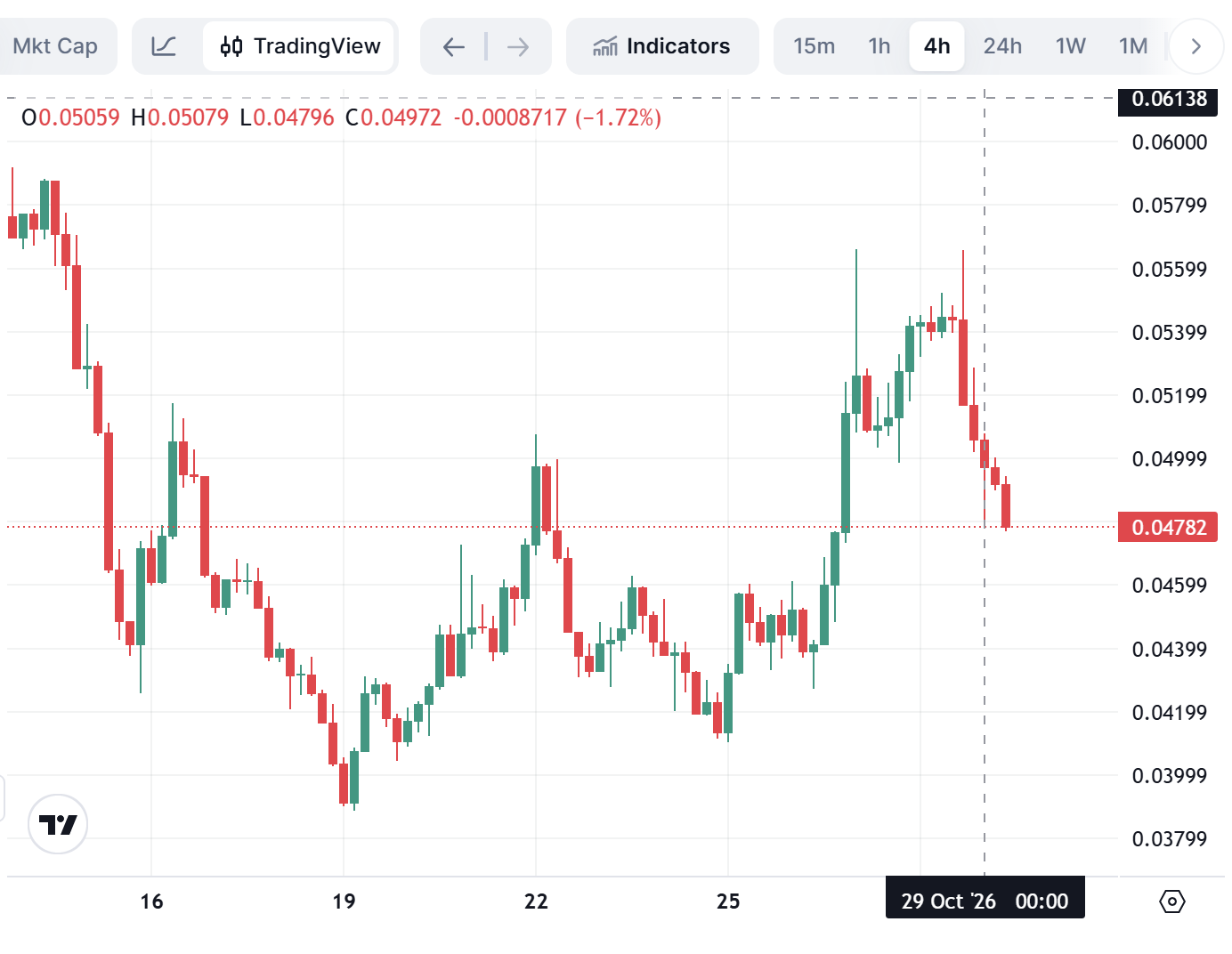
Market data shows CHIP has not posted any notable upward momentum. After hitting a price high of $0.057 on October 18, the token has since pulled back to $0.047, with a 24-hour drop of over 12%. Its current market cap stands at $100 million, with a fully diluted valuation (FDV) of roughly $480 million.
The official framework categorizes protocol revenue into two types. The first is "velocity revenue", generated throughout loan origination and transfer processes, which currently funds reinvestments to improve capital turnover efficiency. The second is "quality revenue", derived from outstanding asset stock, primarily sourced from sUSDai net interest margins and the potential future USDai net interest margin mechanism.
The core of this adjustment is to direct quality revenue from the already standardized settlement workflow directly to CHIP purchases. The long-term goal is for the protocol's CHIP purchase volume to exceed new token issuance, thereby achieving net deflation.
The official team also noted, however, that buyback actions do not automatically reduce circulating supply. The final impact will depend on whether the repurchased tokens are burned, locked, or reallocated, and the relevant mechanisms remain to be clarified through protocol governance.
Prior to this announcement, USD.AI Inc. had completed $1 million worth of CHIP purchases across multiple exchanges using USDC on October 26, acquiring more than 22.34 million CHIP at an average price of roughly $0.044756 per token.
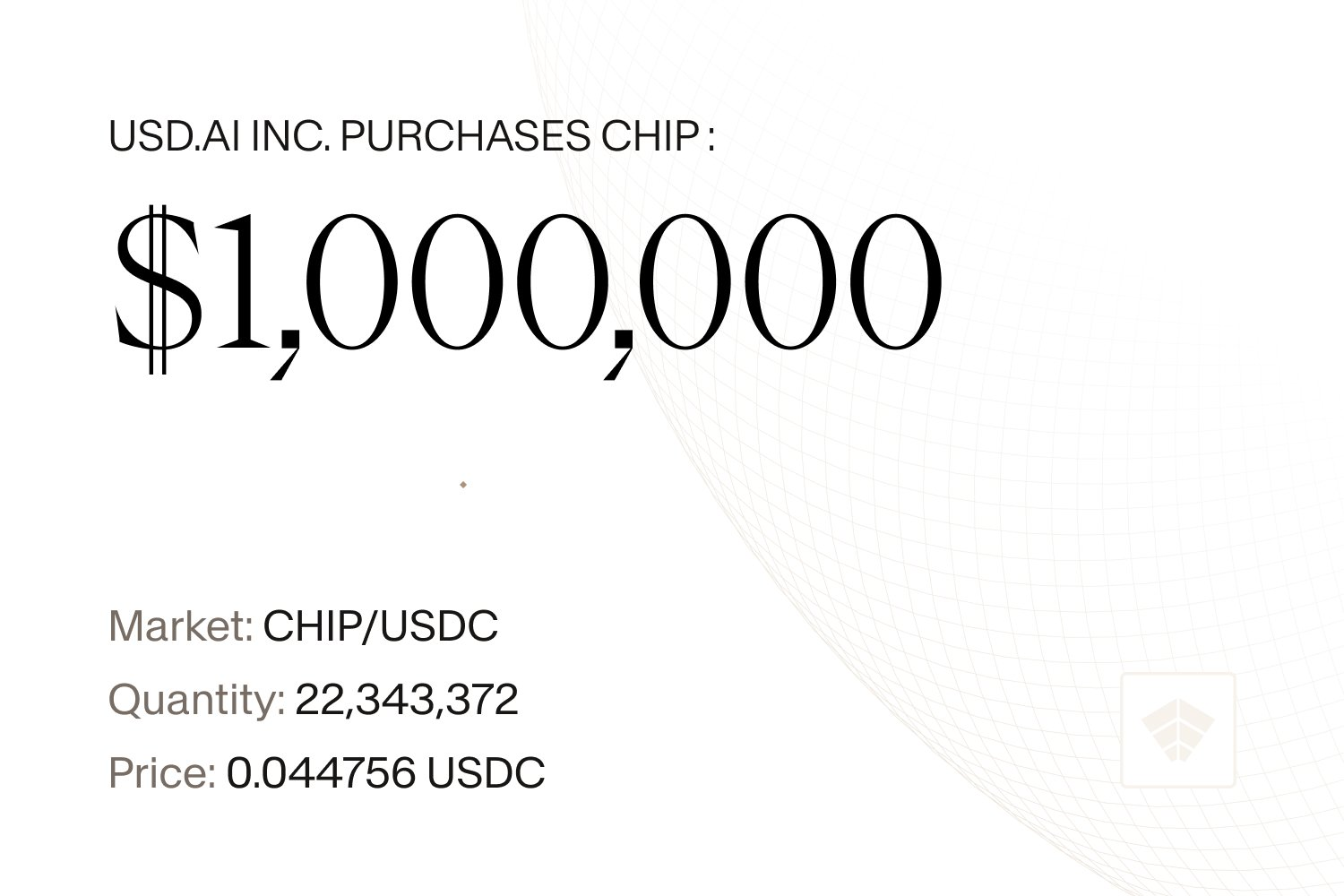
It is worth noting that this CHIP buyback was only a market-making purchase executed by the core team, and operates under a completely separate mechanism from the programmatic protocol-level buyback framework announced this time.
Transitioning to a Turnover Model
USD.AI is a structured credit protocol built for AI compute infrastructure. Its flagship product is financing loans collateralized by deployed GPUs, primarily serving emerging cloud providers and other compute operators.
The protocol's funding side is powered by sUSDai, its yield-bearing deposit receipt, through which depositors earn loan interest and reserve revenue. Loans are denominated and settled in USDai, a stablecoin pegged 1:1 to PYUSD that carries no underlying GPU loan risk, and is primarily designed for settlement and circulation functions. This structure connects the financing needs of compute assets with the stablecoin settlement layer.
Based on its current operational performance, the protocol is transitioning away from its early stablecoin hold-to-maturity model toward a turnover model.
Officially disclosed data shows that as of mid-October, total deposits tied to sUSDai stood at roughly $549 million, with the combined supply of USDai and sUSDai reaching about $660 million, and on-book GPU loans totaling $311 million. Since the start of the year, the protocol has completed due diligence and underwriting assessments for nearly 700 loan applications representing a total of $25 billion in loan demand. The first institutional loan sale executed via GLX was a $98.1 million facility extended to Duos Edge AI.
In August this year, cryptocurrency exchange Bullish provided $100 million in refinancing to USD.AI to support its GPU-backed lending business for AI infrastructure. In September, USD.AI secured an additional $128.9 million in GPU financing lines, which will support borrowers in deploying 32 units of NVIDIA GB200 NVL 72 systems.
Loans are currently held briefly within the sUSDai pool to build up repayment track records, before being sold to institutions such as private credit funds and regional banks. The goal of this workflow is to increase the turnover rate of each unit of capital, so that a limited deposit base can support a larger annualized lending volume.
The protocol's operational logic is built on reducing fixed costs per unit of loan.
Traditional private credit lending typically carries high origination and underwriting costs per loan and long processing timelines, making it difficult to support large volumes of small and mid-sized transactions. The protocol aims to streamline this by standardizing GPU mortgage loan terms, cutting fixed friction costs per loan and shortening approval cycles. As costs fall, capital turnover can improve; as turnover rises, more loans are originated and ultimately settled in USDai, expanding the outstanding supply of stablecoin and sUSDai, which in turn grows the base for quality revenue.
The official team summarizes this path as "velocity builds quality, quality funds CHIP". The meaning behind this slogan is that velocity revenue is first used to reduce frictions and improve turnover, the expanded asset stock then generates quality revenue, which ultimately accrues value to the governance token CHIP. Long term, if compute companies begin to process routine payments, hedging activities, treasury management and refinancing on USDai, the protocol can layer platform service revenue on top of its existing asset base.

This growth path, however, faces multiple constraints.
First, institutional buyers' willingness to consistently absorb GPU-backed loans remains untested. If loan sales cannot be executed on a stable basis, capital will fail to circulate efficiently, breaking the turnover logic. Second, the risk profile of GPU as collateral differs from traditional real estate or industrial equipment: factors including the credit quality of emerging cloud providers, power supply constraints, and potential industry consolidation will all impact loan performance and recovery value.
In addition, the protocol remains in a high-cost phase, with the majority of velocity revenue held by off-chain entities, while the protocol itself primarily accrues quality revenue. If scale expansion falls short of expectations, the actual size of CHIP purchases may be limited.
Against the backdrop of widespread capital constraints and power bottlenecks across the AI compute industry, the key to validating the protocol's growth logic lies in whether it can transform GPU financing from high-cost bespoke transactions into a repeatable, sellable, settleable standardized product.