
Even tiny incremental gains add up: consistent, disciplined trading has delivered $880,000 in net cumulative returns.
Written by Ma He, Foresight News
In prediction markets, countless users argue fiercely every day over questions like "who will win the US midterm elections" or "how many more times the Federal Reserve will raise interest rates", sometimes staking their entire net worth on these outcomes. Yet a dive into underlying on-chain data reveals that profitable players in this space are not limited to "prophets" with exceptional political intuition or insider information — calm, methodical "arbitrage machines" are also capturing consistent returns.
Recently, an anonymous on-chain trading address labeled e46m3 has come to public attention. Cross-sectional data shows that since opening positions in April 2026, this mysterious trader has generated an astonishing $22.3 million in total trading volume on Polymarket over just six months, with cumulative net returns exceeding $880,000 — despite the account being in the red as recently as May this year.
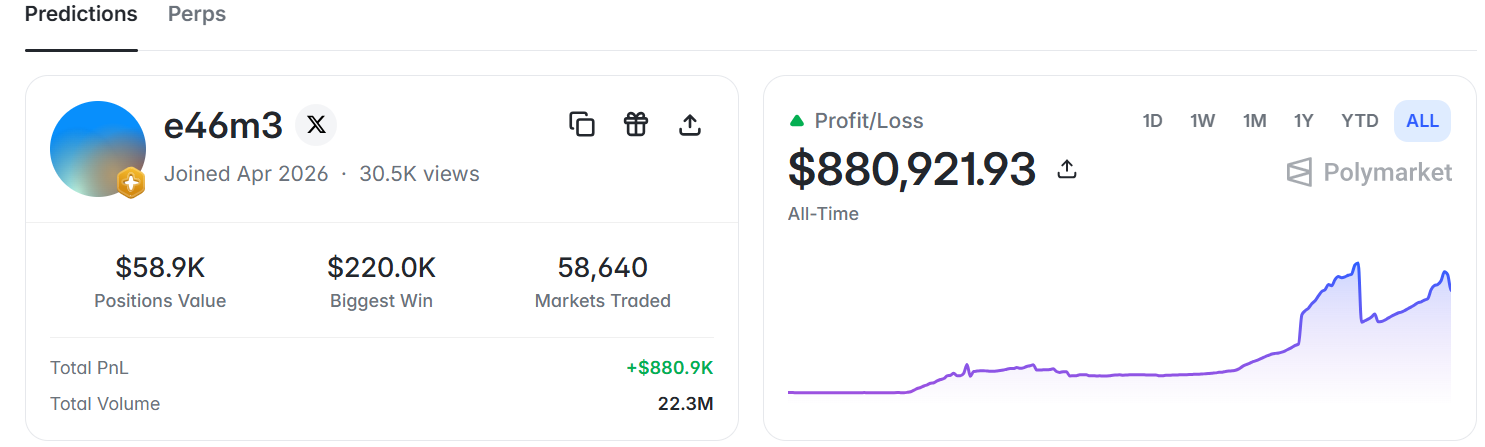
Screenshot of the trader’s Polymarket profile page
This trader does not need to hold tens of millions in capital, nor does he bet on predicting the real future outcome of events. Instead, he works day after day in the prediction markets that casual onlookers treat as pure spectacle, picking up low-risk "coins" left by other participants.
We reviewed a sample of the trader’s verified on-chain trading records, and found his activity spans a remarkably broad range of categories: sports, crypto, politics, culture and technology. He has captured outsized returns multiples — and even tens of multiples — of his initial stake across these markets. Take the 2026 Ballon d'Or winner prediction market as an example: he correctly bet on Harry Kane, generating an astonishing $230,000 in profit in just a few weeks.
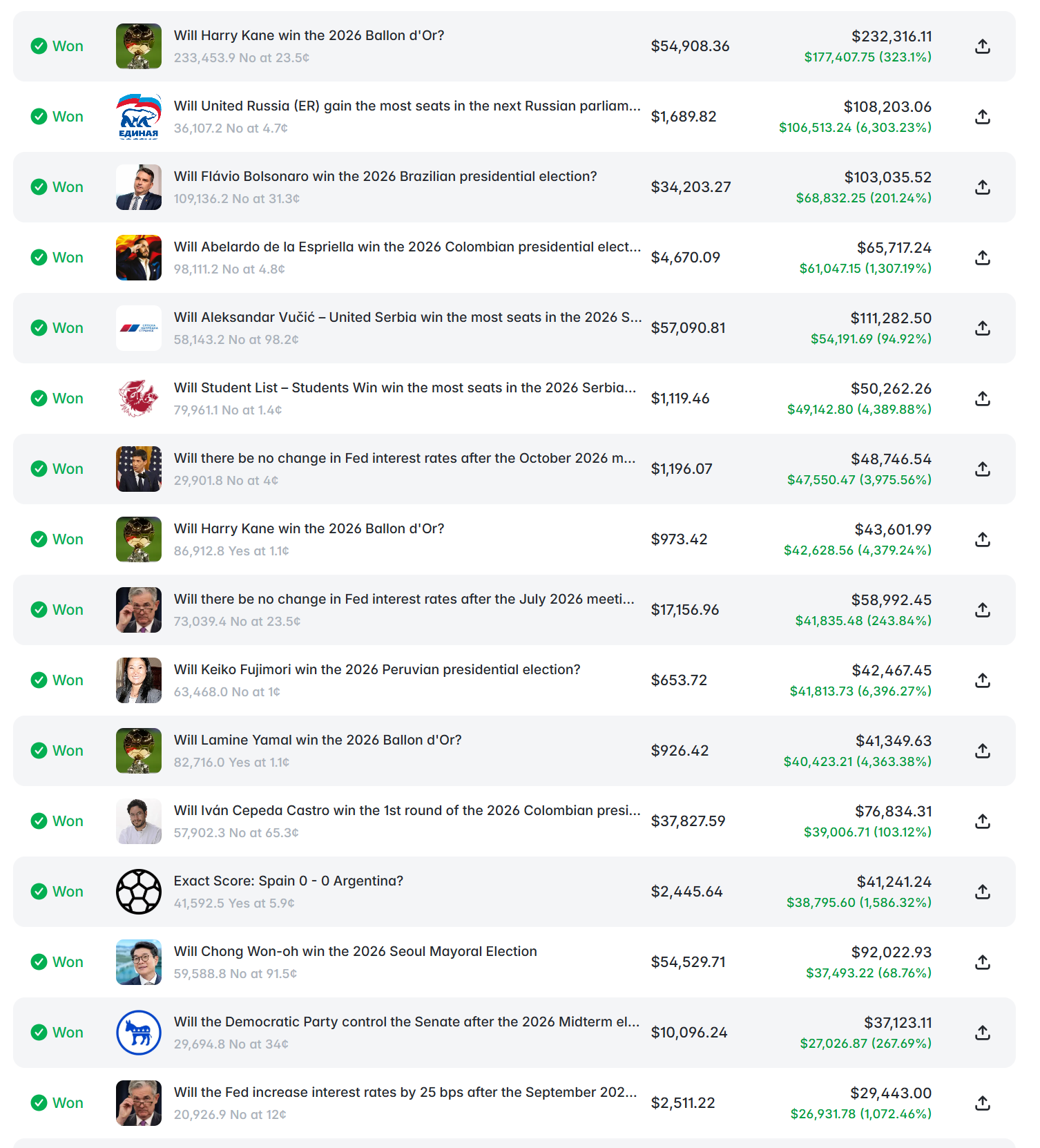
Sample of the trader’s high-return trade examples
He is also a shrewd arbitrage expert. On Polymarket, the vast majority of users trade by simply guessing event outcomes: if they believe a candidate will win, they purchase "Yes" shares at a 60% implied probability price, earning a 40% return on a correct guess, and losing their entire stake if they are wrong. This trading approach inherently carries massive directional risk.
Yet back-end data shows this trader has placed positions across 58,640 distinct prediction markets.
This means he trades on more than 300 distinct events every day — ranging from granular sub-predictions around US midterm elections, to total goal counts in the Spanish Tercera División, to daily Ethereum price fluctuations. It is impossible for a regular person to develop enough expertise across all these domains, let alone manually place precise trades by clicking a mouse hundreds of times per day.
There is only one plausible explanation: he runs an automated trading script (bot) in the background, directly connected to Polymarket’s underlying data API. He does not predict future event outcomes — he only does one thing: arbitrage.
So how exactly does he consistently "skim easy profits" from this market? We dug into his live trading records, and found three remarkably smart commercial strategies embedded in his activity.
Buy All the Lottery Tickets
On Polymarket, there are dozens of distinct prediction categories tied to the 2026 US midterm elections. Because most casual players simply buy shares in the outcome they prefer, these share prices often create pricing gaps where the math does not add up. This is analogous to a lottery game: as long as you purchase every possible winning ticket for a total cost lower than the grand prize, you are guaranteed a risk-free profit.
This trader’s strategy is exactly "buy every possible outcome, as long as the total entry cost is low enough". Let’s break down how he executed this:
He bought an equal number of shares (roughly 8,000 contracts) across three separate markets:
- Bought "Democrats win Senate + Democrats win House of Representatives": entry position cost 40.9%.
- Bought "Republicans win Senate + Democrats win House of Representatives": entry position cost 27%.
- Bought "Democrats lose House of Representatives": entry position cost 11.5%.
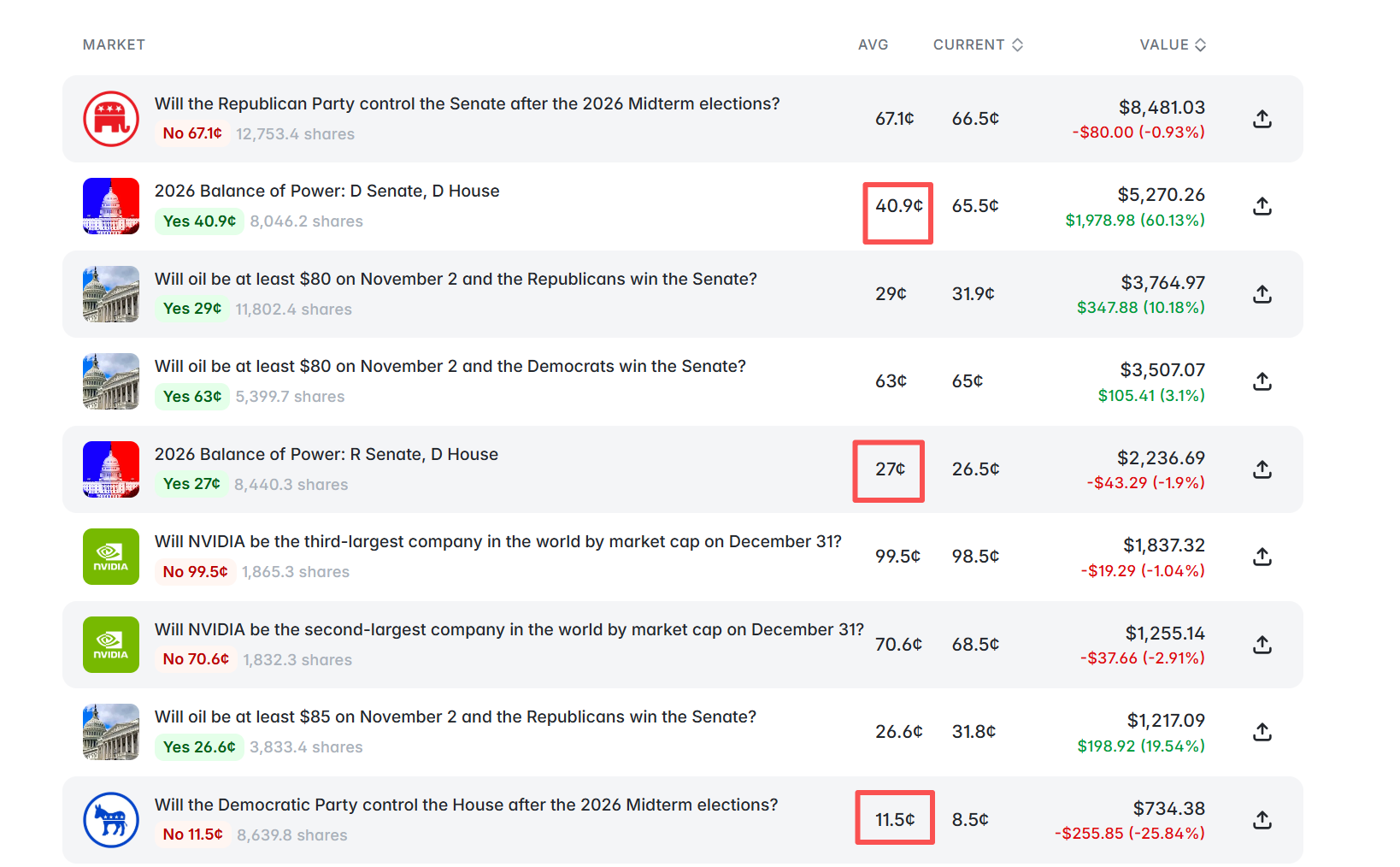
Hedged portfolio trade on Polymarket
There are only three possible future outcomes, no more, no less:
- If Democrats win the House, then control of the Senate will go to either Democrats (triggering the first bet payout) or Republicans (triggering the second bet payout).
- If Democrats do not win the House, the third bet will automatically trigger a payout.
In other words, no matter how the two parties’ electoral contest plays out, exactly one of these three bets will pay out. The total cost to acquire all three positions was just 79.4%.
This is what makes his strategy so effective: he entered positions at an implied 79.4% probability, synthetically constructing a risk-free financial product that is guaranteed to pay out 100% at settlement. The 20.6% price gap between his total entry cost and the guaranteed payout is pure, risk-free profit, translating to a 25.9% return on investment. He turned political betting into a purely mathematical money printer.
Portfolio Hedging on Combination Markets
Polymarket occasionally launches markets with "combined conditional" outcomes, such as "crude oil price above $80 AND Republicans win the Senate". Because these combination markets involve two separate conditions, most casual players cannot be bothered to calculate fair value, so their share prices are often heavily undervalued.
This is exactly like fast food pricing at McDonald’s: a burger costs 10 yuan when sold a la carte, but a value bundle of "burger + a cup of water" costs only 8 yuan thanks to promotional discounts. How does a rational player arbitrage this spread? Buy the 8-yuan bundle, keep the water for yourself (a guaranteed, value-neutral asset with known value), then sell the burger for 9 yuan to a customer who only wants the burger, netting 1 yuan in risk-free profit.
Over the past several months, as conflict between Iran and the US has remained deadlocked, crude oil prices have already surged above $110 and continued to trade near that level. The condition "crude oil price above $80 on November 2" is now a near-certain, high-probability event.
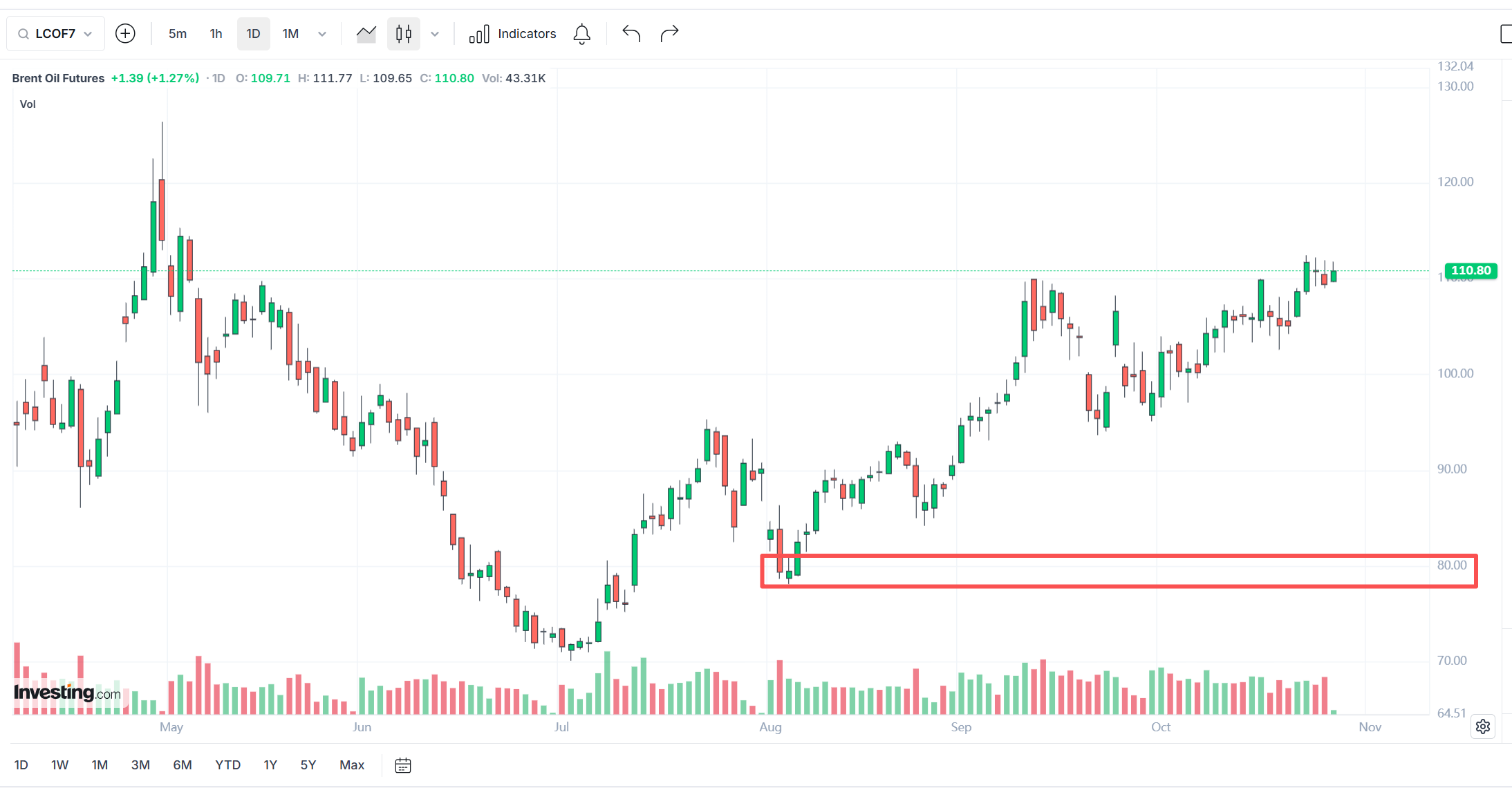
Brent crude oil price (daily chart)
He targeted these niche "value bundle" markets, purchasing roughly 12,000 shares of "crude oil > $80 AND Republicans win the Senate" at an average entry price of 28.5% (effectively buying the cheap promotional bundle). He then turned to the most liquid core market, buying 12,700 shares of "Republicans do not win the Senate" at a 67.1% implied probability — a reverse short position that is equivalent to "returning the burger from the bundle" to lock in profit.

This structure means his total position cost is 95.6%. Since both positions are perfectly hedged against each other, he does not need to care which candidate wins the final election outcome — he locks in the 4.4% price gap as guaranteed profit. He converted discounts overlooked by retail traders into deterministic, risk-free returns.
Even Tiny Margins Count
This is the core strategy that drove the trader’s $22+ million in total trading volume. The logic of this strategy is very straightforward, and closely resembles real-world "short-term pawn shop" operations or "bill discounting".
Some prediction outcomes become completely predictable as settlement approaches. For example, if Ethereum is trading at $2,500 today, and only a few hours remain until market settlement for the bet "will Ethereum exceed $2,100 today?", the outcome is a foregone conclusion.
However, some retail traders do not want to wait those final few hours to settle their position. They spot higher-return opportunities in other markets, and want to free up their capital immediately. As a result, they are willing to sell their guaranteed winning ticket at a discounted price, sometimes as low as 98 or 99 cents per $1 payout.
At this point, the trader moves in like a shark smelling blood, instantly absorbing these 98% priced sell orders. He takes on zero market risk: he only needs to hold the position for two to three hours until settlement, at which point the position matures to its full 100% payout value.

A single trade only generates a 2% return, which looks trivial. But the trader scans tens of thousands of markets each day, executing hundreds or thousands of these small-margin trades. Capital turns over at a rapid, cycle-like pace similar to a washing machine, and the compound annual return from this strategy can be astonishingly high over a full year.
Do Not Copy This Strategy Blindly
Of course, there is no perfect, risk-free money printer in the world. For traders who rely heavily on automated systems and statistical modeling, the biggest risk comes from low-probability "extreme black swan events".
Looking at recent trading records, the trader once recorded a single-day paper loss of up to $137,000. As he hunts for these "pennies-on-the-dollar" low-risk opportunities across global markets, he often takes heavy positions in extremely niche sports events. For example, he might buy "this Colombian Categoría Primera A match will not end in a 0-0 draw" at a 96% implied probability.
This type of strategy is known in finance as "picking up pennies in front of a steamroller". On most days, the trader bends down to pick up small gains, and the equity curve looks consistently smooth and attractive. But once an extreme underdog upset occurs — such as two football teams failing to score a single goal across 90 minutes, ending in a 0-0 draw — the 96% of capital tied up in that position is instantly wiped out.
The loss from a single such trade would require him to win hundreds of small-margin trades across other markets to recoup.
In addition, as capital moves between different markets, settlement delays caused by platform disputes can lock up funds, leading to sharp short-term paper drawdowns.