
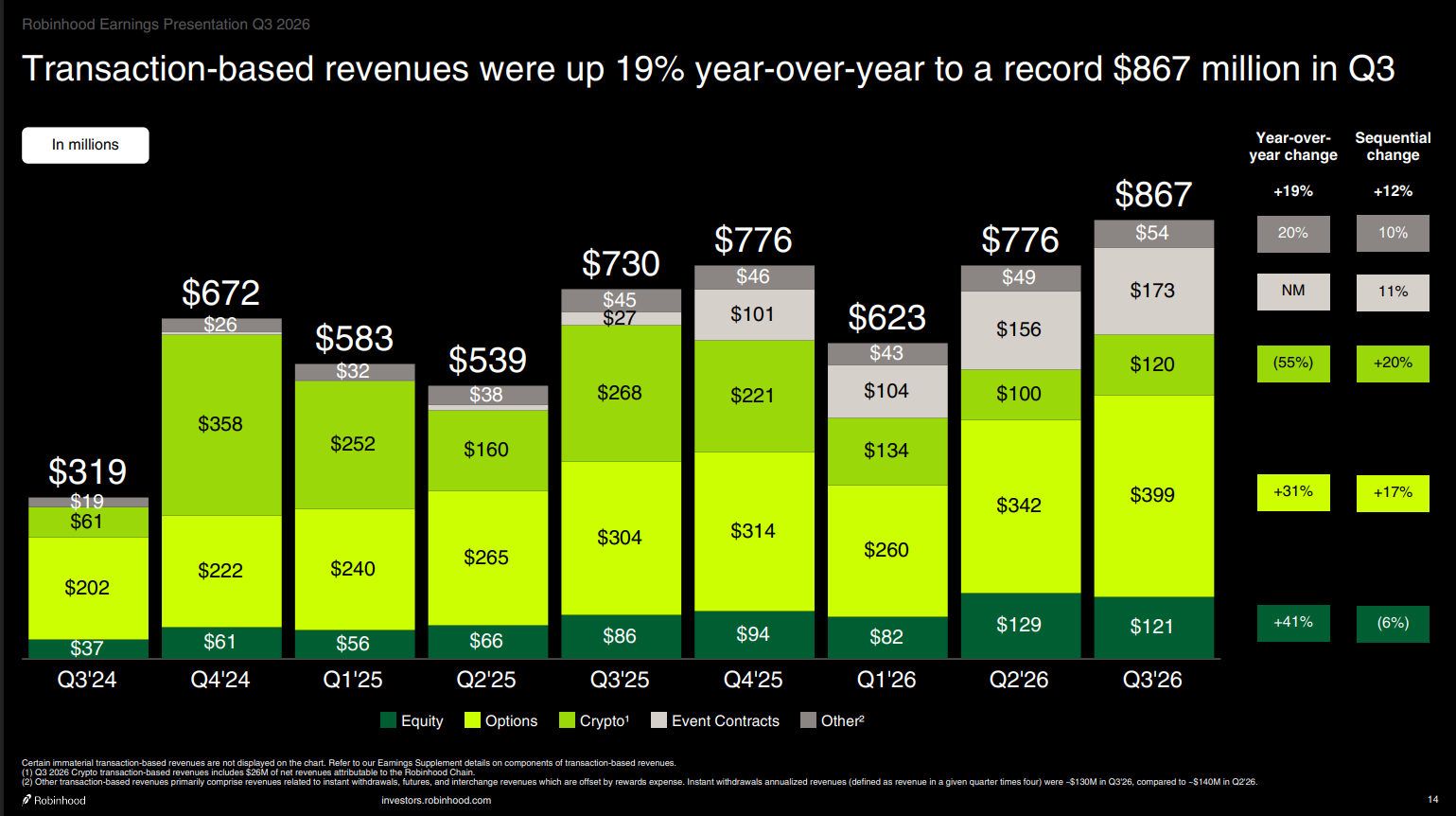
In the third quarter, Robinhood's crypto trading revenue plunged 55%! year-on-year to(MISSING) $120 million, emerging as the key drag on its overall trading business.
Written by ChandlerZ, Foresight News
Prediction markets have generated more revenue for Robinhood than its crypto business for two consecutive quarters.
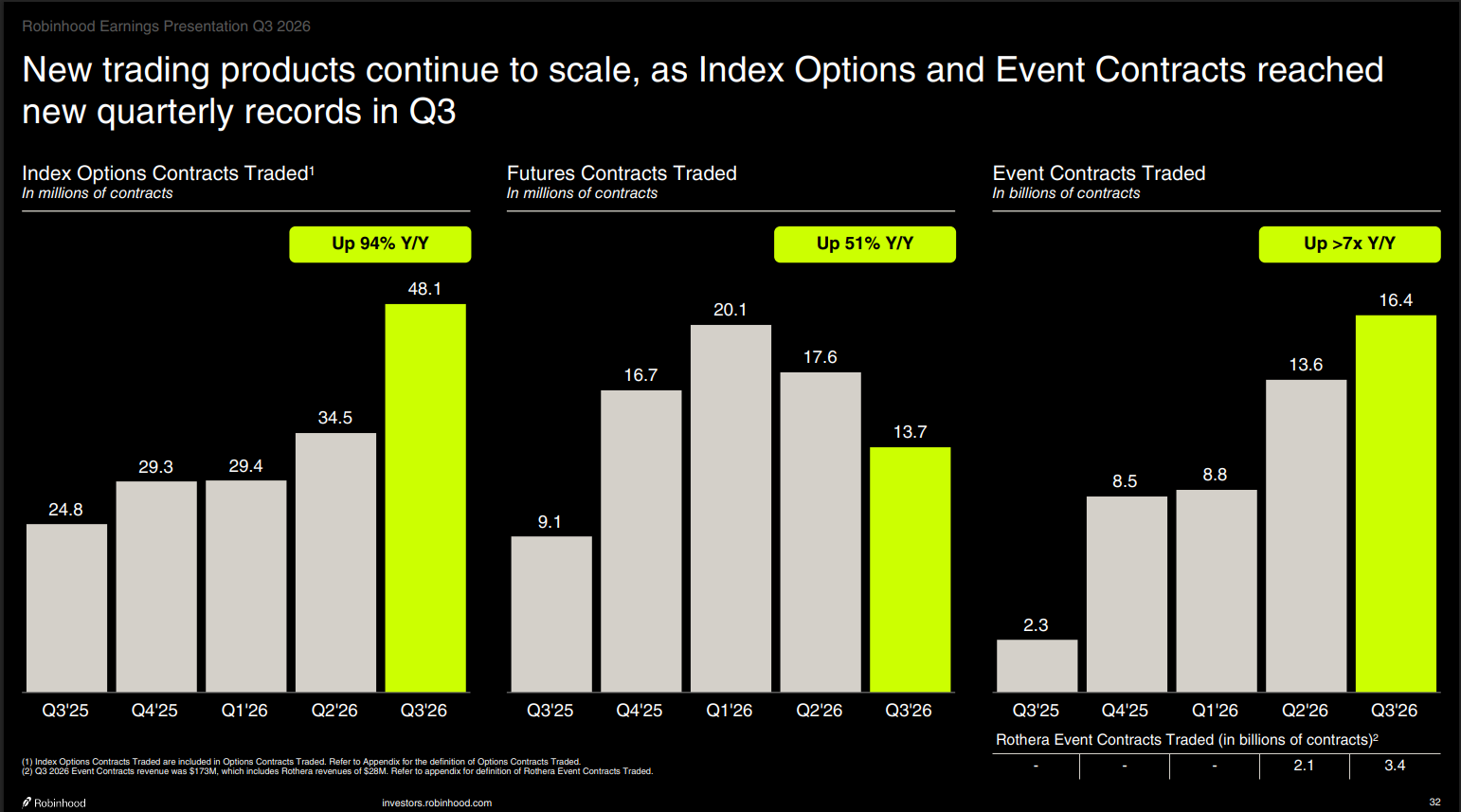
The latest financial report released by the U.S. retail trading platform shows that total net revenue for Q3 2026 reached $1.424 billion, up 12%! year-on-year;(MISSING) net profit stood at $476 million, down 14%! year-on-year.(MISSING) By business segment, options trading remains Robinhood's largest source of trading revenue, hitting $399 million in the third quarter. Prediction markets posted even faster growth: users traded 16.4 billion event contracts in the quarter, generating $173 million in revenue for the company, compared with $27 million recorded in the same period last year.
Meanwhile, crypto business revenue fell to $120 million, down 55%! year-on-year.(MISSING) Prediction market revenue first outpaced crypto business revenue in Q2 this year, and the revenue gap between the two segments widened to $53 million by Q3.
These event contracts cover a wide range of themes, including American football games, Bitcoin price movements, and Federal Reserve interest rate decisions. Users place bets on outcomes, while Robinhood charges trading commissions and earns a share from exchange-based trading and clearing operations. Driven by fast-growing contract trading volume, prediction markets are emerging as a critical revenue pillar for the company.
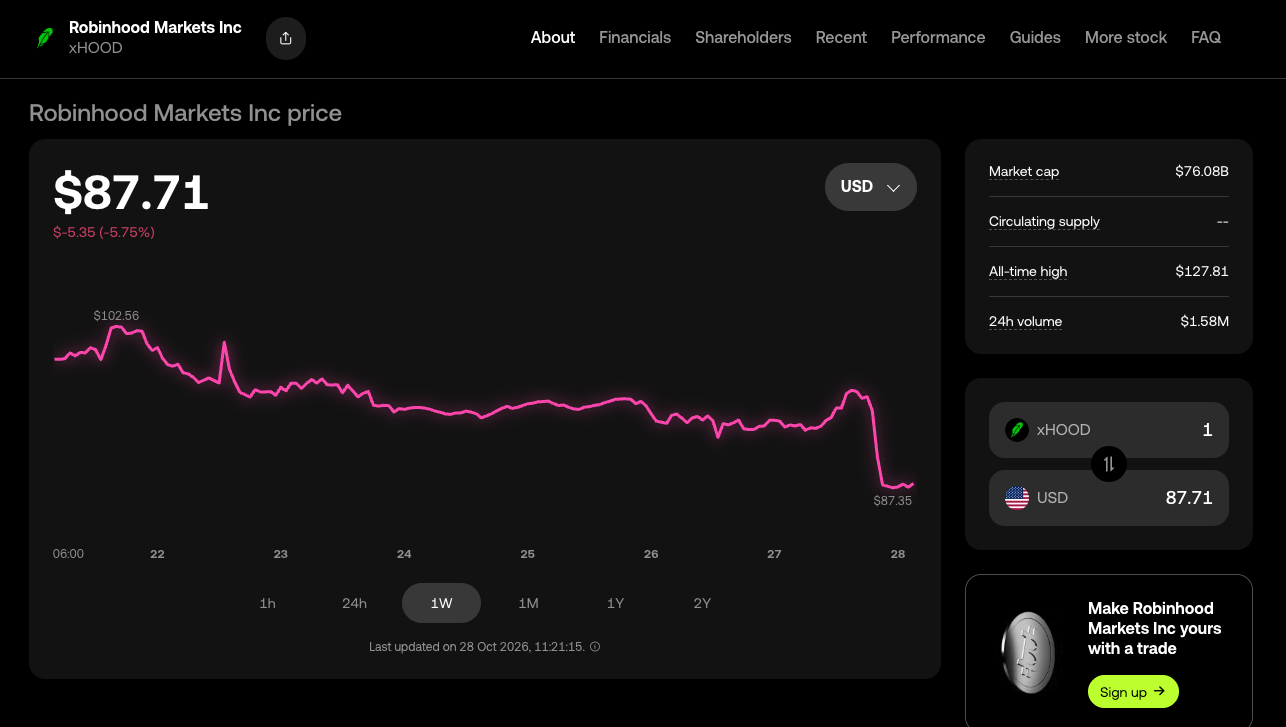
According to a Reuters report, despite the company's all-time high total revenue, its earnings per share came in at $0.51, below analyst expectations of $0.55, weighed down by the slump in crypto business. Data from OKX shows that xHOOD fell nearly 6%! in 24-hour trading amid the impact of this factor.(MISSING)
What Are Users Trading With the 16.4 Billion Prediction Market Contracts?
Robinhood launched its dedicated prediction market section in March 2025, gradually expanding its product coverage to sports, election, and financial events. Revenue from this segment hit $156 million in Q2 this year, and grew by another 11%! in Q3.(MISSING)
On a granular level, sports events remain the most heavily traded category on Robinhood's prediction markets. During the earnings call, Chief Financial Officer Shiv Verma noted that non-sports contracts accounted for roughly 30%! of total trading volume in Q3,(MISSING) up from around 15%! in Q2.(MISSING)
In September, Robinhood expanded its professional and college American football contract offerings, extending trading coverage from game win/loss outcomes to results such as individual player performance. For existing Robinhood account holders, stocks, crypto assets, and event contracts are all integrated into the same app, allowing users to participate in these event trades without switching to another platform.
However, price and economic data beyond sports events are also attracting trading activity. JB Mackenzie, Head of Futures and Prediction Markets at Robinhood, told CoinDesk in an October interview that Bitcoin, gold, and oil price contracts have become fast-growing product lines. Contracts tied to Federal Reserve interest rate decisions made up the largest event contract offering on Robinhood in September.
The time horizon of crypto price contracts has also been compressed to as short as 15 minutes, allowing users to bet on price ups and downs over a set period without needing to buy Bitcoin directly. For Robinhood, this opens up a new channel to collect trading fees tied to crypto market movements. Short-duration contracts can be traded repeatedly, but they also carry the risk of rapid user losses over a short period.
How Does Robinhood Generate Revenue on Every User Order?
The entry barrier for event contracts can be very low: a single contract usually ranges from a few cents to nearly $1, but additional fees apply when trading. Robinhood charges users commissions that vary based on contract price and purchase volume; the exchanges that offer the contracts typically charge separate fees as well.
Robinhood provided an illustrative example: a user without a Gold membership subscribes to buy 100 contracts at $0.9 each. The base cost for the contracts comes to $90, plus a $0.9 Robinhood commission. Assuming the exchange charges an additional $0.01 per contract, the user's total cost for this buy order is $91.9. If the user holds the contracts to settlement and makes the correct prediction, the 100 contracts will pay out a total of $100 upon maturity; if the prediction is wrong, the contracts will settle at zero value when they expire.
The per-order commission may seem small, but the cumulative trading of 16.4 billion contracts in a quarter generates massive fee collection opportunities. Robinhood Gold members can access lower commissions when trading certain contracts, which the company leverages to create more use cases for its subscription service.
Meanwhile, Robinhood is deepening its involvement in the exchange segment. After users place orders in the app, exchanges provide contract trading and clearing services. In the past, the company primarily partnered with trading venues such as Kalshi; this June, it began routing a portion of its contract order flow to Rothera.
Rothera was co-founded by Robinhood and financial institution Susquehanna International Group, operating as an independent exchange and clearing entity. In Q3, Rothera contributed $28 million to Robinhood's total $173 million in event contract revenue. Financial reports show that Rothera has processed over 6.4 billion cumulative contracts since its launch, with annualized revenue exceeding $100 million in its first full quarter of operation.
Robinhood also reached a partnership with Crypto.com and its subsidiary OG.com in September, routing a portion of American football game contract flow to the relevant trading venues. According to Verma's remarks on the earnings call, Rothera will serve as the primary exchange, while Crypto.com and OG.com will act as the main secondary trading venue. The company plans to route the majority of related trading volume to these two groups of partners by the end of this year to early next year.
Robinhood also received initial equity stakes in Crypto.com and OG.com, with the option to increase its holdings further as the partnership evolves. This arrangement allows the company to capture business growth through its equity interests in the trading venues, in addition to charging commissions to users. Which exchange provides support for a given contract still depends on the product offerings listed on each venue.
Amid Falling Crypto Trading Revenue, Robinhood Doubles Down on Public Blockchain and Stablecoin Initiatives
While prediction market revenue grows, Robinhood's Q3 crypto trading volume hit roughly $49.8 billion, down 38%! year-on-year.(MISSING) Of this total, the Robinhood App contributed approximately $20.6 billion, while its in-house crypto exchange Bitstamp contributed around $29.2 billion. Bitstamp, which Robinhood acquired in 2025, serves both retail and institutional clients.
On the surface, crypto revenue grew by 20%! compared with Q2,(MISSING) but the increase was mostly driven by the launch of Robinhood Chain in July. This public chain, built on Ethereum scaling technology, contributed $26 million in net revenue to the company in the quarter; after excluding this contribution, remaining crypto trading-related revenue came in at $94 million, below the $100 million recorded in Q2.
The trading activity attracted by the public chain is not limited to Robinhood App users. The company disclosed that decentralized exchange (DEX) trading volume on Robinhood Chain exceeded $80 billion in Q3. Beyond tokenized stocks, meme coins are also a key source of early on-chain activity. According to CoinGecko statistics, meme coins accounted for 79.2%! of the chain's daily DEX trading volume on July 27.(MISSING)
On the day of the earnings release, Robinhood also announced an expanded partnership with Ripple. RLUSD, the U.S. dollar stablecoin issued by Ripple, has already launched on Robinhood Chain and Bitstamp, Robinhood's crypto exchange, and is expected to be integrated into the Robinhood App later this year. The partnership also covers institutional settlement, asset management, and financing services.
Both the prediction market and crypto businesses face new headwinds. On October 27, the U.S. Commodity Futures Trading Commission (CFTC) filed a lawsuit against the state of Utah, seeking to block the state's efforts to restrict federally regulated event contract markets under state law. Utah previously took enforcement action, arguing that the relevant products fall under state gambling regulations; federal regulators, by contrast, assert that such exchanges fall within their regulatory purview. As the litigation remains ongoing, Robinhood also flagged in its earnings report that state laws, lawsuits, and enforcement actions may impact the availability of certain event contracts.