
The community airdrop allocation totals 50 million tokens, accounting for 0.5%! of the initial supply. (MISSING)
Written by Ma He, Foresight News
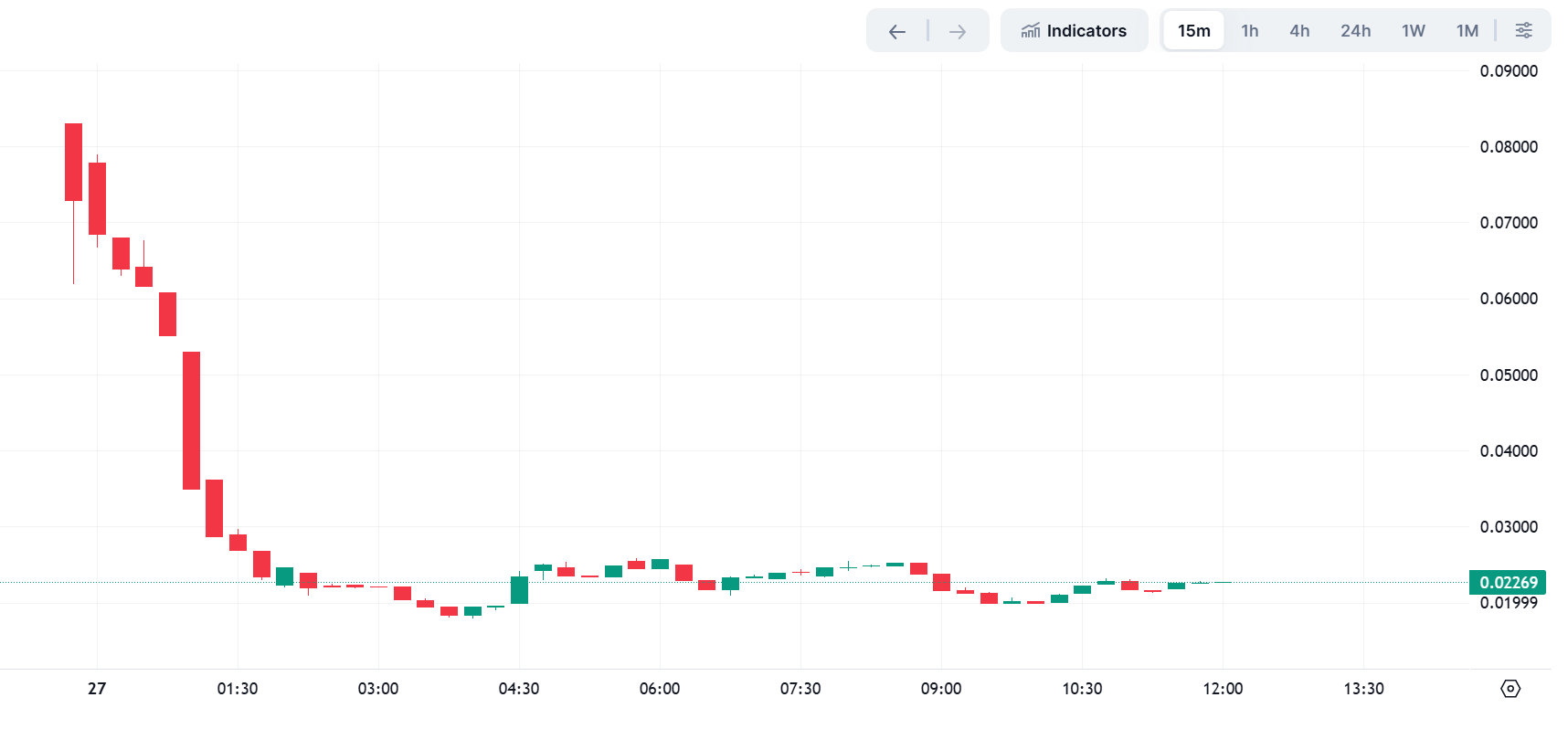
On October 26, the Ritual Foundation announced the mainnet launch of Ritual, its AI-focused Layer 1 blockchain. The protocol’s native token RITUAL was rolled out simultaneously at the Token Generation Event (TGE) and will serve as the network’s Gas token. Coinbase has already listed the token. Currently, RITUAL’s price has plummeted from its launch high of $0.08 to $0.0226, with a fully diluted valuation (FDV) of approximately $220 million.
According to official tokenomics documentation, RITUAL has an initial supply of 10 billion tokens with no maximum supply cap. A total of 1.8 billion tokens, representing 18%! of the initial supply, were unlocked at mainnet launch. (MISSING) Of this amount, the community airdrop allocation totals 50 million tokens (representing 0.5%! of the initial supply) (MISSING), which targets eligible Infernet node operators, Frenrug users and long-standing community members. These airdropped tokens are fully unlocked at launch with no vesting period attached.
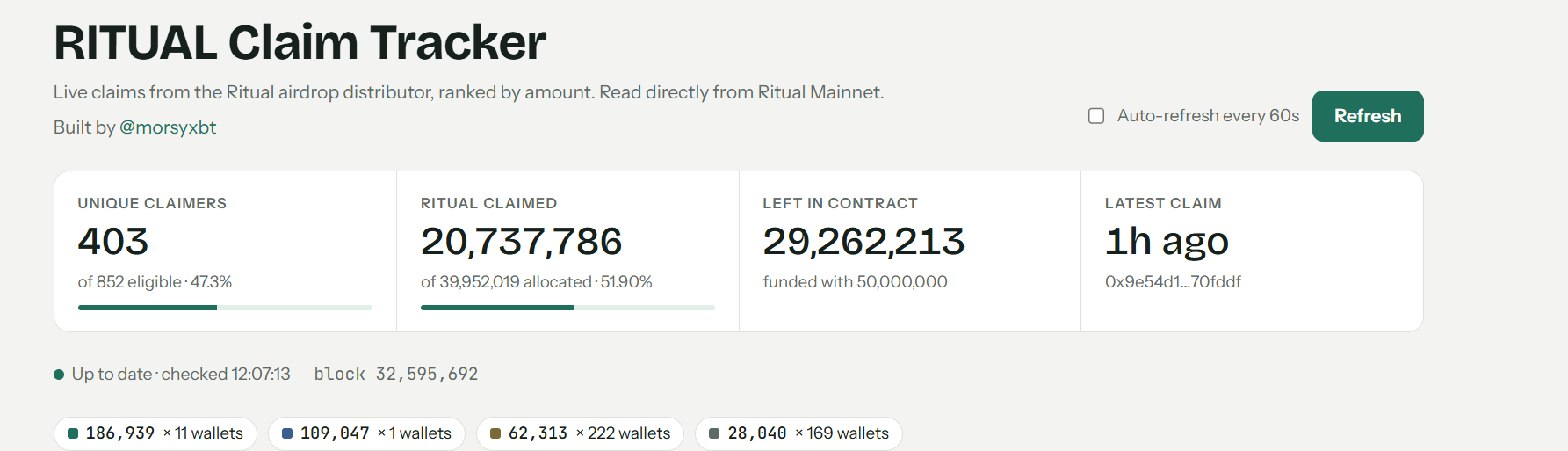
Ritual has now opened token claim for eligible users. However, per a website created by Morsy, only 852 wallets are qualified to claim the airdrop, and 403 users have already claimed a total of 20,737,786 tokens to date.
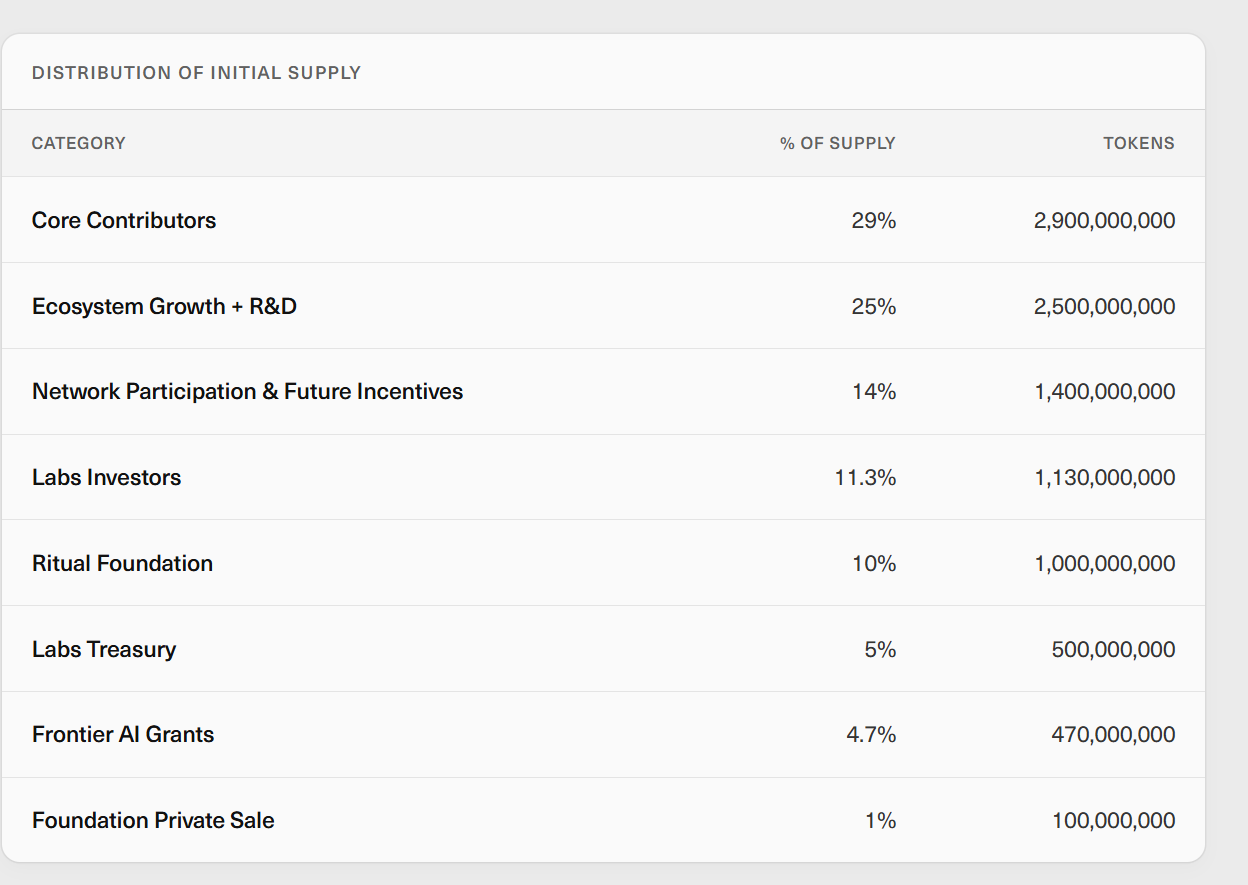
The token allocation structure is as follows: core contributors take up 29%! ((MISSING) 2.9 billion tokens), ecosystem growth and R&D account for 25%! ((MISSING) 2.5 billion tokens), network participation and future incentives make up 14%! ((MISSING) 1.4 billion tokens), Labs investors hold 11.3%! ((MISSING) 1.13 billion tokens), the Ritual Foundation owns 10%! ((MISSING) 1 billion tokens), the lab treasury holds 5%! ((MISSING) 500 million tokens), frontier AI grants cover 4.7%! ((MISSING) 470 million tokens), and foundation private sale allocations account for 1%! ((MISSING) 100 million tokens).
Of the 18%! of tokens unlocked at mainnet launch, the main (MISSING)ly sources include 12.5%! of the earmarked ecosystem growth and R&D allocation, (MISSING) 5%! of the foundation treasury allocation, (MISSING) as well as the 0.5%! air (MISSING)drop component earmarked for the network participation and future incentives pool.
Core team members and early investors are subject to a one-year cliff vesting period. Locked tokens cannot be staked, and staking rewards are only allocated to unlocked circulating supply. The overall vesting cycle spans four years, with all allocated tokens fully unlocked within four years after mainnet launch. The network’s initial annualized inflation rate is approximately 5%! (MISSING), which will be distributed to validators and AI execution nodes in the form of staking rewards. The project team expects to gradually reduce the inflation rate as on-chain fee revenue grows.
Base transaction fees are permanently burned via the EIP-1559 mechanism. The design of no hard supply cap means the total token supply is determined by the net effect of token inflation and fee burns. The use cases for RITUAL include: staking to secure the network, paying for operating costs of AI execution nodes, covering all on-chain operation fees (including standard Gas fees, model inference, HTTP calls and scheduled tasks), and future governance voting weighted by staked amount. Tokens bridged to other chains via LayerZero are locked on the native chain, and do not increase the total token supply.
$30 Million in Funding, With Participation From NEAR’s Founder
Ritual was co-founded in 2023 by former Polychain Capital partners Niraj Pant and Akilesh Potti. Prior to founding Ritual, Niraj Pant served as a general partner at Polychain Capital, where he led investments in projects including Solana.
Akilesh Potti has a professional background at Palantir and in quantitative trading. The project exited stealth mode in November 2023, securing approximately $25 million in funding led by Archetype, with participation from firms including Accomplice and Robot Ventures. It later received a strategic investment from Polychain Capital, bringing its total cumulative funding to over $30 million.
The project’s advisory team includes NEAR co-founder Illia Polosukhin, Gauntlet founder Tarun Chitra, and BitMEX co-founder Arthur Hayes.
In its early stages, the project centered its product on Infernet, a network positioned as a decentralized oracle network for AI workloads, before pivoting to become an AI public blockchain. In December 2024, Ritual Chain launched its private testnet. The project has since rolled out multiple public testnet phases, including the role-based permissioned testnet in April 2026 and the Genesis 1000 agent deployment phase in June.
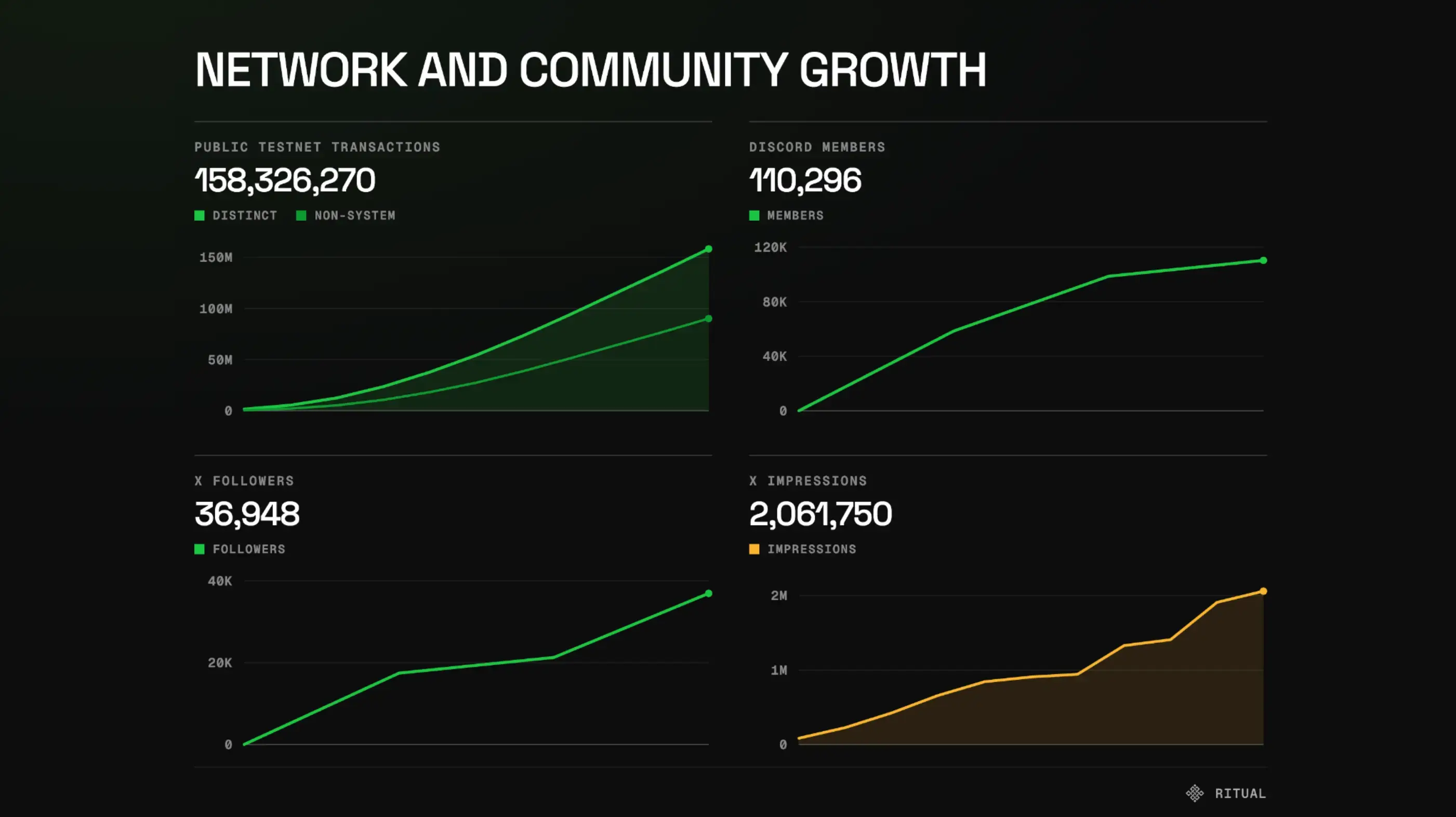
Per official data disclosed before mainnet launch, the project’s testnet has deployed over 2,000 agents, processed more than 90 million transactions cumulatively, and attracted thousands of node operators to participate in early network operations.
Ritual positions itself as an "AI chain" with an EVM-compatible architecture. Its core design goal is to enable developers and agents to natively access AI models, Web2 services and APIs without leaving the chain, while enjoying cryptographic guarantees. Agents can hold their own keys, maintain persistent identities, manage capital, and act autonomously based on preset goals. Inference results, external calls, and settlements can all be completed on the same chain, with no need for additional oracle services.
Per the project team, this design shifts value capture from "paying emissions to produce AI elsewhere" to "charging fees when intelligence is consumed on-chain". It supports use cases including machine-to-machine payments, agent-native companies, heterogeneous computing markets, and RWA (Real World Asset) markets targeted at machine participants.
Currently, RITUAL’s short-term price has pulled back under the pressure of airdrop sell-offs and thin liquidity. Whether its medium-to-long term valuation can converge with more established AI projects still depends on the scale of real on-chain usage and the pace at which fee revenue is generated.