
From Twitter to Bitchat, Jack Dorsey aims to reshape how people communicate.
Written by Nicky, Foresight News
On October 21, French telecom operator Orange suffered a widespread mobile network outage.
For some users, even with their mobile phones in hand, they were unable to make regular calls, send SMS messages, or even use mobile data services.

Image source: Sameer Al-Doumy, AFP
Just a few days prior to the outage, large-scale protests had erupted across France, during which former Prime Minister Gabriel Attal put forward a proposal to temporarily restrict access to social networks in areas affected by civil unrest.
While the telecom outage had no connection to the government’s discussions on potential internet restrictions, the string of consecutive events led some French residents to reconsider a pressing question: if the internet suddenly disappeared one day, how would we stay connected to each other?
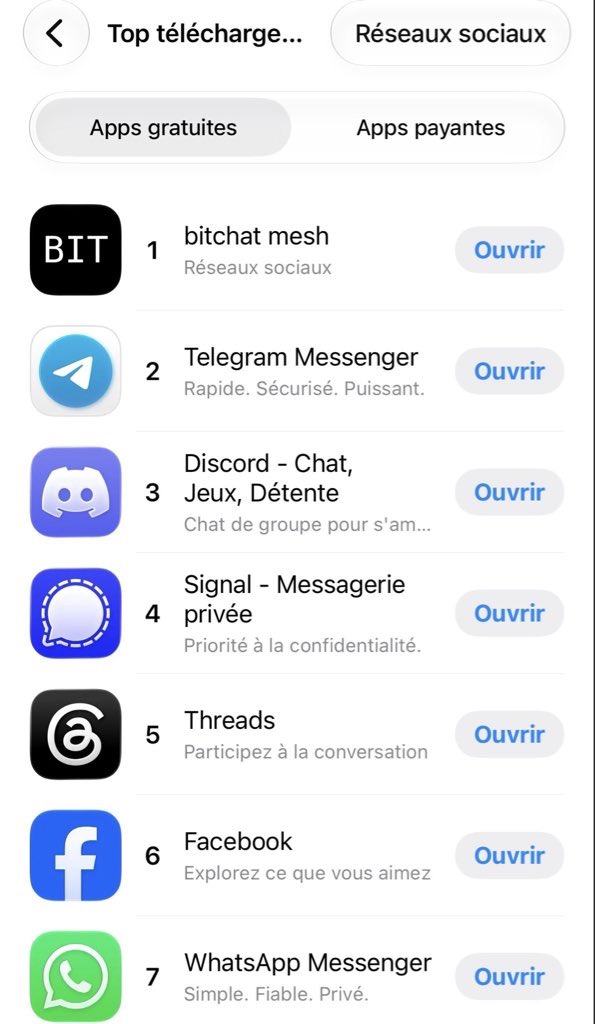
A day later, an app called Bitchat topped the free social networking charts on the French App Store, and broke into the top 10 of all free app categories.
Notably, the app does not require a phone number, user account registration, or even an active internet connection to function. Its developer is none other than Jack Dorsey, co-founder of Twitter, who built the platform that enabled hundreds of millions of people to communicate over the internet.
An Experiment Built Over a Single Weekend
Let us turn back the clock to July 2025.
By that time, Jack Dorsey had stepped down as Twitter CEO several years prior, and had begun focusing more of his energy on Block’s payments business, Bitcoin, and open protocol development.
Over one particular weekend, he began exploring a seemingly outdated use case: could mobile phones send messages to each other without an internet connection?
Leveraging Goose, Block’s open-source AI programming tool, he tested technologies including Bluetooth mesh networking, message relaying, and encrypted communication, before publicly unveiling a project named Bitchat on July 6.
Initially, the project was nothing more than a learning-focused weekend experiment. But after its public launch, it quickly garnered widespread attention: TestFlight beta slots were filled to capacity in no time, and the project later attracted participation from a growing pool of developers.
Bitchat operates on a fairly straightforward mechanism.
Imagine you are at a music festival attended by tens of thousands of people, where mobile networks are completely unusable due to congestion. If you want to send a message to a friend standing far away, traditional chat apps will likely be unable to deliver. But Bitchat can leverage the mobile phones of nearby users to relay your message over Bluetooth, passing it from one device to the next until it reaches its destination.
Every connected device can act as a temporary relay station, forming a communication mesh among nearby hardware that does not rely on traditional mobile network infrastructure.
The app also supports encrypted private messages, public channels, and one-tap local data wiping. When internet connectivity is restored, users can leverage the Nostr protocol to connect to long-range communication networks.
Admittedly, this does not mean Bitchat can work in every scenario. Bluetooth communication has a limited range, and if there are not enough nearby devices to relay messages, a message may never reach its recipient. Continuous scanning and message relaying also drain device battery.
Looking back on Jack Dorsey’s work over the past two decades, it becomes clear that Bitchat is not an out-of-the-blue endeavor.
In 2006, he co-founded Twitter to enable real-time public information sharing. In 2009, he co-founded Square with the goal of making it easier for individuals and merchants to process payments.
In the years that followed, his focus gradually shifted to Bitcoin.
From Jack’s perspective, Bitcoin’s value lies not in its price appreciation, but in the fact that it provides an open monetary network that does not rely on any single financial institution.
This philosophy has steadily shaped his subsequent business decisions.
Square integrated Bitcoin trading support into its Cash App, and later rebranded itself as Block. The company has since launched the Bitkey hardware wallet, developed Bitcoin mining chips and supporting infrastructure. Jack publicly noted in 2021 that he had experimented with Bitcoin mining via Compass Mining.
In parallel, he has supported open communication protocols including Nostr, to explore social networks that are not controlled by any single platform.
Having helped build one of the most influential centralized social platforms of the internet age, he is now increasingly focused on reducing users’ reliance on centralized platforms and infrastructure.
This shift in priority is also reflected in Bitchat’s integrated payment features.
On the Android version of the app, users can transfer Cashu e-cash tokens via Bluetooth. Tied to the Bitcoin ecosystem, these tokens can be passed from one device to another even without an active network connection.
This does not mean, however, that Bitcoin on-chain settlement can be completed fully offline. The final redemption and validity verification of Cashu tokens still requires a network connection, and offline recipients bear the risk that a token may have already been spent.
But at the very least, on a technical level, the two areas Jack cares about are beginning to converge: when the internet is unavailable, can people still exchange information, and even transfer tokens that carry monetary value?
An Application That Is Not Yet Secure Enough
As previously reported by TechCrunch, security researchers found identity verification flaws in early versions of Bitchat that could allow attackers to impersonate other users. Jack has also explicitly warned in the project documentation that the software has not yet undergone sufficient external security audits, and users should not rely on its security properties to process sensitive communications.
More importantly, the lack of a required phone number does not equate to full anonymity.
Bluetooth communication still generates radio signals that can be detected by nearby devices, exposing information including a user’s network participation status and physical proximity to other devices. Even if private messages are end-to-end encrypted, there is no guarantee that all communication metadata will be fully hidden.
This creates Bitchat’s most notable contradiction: it aims to provide users with an alternative when traditional communication infrastructure fails, but cannot yet guarantee that this alternative is reliable enough for use in high-risk environments.
France is not the first country where Bitchat has seen a surge in public attention.
The app previously saw download growth during protests or internet shutdown events in locations including Nepal and Madagascar. It has now climbed the app charts against the backdrop of France’s recent civil unrest and telecom outages.
That said, rising download volumes do not mean a functional peer-to-peer communication network has actually formed. Whether Bitchat can deliver on its core value ultimately depends on how many nearby users are on the network, whether devices can maintain consistent connections, and whether the software itself is secure enough.
In the meantime, Jack continues to explore other products that do not rely entirely on traditional technical architectures.
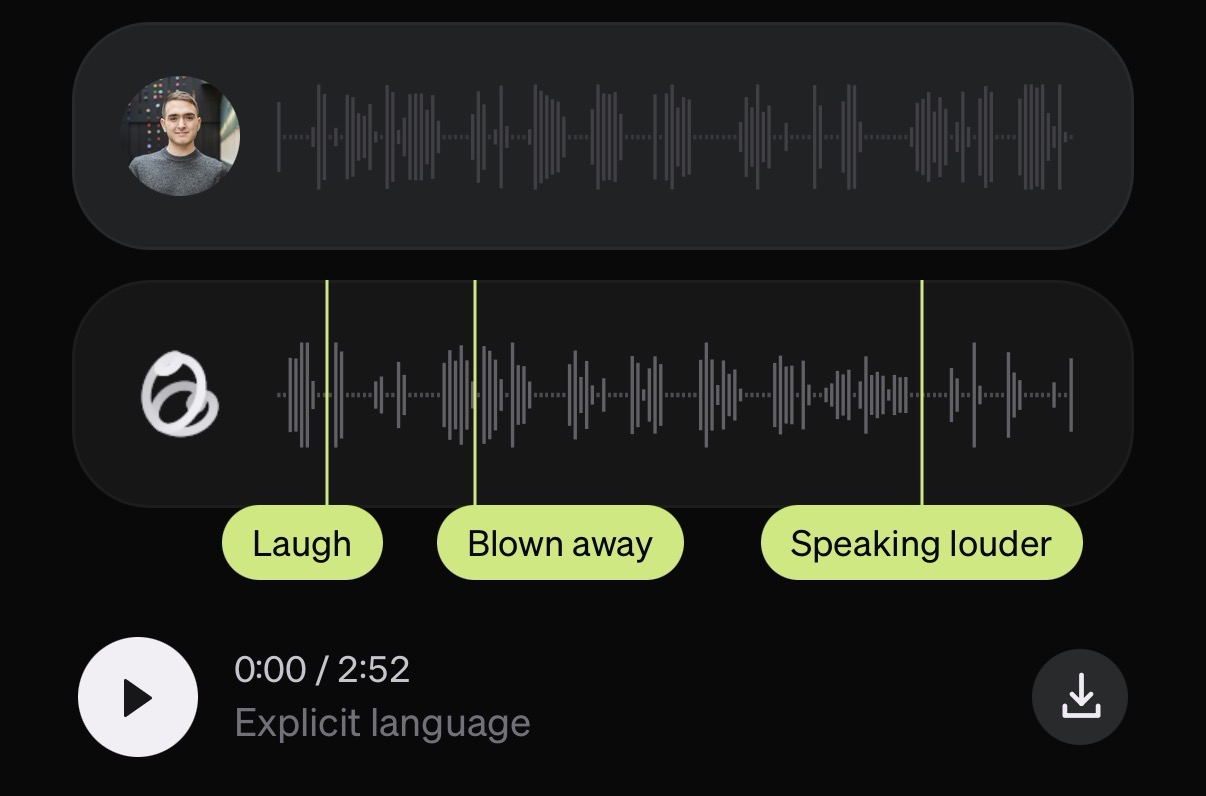
On October 24, Block released Dessa, an experimental speech model. Unlike common speech processing solutions that rely on intermediate text representation, Dessa is trained directly on human conversational audio, aims to enable more natural real-time two-way voice communication, and has demonstrated the ability to run locally on high-performance personal computers.
Bitchat and Dessa are built on entirely different technical foundations, but both reflect Jack’s ongoing exploration of alternative technical paths: the former seeks to eliminate people’s full reliance on the internet for interpersonal communication, while the latter explores whether machines can understand and generate speech directly, without text as an intermediary.
Twenty years ago, Jack Dorsey co-founded Twitter to enable people across the world to share real-time updates about current events at any time.
Twenty years later, he has built an application that can still deliver messages even when there is no internet access.
From building a tool to connect everyone, to exploring what to do when connectivity is lost, this is perhaps the most compelling part of the Bitchat story.