
Liquidity providers could earn an additional $62 million annually, but CAKE’s net deflation rate will be cut in half.
Written by Sanqing, Foresight News
Voting for PancakeSwap’s "The Flip" governance proposal on BNB Chain has shown a strongly lopsided trend.
Voting page data shows that as of October 23, a total of 33 wallet addresses have participated in the vote, with roughly 1.23 million votes cast against the proposal and only around 22,000 votes in support, translating to a staggering 98.2% opposition rate. A single address alone cast approximately 766,000 opposition votes, accounting for nearly 60% of all total votes. The voting process will conclude at 16:07 on October 24.
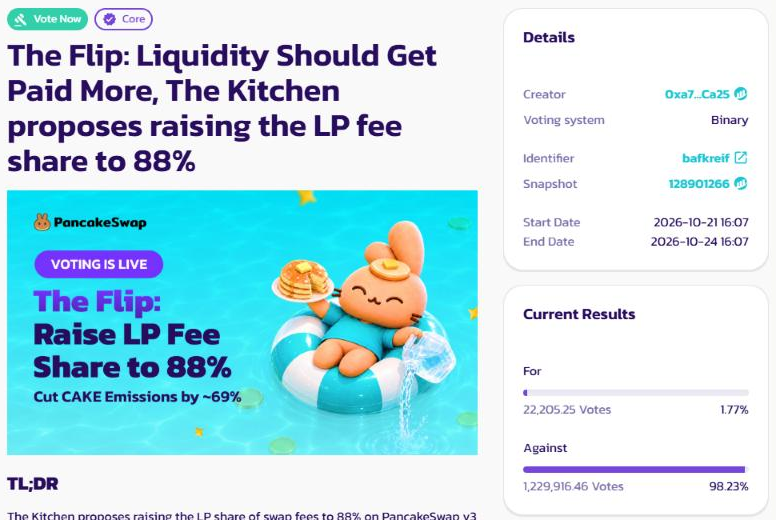
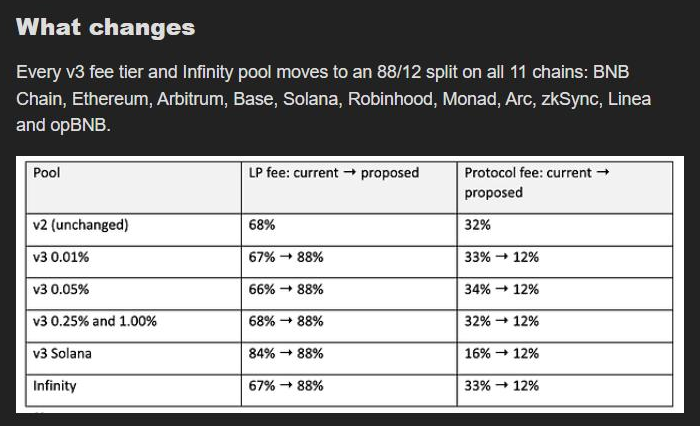
Under the current mechanism, every trading fee paid by PancakeSwap users is split into three parts: the majority is allocated to liquidity providers (LPs), while the remaining portion is used to buy back and burn the platform’s native token CAKE or deposited into the protocol treasury. On October 14, the project’s core team The Kitchen launched The Flip proposal on its governance forum, which plans to raise the LP fee share for v3 and Infinity pools across 11 blockchains from the current 66%-68% range (applied to most pools) to 88%. The remaining 12% of fees will be fully allocated to the protocol treasury, with no portion directly earmarked for CAKE burning; fee distribution for v2 pools will remain unchanged. Meanwhile, newly issued CAKE allocated as liquidity mining rewards will be cut from 22,500 tokens per day to 7,000 tokens per day (a roughly 69% reduction), with these tokens transferred to the ecosystem growth fund, the Pantry.
Whether the proposal passes is decided by CAKE holders. Voting power is calculated based on the CAKE balance held in BNB Chain wallets at the time of the snapshot (1 CAKE = 1 vote); tokens that are staked, deposited into liquidity pools, or held on centralized exchanges are not counted towards voting power. For context on historical voting turnout for core governance proposals: the January 2026 proposal to lower CAKE’s supply cap drew roughly 1.67 million votes, the February proposal to retain fee revenue from stablecoin pools drew around 320,000 votes, and the June proposal to adjust the fee revenue flow for adjacent product offerings drew approximately 4.03 million votes. The Flip has accumulated around 1.25 million votes to date, leaving room for the result to shift before voting concludes.
Trading Token Burns for Liquidity
The Kitchen justifies the proposal by arguing that liquidity directly determines trade execution prices. Using 2025 trading volume as a baseline for its calculations, the core team estimates the new fee split structure will allow LPs across v3 and Infinity pools to earn an additional $62 million per year, supporting up to 30% more additional liquidity. As pool depth improves, the price impact of individual trades will decrease, and DEX aggregators will route more order volume to PancakeSwap pools. The team emphasizes that this approach attracts liquidity using platform fee revenue, rather than relying on new CAKE emissions.
However, the proposal would eliminate CAKE’s single largest source of token burns. Weekly breakdown data from PancakeSwap’s official burn dashboard shows that over the 13-week period from the week of July 27 to the week of October 19, a total of ~7.51 million CAKE was burned. Of this total, roughly 3.9 million CAKE (51.9%) was burned from v3 pools, and around 3.01 million CAKE (40.1%) from v2 pools. V3 pools contribute over half of total burn volume primarily due to their far higher trading activity compared to v2: per DefiLlama data, v3 currently holds approximately $720 million in total value locked (TVL) — less than half of v2’s TVL — but recorded $15.4 billion in trading volume between September 23 and October 22, more than 13 times the volume of v2 pools.
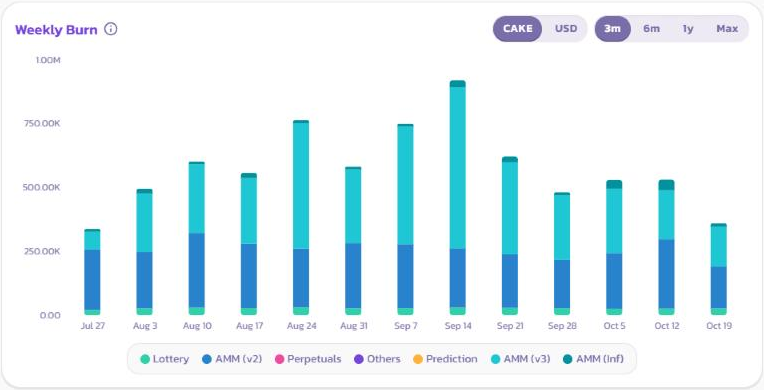
Using the 13-week average as a baseline, CAKE currently sees net deflation of roughly 426,000 tokens per week. Once The Flip is fully implemented, the ~319,000 weekly CAKE burns from v3 and Infinity pools will be eliminated entirely, while emission cuts will only reduce weekly new supply by ~103,000 tokens. This will bring weekly net deflation down to roughly 210,000 tokens — less than half of the current level. If calculated using the 10-week average cited by the core team, this figure drops to approximately 190,000 tokens per week.
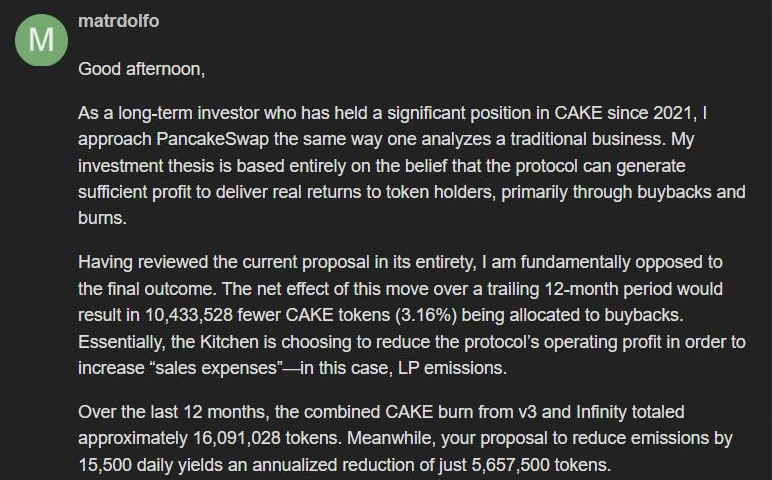
On the governance forum, matrdolfo, a long-term CAKE holder who claims to have held a large, concentrated position in the token since 2021, ran the numbers on a 12-month basis: over the past year, v3 and Infinity pools collectively burned roughly 16.09 million CAKE, while the new proposal’s emission cuts will only reduce annual new supply by around 5.66 million CAKE.
Is Deflation a Means or an End?
The reason token holders value burn mechanisms so highly traces back to CAKE’s early history. In its early days, CAKE saw large-scale new issuance as liquidity mining rewards. Starting in 2023, the team repeatedly adjusted the project’s tokenomics to shift toward a deflationary model; the Tokenomics 3.0 upgrade launched in April 2025 eliminated the veCAKE locking mechanism, cut token emissions, and set a target of reducing total CAKE supply by approximately 20% by 2030.
Per PancakeSwap’s September burn report, CAKE has recorded net deflation for 37 consecutive months, with total supply reduced by roughly 61.6 million tokens from the ~392 million peak recorded in September 2023.
In a forum response, The Kitchen stated that deflation is only a means to an end, not an end in itself, and that token price is ultimately driven by platform usage. The team noted that CAKE is already ahead of schedule in meeting its supply reduction goals under Tokenomics 3.0, and the projected shortfall in treasury revenue is a short-term sacrifice made to support long-term growth.
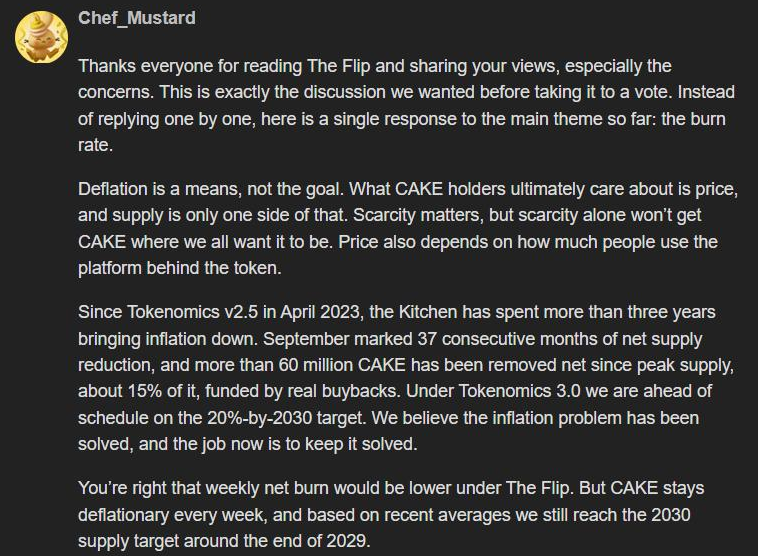
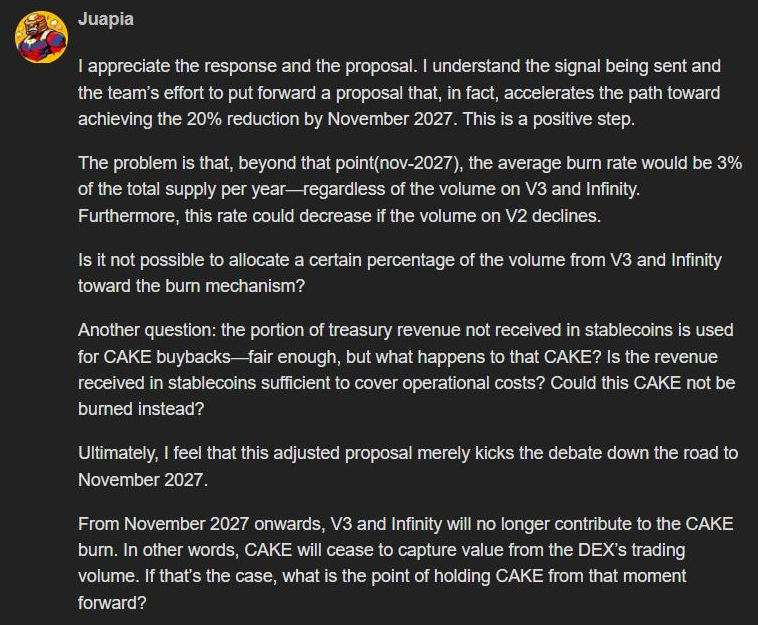
On October 19, the team released a revised proposal: instead of a simultaneous switch across all chains, the fee structure change will be rolled out in phases, starting with chains that contribute the least to CAKE burns and ending with the chains that contribute the most. The final phase of the rollout will only be implemented after CAKE meets its 20% total supply reduction target (the team estimates this will occur roughly 12 months after the first phase launches). The proposed emission cut will also be adjusted, bringing daily CAKE issuance down to 11,000 tokens by week 10. The team additionally committed that non-stablecoin trading fees received by the treasury will continue to be used to buy back CAKE.
This compromise has not quelled opposition. User Juapia pointed out that the core value of proportional burns is that higher platform usage translates to more CAKE being burned; once the full fee structure switch is completed, any growth in v3 and Infinity trading volume will no longer directly contribute to CAKE burns. He argued that the revised proposal only kicks the can down the road, delaying the core debate until November 2027.
An Overhaul Amid Sluggish Trading Activity
DefiLlama data shows PancakeSwap’s monthly trading volume peaked at roughly $110.2 billion in October 2025 before trending downward, dropping to as low as $18.5 billion in July 2026. Volume has recovered slightly since August, reaching approximately $29.7 billion in September (13.4% month-over-month growth), with monthly trading fee revenue hitting $24.3 million (38.5% month-over-month growth).
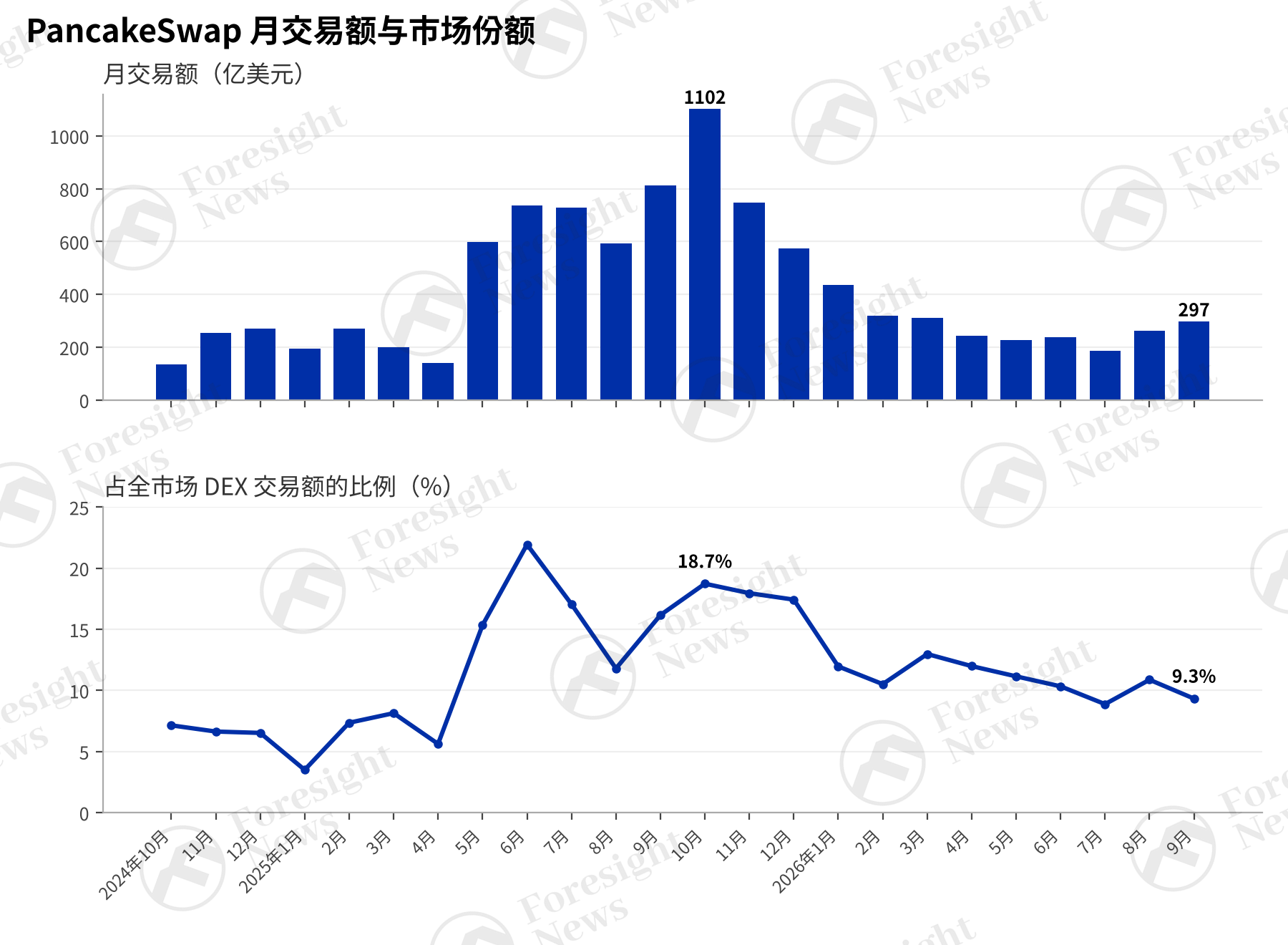
Over the same period, total monthly DEX trading volume across the entire market dropped from ~$588.1 billion to ~$318.4 billion, a 45.9% decline. PancakeSwap’s volume decline of 73.0% was far steeper than peer DEXs over the same window: Uniswap recorded a 25.4% drop, Aerodrome 42.8%, and Raydium 58.1%. PancakeSwap’s market share of total DEX trading volume also fell from 18.7% to 9.3%.
Additionally, PancakeSwap’s current protocol fee take rate is higher than its peers. Crypto analyst thelearningpill cited 30-day data from Token Terminal (as of October 18) showing that PancakeSwap’s protocol revenue accounts for 32.7% of total trading fees — the highest among large automated market makers (AMMs). In comparison, Raydium’s take rate is 16.1%, and Uniswap’s is 12.5%.
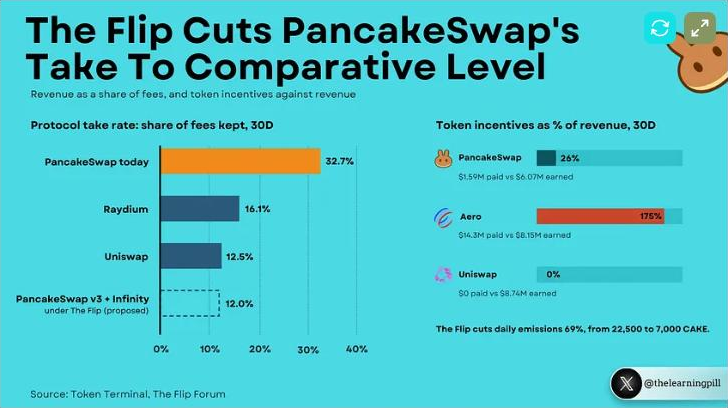
Once The Flip is implemented, this take rate for PancakeSwap’s v3 and Infinity pools will drop to 12%. Notably, both peer DEXs mentioned above direct a fixed portion of fee revenue back to their native tokens: Uniswap activated protocol fees via the UNIfication proposal in December 2025, allocating between 1/6 and 1/4 of LP fees from v3 pools to burn UNI, while Raydium dedicates a fixed 12% of fee revenue to buy back RAY.
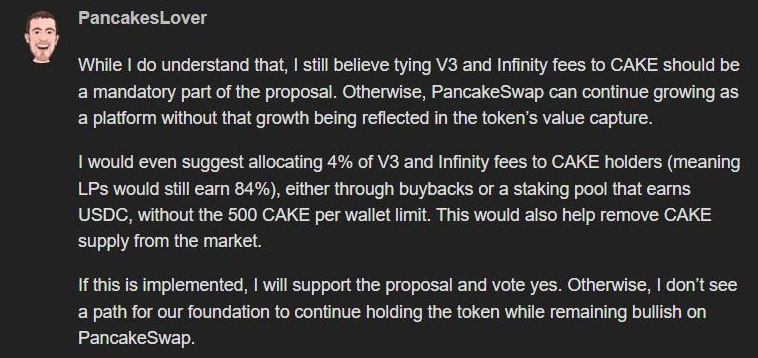
Community opposition is not rooted in a denial of liquidity’s value; the core disagreement lies in how business growth should translate to value accrual for the native token. User PancakesLover argued that the proposal must link v3 and Infinity pool fees to CAKE, recommending that 4% of fees be allocated to CAKE holders, while LPs retain an 84% share. He stated that his associated foundation would vote in support if the team adopts this adjustment, but sees no reason to continue holding CAKE otherwise. Other forum users have proposed retaining a 6% to 10% fee allocation for CAKE burns, but none of these suggestions were incorporated into the final vote text.
Voting will close at 16:07 on October 24. If the proposal fails to pass, the existing fee distribution mechanism and current daily CAKE emission rate of 22,500 tokens will remain unchanged, and the core team will need to re-submit a revised proposal for community consideration.