
From exclusively investing in crypto to covering frontier technologies, a16z has adjusted the public positioning of its new fund in just over five months.
Written by ChandlerZ, Foresight News
On October 22, a16z crypto, the crypto investment arm of Silicon Valley venture capital firm Andreessen Horowitz, officially announced that it will expand the investment scope of its new fund from crypto startups to a broader range of frontier startups, and rebrand a16z crypto as a16z Frontier.
"Frontier" refers to the cutting edge. Chris Dixon, a managing partner of the firm, uses the term to describe startups that develop new technologies and open up new markets, some of which may take years to mature. The official announcement stated that it will continue to invest in cryptocurrencies and related enterprises, and advocate for sound crypto regulation. The new fund will be co-led by Chris Dixon, a16z co-founders Marc Andreessen and Ben Horowitz, and general partners Eddy Lazzarin and Guy Wuollet.
a16z stated that the world is currently in a major technology wave centered on artificial intelligence (AI), and blockchain will play an important role in the AI transformation. Cryptocurrencies provide the internet with fast, low-cost, global, and programmable payment rails. Stablecoins are rapidly becoming a standard tool for fintech companies, traditional financial institutions, and other organizations. Moreover, thanks to the programmability of blockchain, both centralized and decentralized financial services can be built on it. Cryptocurrencies can endow emerging networks with native economic capabilities, enable machine-to-machine transactions, and create new launch models.
Just over five months ago, the team announced the closing of its $2.2 billion fifth crypto fund. At the time, the firm emphasized to media that the fund would focus exclusively on crypto and would not expand into adjacent fields such as AI and robotics. Now, autonomous machines, new devices, and even biomedicine have all appeared in Chris Dixon's new investment scope.
Five Months Ago, It Emphasized Exclusively Investing in Crypto
In 2018, a16z launched its first dedicated crypto investment fund, valued at $350 million. Since then, the second and third funds raised $515 million and $2.2 billion respectively; by 2022, the fourth fund reached $4.5 billion in size. As the head of this business, Chris Dixon has long supported blockchain networks and related startups, with his investment portfolio including Coinbase, Solana, and Uniswap.
The fifth fund, announced on May 5 this year, returned to a size of $2.2 billion, a decrease of approximately 51.1% from the previous one, bringing the total cumulative raised across the five funds to approximately $9.765 billion. Regarding the smaller size of the single fund, a16z communications partner Paul Cafiero explained to media at the time that a shorter fundraising cycle would help the team adapt to the constantly changing crypto market.
Cafiero explicitly stated that the fifth fund would maintain its focus on the crypto sector and would not expand into adjacent industries such as AI and robotics. He described the fund's positioning as "100% dedicated to investing in crypto founders at all stages".
However, the description of crypto applications in the May announcement already went beyond token trading. The team listed cross-border payments, stablecoin lending, prediction markets, and the on-chain tokenization of traditional assets, and also discussed how agents can purchase computing power, data, and services on behalf of users. It hopes to use this capital to support founders in turning the already built blockchain infrastructure into products that people use on an ongoing basis.
By October, Chris Dixon directly announced that the new fund's scope would be expanded beyond crypto startups.
What Does Frontier Plan to Invest In?
According to Chris Dixon's explanation, the first point involves the position of blockchain in commercial products. Wall Street and fintech companies are increasingly adopting on-chain technologies, and infrastructure is gradually moving behind the products themselves. In his judgment, it is more appropriate to define a business by the services a company actually provides, rather than by whether it uses blockchain.
At the same time, he hopes to invest in new products and new markets brought by AI. At this stage, AI is often used to improve the efficiency of programming and knowledge work; in his vision, activities that were previously impossible will emerge in the future, as well as autonomous machines that can perceive, reason, and act in the real world. Advances in biomedicine and new companies combining software and hardware have also been included in the scope of discussion.
He also expects that founders will combine software, hardware, and services to develop products that can provide end-to-end services. As AI agents can autonomously perform more tasks, companies can try new business organization models, and the fund will also focus on opportunities that have not yet formed mature industry classifications.
To explain the origin of this line of thinking, Chris Dixon reviewed his investment experience after joining a16z in 2013. At that time, the smartphone industry drove down the cost of cameras, sensors, and chips, spawning new computing devices, and he thus participated in investments in companies such as Oculus, Skydio, and Zipline. This expansion of scope also continues his practice of seeking new technology products that have not yet entered the mainstream market.
In the future network depicted by Chris Dixon, crypto still has its uses: he still lists stablecoins, programmable financial services, and machine-to-machine transactions as application directions for blockchain. If AI agents need to purchase data or services on their own, it involves accounts, payments, and settlement, and blockchain can provide the fund flow capability for these processes.
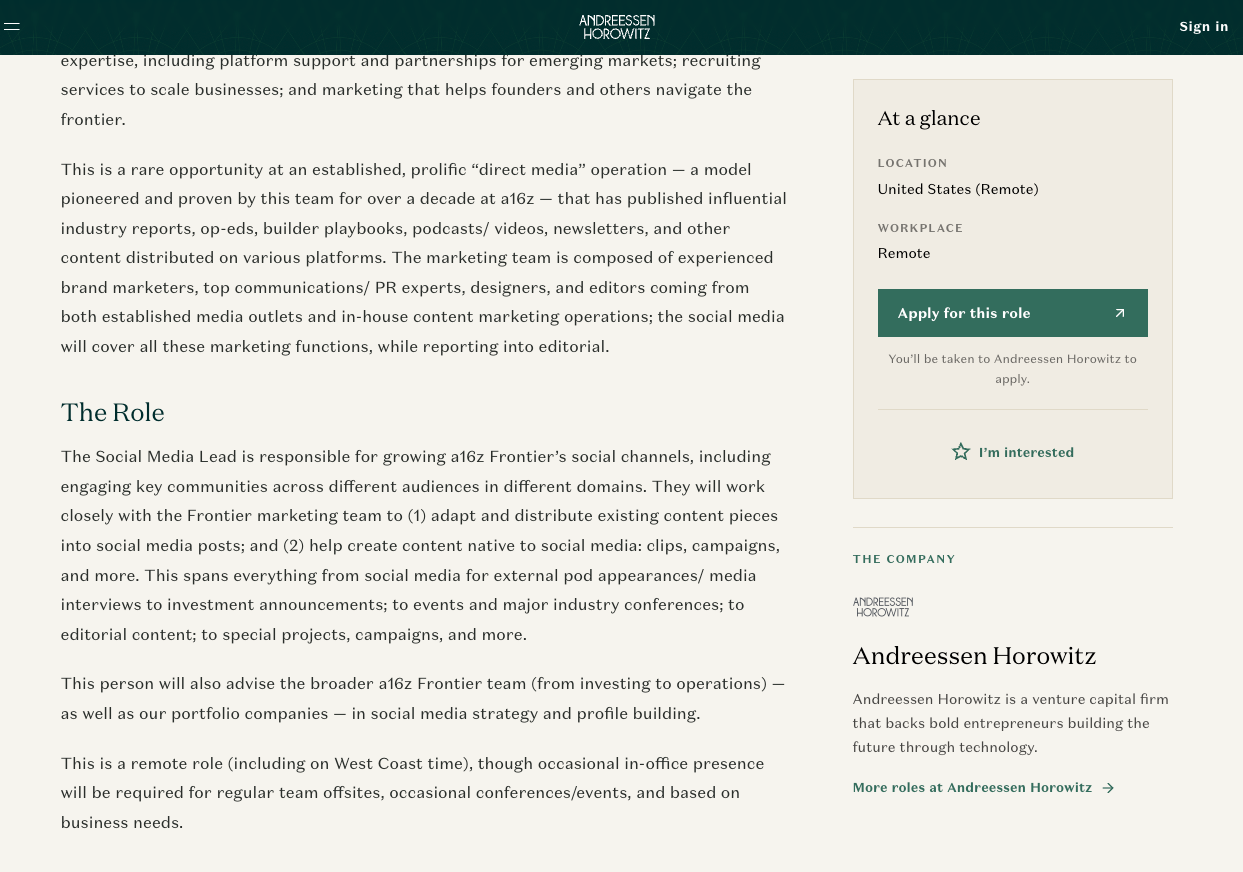
Interestingly, the firm also released a job posting for a head of social media on the same day, which already introduced Frontier as a venture capital fund covering emerging technologies such as AI, biotech, crypto, and hardware. The position will be responsible for expanding a16z Frontier's social media channels, including interacting with key communities across different fields and audience groups.
From Prediction Markets to Computing Power Trading: What Has the Team Already Invested In?
Before the rebranding, a16z Crypto's investment notes already included companies connected to traditional finance and AI infrastructure.
In October 2025, Chris Dixon announced an investment in prediction market platform Kalshi. Users can trade contracts around elections, economic events, and other incidents, expressing their judgment on outcomes through prices. Kalshi completed a $300 million Series D round at a $5 billion valuation at the time, co-led by a16z and Sequoia Capital. Chris Dixon's investment note focused on how markets aggregate dispersed information, and also mentioned that Kalshi plans to deeply integrate crypto functions.
On June 24 this year, a16z Crypto also announced that it led a $33 million seed round for computing power company Ornn, with participation from Galaxy Ventures, Nordstar, SV Angel, Vine Ventures, Crucible Capital, Link Ventures, and Box Group, among others.
According to the official investment introduction, Ornn uses real transaction data to compile a computing power price index, and continues to develop services around futures, equipment residual value protection, and capital market products. Its goal is to help enterprises manage the risk of future computing power procurement or rental prices, and also provide investors with tools to participate in AI infrastructure revenue. At the same time, Ornn launched Ornn Compute, a physical capacity layer for the computing market. This product can aggregate dedicated GPU capacity from multiple new cloud platforms into a unified platform, adopt a single onboarding process, and provide a secondary market for capacity transfer and on-demand subleasing.
Paradigm and Haun Are Also Expanding Their Investment Scope
Before a16z's rebranding, Paradigm, which also started with crypto investments, had already directed its new fund into more industries. On July 8, co-founder Matt Huang and managing partner Alana Palmedo announced the closing of its fourth $1.2 billion fund, with an investment scope covering crypto, AI, robotics, and other frontier technologies.
The enterprises listed in the announcement include drone delivery company Zipline, rapid manufacturing platform SendCutSend, space defense company True Anomaly, and AI research company Nous Research. Compared with Chris Dixon's review of his early equipment investment experience, Paradigm has already included these non-crypto enterprises in its new fundraising announcement, showing the expanded portfolio to the public.
At the same time, Paradigm continues to invest in on-chain trading platform Hyperliquid, stablecoin public chain Tempo (co-incubated with Stripe), and prediction market Kalshi. Its engineering team is also developing both blockchain tools and AI agent tools: the former includes Foundry and Reth, and the latter includes Centaur. Its capital and R&D work have begun to cover multiple technologies, but stablecoins, trading, and on-chain finance remain on its investment list.
On May 4 this year, Haun Ventures announced the closing of $1 billion in new capital, listing three investment directions: new financial infrastructure, new assets and markets, and the agent economy. Founder Katie Haun stated in the announcement that building a new generation of financial services will use both crypto technology and other technologies, with specific businesses including payments, banking, custody, and foreign exchange. For agents, she further listed demands such as identity, credit, insurance, and anti-fraud: that is, after software is able to make payments, it is also necessary to solve the problem of who is transacting and who bears the risk.
The options these firms chose after expanding their scopes are not the same: Haun still focuses on financial services, Paradigm has already invested in manufacturing and space defense, and a16z has also included biomedicine in its scope. For enterprises such as new hardware and biotech companies, whether they use blockchain no longer solely determines whether they can enter these funds' investment scope.
Chris Dixon will continue to lead the fund, co-leading it with a16z founders Marc Andreessen, Ben Horowitz, and general partners Eddy Lazzarin, Guy Wuollet. The existing operations team will continue to provide regulatory, market expansion, recruitment, and technology R&D support for existing and future portfolio companies. As of October 23, the rebranding announcement has not disclosed the proportion of capital allocated to non-crypto investments, nor has it announced any new fundraising amount.