
Priors has surpassed a $10 million market capitalization.
Written by Ma He, Foresight News
AI agents are evolving from standalone conversational tools to a stage where they autonomously call APIs, execute tasks, and settle transactions with peer agents. Amid this transition, a fundamental challenge has become clear: the core bottleneck for cross-entity interaction between AI agents is the lack of Sybil-resistant credit anchors across machines.
Social follows and interactive comments can be fabricated at extremely low cost. Only verifiable, on-chain records of actual borrowing and repayment cannot be forged at zero cost — this forms the core underlying logic behind new project Priors’ entry into on-chain credit scoring.

Priors aims to fill this gap on Robinhood Chain. The protocol issues small-value USDG loans to agents compliant with the ERC-8004 standard — an on-chain identity and reputation framework for AI agents jointly promoted by the Ethereum Foundation, Google, and Coinbase — and publicly records every repayment and default event on-chain to generate recalculable credit scores.
Operating Mechanism
The operating logic of the Priors protocol is relatively straightforward.
Any agent meeting the ERC-8004 standard can register an on-chain identity, but activation of a credit line requires a mandatory prerequisite: sponsors or owners must inject First-Loss Capital as collateral.
New agents can access an initial credit line of roughly $5 from the protocol treasury. Larger credit limits require capital provided by sponsors, the agent’s owner directly, or via mechanisms such as tokenized equities.
Current loan limits are capped between $5 and $500, with terms ranging from 1 day to 1 month, and a base interest rate of approximately 1% per 30-day period. Fees are locked in at the time of borrowing, and allocated at a ratio of 50% to lenders, 25% to endorsers, and 25% to the reserve fund.
If an agent repays on schedule, its track record is publicly accumulated and factored into its credit score; upon default, the score is directly reset to zero and fully visible to all network participants.
The protocol adopts a so-called Junior Tranche Backstop structure: in the event of default, bad debt is fully backstopped by the junior tranche funds provided by endorsers, ensuring that senior liquidity providers (USDG lenders) suffer zero loss to principal and interest.
Credit scores are calculated based on on-chain events, with reference factors including repayment amount and duration, number of qualified loans, and size of endorsements, and are written into the ERC-8004 reputation registry. Any user can re-verify these records directly from on-chain logs without relying entirely on the interfaces provided by the project team. The protocol also provides MCP servers and x402-related tools to help agents complete borrowing, repayment, and record queries during actual operations.
In terms of development progress, Priors is built as an open-source project, with core code hosted in the priors-agents organization on GitHub, including smart contracts, SDKs, MCP servers, and independently runnable example agents.
The project has not publicly disclosed specific founder information. Recent updates include the launch of the open-access Go Mode frontend, which supports Google login and covers gas fees on behalf of users via the protocol. The team has also set up a public bug bounty program, but explicitly notes that its smart contracts have not yet undergone external audits.

As of now, official protocol data shows that nearly 50,000 repayments have been completed cumulatively, with over $360,000 in principal repaid across approximately 292 agents. This translates to an average individual loan of roughly $7.3, and about 170 high-frequency cyclic borrow-repay cycles per agent — essentially, agent owners accumulate on-chain compliance credit scores at high frequency by paying a 1% borrowing fee. On the lender side, the protocol emphasizes that no losses have occurred to date.
However, according to the latest data from DefiLlama, the protocol’s current TVL (idle available funds, excluding outstanding loan capital and token staking) remains at $6,600, indicating that the project is still in its early validation stage.
Market Cap Surpasses $10 Million, Token Supply Reduced to 900 Million
PRIORS is the native token of the Priors protocol. It launched on the Pons launchpad in September 2026, trading in pairs with USDG. Its primary liquidity has now migrated to Pons V2 DEX and Uniswap V4 on Robinhood Chain.
According to the latest data from the Pons platform, the token is currently priced at $0.0125, with a market capitalization of $12.4 million and a total of 4,066 holders.
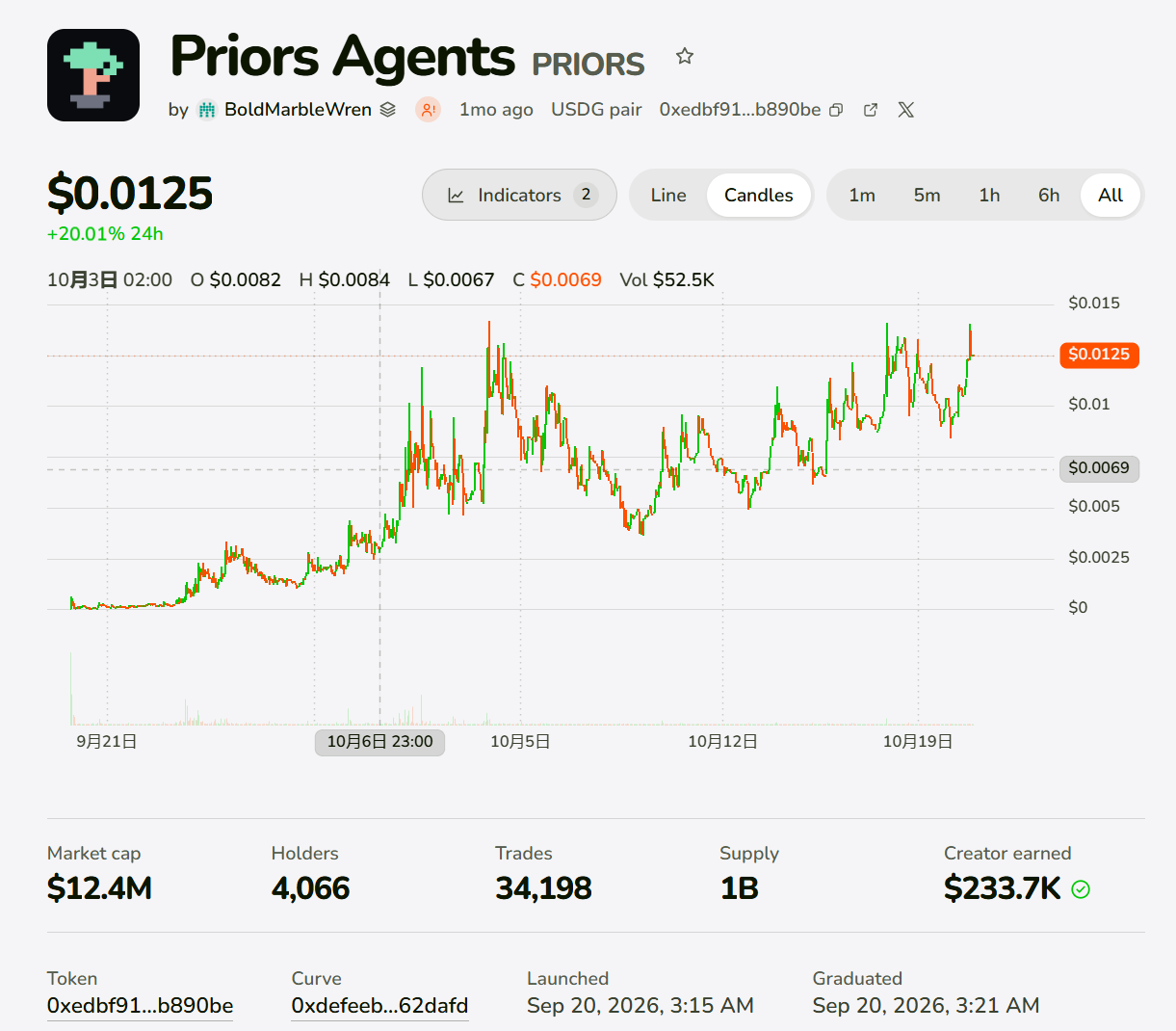
Its core role in the protocol is not as a generic payment tool, but as endorsement capital for agent credit lines. Agent owners can stake their held PRIORS into the SeatVaultV5 (credit seat vault) contract via Go Mode to activate or increase the credit line for their own agents.
Credit lines start at roughly $25 to $50, and can be gradually increased to a maximum of $500 as repayment records accumulate. Owners can also directly pay USDG, which the protocol automatically swaps into $PRIORS within the same transaction to complete staking.
During the staking period, endorsers can capture a 25% share of the agent’s borrowing interest spread. The majority of this share is directly credited to the agent’s credit reserve account to enhance its credit limit, while a small portion is allocated to the protocol’s risk buffer pool.
Once an agent defaults, the protocol first uses the corresponding USDG held in SeatVaultV5 to fully cover the loan principal and fees, ensuring lenders bear no losses. Meanwhile, the current iteration of SeatVaultV5 has increased the proportion of burned tokens from defaulters from 50% in earlier versions to 75% (with the remaining 25% refunded). It also directly flags and blocks defaulting wallet addresses, preventing them from applying for new credit lines for other agents, to deter malicious debt evasion with extremely high sunk costs.
The protocol allocates 25% of base fees to the reserve fund. Once the reserve exceeds a certain threshold, any user can trigger a daily sweep operation to distribute surplus funds according to established rules. Half of the surplus is used to repurchase PRIORS via Engine 2 (BuyAndBack), with repurchased tokens allocated as backing for credit lines of well-performing agents with no recent overdue records. The other half is injected into the PRIORS/USDG liquidity pool as unilateral USDG via Engine 3, and this portion of liquidity is designed to be non-withdrawable.

It should be noted that creator fees generated from tokens on Pons do not currently flow automatically into the protocol treasury. Initial credit line funds for the treasury still require manual USDG injection, which is then converted into pool shares via sweep operations.
Thanks to the protocol’s built-in default token burn and repurchase mechanisms, the current maximum supply has shrunk from the initial 1 billion tokens to approximately 918.37 million tokens.
Overall, PRIORS’ value capture path primarily relies on endorsement demand, fee revenue sharing, and the potential token placement mechanism for repurchased assets, rather than a clearly defined fixed vesting schedule.
Constrained by the current pool size, the real-world impact of these mechanisms remains relatively limited.
The most distinctive feature of Priors to date is that it turns the simple act of repaying borrowed funds into a public, verifiable, on-chain behavior with real associated costs — rather than yet another easily gamed points system.
Its mechanism design is relatively straightforward, and it has a proven track record of zero losses for lenders. However, this is fundamentally an inevitable outcome of a full margin deposit system, rather than a sophisticated risk control model for AI agents.
That said, its absolute scale remains very small, with limited real lending depth, and contract risks have not yet been externally validated. Whether it can evolve from its current early experimental stage into a trusted credit reference that agents check before real-world interactions depends largely on whether more agents actually use the borrowed funds to complete tasks and repay on time going forward.
For those tracking AI agent infrastructure, the sustained growth of repayment data and credit line utilization is far more worthy of attention than mere price fluctuations.