
Happy Monday, friends!
Some thoughts on tax in crypto, and a walkthrough of which countries that has among the lowest taxes.
Btw, if you want daily updates from me (posting like 10x per day), then check out my free TG channel: https://t.me/cryptogoodreads
Thanks for reading The Black Swan 📈! Subscribe for free to receive new posts and support my work.
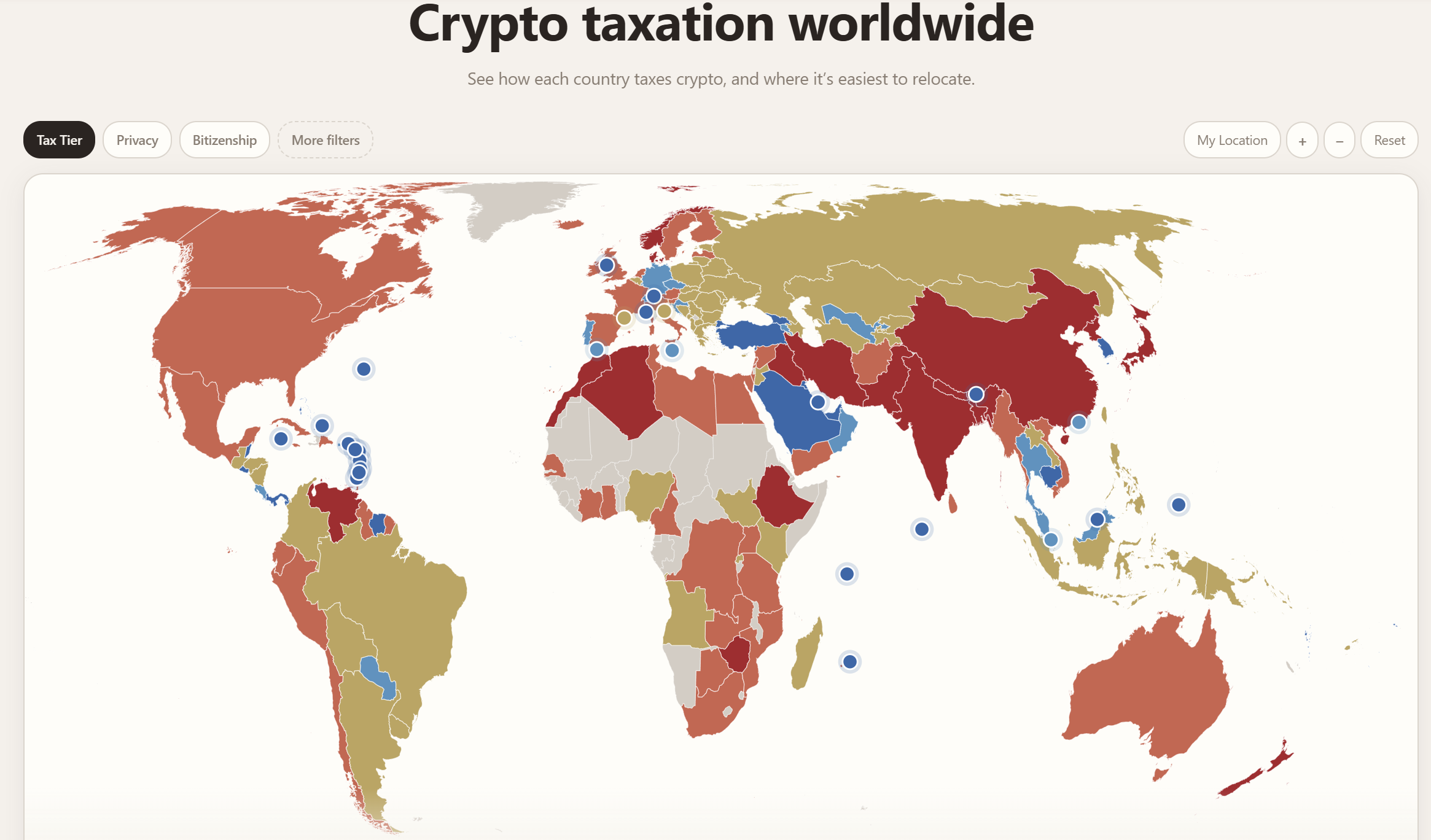
30+ countries have 0% tax on crypto.
Where in the world can you actually pay 0% tax on crypto?
A guide to Europe’s crypto tax rules, plus the UAE, Singapore and Hong Kong.
There’s a big difference between a country having no capital gains tax and your crypto profits being tax-free.
Singapore and Hong Kong don’t tax genuine capital gains, but they can tax profits that qualify as business income. Switzerland generally exempts private investment gains, but still taxes your wealth. Germany, Portugal and Luxembourg offer exemptions based on how long you hold.
And Cyprus, which still appears on outdated “zero-tax crypto” lists, introduced an 8% tax on qualifying crypto disposal profits in 2026.
The word that matters is classification.
Are you investing, trading professionally, earning income or running a business? That question often matters more than the headline rate.
Here’s how the main destinations compare, what the exemptions actually cover, and where the “0% crypto tax” narrative starts to fall apart.

Switzerland: tax-free gains, but not tax-free wealth
Switzerland’s attraction is straightforward: capital gains on assets held as private wealth are generally exempt from income tax. That includes privately held crypto.
There isn’t a universal one-year crypto holding requirement comparable to Germany’s.
But there are two qualifications.
First, your activity must remain private investing. If it qualifies as professional trading or self-employment, the gains become taxable.
Second, your crypto holdings form part of your taxable wealth. The amount payable depends on the canton and local tax scale.
That creates a different calculation from a country that only taxes realised profits. A Swiss investor can owe wealth tax even in a year when they sell nothing.
Switzerland is therefore better described as “generally no tax on private capital gains” than “no crypto tax.”
Cyprus: older guides can give you the wrong answer
Cyprus deserves particular attention because its rules changed.
From January 1, 2026, profits from qualifying crypto disposals are subject to a flat 8% income tax. The regime covers sales, crypto-to-crypto exchanges, spending crypto and gifts that give rise to gains.
It captures both capital and trading gains within its scope.
There are also limits on losses. Crypto losses can generally offset crypto gains of the same person in the same year, but cannot be carried forward under this special regime. Crypto acquired through mining falls outside this particular treatment.
This means Cyprus should not be presented as a zero-tax destination for ordinary crypto disposals in 2026.
Its non-dom reputation doesn’t change that conclusion. A favourable rule for one category of income isn’t a universal exemption for everything a resident earns.
Cyprus now belongs in the low-tax discussion, not the zero-tax column.
Portugal: still attractive for holders
Portugal’s rules are more specific than its old crypto-haven reputation suggests.
For qualifying cryptoassets that are not securities, gains on disposals after a holding period of at least 365 days are excluded from taxation.
Gains that don’t qualify for the exclusion are generally subject to a 28% rate, although aggregation rules and other exceptions can change the result.
The structure favours patient investors more than short-term traders.
But “hold for a year” isn’t a complete answer to every crypto tax question. The exemption concerns a defined category of disposal gains. It doesn’t mean every token, business activity or source of crypto income receives identical treatment.
For someone buying and holding qualifying assets, the long-term exemption can be valuable.
For someone running a complicated onchain portfolio, the details need more work.
Monaco: a genuine zero-personal-tax option
Monaco has no personal income tax for most residents. French nationals are the major exception because of the France–Monaco tax convention.
For eligible individuals, that makes Monaco one of the clearest European jurisdictions for untaxed personal investment gains.
The important qualification is that the treatment applies to people genuinely established in the principality. It also doesn’t override the rules applied by other countries.
Monaco residency doesn’t, by itself, prove that your previous country has stopped treating you as a tax resident.
The tax proposition is simple. Establishing that it applies to you is the part that requires evidence.
Luxembourg: the six-month rule people overlook
Luxembourg is less prominent in crypto relocation conversations, but its private-investor rules are worth understanding.
An individual’s crypto gain is generally taxable as a speculative gain if the disposal occurs within six months of acquisition and total speculative profits reach at least €500 for the year.
Outside that speculative window, genuine private investment gains are generally not taxable.
That makes its holding-period threshold shorter than Germany’s or Portugal’s.
However, this is an investor rule, not a universal exemption for a crypto business. Where short-term gains are taxable, they fall under ordinary individual income tax rates rather than a special low crypto rate.
Luxembourg’s appeal is therefore quite specific: it can be favourable for private investors who hold beyond six months.
Malta: the token matters as much as the holding period
Malta is frequently reduced to “long-term crypto gains are tax-free.”
The actual framework is more nuanced.
Its tax guidance distinguishes coins, financial tokens, utility tokens and hybrid assets. Coins held as capital assets fall outside capital gains taxation.
But profits from a business exchanging coins, or selling coins held as trading stock, are ordinary income.
Financial tokens can have a different outcome. If a token qualifies as a security under the relevant rules, its disposal can fall within capital gains taxation.
There also isn’t a general rule saying every cryptoasset becomes tax-free after six months or one year. Purpose and context matter, not just time elapsed.
Malta can be favourable for genuine investment holdings. But “Malta = 0% crypto tax” leaves out too much to be a useful summary.
Germany: a strong exemption for patient investors
Germany’s current framework generally allows privately held crypto to be sold tax-free after more than one year.
That exemption can apply regardless of the size of the gain.
Sell, swap or spend within the one-year window, and a gain can instead be taxable under the rules for private disposals.
There is an annual exemption threshold of €1,000 across relevant private disposal gains. This is a threshold, not a deduction: reaching it can make the full relevant gain taxable.
Two distinctions matter here.
First, exchanging one token for another can be a disposal. You don’t necessarily need to withdraw euros to create a tax event.
Second, business-held crypto follows different rules from private holdings.
As of this edition, the one-year exemption remains the current rule. Reform proposals have been reported, so anyone making a future relocation or disposal plan should distinguish existing law from proposed changes.
For a patient private investor, Germany can be much more favourable than its high-tax reputation suggests. For a frequent trader, the outcome can look very different.
With that said, there’s a high risk Germany will do something with the 0% tax.
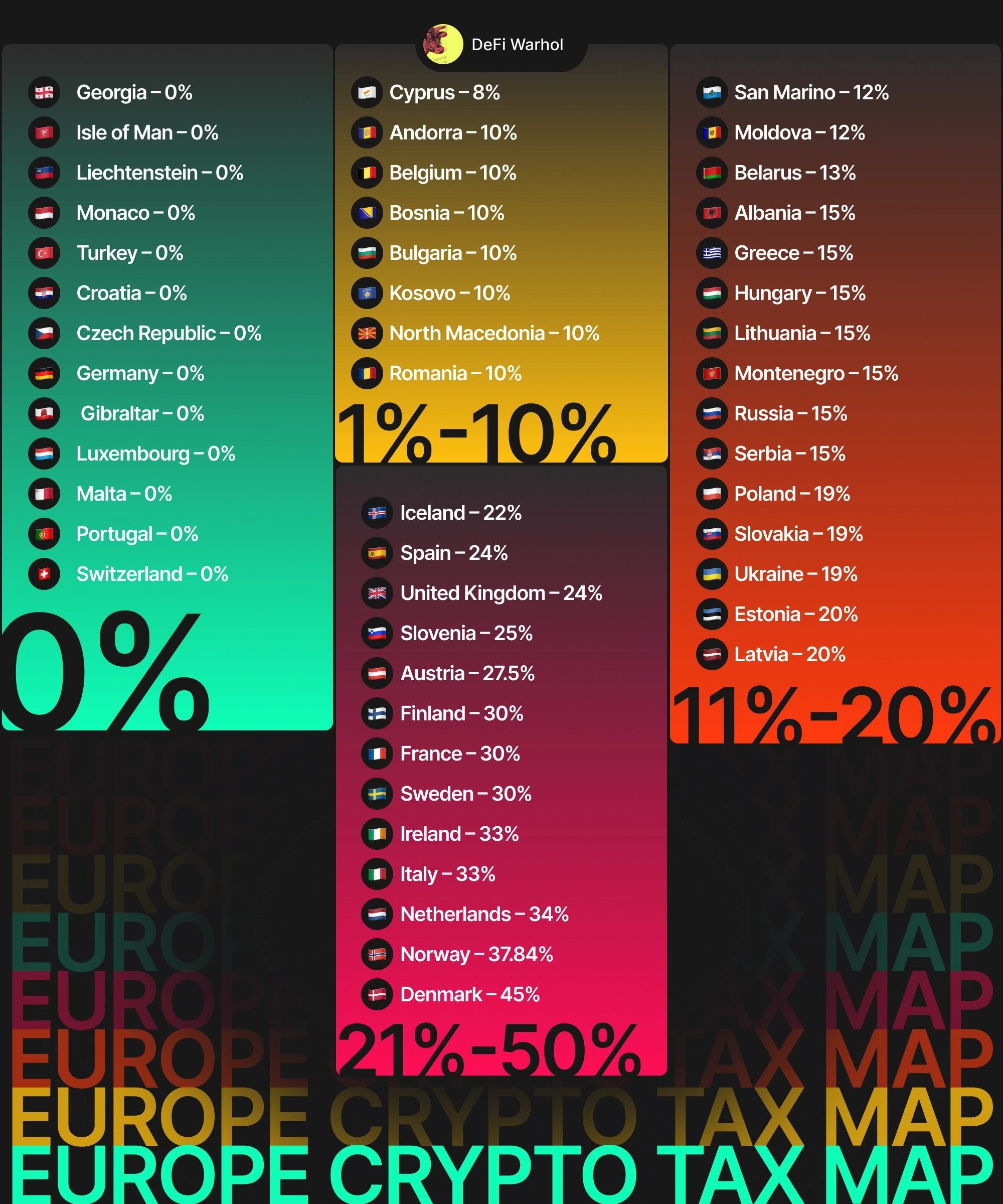
UAE: personal investing is the key distinction
The UAE is one of the clearest non-European options for individuals seeking zero tax on qualifying personal crypto investment gains.
Qualifying personal investment income is excluded from the business activities that bring an individual within corporate tax.
But the UAE isn’t a place where every crypto-related activity automatically receives a zero rate.
An individual carrying on a UAE business or business activity can enter the corporate tax regime when annual business turnover exceeds AED 1 million. Qualifying personal investment income is excluded from that threshold.
Where the standard corporate tax regime applies, the headline rates are 0% on taxable income up to AED 375,000 and 9% above that amount.
Those are profit thresholds, not the same thing as the AED 1 million turnover test for individuals.
The distinction is between managing your own investments and conducting a taxable business—not simply between crypto and everything else.
Singapore: no capital gains tax, but trading income is different
Singapore does not tax genuine capital gains.
For individuals, profits from buying and selling financial instruments, including digital tokens, are generally viewed as personal investment gains.
But businesses buying and selling tokens in the ordinary course of business are taxed on their trading profits.
The authorities consider factors such as the purpose of the investment, transaction frequency and holding period when distinguishing capital gains from taxable trading income.
There isn’t a simple rule saying every crypto profit is tax-free because it was made in Singapore.
Singapore belongs on a list of jurisdictions with no capital gains tax. It does not belong on a list claiming that every form of crypto income is untaxed.
Hong Kong: investment gains and business profits are separate
Hong Kong also distinguishes investment gains from business profits.
Capital gains are excluded from profits tax. Crypto held as a long-term investment can fall within that treatment.
By contrast, Hong Kong-sourced profits from a cryptocurrency business can be taxable.
Determining the source requires examining the operations that produced the profits and where those operations took place.
“Hong Kong has no capital gains tax” is therefore a useful starting point.
“Every crypto trading strategy is tax-free” is not a reliable conclusion.
So which places actually offer 0% capital gains tax?
There are three different answers.
Jurisdictions with no general tax on genuine personal capital gains
Among the destinations covered here:
UAE: qualifying personal investment gains generally fall outside tax.
Singapore: genuine capital gains are not taxable.
Hong Kong: capital gains are excluded from profits tax.
Monaco: most eligible, genuinely established residents are not subject to personal income tax. French nationals require separate analysis.
Hong Kong is a separate tax jurisdiction rather than a sovereign country. This is also a shortlist of the destinations covered in this article, not an exhaustive global list.
Jurisdictions offering exemptions for qualifying private investments
Switzerland: private investment gains are generally exempt, but wealth tax remains.
Malta: capital gains on qualifying coins fall outside the charge, while trading income and some token categories receive different treatment.
Jurisdictions offering 0% after a holding period
Luxembourg: generally after more than six months for private investment holdings.
Germany: generally after more than one year for private crypto holdings under current rules.
Portugal: at least 365 days for qualifying cryptoassets, subject to the applicable conditions.
Cyprus is not in these zero-tax groups for disposals covered by its 2026 regime. Its rate is 8%.
Why DeFi makes the comparison harder
Country comparisons become less straightforward once your portfolio does more than buy, hold and sell.
A capital gains exemption doesn’t automatically answer how a jurisdiction treats mining, token remuneration, investment returns or business trading.
That’s why a tax review for an active crypto user should separate at least four questions:
What happens when you dispose of a token?
What happens when you receive tokens as income or rewards?
Could your activity qualify as a business?
Are your actual instruments covered by the exemption you’re relying on?
A favourable answer to the first question doesn’t settle the other three.
Someone holding BTC for two years and someone earning tokens, rotating positions and trading derivatives might live in the same country but need very different tax analyses.
The part a country ranking can’t answer
A low headline rate is only useful if the rules actually apply to your circumstances.
You need to establish which jurisdiction has taxing rights rather than assume a new address settles the issue.
And low tax shouldn’t be confused with low visibility.
EU crypto reporting rules under DAC8 apply to reportable activity from 2026, with initial reporting taking place in 2027 under national implementations. Tax-free treatment and reporting obligations are separate questions.
The useful question isn’t simply, “Where is crypto tax 0%?”
It’s, “Where would my actual portfolio, trading activity and income qualify for that treatment—and can I document why?”
…
Until next time,
Ciao.
Thanks for reading The Black Swan 📈! Subscribe for free to receive new posts and support my work.