
AEP licensing fees are a new variable.
Author: KarenZ, Foresight News
In the past few days, the fee revenue curve of Robinhood Chain has suddenly steepened. According to ArbData, from August 31 to September 2 alone, the chain generated approximately $10.5 million in fee revenue, accounting for more than half of its total fee revenue since launch.
The buzz brought by Robinhood has also brought the underlying Arbitrum back into the market spotlight.
Beyond the buzz, for Arbitrum, how much cost does it take to support the continuous operation of a blockchain and its ecosystem, and how much revenue can it generate?
The latest H1 2026 report released by the Arbitrum Foundation shows that ArbitrumDAO earned $6.19 million in revenue during the reporting period, while the foundation recorded $27.70577 million in USD costs and an additional cost of 4.6 million ARB tokens.
This report provides a window into Arbitrum: on one side are continuous expenditures from infrastructure, ecosystem cooperation, and developer projects; on the other side are revenues from transaction fees, Timeboost, and AEP licensing fees. The sudden surge of Robinhood Chain has made one of the newer revenue streams begin to show scale.
What Are Arbitrum's Revenue Sources?
As explained in the foundation's ongoing funding proposal, the Arbitrum Foundation is the "growth engine and cost center" of the entire ecosystem: it is responsible for technical infrastructure, strategic cooperation, ecosystem grants, governance support, and bears the relevant operating costs of Arbitrum One and Arbitrum Nova; at the same time, the revenue generated by the protocol directly goes into the ArbitrumDAO treasury, and the foundation needs to apply for funds from the DAO regularly.
Therefore, the $6.19 million in the report is the revenue belonging to ArbitrumDAO in H1 2026, sourced from Arbitrum One transaction fees, Timeboost, Arbitrum Expansion Program (AEP) licensing fees, and treasury returns. The report states that the gross margin of these revenue streams is over 97%; as of June 2026, the DAO also held approximately $125 million in non-native token assets (excluding ARB).
As of June 30, the value of liquid and usable assets held by the foundation was approximately $86.8809 million.
Where Did the Half-Year Costs Go?
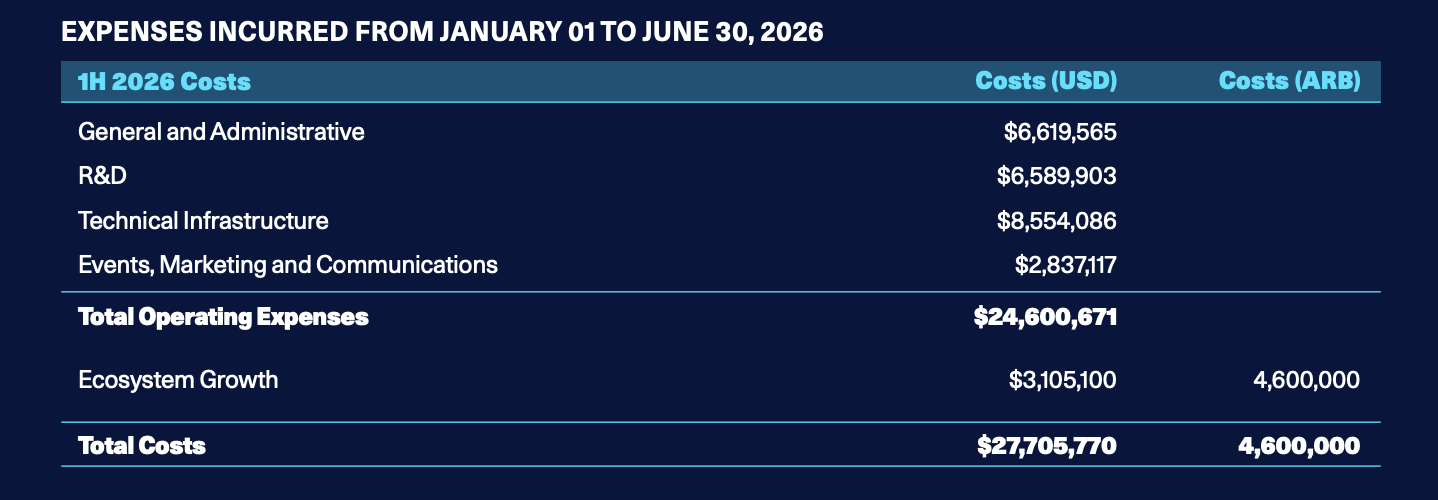
The report shows that from January to June 2026, the foundation's total USD costs were approximately $27.7 million, with an additional cost of 4.6 million ARB tokens.
Among them, USD operating expenses were approximately $24.6 million, mainly divided into four parts: technical infrastructure at $8.55 million (the largest single expenditure); general and administrative expenses at $6.619565 million; R&D expenses at $6.589903 million; and events, marketing, and communication expenses at $2.837117 million. In addition, ecosystem growth projects recorded costs of $3.1051 million and 4.6 million ARB tokens.
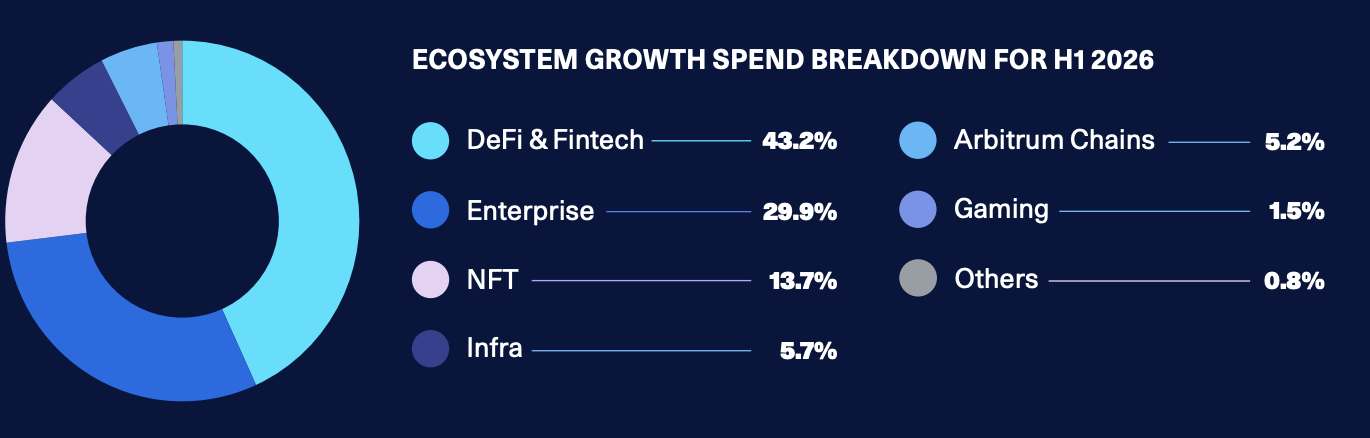
From the perspective of ecosystem growth fund allocation: DeFi and fintech accounted for 43.2%, enterprise business accounted for 29.9%, totaling 73.1%. The remaining funds flowed to NFTs, infrastructure, Arbitrum Chains, gaming, and other areas. This indicates that the foundation focused its ecosystem funds mainly on financial applications and enterprise adoption during the reporting period, rather than distributing them evenly across all tracks.
The foundation also emphasized that most of its cooperation funds are disbursed based on project milestones. In H1, it evaluated 43 cooperation opportunities, approved 11, rejected 32, with an approval rate of approximately 26%;预付款 without milestone requirements was less than $200,000. As of the end of June, the foundation had 29 signed and ongoing cooperations, of which 20% completed the first payment milestone in H1.
How Much Money Does the Foundation Have Left?
As of June 30, 2026, the foundation disclosed a total of $86.88 million in "liquid and usable assets."
Among them: fiat, stablecoins, and RWA products accounted for $50.529435 million (59%); approximately 427 million unlocked ARB tokens were valued at $32.476878 million at the daily market price (37%); other tokens were valued at $3.874595 million (4%).
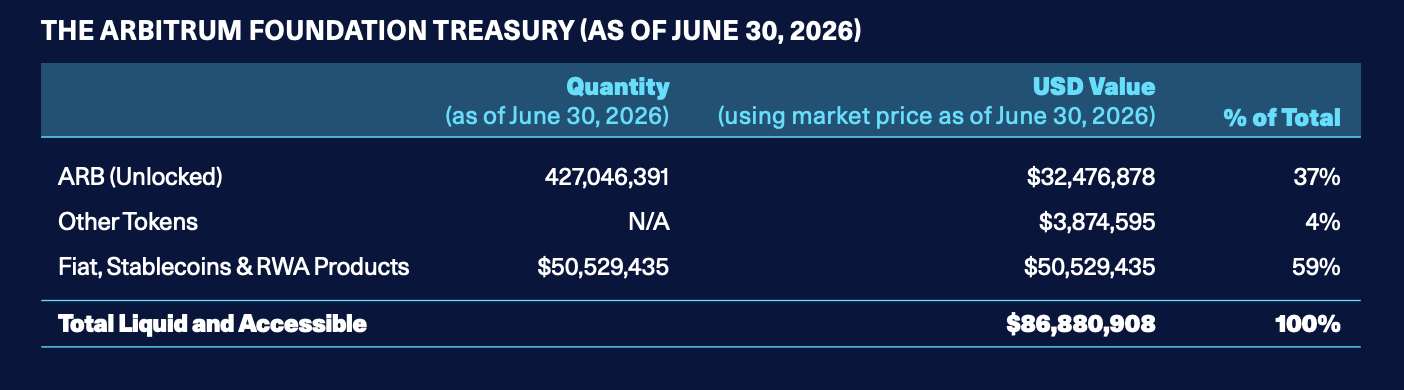
This asset snapshot shows which usable assets the foundation held at the time, but it is not sufficient to calculate its complete cash burn cycle alone: the report does not fully list liabilities, outstanding contractual commitments, and future funding disbursement pace in the same table, and the specific allocation of some strategic cooperations is not public.
The report footnote also states that the relevant balance includes assets involved in the ongoing funding proposal approved by the DAO on June 25. The proposal applied for $16 million (paid in RWA and stablecoin form), 1,740 ETH, and 230 million ARB tokens, with a total value of approximately $43.5 million at the time, to support 2027 operations. The foundation also stated that the applied amount was lower than its expected total 2027 demand, and the gap would be supplemented by existing assets and ETH obtained from the application.
Arbitrum's Half-Year Business Report Card
Looking only at the expenditure table, it is difficult to determine where the funds ultimately went. Combining the entire report, the foundation's investments roughly correspond to five directions: network and financial activities, institutional cooperation, project support, developer ecosystem, and technical infrastructure. It should be emphasized that the following data reflects business progress during the same period and cannot alone prove that each growth was directly brought by the foundation's investment.
Network level: In H1 2026, Arbitrum processed approximately 478 million transactions, accounting for about 18% of the 2.7 billion historical cumulative transactions at the time; monthly stablecoin transfer volume exceeded $70 billion, and stablecoin holders increased by 40% to 10.5 million. Derivatives open interest grew 434% in six months, peaking at $1.5 billion. During the same period, Arbitrum had 1,142 active projects, ranking among the top three blockchain networks by number of protocols.
RWA and institutional business are the growth directions most emphasized in the report. The report states that Arbitrum ranks first in the number of deployed RWA assets with over 2,000 deployed RWA assets.
Besides Robinhood Chain, LG Electronics announced a pilot on-chain advertising network on Arbitrum, Mastercard expanded stablecoin settlement support for Arbitrum on-chain assets, and PYUSD issued by PayPal once reached a scale of $475 million on Arbitrum in Q1.
For specific projects: USD.ai's active loan size increased from about $500,000 to $188 million; Spiko's TVL on Arbitrum increased from $270 million to about $500 million; the cumulative trading volume of perpetual contract project Variational increased from $3.75 billion to $160 billion.
In terms of project support: the foundation evaluated 43 cooperation opportunities in H1, approved 11, rejected 32, with an approval rate of approximately 26%. As of June 30, the foundation had 29 signed and ongoing cooperations, of which 20% completed the first payment milestone during the reporting period. The foundation stated that its cooperation funds are mainly disbursed based on milestones, and预付款 without milestone conditions was less than $200,000 in H1.
In addition: ArbiFuel, which subsidizes transaction fees for new users, received 112 applications, finally approving and onboarding 19 teams with an acceptance rate of 17%; the foundation committed to providing $94,500 in gas credits for these teams, sponsoring 272,453 user operations in total. Compared with the 35% acceptance rate in 2025, the screening criteria in 2026 were significantly tightened, which the foundation explained as attaching more importance to the project's execution readiness.
Screening for security investments has also become stricter: the Arbitrum Audit Program received 194 applications in H1, approving only 7 teams with an acceptance rate of about 4%; as of the end of June, the program had committed approximately $1.42 million, completed audits of 9,168 lines of code, and found 50 vulnerabilities. Since some audits are still waiting to start or are in business communication stages, the report expects the committed amount to rise to approximately $2 million later.
Developer support: The New York Open House online event and offline Founder House received a total of 1,041 developer applications, forming 183 projects, and awarded $300,000 in prizes and grants. The subsequent London events received a total of 1,348 applications, forming 342 projects, and allocated $415,000 in prizes and grants. Since the data for the London Founder House was counted until July 12, some results have exceeded H1 and cannot all be counted as achievements completed in the first half of the year.
The foundation also launched its first equity-free acceleration program, receiving 902 applications and finally selecting 13 teams with an acceptance rate of 1.4%. Among them, 10 teams completed Demo Day on July 7. The follow-up data provided in the report shows that within one month after graduation, 5 teams have launched on Arbitrum or Robinhood Chain, and 3 teams raised a total of $1.2 million. These are also follow-up progress补充 before the report was released, not H1 data completed as of June 30.
Technical investment: ArbOS 61 Elara has been approved by the DAO and implemented. The upgrade increased the size limit of Stylus smart contracts from 24KB to 96KB, added support for Priority Fees needed for future priority gas auctions, and added alternative data availability interfaces and optional compliance infrastructure for Arbitrum Chains.
The report also lists R&D directions such as protocol-level compliance, privacy architecture, ZK settlement, yield-bearing cross-chain bridges, and real-time sequencer data. However, these projects are still in the development stage, and subsequent protocol upgrades need to be approved by ArbitrumDAO governance.
AEP Licensing Fees Are Emerging as a New Revenue Variable
ArbitrumDAO's existing revenue includes Arbitrum One transaction fees, Timeboost, Arbitrum Expansion Program (AEP) licensing fees, and treasury returns.
The special feature of AEP is that it allows enterprises or projects to build dedicated chains using Arbitrum technology and return part of the protocol revenue to the Arbitrum ecosystem. This gives Arbitrum the opportunity to expand its revenue sources from one mainnet to multiple independently operated ecosystem chains.
Robinhood Chain is currently the most watched sample of the AEP model. The chain launched its mainnet on July 1, 2026, the day after the end of the H1 reporting period, so its mainnet revenue is not part of the H1 financial data.
According to the licensing arrangement announced by Arbitrum officials, Robinhood Chain needs to allocate 10% of its net protocol revenue to AEP sharing, with 8% going to the ArbitrumDAO treasury and 2% to the Arbitrum Developer Guild (Developer Guild). According to the statistical口径 adopted by the ArbData economic panel, on-chain fee revenue first deducts the cost of submitting data to Ethereum to form net protocol revenue; 90% is retained by Robinhood Chain, and 10% is recorded as AEP licensing fees.
Robinhood Chain's recent revenue growth curve is very steep. As of August 30, 2026, the chain's cumulative fee revenue was approximately $8.118 million; from August 31 to September 2, it generated approximately $2.177 million, $3.833 million, and $4.486 million in fee revenue respectively, adding a total of about $10.496 million over three days.
As of September 2, Robinhood Chain's cumulative fee revenue reached approximately $18.614 million, cumulative Ethereum costs were about $42,000, and net protocol revenue after deduction was approximately $18.572 million. According to the 10% AEP sharing, the Arbitrum ecosystem is entitled to approximately $1.857 million, of which about $1.486 million corresponds to ArbitrumDAO's 8% share and about $371,000 corresponds to the Developer Guild's 2% share.
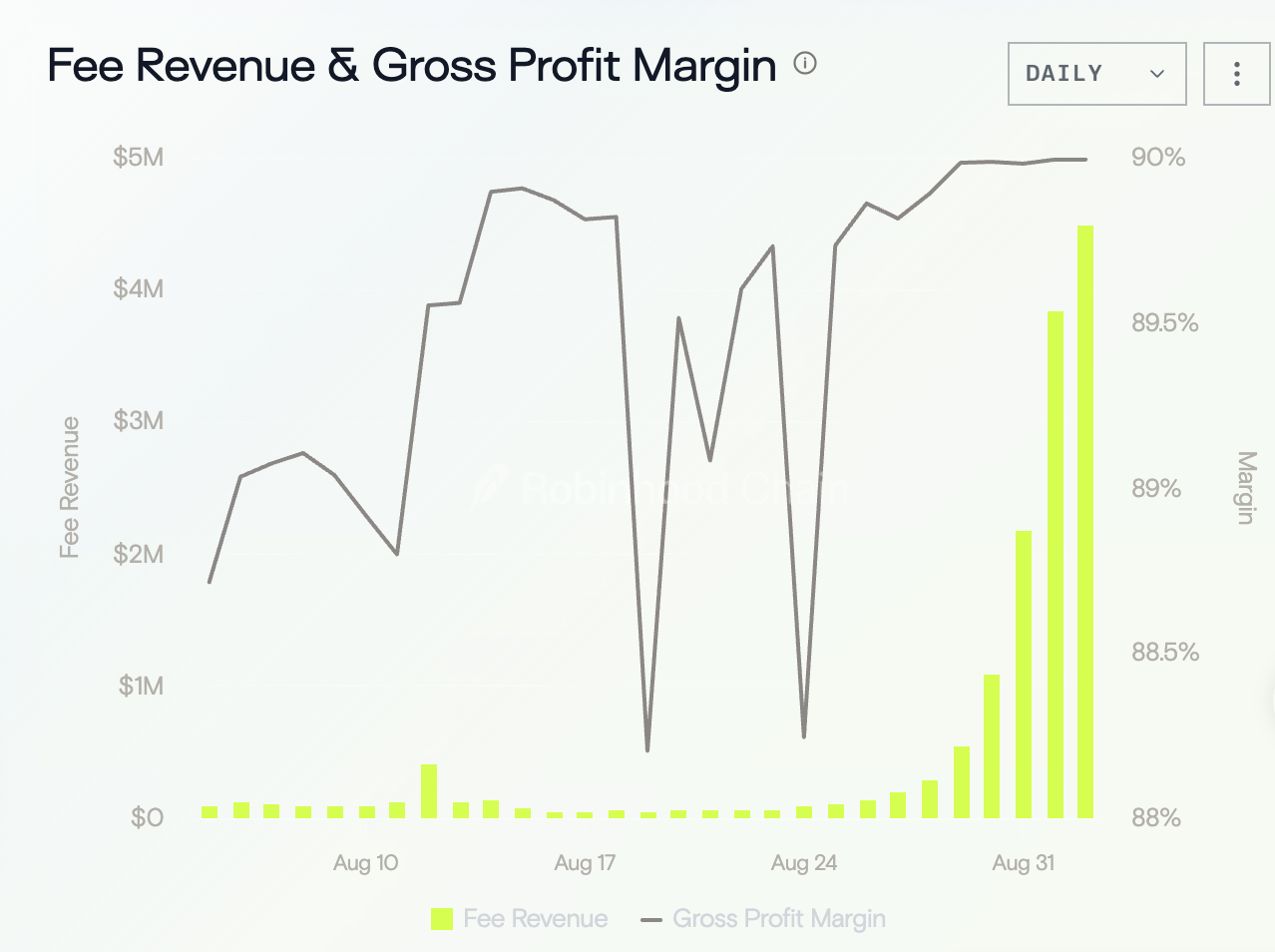
Robinhood Chain Fee Revenue Overview, Source: ArbData
Robinhood's impact on Arbitrum is therefore not just brand exposure. A more direct change is that AEP licensing fees are starting to shift from a small new revenue stream to a business line that could affect the DAO's revenue composition. The more active Robinhood Chain's transactions are, the higher the net protocol revenue, and the more funds flow to ArbitrumDAO and the Developer Guild.
However, currently more than half of the cumulative fee revenue is concentrated in the last three trading days, so short-term data is not enough to prove that this revenue level can be sustained long-term. What's more worth watching next is whether Robinhood Chain can maintain stable trading volume after the hype subsides, and whether other Arbitrum Chains can replicate this model.
If more enterprise dedicated chains can generate sustained licensing fees, Robinhood's significance will upgrade from a popular collaboration to a practical case of Arbitrum's revenue structure expansion.