
In 10 months, user count grew from 120,000 to 1.9 million.
Written by: KarenZ, Foresight News
How popular has fomo been lately?
On one side, profit screenshots are frequently seen on social platforms, with profits often reaching hundreds of thousands or even millions of dollars; on August 31, fomo's official newsletter even stated that the first trader with a PnL of $10 million had appeared on the platform's leaderboard. On the other side, many KOLs have begun sharing their fomo referral codes intensively, directing followers straight to the platform.
As Robinhood Chain trading heats up, a battle for user and order flow entry points has quickly unfolded, and fomo is one of the platforms with the most noticeable growth.
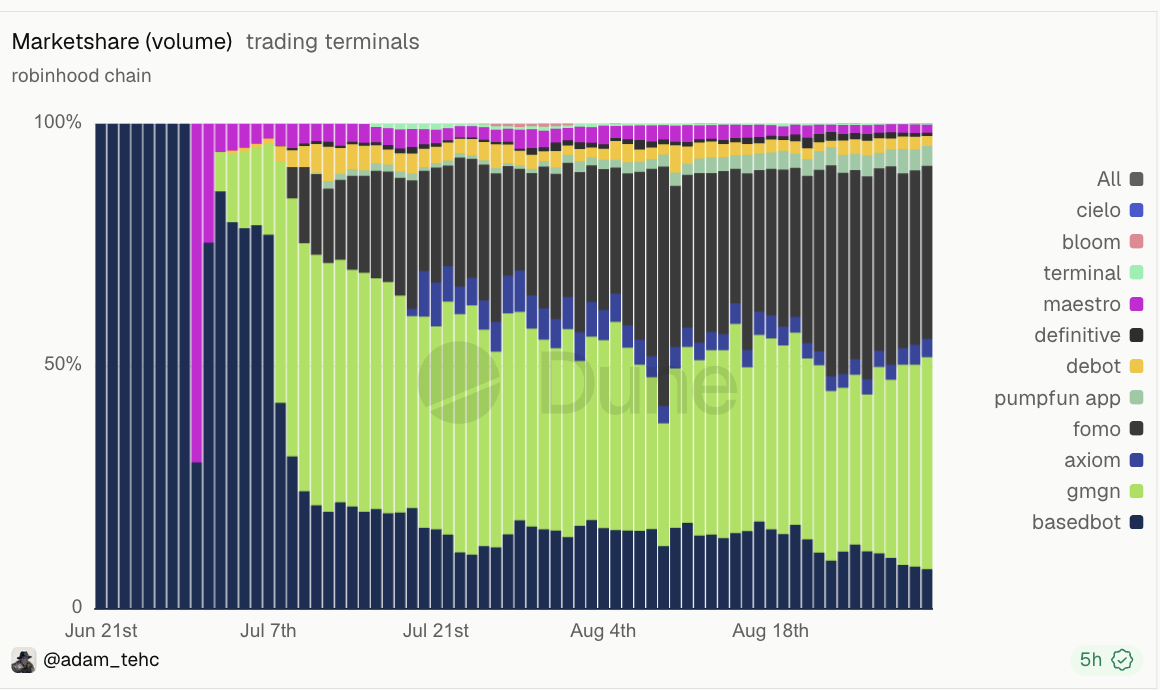
The Dune dashboard created by Adam Tehc specifically includes a "Trading Bot Wars" section. On August 31, GMGN accounted for approximately 43.6% of Robinhood Chain's trading terminal volume, fomo accounted for about 35.6%, and together they made up around 79.2%. This proportion is based on trading terminal volume, but it indicates that fomo has become one of the main trading entry points on Robinhood Chain.
Source: Dune
Robinhood Chain Trading Dominates on fomo
fomo originally focused on Solana as its main market, but its trading structure is changing with the latest trends.
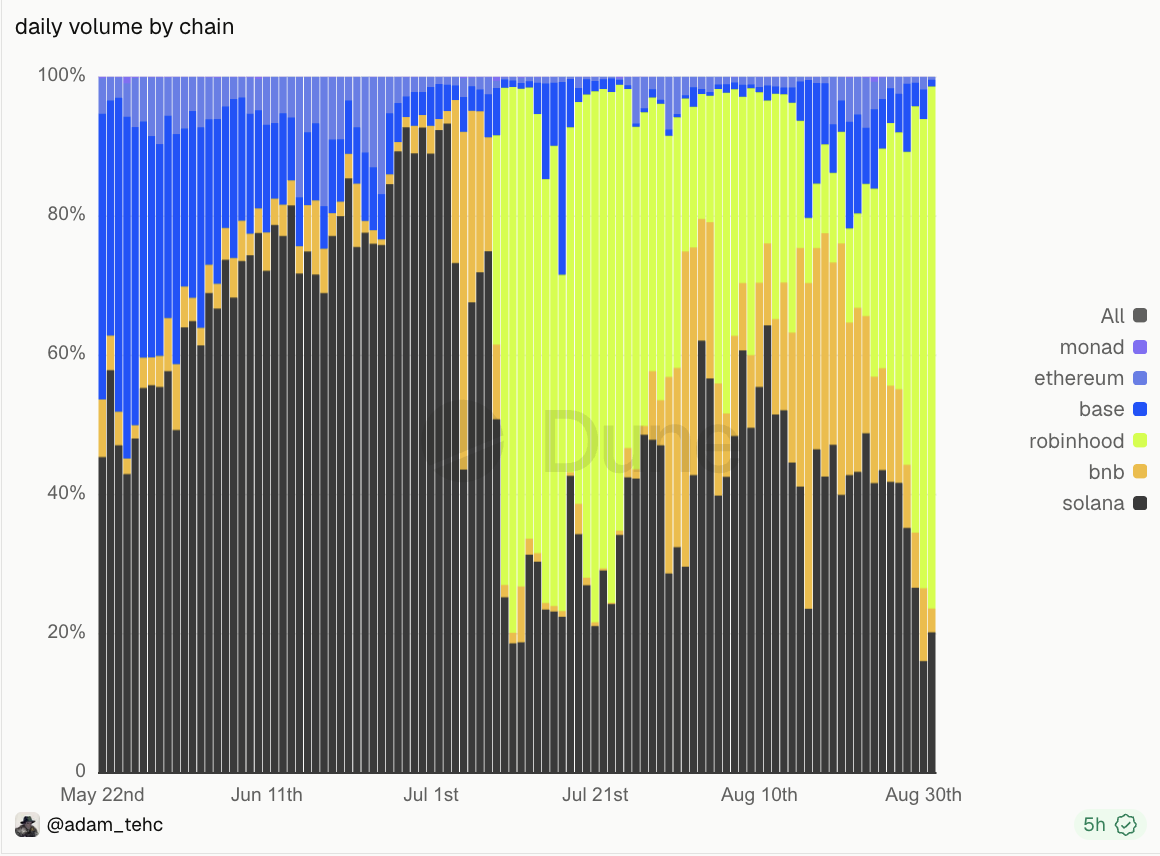
The Dune dashboard by Adam Tehc shows that in late May 2026, fomo's daily trading volume mainly came from Solana and Base; by early July, Solana once contributed nearly 90%. With the support for Robinhood Chain and the rising trading enthusiasm on the chain, the platform's trading focus shifted again.
On August 31, Robinhood Chain accounted for approximately 75% of fomo's daily trading volume, Solana about 20%, BNB Chain around 3.4%, and Base roughly 1%. These are approximate proportions read from the latest bar interval of the chart, and the daily proportions will change with market trends, so they should not be regarded as long-term fixed shares.
Source: Dune
The number of active traders is also growing simultaneously. From March to May 2026, fomo's daily active traders were mostly in the thousands; in early June, it was still less than 10,000, then began to rise rapidly. By late August, daily active traders had been between 80,000 and over 100,000 for many days, with a peak exceeding 100,000—an increase of at least one order of magnitude compared to early June.
This growth is also reflected in the overall business data disclosed by fomo. In November 2025, the author sorted out this product in "Gold Rush Manual: Why Did Top VC Benchmark Set Its Sights on fomo?". At that time, fomo disclosed that it had over 120,000 users and about 35,000 traders; up to that point, its cumulative trading volume was only $850 million.
On August 31, 2026, fomo announced that its total user count had exceeded 1.9 million, of which more than 1.2 million were active in August, and the platform added over 30,000 new users daily.
Its monthly trading volume increased from $500 million in June to $1.5 billion in July, a 200% monthly growth (tripling the original); fomo predicted at the time that August's trading volume would exceed $2.8 billion, a further increase of at least about 87% compared to July.
fomo also estimated that August's monthly revenue would be about $17 million, corresponding to an annualized revenue level of over $200 million.
Why Are Referral Codes Going Viral?
KOLs sharing fomo referral codes intensively is not just spontaneous recommendation. Around user growth and social trading, fomo has built three interconnected mechanisms: Clans, Trader Rewards, and Referral Rewards.
First is the Referral Reward. According to official information released by fomo on June 2, 2026, when a new user registers via a referral code, the referrer can get 25% of the transaction fees generated by that user. At that time, fomo announced that the cumulative referral fees paid to users had exceeded $2 million.
Second is Trader Rewards, which reward "those who promote the spread of trading ideas". According to the introduction released by fomo on August 28, users can share their trading views or investment logic on the platform; if these contents drive other users to trade, the publisher can get corresponding rewards in real time. However, fomo has not disclosed the specific calculation formula, reward ratio, or applicable trading scope in that post, so it cannot be simply understood as a fixed-rate rebate.
Clans turn individual trading into team activities, focusing on group trading. A user can only join one Clan at a time, can enter the team via invitation, and display their Clan on their personal homepage.
From Spot to Perps: fomo Is No Longer Just a Mobile Trading App
fomo's ability to capture hotspots on different chains is related to its product design. Users can access multiple blockchains through the same account and balance, without having to switch networks, cross chains, or prepare different Gas assets on their own. Leaderboards, trading dynamics, and quick buys shorten the path from discovering an asset to completing a transaction.
In the past few months, fomo has added Web, professional charts, perpetual contracts, and team competition functions. In April 2026, according to data disclosed by fomo at the end of August, the Web end currently accounts for about 25% of the platform's total trading volume.
In June, fomo launched fomo Perps. This product is supported by Hyperliquid and TradeXYZ at the underlying level, covering perpetual contracts related to crypto assets, stocks, pre-IPO companies, stock indices, and commodities, and provides functions such as long/short trading, leverage, isolated margin, and take-profit/stop-loss.
Perps is not separated from the original social functions. Relevant positions are also integrated into user homepages and dynamic information streams, allowing users to see when other traders establish positions.
19-Year-Old Founder Completes Eight-Figure Exit: fomo Acquires Mobula's Core Technology
When daily active traders increased from thousands to over 100,000, and fomo needed to handle multiple networks such as Solana, Robinhood Chain, and BNB Chain, the pressure it faced came from on-chain data.
After a new token appears, the app needs to identify its contract address, name, and network, continuously read transactions, liquidity, prices, token-holding addresses, and wallet behaviors, and organize the original records from different blockchains into data that users can understand.
Mobula provides exactly this type of infrastructure. Its public documentation shows that Mobula's data products cover token prices and market data, wallet assets and transaction records, token metadata, position PnL, and real-time data streams, and are provided to other applications via APIs and other methods.
On August 31, fomo announced the acquisition of the proprietary software and intellectual property developed by Mobula. According to Axios citing fomo CEO Paul Erlanger, the deal is worth $17 million, but fomo's official announcement did not disclose the amount itself.
Mobula founder Sacha Marcus, co-founder and CTO Sacha Delhoux, and infrastructure head Cyril Conan will join fomo's engineering team. A notable, viral detail of this deal: Sacha Delhoux was only 19 years old when the transaction was completed.
He later posted on X to review his entrepreneurial experience with the theme "How I Sold My Company for Eight Figures at 19". He attributed Mobula's development to a small but technically dense team, long-term trust accumulated with B2B clients, and product differences that can be directly perceived by clients, such as data latency, stability, and service response.
The scope of the transaction needs to be clearly distinguished. fomo's official announcement confirmed that it acquired the software and intellectual property developed by Mobula and absorbed some core members.
Summary
fomo is no longer just a mobile app that simplifies trading steps; it has gradually formed a product system covering asset discovery, social communication, creator distribution, trading entry, and data support.
As the operational threshold for on-chain trading continues to decrease, the competition among consumer-grade apps has shifted from "whether transactions can be completed" to "who can master users, distribution, and data at the same time".