
Scaling is a mandatory course for stablecoins.
Written by: Eric, Foresight News
On September 1st, Ethena officially launched its new application, Ethena Pay. Simply put, it's a bank-like mobile app where you can deposit US dollars to earn interest, transfer money to friends using usernames, and generate a Visa card to spend at 130 million merchants worldwide. It sounds like Revolut or Alipay, but the dollars in the account are not bank deposits—they are Ethena's own synthetic dollar, USDe.
For the first time, USDe has transformed from an on-chain wealth management asset into spendable money.
Ethena Pay is essentially a self-custody wallet. Users can receive fiat currency via IBAN or directly transfer cryptocurrencies in; regardless of the method, the funds are automatically converted to USDe balance upon arrival. For transfers, user-to-user transfers via usernames are instant and free, and bank transfers in USD, EUR, or GBP are also free. The card operates on the Visa network, issued by Third National Bank of Puerto Rico, managed by Rain (the same company that helped Avalanche issue the Avalanche Card), and its underlying technology is provided by Iron, acquired by MoonPay.
The balance in Ethena Pay earns interest at USDe's base rate, and Ethena adds a Daily Boost to reach the full-tier interest rate. Standard users get a 5% annual percentage yield (APY) on balances up to $5,000. After locking $2,000 worth of ENA or referring 10 friends to upgrade to Pro, users get a 6% APY on balances up to $15,000. The VIP tier has an interest cap of $50,000. Cashback on card purchases starts at 4% and goes up to 5%, all paid in AVAX.
At selected merchants like Uber, Spotify, and even Claude, VIP users can get up to 10% cashback. The official also promotes a feature called "Buy Now Pay Never", which means using interest to cover daily expenses so the principal remains untouched forever.
Looking back, since its launch in early 2024, USDe has been positioned as an interest-bearing asset. Its delta-neutral hedging structure allows it to offer returns far higher than U.S. Treasuries. Over the past two years, it has served as margin on exchanges, collateral on Aave and Pendle, integrated with over 100 protocols, and processed over $30 billion in cumulative minting and redemption. Last September, it once reached a circulation size of $15 billion, taking the third spot among stablecoins.
But discerning observers know that USDe at that time was not a true stablecoin; it was just a $1 share of a delta-neutral fund. To become a true "stablecoin", Ethena has made many efforts.
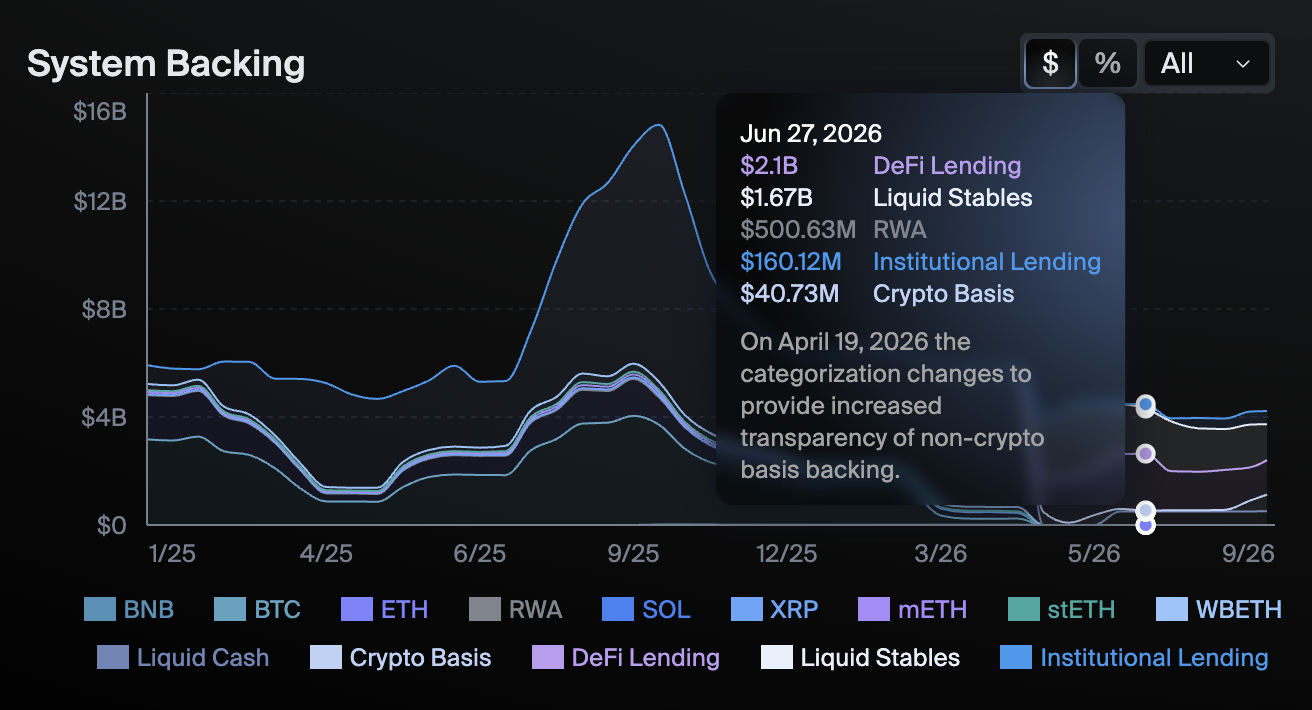
Currently, the proportion of perpetual contracts in Ethena's "reserve assets" has dropped significantly, while the share of liquid stablecoin reserves, DeFi lending, and institutional over-collateralized lending has increased. Although this has reduced yields to some extent, it has also avoided losses like those in the extreme market conditions of last October. Additionally, Ethena has added tokenized Real World Asset (RWA) reserves, including tokenized U.S. Treasuries, CLOs (Collateralized Loan Obligations), investment-grade corporate bonds, short-term credit, and structured credit.
In terms of delta-neutral strategy, Ethena is further exploring equity and commodity perpetual basis trading, prime lending, etc., to reduce reliance on a single crypto funding rate. Currently, the circulation of USDe is about $4.23 billion, and as shown in the figure, the reserve assets based on pure crypto hedging have dropped to less than 1%.
For compliance, it collaborated with federally regulated Anchorage to issue USDtb, aligned with the GENIUS Act, launched institutional-focused iUSDe, and partnered with Securitize to build the RWA settlement chain Converge. For distribution, earlier this year it partnered with Coinbase to launch a savings product, bringing USDe to hundreds of millions of exchange users. Ecologically, last September USDe and sUSDe launched on Avalanche, integrating with lending markets like Euler and Silo, and offering AVAX rewards to interacting users. Now, launching a card directly on Avalanche seems like a natural outcome of that collaboration.
USDe's former narrative was "high-yield USD", but countless thefts and major losses due to extreme market conditions in DeFi have again warned us that high returns always correspond to high risks. To maintain its circulation, USDe must be usable.
As for why they chose Avalanche instead of Converge (which they co-built), founder Guy Young put it plainly: the two parties share the same vision for "building products for enterprises". Avalanche excels at invisible infrastructure that users don't notice, and it already has practical experience issuing cards with Rain. Looking deeper, Avalanche launched a payment alliance of 28 institutions in June this year, including Franklin Templeton, Paxos, Anchorage, Rain, and Ethena. Ethena Pay is directly plugged into this existing payment ecosystem. For Avalanche, cashback paid in AVAX creates a sustained demand scenario for its native token—this is a win-win deal for both parties.
The author once pointed out in the article "Avalanche Secretly Became an RWA Public Chain" that Avalanche has become the most cost-effective chain in the EVM ecosystem for tokenized RWAs, including stablecoins. Ethena's choice precisely confirms this view. In the past, Avalanche did not have an advantage over other chains in stablecoin settlement, but this collaboration with Ethena may change that.
From USDC giving up most of its returns to capture Hyperliquid, to Ethena lowering its returns to make USDe a "currency", regardless of whether the stablecoin's issuance mechanism is centralized or chain-based, everyone has realized that the key to success in the stablecoin business is scale. And the core of scale is that the stablecoin must be useful.
USDT's usage rate in payments may no longer be comparable to USDC, but in terms of fund transfers and other aspects, USDT still holds an absolute advantage. If USDC only focuses on compliance, and USDe only focuses on returns, their ceiling is foreseeable from the start. Only when stablecoins are actually used in daily life and can circulate between different individuals and entities can they maintain their base, preserve their yields, and thus free up more energy for horizontal expansion.