
Robinhood can "leave anytime", but ARB has to wait for large-scale unlocks.
Written by: Nicky, Foresight News
Against the backdrop of Robinhood Chain's continuously rising trading volume, the token ARB of the established Ethereum Layer2 Arbitrum has seen a maximum price increase of 43% in the past two days. According to Bitget market data, ARB's price has rebounded from a historical low of around $0.07 to near $0.113.
On September 1st, according to Adam Data, the 24-hour trading volume of DEX on Robinhood Chain exceeded $900 million for the first time, the daily trading volume of the Meme token launchpad reached a record high of $438 million, and the RWA transaction volume exceeded $200 million for the first time. These three data points all point to one direction: Robinhood Chain, built on Arbitrum Orbit, is bringing long-awaited market attention to ARB.
Robinhood Chain is not a competitor of Arbitrum, but its "client". This Layer2 network launched by U.S. stock broker Robinhood is built on the Arbitrum Orbit tech stack and officially launched its mainnet on July 1st this year, focusing on tokenized stocks and other real-world assets.
According to Arbitrum's expansion plan, chains built on its technology need to return 10% of their net protocol revenue to the Arbitrum ecosystem, with 8% going into the ArbitrumDAO treasury. This means that a fixed proportion of every revenue generated by Robinhood Chain flows to Arbitrum. Whether this revenue is eventually used to repurchase ARB or not, at least in terms of revenue logic, the market has tied the two together.
Crypto blogger Chen Jian quantified this relationship in his analysis on September 1st. He said that since Robinhood launched on July 8th, its average daily revenue is about $100,000, corresponding to about $10,000 for Arbitrum; but yesterday this figure soared to $1.92 million, and Arbitrum's corresponding share reached $190,000. Although this amount is still negligible compared to ARB's $742 million market cap, the revenue growth rate itself forms the basis for the market to re-evaluate ARB.
Arbitrum was once one of the top Layer2s in the Ethereum ecosystem in terms of TVL and actual usage. The ARB token airdrop in March 2023 was also one of the largest airdrop events in the industry's history. At that time, the total airdrop was about 1.162 billion ARB, covering 625,000 addresses, with an average of about 1,859 tokens per address. Based on the price at that time, the average value per airdrop was between $2,000 and $2,800. The website crashed briefly on the day of claiming, and on-chain activity hit a record high.
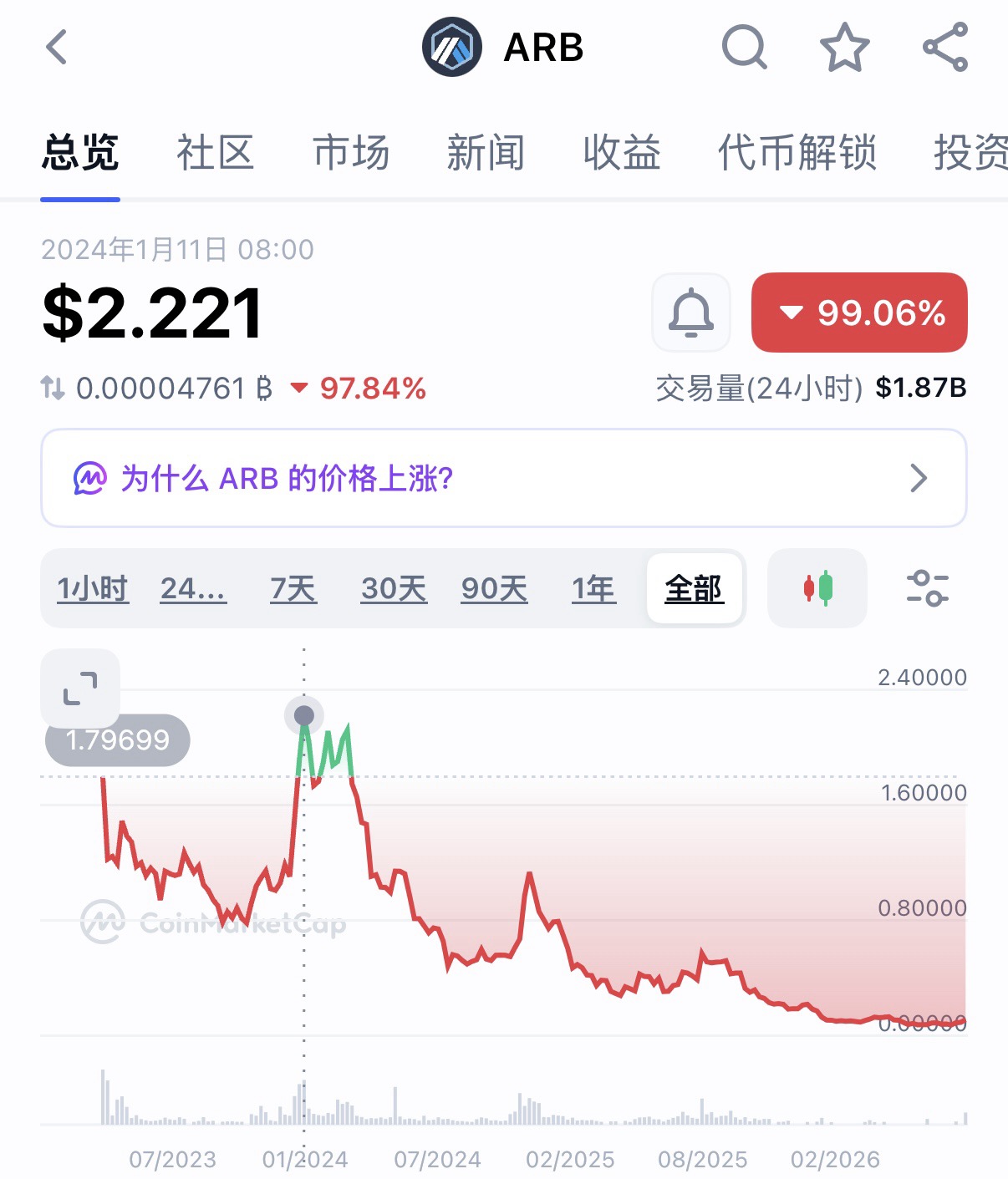
Since then, ARB has been on a downward trend after hitting an all-time high of $2.4 in January 2024, and set a new all-time low of $0.07 in June 2026, a retracement of over 97% from the high. According to CoinMarketCap data, ARB's current market cap is about $742 million, fully diluted market cap is about $1.11 billion, ranking 69th in market cap. The current total circulating supply is about 6.67 billion tokens, the maximum supply is 10 billion tokens, and the value of remaining unlocked tokens is about $376 million.
From on-chain data, according to DefiLlama, Arbitrum's current TVL is about $1.408 billion, with the top five applications being Aave V3 ($490 million), Spiko ($441 million), USD AI ($228 million), Spark ($226 million), and GMX ($197 million). Among these, GMX, as the most representative perpetual contract product on Arbitrum, only generated $26,800 in fees in 24 hours, and its market share is being continuously diverted by emerging platforms like Hyperliquid and Aster.
Behind the price collapse is not only the continuous decline in ecological market share, but more importantly, the systemic flaws in the token economic model of Ethereum Layer2s. ARB and OP, as the tokens of the two major Ethereum Layer2s — Arbitrum and Optimism, are designed only for governance purposes. Network fees are paid in ETH, so token holders cannot directly benefit from the growth of network usage. At the same time, team and investor tokens are continuously unlocked according to the schedule, with new supply entering the market every month. According to Tokenomist data, ARB unlocked 92.65 million tokens on August 16th this year alone, accounting for 1.61% of the circulating supply, and will unlock about 10.45 million tokens on September 16th. In the absence of a value capture mechanism, continuous token releases have exacerbated market selling pressure.
Thus, there is a view in the market that "buying PONS is better than buying ARB". On September 1st, crypto blogger Dayu said that he believes directly buying the PONS token of the token launchpad Pons on Robinhood Chain is far more efficient than buying ARB, because PONS accounts for 50% of the chain's revenue and uses 80% of it for repurchase and burn, while ARB "is still a meme token with a large number of unlocks every month". According to MemeFees data, Pons, the token launch platform on Robinhood Chain, ranked first among all launchpads in fee revenue in the past 24 hours (about $4.73 million), with a 24-hour trading volume of about $82.68 million.
Optimism's experience provides a more cruel footnote to Arbitrum's current predicament. On February 18th, 2026, Coinbase's official blog announced that Base would withdraw from the OP-Stack and Superchain system and switch to a self-developed unified tech stack. According to Bitget market data, OP fell from $0.1869 to $0.1247 within three days after the news was announced, a drop of 33%. Base previously contributed the majority of Superchain's revenue; its departure not only took away revenue sharing but also shook the narrative foundation of OP Stack as a "one-click chain issuance" infrastructure.
It is this lesson from the past that makes the market alert to the cooperation prospects between Robinhood Chain and Arbitrum. On September 1st, crypto blogger Chen Jian pointed out that Base only needed to pay 2.5% profit share to Optimism and received a subsidy of 120 million OP tokens, but still chose to leave in the end; while Robinhood needs to pay 10% of its net protocol revenue to Arbitrum without any subsidy. As a U.S. listed company, when Robinhood faces shareholder inquiries in the future, this continuous share payment is likely to become the starting point for renegotiation. Based on this, Chen Jian judged that "the final outcome of this marriage can probably be guessed".
When revenue, users, and trading volume are all converging to Robinhood Chain, while ARB itself is still constrained by monthly unlocks and governance token issues, the current rise reflects more of an improvement in expectations rather than a fundamental reversal. Is the relationship between Robinhood Chain and Arbitrum a long-term win-win, or a preview of another "Base departure" story?