
What market rules did this bull market return revalidate?
Written by: Joe Zhou, Foresight News
The cryptocurrency market, which had been quiet for almost a full year, suddenly exploded last week.
Bitcoin surged violently from around $62,800 at the start of the week, hitting an intraday high of $79,500 on August 21, with a maximum weekly gain of over 26%—setting the record for the largest weekly gain since March 2023. Voices across the market shouting "the bull is back" have been endless.
Signals don’t ring just once, but the real test lies in whether we can accurately identify their nature. What’s more worth asking is: in this rebound, which assets rose with justification and which were just going with the flow? The answer holds the key to the next phase.
What Market Rules Did This Bull Market Return Revalidate?
Every extreme market move is not accidental noise but a stress test of the market structure. This rebound reaffirmed several clear rules.
Rule 1: The short-to-medium term directional turns of the crypto market are highly dependent on the swings of the U.S. policy cycle.
Looking back over the past four years, several major inflection points in the crypto market—whether it was the approval of Bitcoin spot ETFs, the switch between the Federal Reserve’s interest rate hike and cut cycles, or this U.S. Treasury buyback operation—have almost all resonated with the rhythm of U.S. fiscal and regulatory policies. Market pricing power is gradually shifting from crypto-native on-chain leverage cycles to macro liquidity and regulatory expectations.
This time is no exception. From the news attribution, the core driving forces of the rebound can be summed up in two points:
First, long-term bond buyback policy triggered a reversal of macro liquidity expectations. On August 19, U.S. Treasury Secretary Yellen announced that the single buyback size for 10-to-30-year long-term Treasury bonds would be increased from $2 billion to at least $4 billion to address the previous surge in long-term yields and the sharp sell-off of long-term Treasuries. The market quickly interpreted this as: the U.S. government is using loose operations to ease its own borrowing cost pressure → the U.S. dollar is under pressure to weaken → funds shift to alternative stores of value such as gold and Bitcoin. Due to Bitcoin’s high-elasticity risk asset attribute, its gain was the most prominent among similar assets.
Second, Trump’s promotion of crypto legislation catalyzed a rebound in risk appetite. Almost at the same time, Trump met with crypto industry executives from Coinbase, Kraken, Ripple, etc., at the White House and publicly urged Congress to pass the Digital Asset Market Clarity Act (CLARITY Act) as soon as possible to clarify the jurisdictional boundaries between the SEC and CFTC over digital assets. This move was seen by the market as a signal of reduced regulatory uncertainty, further boosting the recovery of capital risk appetite.
A special supplementary point: On August 18, the SEC also proposed a draft of new rules for public crypto token sales, which the market viewed as a positive signal towards clear rules for token issuance. The market called it "legal ICO 2.0". This means that the old wild ICO model is gradually "evolving", and today’s ICO will be a new regulatory framework with upper limits on quotas, information disclosure requirements, and exit mechanisms.
Rule 2: Bitcoin spot ETFs have become a market barometer and continue to lead the entire crypto market.
Bitcoin spot ETFs starting ahead of the market and leading the trend has become one of the most prominent structural features of the crypto market in the past two years, and this rule has been repeatedly verified by multiple market cycles.
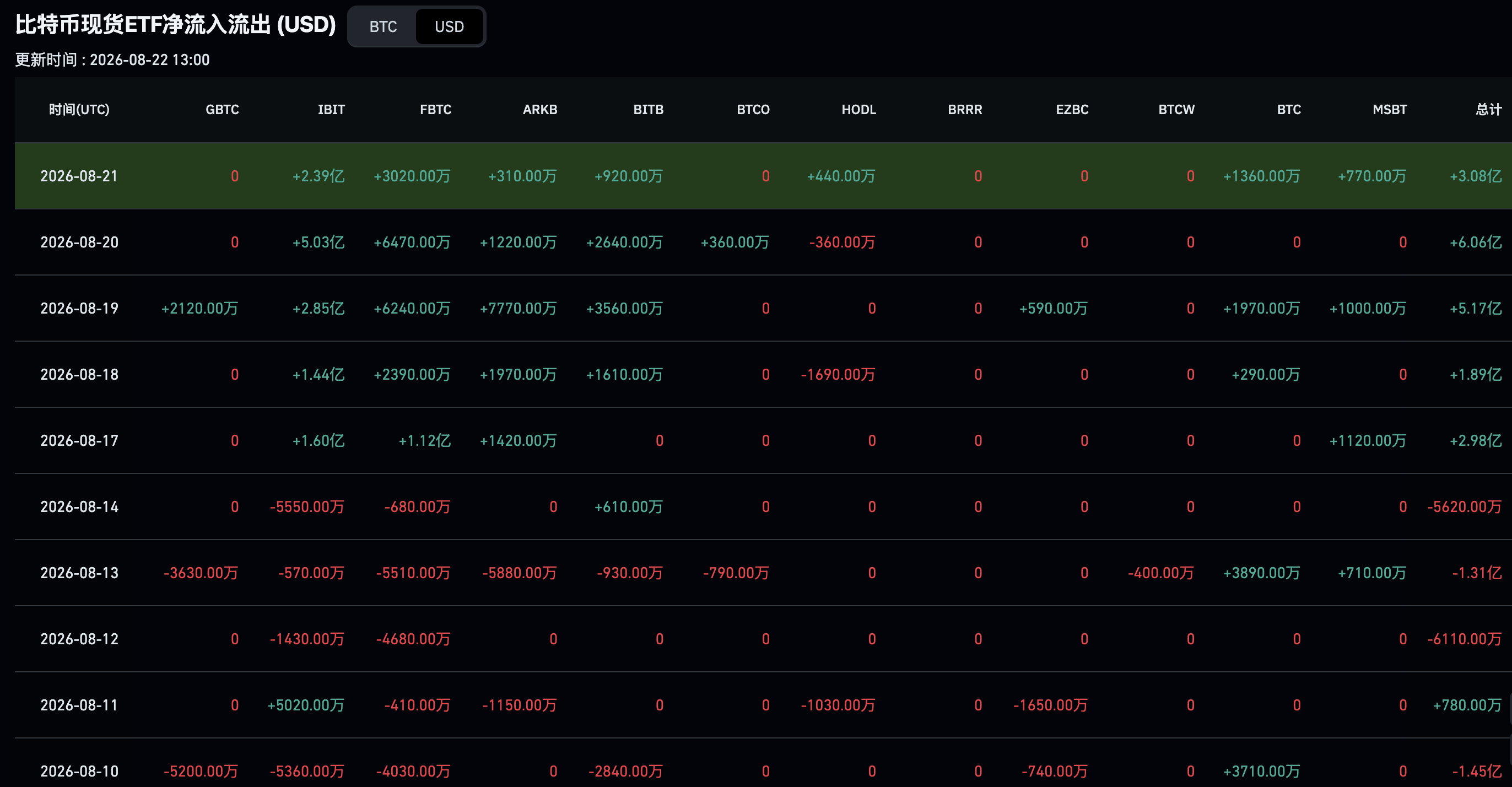
Take this rebound as an example—the full outbreak of the crypto market started on August 19, while Bitcoin spot ETFs had already shown a "steady" continuous net buying trend several days earlier, accurately hitting the starting point of this round of market.
From the data, last week (as of the week ending August 21), the total net inflow of U.S. Bitcoin and Ethereum spot ETFs was $2.6 billion, setting a record for the highest weekly inflow since October 2025. Among them, Bitcoin spot ETFs had a net inflow of about $1.9 billion, weekly trading volume surged from $6.9 billion the previous week to $22.1 billion, an increase of 219%—total net assets rose from $76.6 billion to $96.1 billion.
Ethereum spot ETFs also performed strongly, with a net inflow of $697.2 million last week, the highest since the week ending October 3, 2025; weekly trading volume increased from $1.9 billion to $6.9 billion, a surge of 259.4%.
Both types of ETFs recorded their largest weekly net inflows since 2026. In contrast, the previous week saw a total net outflow of $392 million for both types of ETFs.
The simultaneous volume increase of both types of ETFs not only verified the large-scale return of institutional funds but also further established the market position of spot ETFs as the "leading indicator" of this bull market.
Rule 3: The violent surge of Bitcoin almost inevitably drives the overall rise of the entire crypto sector—from mainstream coins to altcoins, then to hot Meme coins, forming a clear capital rotation transmission chain.
This round of market once again verified this iron law: Bitcoin breaks through first, then funds spill over level by level, with Ethereum, high-quality altcoins, and hot Meme coins taking turns, and gains showing a stepwise amplification.
Data is the most powerful proof—Ethereum’s weekly gain was nearly 30%, ENA soared nearly 100%, the new Meme coin "Niu Lai" in the BNB Chain ecosystem had a single-day gain of 30.3% on August 21, with a market cap once touching $70 million. From large-cap blue chips to small-cap elastic varieties, none were absent from this rebound feast.
Bitcoin is the trigger, but what really makes market sentiment boil is always those altcoins and Meme assets with more amazing multiples. The gradient distribution of gains exactly outlines the complete path map of this round of capital inflow.
Crypto Bull Market Is Back: Which Assets Rebounded the Hardest?
In this rebound, Bitcoin ignited first, but the real elastic explosive power was concentrated on the relay between mainstream coins and altcoins.
Ethereum started from around $1,900 last week, hitting a high of $2,546, with a weekly gain of 29.8%—significantly outperforming Bitcoin’s 22.9%. The ETH/BTC exchange rate rebounded to around 0.031, and its market cap returned to above $280 billion.
Behind Ethereum’s stronger elasticity, in addition to the common drivers of macro liquidity and short squeeze, there are three unique factors resonating:
First, large-scale capital inflow into Ethereum spot ETFs. Last week, Ethereum spot ETFs had a net inflow of about $697 million, the strongest week since October 2025.
Second, exchange supply continues to tighten. Data shows that Ethereum held by exchanges decreased from about 7.7 million coins in early June to about 6.54 million coins in mid-August, a drop of about 15%. At the same time, more than 42 million ETH have been staked, and the tradable circulating supply continues to shrink, significantly amplifying the effect of buying pressure pushing up prices.
Third, positive news from the regulatory level. On August 18, the SEC proposed a draft of new rules for public crypto token sales, which the market viewed as a positive signal towards clear rules for token issuance, further boosting the market’s risk appetite for the Ethereum ecosystem.
Bitcoin rose 22%, Ethereum rose nearly 30%—this is already amazing. But in the world of altcoins, there are even more crazy players.
According to statistics from multiple data platforms, among the top 50 altcoins by market cap last week (as of August 23), the five coins with the highest gains are: ENA, PUMP, Stacks, Trump, Zcash.
1. ENA (Ethena): Weekly Gain 100.75%, Market Champion
ENA topped the crypto gain list last week with a 100.75% weekly gain. This once again confirms the market’s general perception of it—ENA has always been one of the most elastic targets in market rebounds; every time the market warms up, it always delivers gains far exceeding the average level.
There are two core catalysts for the surge: first, Coinbase announced a strategic partnership with Ethena, planning to provide products based on the USDe stablecoin to more than 100 million users, and for the first time invested in Ethena by purchasing ENA tokens through the public market; second, FalconX launched a $1 billion secured warehousing facility, deploying the underlying assets of USDe into institutional loans, greatly expanding the protocol’s business boundaries.
However, it should be noted that ENA’s current price is still about 89.2% lower than its all-time high—although the gain is fierce, it is still far from truly recovering lost ground.
2. PUMP (Pump.fun): Weekly Gain 88-99%, Victory of the Meme Launchpad
PUMP’s weekly gain last week was between 88% and 99%, with its market cap exceeding $2 billion.
As the most active Meme coin launch platform in the Solana ecosystem, Pump.fun directly benefited from this round of Meme coin craze—new tokens on the platform emerged one after another, and the surge in trading volume directly pushed up the price of the platform token PUMP. But similarly, PUMP is still about 39.7% lower than its all-time high.
3. STX (Stacks): Weekly Gain 82-94%, Bitcoin Ecosystem Narrative Reignited
STX’s weekly gain last week was about 82% to 94%, making it the most outstanding asset in the Bitcoin Layer 2 ecosystem.
STX’s rise is closely related to the reignition of the Bitcoin ecosystem narrative. As Bitcoin’s price broke through $77,000, market attention to Bitcoin ecosystem expansion solutions rose again, and Stacks, as one of the most mature BTC Layer 2 projects, directly benefited. But STX’s current price is still about 94% lower than its all-time high, making it the coin in the top five furthest from its high.
4. TRUMP (Official Trump): Weekly Gain 79-91%, Rebound of Political Meme
TRUMP’s weekly gain last week was between 79% and 91%. As a political Meme coin themed around Trump, its rebound resonated with the news of Trump promoting crypto legislation.
This Meme coin themed around former U.S. President Trump had been under continuous pressure due to criticism from U.S. legislators and Nansen data disclosing that nearly one million investors had accumulated losses of about $3.8 billion. However, this round of rebound is more of an emotional repair after an oversell rather than a fundamental improvement—TRUMP’s current price is still about 96.4% lower than its all-time high.
5. ZEC (Zcash): Weekly Gain 75%, Hit All-Time High
Zcash rose 75.15% last week, trading at $851 and hitting an all-time high during the week.
ZEC is the only coin in the top five to hit an all-time high, and also the only asset that fully recovered its historical losses in the rise. As a veteran privacy coin, Zcash’s strong performance reflects a feature of this round of rebound—veteran projects are also sought after by funds, not only new concepts can lead the rise. The privacy track often gains an additional safe-haven premium in an environment of rising macro uncertainty.
Meme Coins: Hot Spot of Emotion, Maximum Elasticity
In addition, the Meme coin sector once again proved its status as the king of elasticity in a bull market. The new Meme coin "Niu Lai" in the BNB Chain ecosystem had a single-day gain of 30.3% on August 21, with a market cap once touching $70 million; Book of Meme (BOME) on Solana had a weekly gain of 95.57%, also becoming one of the best-performing assets in this Meme coin round.
From Ethereum’s steady leadership, to AAVE’s return to the throne, to the multiple explosions of ENA and Meme coins—this round of rebound clearly outlines a capital transmission path: Bitcoin sets the stage, mainstream coins perform, and altcoins and Meme coins take the stage. The gradient distribution of gains is exactly a complete portrayal of market sentiment from caution to frenzy.