
Editing privileges can grant oneself a green light, but hashrate never will.
Written by: Sanqing, Foresight News
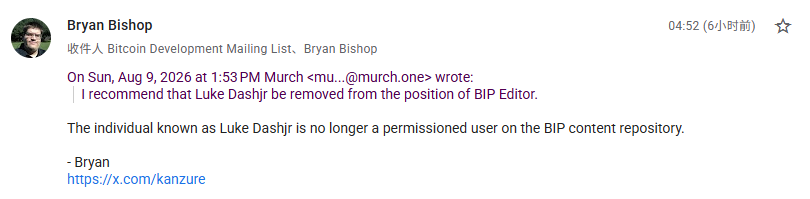
On August 10, Luke Dashjr—longtime Bitcoin Improvement Proposal (BIP) editor, co-founder and CTO of Ocean Mining Pool—was removed from the editorial team and stripped of his editing privileges by his peers. The reasons included bypassing discussion processes and preemptively assigning a number to BIP-110 while promoting it, as well as his minimal contributions to editorial work in recent years.
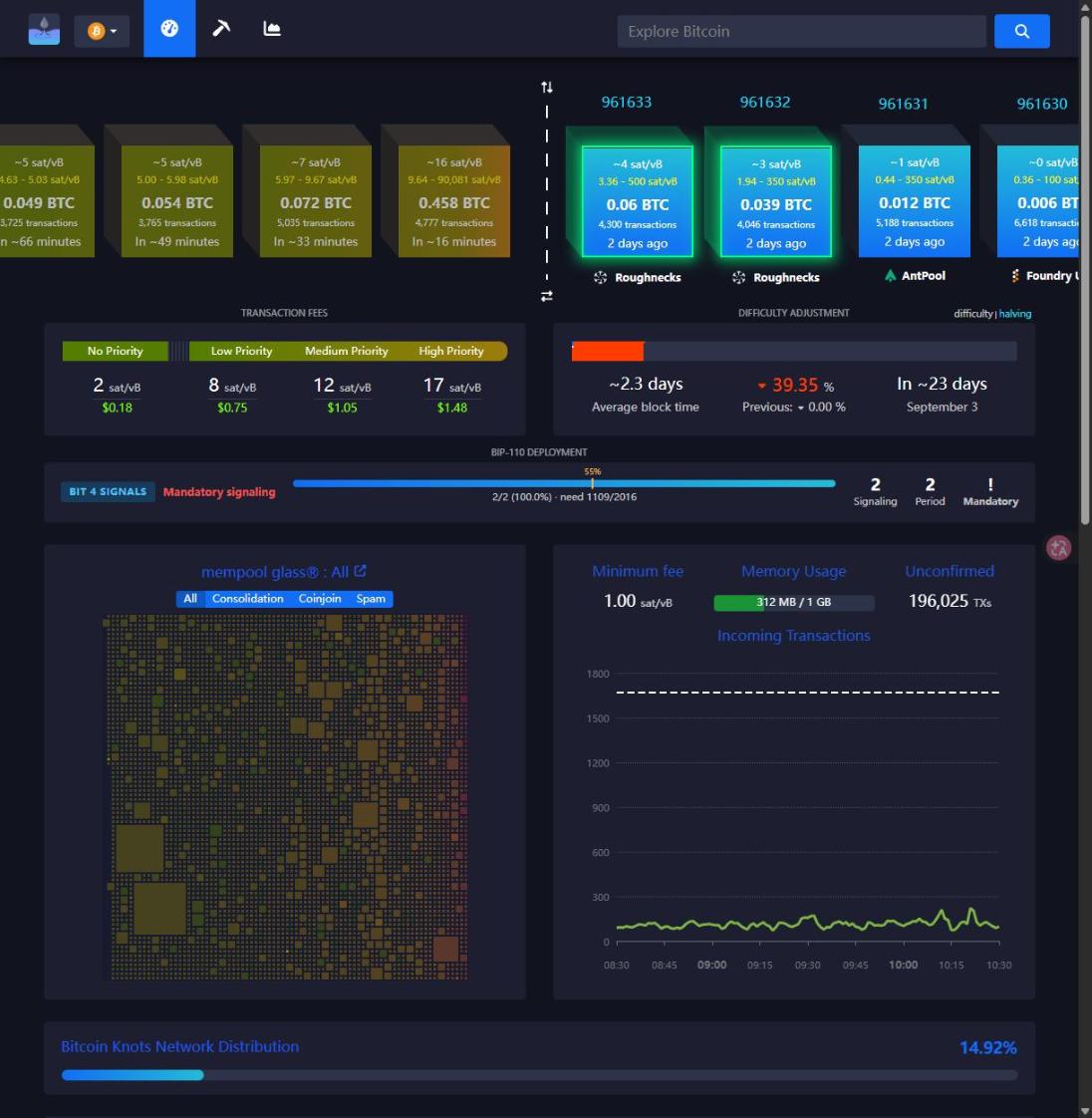
The trigger for this disciplinary action was the chain split that occurred a few days earlier—the first real split in Bitcoin since the 2017 Bitcoin Cash hard fork. On August 8, the Bitcoin network split into two at block height 961,632: some nodes refused to follow the main chain and insisted on implementing BIP-110, a soft fork proposal co-drafted by Luke that prohibits embedding non-transaction data in transactions. The minority chain only produced one additional block before stalling completely, while the main chain continued to operate normally and quickly pulled ahead by dozens of blocks.
Who Should Control the Block Space?
Bitcoin generates a new block every ten minutes on average, which packages transaction records from a certain period. Once filled, miners confirm it and link it to the previous block. Most of the content in blocks is transaction information, but as long as one is willing to pay for the space, the rules do not prohibit embedding text, images, or even code.
The conflict began with the release of Bitcoin Core (the most widely used node software for the Bitcoin network) version 30 in October 2025, which lifted the 83-byte limit on the OP_RETURN field (used for additional information). This limit was originally just a default software recommendation; after its removal, the cost of adding non-transaction data decreased significantly.
However, some community members disagreed with this relaxation. They switched to running another software, Bitcoin Knots—a free, open-source alternative that retains the old limit. Its user share rose from nearly zero at the start of 2024 to over 22% within two years.
Against this backdrop, BIP-110 was proposed. Its proponents wanted to enshrine the Knots limit into Bitcoin's underlying consensus rules, making it mandatory for the entire network. Initially numbered BIP-444, the draft included "legal and ethical consequences" for non-compliance, which was removed after backlash. It was renumbered to 110 in December 2025.
What started as a technical discussion thus escalated into a power struggle.
Trust at Stake Over Low Thresholds
For a Bitcoin soft fork to take effect, miners (individuals or institutions running specialized equipment to record transactions for the network and earn Bitcoin rewards) usually need to vote: they insert a signal marker in blocks, and the new rules take effect once the hashrate proportion covered by the signal reaches a threshold. The historical convention is a high threshold of 95%, meaning almost all miners must agree to activate the new rules, with the goal of avoiding splits.
However, BIP-110 lowered the threshold to 55% and added a mandatory activation clause: even if the support rate does not meet the threshold, nodes running the patch will automatically reject blocks that do not comply with the new rules.
Thresholds can be written into code, but whether miners are willing to cooperate is not determined by code.
Since entering the voting period on May 1, the support rate has never exceeded 3%; in the final statistical cycle near the mandatory activation deadline, it only climbed to approximately 2.53%.
Mining pools like Foundry USA and AntPool have not expressed support; almost all support votes came from Ocean Mining Pool and some independent miners. Wang Chun, co-founder of F2Pool, even publicly criticized Luke, mocking him for being "financially and personally bankrupt in credibility" and joking that switching to another proof-of-work algorithm would not yield better results.
Michael Saylor, founder of Strategy, listed "110 reasons" to oppose it, arguing that Bitcoin's neutrality would be broken once transactions can be filtered based on content. Security expert Jameson Lopp was more direct, calling it "reckless" and "doomed to fail", noting that data could bypass the restrictions via alternative encoding methods and that some transaction outputs might become permanently unspendable.

A Fork That Lasted Only One Block
On August 8, the block height reached 961,632. Nodes running the BIP-110 patch refused to recognize this block because it did not carry the signal required by the new rules, and instead produced another block according to their own rules—thus the split occurred. This new chain initially received about 2.53% of the network's hashrate support, equivalent to only one out of every 40 mining machines worldwide willing to record transactions on the new chain.
However, the minority chain only produced one more block before stopping updates entirely. The chain with more hashrate runs faster and further. The main chain stably produces one block every ten minutes, leaving the minority chain 243 blocks behind (data from bip110.mempool.guide).
In its August 10 announcement, Japan's bitFlyer only stated that it would continue to monitor the impact of BIP-110 and did not commit to any handling method. Additionally, no major exchange has expressed support for the minority chain—unlike the 2017 Bitcoin Cash fork, where many exchanges issued guidelines in advance.
Nodes that are self-custodied and running Bitcoin Knots need to be cautious: BIP-110 lacks replay protection, so the same transaction may be valid on both chains, and improper operation could lead to double-spending the same funds.
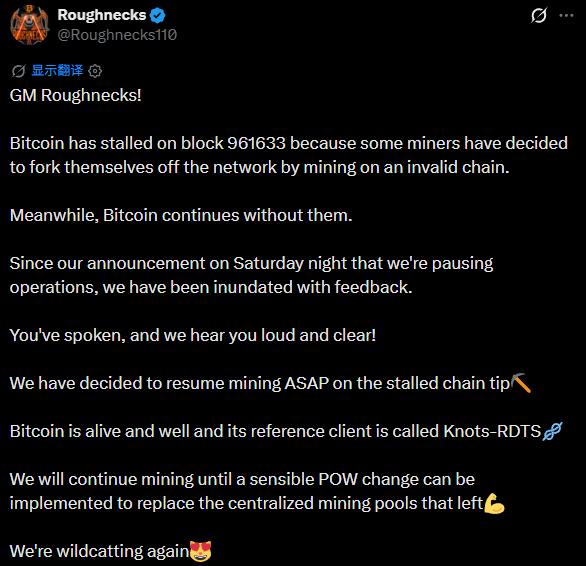
Roughnecks, the largest BIP-110 miner that mined that block, temporarily stopped production. On August 10, it reversed course and said it would resume mining, but by then its signal hashrate had plummeted from over 15 EH/s to 1.16 EH/s, and no new blocks were still being produced on the chain. The economic cost of continuing to mine has exceeded the benefits.
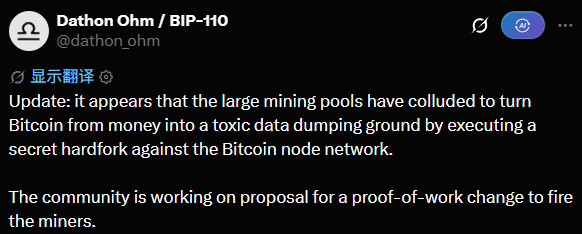
However, supporters do not seem ready to give up. Dathon Ohm, the proposal's author, and Luke—who just lost his editorial role—have actually started discussing the path mocked by Wang Chun: switching the proof-of-work algorithm to leave behind miners using specialized hardware and turn the minority chain into an independent new coin. This is still in the discussion and code testing phase.
But no matter what path it takes, this farce has confirmed the rule written into Bitcoin since its birth: rules can be drafted by a few, and editing privileges can grant oneself a green light, but what truly matters are the miners willing to keep paying electricity costs for the chain, and the exchanges and users who recognize which chain is valid.