
Attacks outpace patches—Boltz was forced to hit the pause button.
Written by: KarenZ, Foresight News
After a five-person company hit the pause button, the "Lightning Buttons" in multiple Bitcoin wallets stopped working.
On the evening of August 3, 2026, non-custodial Bitcoin cross-layer exchange service Boltz announced, "Swap services will be suspended until further notice. Do not expect a resumption in the short term, and no timeline for reopening can be provided. The APIs and official support channels needed for refunds will continue to operate, but regarding the future of the service, Boltz’s response is: the team does not know either right now."
Boltz was not brought down by a single vulnerability. What truly forced it to hit the pause button was an increasingly unsustainable speed gap—attackers use automation and AI tools to constantly find new entry points, while a small development team can only chase, patch, and wait for the next round of attacks on the other end.
At the same time, after Boltz suspended its exchange services, the impact quickly spread beyond Boltz, affecting multiple Bitcoin ecosystem projects such as BULL Wallet, AQUA Wallet, Blockstream, BTCPay Server, and Zeus.
Boltz Suspends Operations: Attack Speed Outpaces Patching Speed
Boltz stated that this service suspension was not due to an isolated incident. Over the past few months, its infrastructure has been continuously probed by automated, AI-assisted tools, and it has experienced several controlled exploit incidents; in recent days, the attack pace has accelerated significantly. After evaluating recent security scan results, the team believes it would be irresponsible to continue offering swap services.
Boltz also said it suspects it is being targeted by multiple well-resourced attack groups, but did not disclose specific vulnerabilities, attacker identities, or the amount of losses.
Regarding fund security, Boltz clearly stated that user funds were never at risk, and all related losses were borne by the company itself. Its APIs are still available to handle refunds.
Boltz: The "Transfer Station" Behind Lightning Payments
To understand why Boltz’s shutdown affected multiple wallets and payment products, we first need to understand the role it played.
Boltz defines itself as a "non-custodial Bitcoin bridge" that mainly helps users convert assets between Bitcoin mainnet, Lightning Network, Liquid, RootStock, and other networks and scaling systems. It does not require users to deposit funds into platform accounts first; instead, it uses preimages and timelocks to bind both ends of the exchange.
Take a user paying a Lightning invoice with L-BTC as an example: one end is the user locking L-BTC on Liquid, and the other end is Boltz paying BTC on the Lightning Network. After the payment is successful, Boltz can claim the locked L-BTC using the preimage (a secret value revealed when the transaction is completed); if the payment fails, the user can retrieve their funds. Thus, an exchange either executes fully or returns the original assets after failure.
According to a June 2024 interview with Boltz co-founder and CEO Kilian Rausch by Bitcoin Magazine, Boltz’s concept began in 2018. At that time, Rausch was developing a Lightning Network-based decentralized trading platform but found it very difficult to maintain Lightning channel balances, so he designed Boltz as a tool to help nodes manage liquidity.
Boltz launched on the mainnet in April 2019, initially only offering swaps between Bitcoin mainnet and the Lightning Network. The project was mainly operated on an amateur basis in its early days until the founding team decided to go full-time in 2023 and registered a company in El Salvador. In May of the same year, Boltz launched Liquid Swap, and then gradually grew from a channel liquidity tool to an exchange infrastructure behind wallets and payment products.
Bitcoin Magazine also mentioned at the time that Breez was the first Bitcoin wallet to integrate the Boltz API, allowing users to directly use Lightning Network balances for on-chain payments within the wallet; later, AQUA used Boltz to provide swaps between Liquid and the Lightning Network. In other words, before this shutdown, Boltz had been running in the background of multiple products for years, but ordinary users may not have known of its existence.
According to Boltz’s official documentation, its services mainly include three types of swaps:
The first type is the regular Submarine Swap, used to convert on-chain assets into Lightning Network payments. "Submarine" is literally translated as "submarine" and is usually understood as a metaphor for funds "diving" from on-chain to the off-chain Lightning Network.
The second type is Reverse Submarine Swap, which is the reverse process. The user first pays via the Lightning Network, then Boltz locks the corresponding assets on the Bitcoin mainnet or Liquid. When the user claims the on-chain assets, the preimage is disclosed, and Boltz then uses this preimage to settle the Lightning payment. If Boltz fails to lock the assets, the unfinished Lightning payment is canceled, and the funds automatically return to the user.
The third type is Chain Swap, used to convert assets between different on-chain networks, such as swapping BTC and L-BTC between Bitcoin mainnet and Liquid.
Boltz’s core value is turning "trusting the service provider" into "verifying transaction conditions". Although Boltz provides quotes, liquidity, and transaction coordination, user assets are not held by the platform for a long time like in centralized exchanges. The service provider cannot unilaterally take away assets after receiving funds from one end, nor can it prevent users from retrieving funds after an exchange fails or the timelock expires.
Wallets like Aqua and BULL use this mechanism to encapsulate complex cross-network swaps into ordinary send and receive buttons.
As a result, users do not need to run a Lightning node, establish a payment channel, or manage inbound liquidity. Opening the wallet, scanning an invoice, and clicking send— the experience is almost the same as a regular Lightning wallet. Boltz acts like a transfer station hidden behind the interface, responsible for moving funds into or out of the Lightning Network.
An Ecosystem-Wide Chain Reaction
This design does not truly eliminate the complexity of Lightning payments; instead, it shifts the complexity from the user side to the swap service provider. Users no longer need to manage channels, but wallets begin to rely on Boltz for quotes, liquidity, and transaction execution.
After Boltz’s shutdown, this dependency was immediately exposed: users still control their L-BTC and can continue to make internal transfers on the Liquid network, but Lightning payments and cross-network conversions that must go through Boltz are temporarily unavailable. Boltz did not become a single point of failure at the fund custody level, but it has become a single point of failure for the functionality of some products.
After Boltz suspended its exchange services, the impact quickly spread beyond Boltz.
The most direct impact is on the cross-layer exchange function of wallets. BULL Wallet, which relies on Boltz for Lightning payments and Liquid-to-Bitcoin exchanges, stated that until an alternative solution is implemented, Lightning payments/receipts and swaps between Liquid and Bitcoin mainnet within the wallet will fail. However, Bull Bitcoin also said it is a member of the Liquid Alliance and can convert L-BTC to BTC without relying on third parties, so user funds will not be trapped in Liquid.
AQUA Wallet also listed restoring exchanges between Liquid and the Lightning Network as a top priority, and said there are still multiple paths to convert L-BTC to BTC or USDT, with users continuing to control their funds. Bitcoin wallet Zeus suspended its own Swap instance.
In addition, Blockstream App confirmed in March 2026 that the atomic swaps between the Lightning Network and Liquid for Blockstream App and hardware wallet Jade are provided by Boltz. Thus, it can be judged that Boltz’s shutdown will block this exchange path.
The chain reaction did not stop at wallets and swap services.
- Bitcoin payment processor BTCPay Server stated that plugins relying on Boltz are no longer working properly, and merchants using this plugin cannot temporarily receive Lightning Network payments; users who have not enabled the Boltz plugin are not affected.
- Bitcoin ecosystem crowdfunding platform Geyser said its donations and project withdrawals are processed via Swap, so it cannot continue for now, but user funds are not at risk.
- Virtual card project Freedomia said its Lightning and Liquid recharges processed via Boltz routes are affected.
- Custodial project Mynymbox suspended related payment functions.
This chain reaction shows that Boltz is no longer just a swap product directly accessible to ordinary users. It is also the infrastructure behind multiple wallets, payment plugins, merchant tools, and Bitcoin applications.
When these products encapsulate Boltz into a smooth user interface, ordinary users may not even know that a "Lightning payment" relies on an external swap service until that service stops working.
AI Is an Attack Amplifier, but Not Necessarily the Only Reason
Boltz described this predicament as a "major paradigm shift" that open-source Bitcoin services are experiencing. This judgment has also been echoed by some peers.
PayPerQ, a pay-per-query chatbot project, said it has had to deal with an exploit almost every week over the past few months, and believes most of them may be AI-driven.
The operator of lnp2pBot, a peer-to-peer Lightning Network Telegram bot, also said that its Telegram bot has been continuously attacked since its launch day, and the team is using AI to review code in return; if the attack volume exceeds its capacity, it may also choose to shut down the service.
There is currently no public technical report proving that every attack Boltz encountered was AI-led. A more reasonable understanding is that AI has become an amplifier of attack capabilities. It can help attackers read public code, generate abnormal inputs, traverse API states, combine exploit paths, and iteratively improve based on return results. But another issue is that services like Boltz have open interfaces, complex transaction processes, and vulnerabilities that can bring direct economic benefits, while the defending team has relatively limited resources. The combination of these conditions makes automated attacks particularly effective.
Boltz’s GitHub organization page currently shows five public members. In addition, in an interview in January 2026, Boltz co-founder and CEO Kilian Rausch again confirmed that it is a self-funded five-person team.
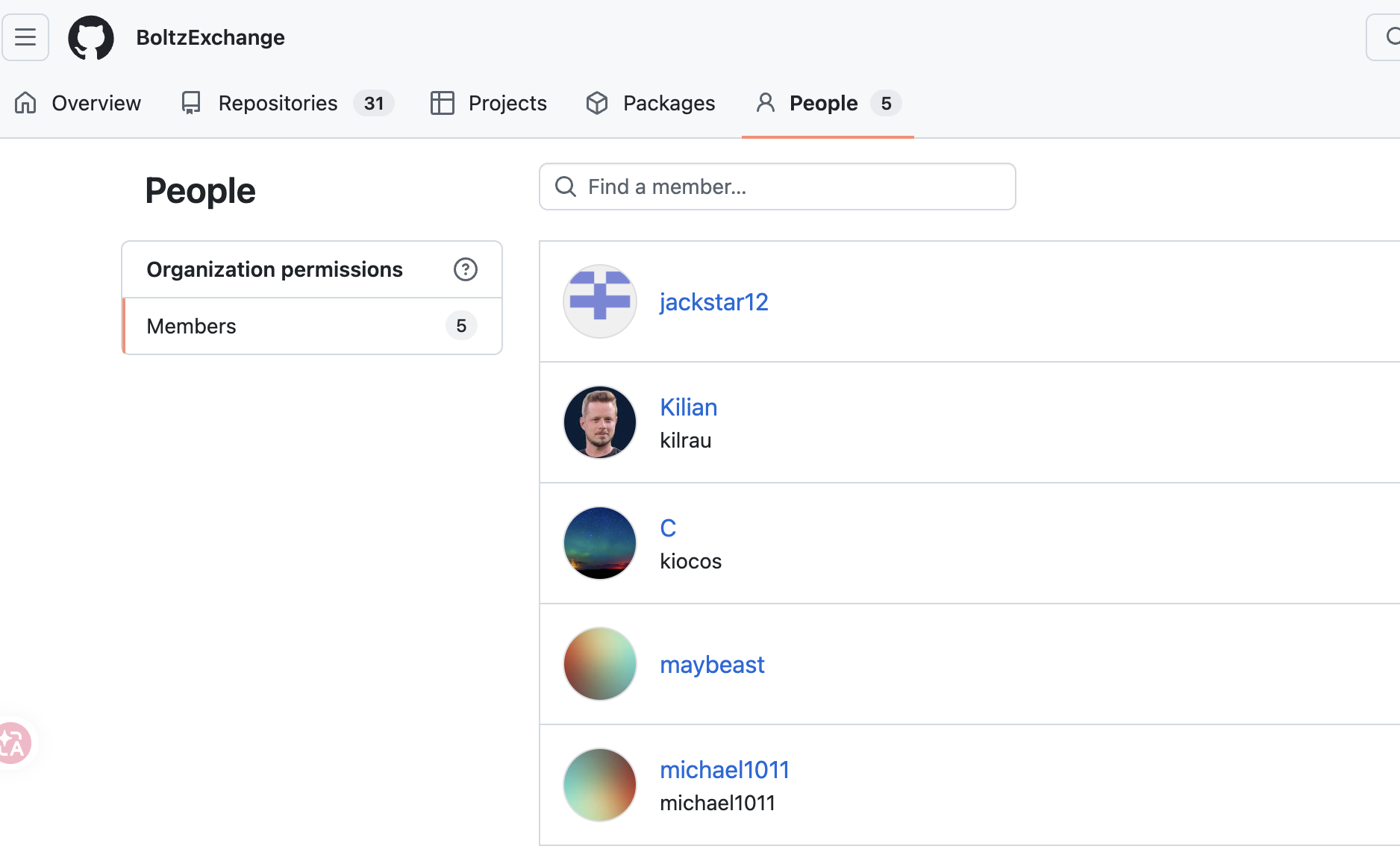
Open source brings transparency, verifiability, and community auditing, but it also requires projects to have security investments that match their open attack surface.
The Real Wake-Up Call from Boltz
Luke de Wolf, a Bitcoin network security expert and author of "Defending Bitcoin", called Boltz’s shutdown a major setback for Bitcoin’s cross-layer interoperability. He has long recommended wallets that use Liquid as the balance layer and connect to the Lightning Network via Boltz, while also worrying that Boltz would become a single point of failure. Now, this once theoretical risk has become a real failure.
Early Bitcoin developer Peter Todd thus called such products "fake Lightning wallets" and believes that simulating the Lightning payment experience via Liquid plus background swaps is a design that deserves vigilance.
In the author’s view, the Boltz incident also raises the following questions:
First, non-custodial products cannot only prove that "the service provider cannot take the money"; they also need to tell users: which functions rely on external infrastructure, which operations remain available after external services are shut down, and how users can independently recover their funds.
Second, wallets cannot treat a single swap provider as a permanently available public facility. A more mature architecture should support multiple swap providers, dynamic routing, and automatic failover, or allow advanced users to connect to self-hosted instances. However, multiple providers are not just adding a few API addresses; it also involves liquidity depth, quote quality, privacy leaks, and security standards between different implementations.
Third, security competition in the AI era may force small open-source financial teams to redefine product boundaries. In the past, "open code and non-custodial funds" were often enough to build trust; in the future, projects will also need to prove that they can continuously perform automated testing, attack surface management, abnormal traffic isolation, and emergency response.