
The teleprompter operator who has been with Trump for ten years actually traded on Trump's speech content in prediction markets.
Written by: Nicky, Foresight News
On July 16, according to reports from CNBC and ABC News, a long-time teleprompter operator for U.S. President Trump is under investigation by federal regulators for allegedly using insider information to place bets on prediction market platforms, and the White House has suspended him.
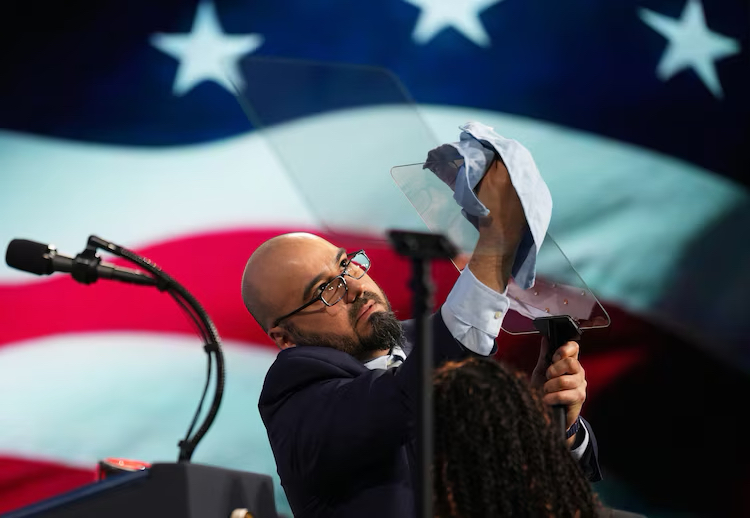
March 27, 2026, Miami Beach, Florida: Perez cleans the teleprompter before Trump delivers a speech at the Future Investment Initiative Institute summit.
The involved individual, Gabriel Perez, has operated teleprompters for Trump since 2016. Among all aides, he usually is the last to access and adjust the president's speech drafts, even receiving impromptu revisions from Trump himself. According to ABC and CNBC citing informed sources, investigators from the U.S. Commodity Futures Trading Commission (CFTC) found that Perez traded on more than 12 of Trump's public speeches over approximately three months, covering occasions such as the State of the Union address, Davos World Economic Forum speech, prime-time addresses, and Medal of Honor ceremonies.
Using advance knowledge of speech content, he placed bets on Kalshi's "Mentions" market on whether specific words, phrases, or topics would be mentioned, and sometimes even withdrew bets mid-speech when Trump skipped parts of the script.
Perez's transactions were detected by Kalshi's monitoring system in March this year; the patterns did not align with typical trading behavior and were additionally flagged by market makers via reporting channels. The platform then froze the account, withheld almost all proceeds, and transferred the case to the CFTC. Robert DeNault, Kalshi's head of enforcement, stated via CNBC that the monitoring team quickly flagged these transactions, and the platform is assisting regulators and has submitted collected evidence.
CNBC reports that Perez accumulated over $90,000 in profits, but most of the proceeds have been frozen by Kalshi. Currently, Perez is in settlement negotiations with the CFTC and may face returning all profits and being banned from similar transactions. The Manhattan U.S. Attorney's Office has been informed but decided not to launch a criminal investigation.
White House Press Secretary Karoline Leavitt confirmed at a press conference that Perez has been placed on unpaid administrative leave, is no longer responsible for teleprompter operations, and will not continue working at the White House. According to CNBC, Leavitt revealed that Trump himself was aware and considered the matter "very unfortunate, simply a disgrace," and made the relevant decision personally. Leavitt emphasized that the White House has extremely strict ethical guidelines, and an internal memo was specifically issued in March this year warning staff not to use non-public information to trade on prediction markets.
Perez's case is not an isolated incident. As early as May 2025, California gubernatorial candidate Kyle Langford made about $200 in trades on markets related to his own campaign; despite minimal profits, he was ultimately fined $2,246 and banned from the platform for five years. From August to September 2025, Artem Kaptur, a video editor who used his position to obtain advance knowledge of program schedules, was flagged for unusually high win rates; he made about $5,400 in profits, and in addition to having profits recovered, he was fined an extra $15,000 and banned for two years.
In February 2026, former Congressman George Santos publicly promised to attend Trump's State of the Union address while betting that he would not attend, making tens of thousands of dollars in profits; his account was immediately frozen and transferred to regulatory and judicial authorities. In April of the same year, three congressional candidates were investigated for placing small bets on markets related to their own elections; they were fined between hundreds and thousands of dollars each and banned for five years. Even with small profits or no withdrawals, trading using insider information still faces platform penalties and regulatory accountability.

Source: Internet
Polymarket, another major prediction market platform, has also had similar serious violations. According to previous CNBC reports, Gannon Ken Van Dyke, a U.S. Army Special Forces sergeant, used classified information to buy a large number of contracts in Polymarket's related markets during his participation in the military operation to capture former Venezuelan President Maduro from December 2025 to January 2026, making over $400,000 in profits. He was arrested in April this year and faces criminal and civil insider trading charges. In May of the same year, Michele Spagnuolo, a Google software engineer, was indicted for allegedly using the company's internal "annual search trend" data to trade on Polymarket from October to December 2025, making about $1.2 million in profits.
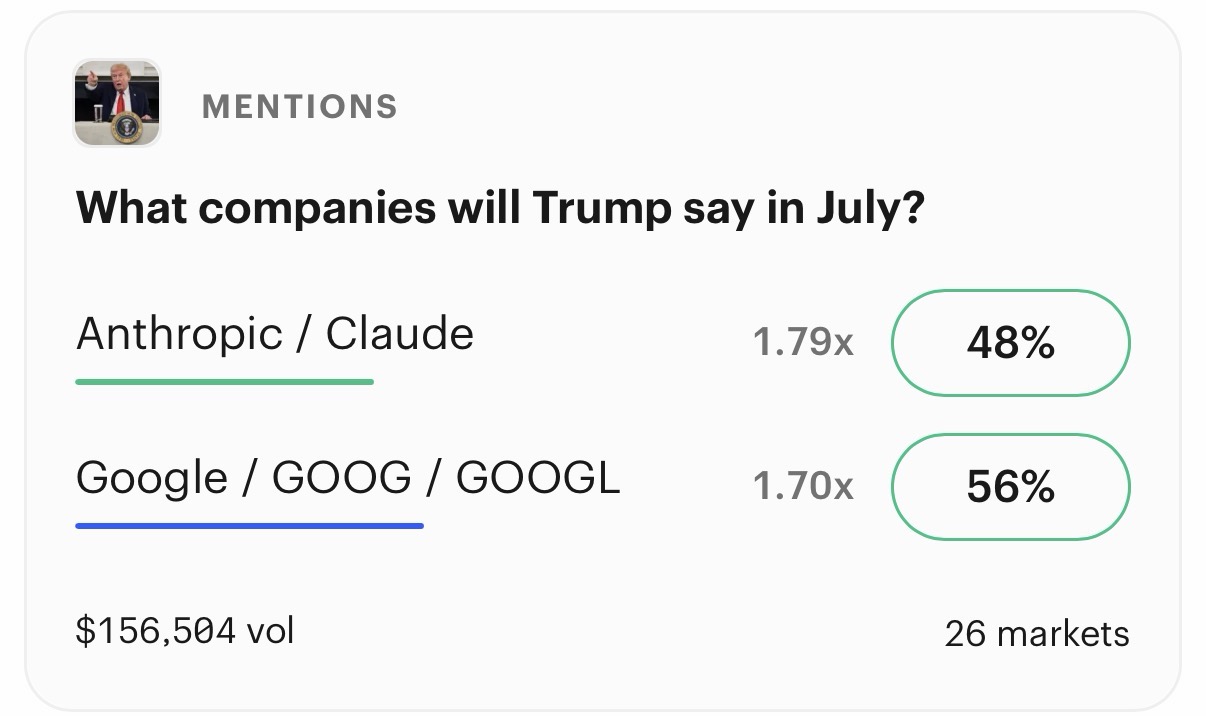
The reason insider trading repeatedly occurs in prediction markets lies in the fact that information advantages can quickly translate into excess returns, and some topic markets have reached a scale of funds that cannot be ignored. For example, the topic "Which companies will Trump mention in July" on Kalshi has a trading volume of over $150,000. High-liquidity markets provide sufficient profit space for insider holders, while ordinary users are at a disadvantage due to information asymmetry, thus damaging the fairness of market prices and the credibility of the platform.
In response to these disorders, platforms and regulators are trying multiple measures to curb them. Kalshi recently updated its policies, requiring traders in specific markets to disclose professional information, and strengthening pre-prevention through KYC procedures, 24/7 abnormal transaction detection, and reporting channels. In the first quarter of this year, the platform conducted over 150 investigations, froze more than 100 potentially suspicious transactions, and transferred over 20 cases to law enforcement agencies.
At the regulatory level, the CFTC has repeatedly cited regulations prohibiting the misuse of non-public information and market manipulation in recent enforcement actions, and has joined hands with the Department of Justice to promote criminal accountability, so that trading using government internal information or corporate data may face felony charges such as fraud and money laundering, as well as several years of imprisonment. The White House has also clearly stated through internal memos that government employees are not allowed to participate in such bets.