
Pump's cumulative buyback and burn amount is approximately $400 million, with the total burned tokens accounting for 15% of the total supply!
Author: Ma He, Foresight News
On July 14, 2026, Pump.fun's native token PUMP saw its first large-scale cliff-style unlock after TGE. According to cross-verification by Tokenomist, on-chain monitoring, and multiple data platforms, the theoretical maximum number of tokens unlocked that day was 82.5 billion, accounting for 8.25% of the total supply (1 trillion tokens), with a value of approximately $131.35 million (calculated at the then price of about $0.00159), equivalent to about 20.23% of the circulating supply before the unlock.
This is the first unlock for the two major allocation categories: team/advisors and private investors. Among them, private investors will unlock 32.5 billion tokens, and the team and advisors will unlock 50 billion tokens.
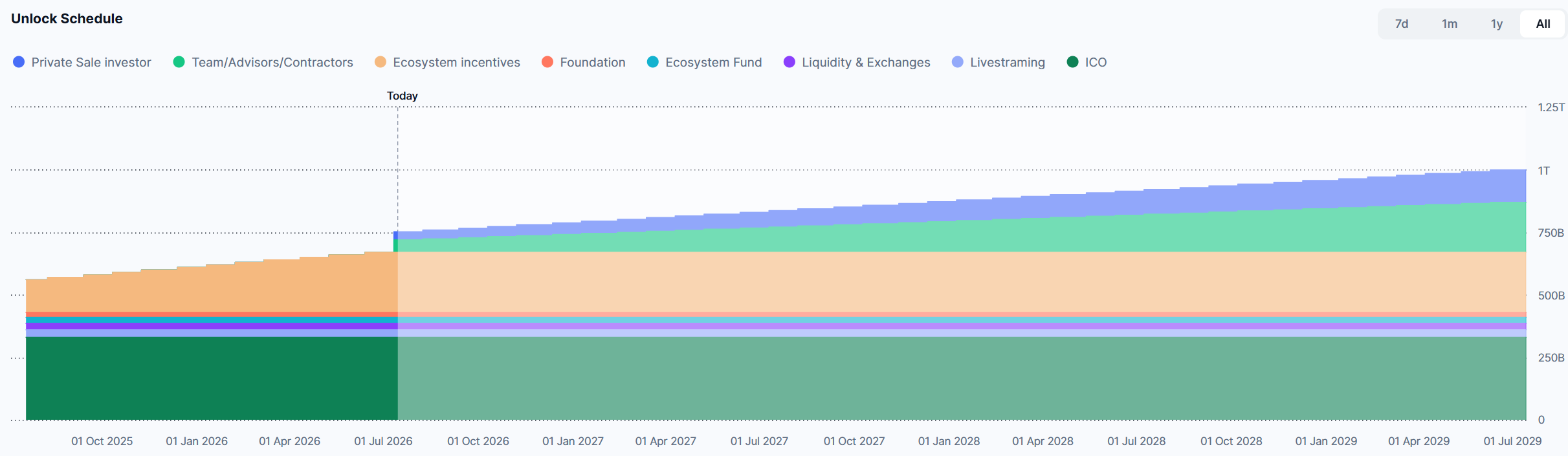
In the early morning of July 15, according to on-chain tracking data from Arkham, 57.279 billion tokens were distributed to 121 wallets after unlocking. PUMP's current market cap is approximately $650 million, and its FDV is about $1.6 billion.
Earning $20 Million Monthly, $940,000 Daily
This event occurred against the backdrop of Pump.fun having become one of the most profitable applications on Solana and in the entire Web3 space. Over the past 30 days, the platform's protocol revenue reached $24.52 million (per DefiLlama data), second only to Hyperliquid's $43.93 million and higher than Polymarket's $22 million; cumulative revenue has exceeded $1.05 billion, with over 12 million tokens issued cumulatively.
Even in a deep bear market environment, Pump's weekly revenue currently maintains around $5 million.
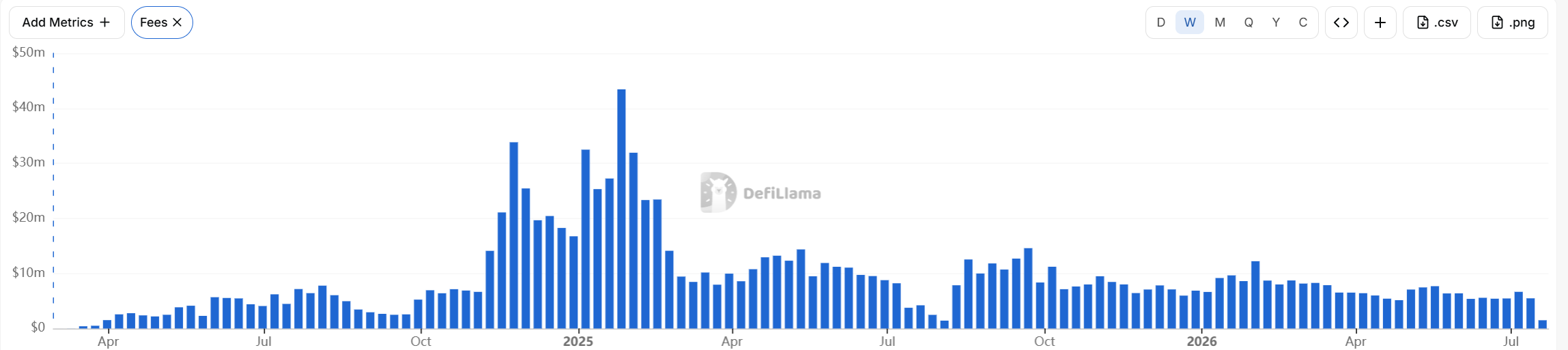
However, such large revenue does not seem to have brought a positive cycle to its token price. PUMP has fallen from a high of $0.008980 to around $0.001628, oscillating there.
Where exactly is the problem?
Pump.fun's core value capture mechanism is to use protocol fees to buy back and permanently burn PUMP. As of now, official platform data shows its annualized revenue is $343.71 million, with an average daily revenue of $941,700 over the past 90 days. The cumulative buyback and burn amount has reached $408.15 million, with the total burned tokens accounting for 15.029% of the total supply.
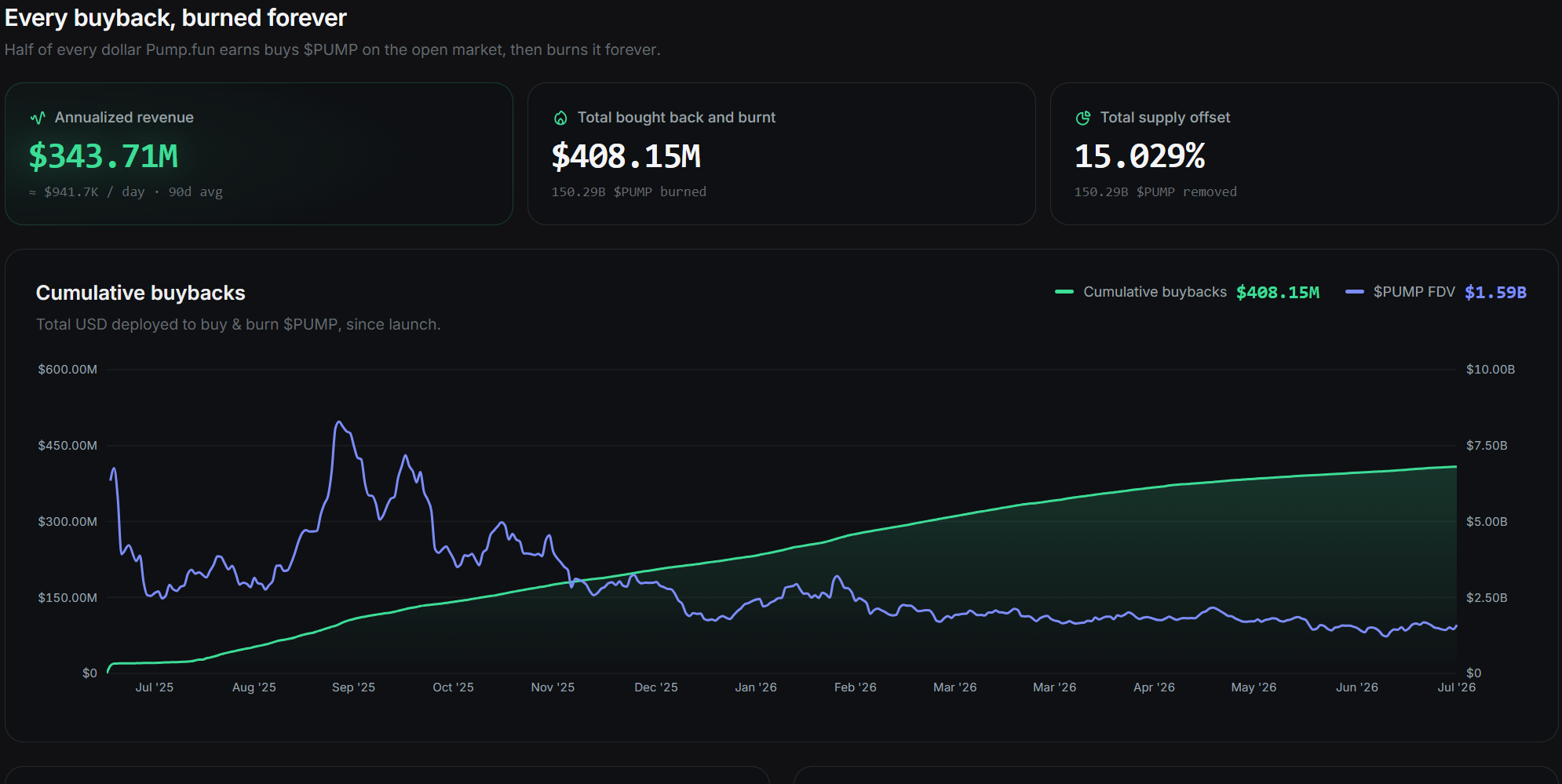
Pump launched after its TGE in July 2025: initially, 100% of net protocol fees (cross-chain revenue from bonding curve, PumpSwap, Terminal, etc., after deducting referral fees and cash rebates) were used to buy PUMP on the open market and burn it.
Adjustment on April 28, 2026: switched to 50% of net revenue being programmatically locked and used for buyback and burn for one year; the other half is used for recruitment, marketing, and product development. All repurchased tokens are permanently burned instead of being locked. This forms PUMP's core flywheel that differentiates it from most meme or platform tokens—the more profitable the platform, the scarcer the token supply.
However, the intensity and durability of the buyback have caused considerable controversy. PUMP only uses 50% of net revenue for buyback and burn, a significant reduction from the previous 100%, leading to a sudden drop in buying support. Compared to HYPE's nearly 99% fee buyback and Lighter's recent full use of revenue for buyback and burn, PUMP's buyback, with similar revenue volume, seems insufficient to hedge against unlock selling pressure, leading to a natural slump in price.
In addition, Pump is facing a class-action lawsuit. U.S. plaintiffs have characterized it as an "illegal digital casino." Under such intense compliance pressure, cutting 50% of the buyback and diverting large sums of funds to the treasury for hiring a "chief legal officer with a $5 million salary" is a political risk mitigation measure by the team, sacrificing the interests of secondary token holders to pay for their own compliance.
Furthermore, there is a huge question mark over whether buybacks will continue after the one-year period expires.
A deeper reason is PUMP's "casino gene." It is essentially a meme launch platform filled with PVP betting and casino culture, with sharp volatility and vulgar narratives. Institutional funds have almost zero willingness to buy or HODL long-term. Compliance risks, reputation pressure, and lack of real utility keep mainstream capital at bay, with only retail and speculative funds supporting the market. Once unlocks arrive, the absorption capacity is inevitably fragile.
Can the Huge Selling Pressure Be Absorbed by the Market and Buybacks?
On-chain observations show that some distribution wallets have transferred tokens on the day of unlock and the next day. Although no crash was triggered, short-term volatility and liquidity tests are inevitable. In addition, PUMP's own utility is still weak (mainly for ecological incentives and potential governance), and the market sees it more as an "income-sharing voucher" rather than a strictly utility token, which amplifies selling pressure sensitivity in bear market sentiment.
Comparing with similar high-revenue protocols: Hyperliquid has higher monthly revenue but a market cap of nearly $15 billion (more than 20 times that of PUMP); Polymarket has similar revenue but has not yet issued a token, with a financing valuation reaching the $15 billion level. Both have proven their sustained revenue capabilities, while Pump may see a sharp drop in revenue due to the bear market and the slump of meme coins.
However, this unlock is not a "one-time death." The team and investors have a three-year release period instead of selling all at once. Historical experience shows that some project parties and early investors will choose to hold or sell slowly to maintain their reputation and long-term interests. At the same time, the release of ecological incentives and foundation portions can be used for growth rather than pure selling pressure. Pump.fun has expanded from a single launchpad to PumpSwap, multi-chain support, and live streaming, forming a more complete ecosystem. As its native token, PUMP directly benefits from the platform's expansion.
The 82.5 billion token unlock is a real stress test for PUMP as it moves from the "100% buyback honeymoon period" to the "sustainable but more restrained" phase. In the short term (weeks to 1-2 months), the game between selling pressure and buyback intensity will determine the price volatility; if the market can absorb it well without liquidity drying up, it may instead strengthen the narrative of high-revenue protocol tokens.
In the long run, what determines PUMP's fate is not a single unlock, but whether Pump.fun can continue to make money as the core infrastructure of the meme economy. As long as the revenue flywheel keeps spinning, buybacks and burns will continue to reduce supply; conversely, any sharp drop in revenue will turn subsequent unlocks into a real burden.