
Securing funding from NVIDIA, Intel, and Dell while quietly erasing traces of token issuance—Prime Intellect claims $100 million in ARR. What path has it taken to get here?
Written by: KarenZ, Foresight News
A two-year-old AI infrastructure company that announced backing from investment arms of NVIDIA, Intel, and Dell while claiming annualized revenue exceeding $100 million—these two figures together make Prime Intellect one of the most noteworthy AI projects to revisit recently.
On July 8, 2026, decentralized AI infrastructure network Prime Intellect announced the completion of a $130 million Series A funding round at a $1 billion valuation, led by AI-focused venture capital firm Radical Ventures. Investment arms of NVIDIA, Intel, and Dell made a rare joint investment, bringing the total funding raised to over $150 million.
Alongside the disclosure of the large funding round, Prime Intellect officially announced that in less than a year, its annualized revenue (ARR) has rapidly jumped to over $100 million, and the platform now serves more than 6,000 enterprise and startup clients.
What's the Background?
As mentioned in my March 2025 article OpenAI Co-Founder Takes Action! Quick Look at Decentralized AI Dark Horse Prime Intellect, Prime Intellect was co-founded by Vincent Weisser and Johannes Hagemann in January 2024.
- CEO Vincent Weisser has long been involved in the intersection of decentralized science (DeSci) and AI. He was a co-founder of projects like Bio Protocol, VitaDAO, and CryoDAO, and previously served as the ecosystem and AI lead at DeSci platform Molecule.
- CTO Johannes Hagemann focuses on distributed AI, semi-automated engineering, and brain-computer interfaces, and previously worked as an AI research engineer at German AI company Aleph Alpha.
Additionally, in October 2025, venture capitalist Ash Arora joined Prime Intellect as Head of Applied GTM (Go-to-Market), responsible for product strategy, commercialization, revenue, and applied AI products in post-training processing and reinforcement learning. Ash Arora recently stated that Prime Intellect now has 40 full-time employees.
In terms of funding, Prime Intellect has raised over $150 million in total. Its $5.5 million seed round in April 2024 was co-led by Distributed Global and CoinFund, with angel investors including Clem Delangue, CEO of machine learning tool Hugging Face.
Less than a year later, in March 2025, Prime Intellect completed another $15 million funding round led by Peter Thiel's Founders Fund, with investors including AI heavyweights like Andrej Karpathy (co-founder of OpenAI and former AI director at Tesla), Tri Dao (chief scientist at Together.AI), and Emad Mostaque (co-founder of Stability AI).
The latest round is of a different nature. In the $130 million Series A, NVIDIA Ventures, Intel Capital, and Dell Technologies Capital are not just financial investors—their parent companies are key players in GPU, CPU, server, and data center infrastructure respectively.
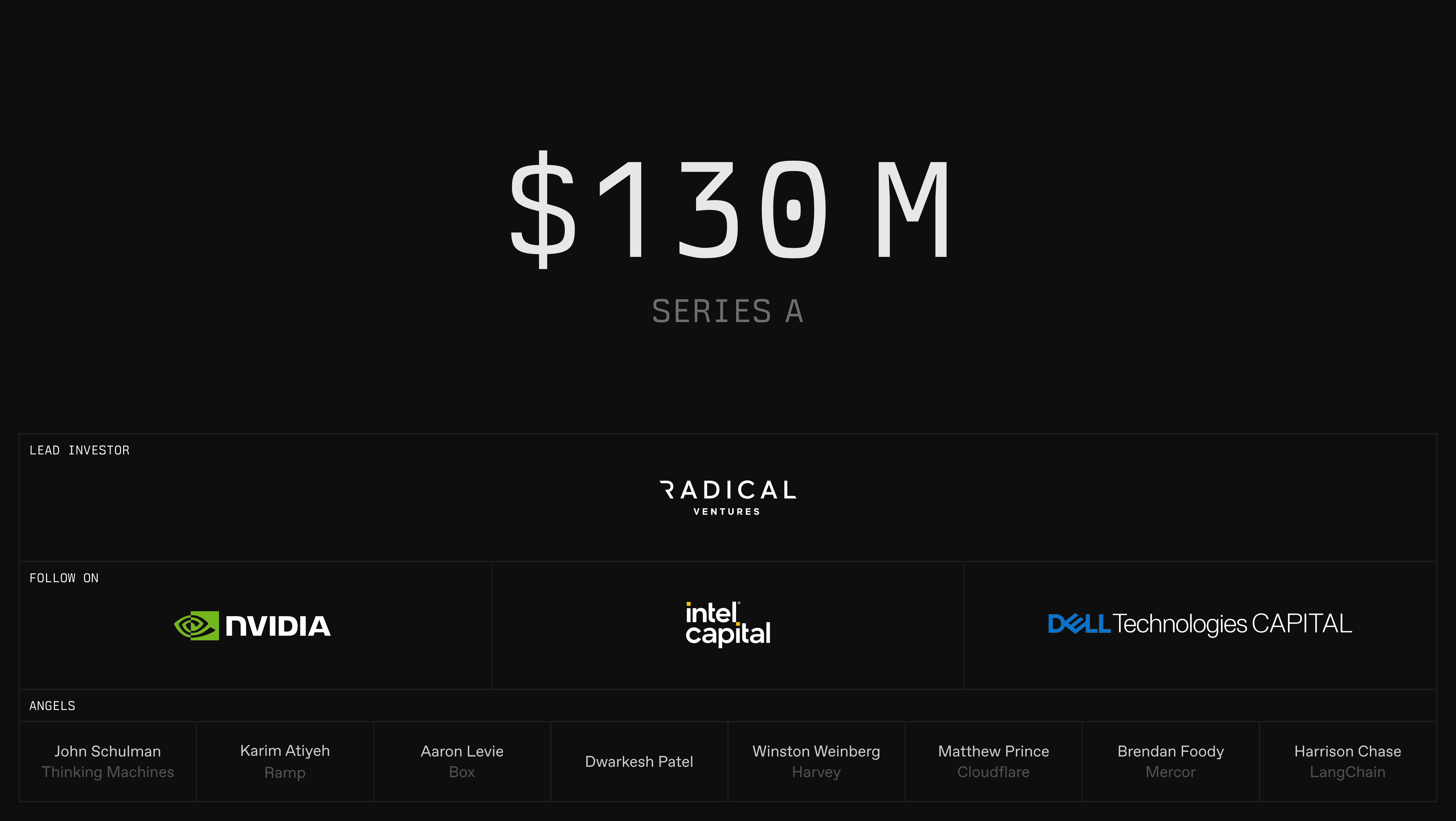
Intel Capital's explanation for this round also shows that hardware giants are investing because Prime Intellect is trying to integrate underlying computing, training environments, evaluation, post-training reinforcement learning, and upper-layer inference into a single unified control plane.
What Substantial Progress Has It Made?
One of Prime Intellect's early notable achievements was proving that distant, heterogeneous GPUs can collaborate on training. Tracking its technical iterations over the past two years shows how the platform has gradually turned scientific experiments into commercial product lines.
At the end of November 2024, Prime Intellect released INTELLECT-1, a 10-billion-parameter model trained across nodes in five countries and three continents. The company claimed an overall cross-continental compute utilization rate of 83%, and 96% when using nodes only in the U.S.
Less than six months later, Prime Intellect released INTELLECT-2, targeting 32-billion-parameter global distributed reinforcement learning. To this end, the team developed the asynchronous RL framework PRIME-RL, SHARDCAST for propagating model weights, and TOPLOC to verify if inference nodes are performing as expected.
A more critical change came with INTELLECT-3. In November 2025, Prime Intellect released a 106-billion-parameter Mixture of Experts (MoE) model based on Zhipu GLM-4.5-Air, which underwent supervised fine-tuning and reinforcement learning. The model was trained on 64 nodes with 512 NVIDIA H200 GPUs for about two months; its weights, training framework, data, RL environment, and evaluation methods were all open-sourced. The significance here is not just another model release, but that the company used its research project to validate a complete production system: PRIME-RL handles asynchronous training, Verifiers and Environments Hub provide unified tools and community ecosystem for building and hosting RL environments and evaluations, Prime Sandboxes isolate the execution of agent-generated code, and the compute orchestration layer manages clusters, storage, and monitoring.
In February this year, Prime Intellect launched Prime Intellect Lab, a full-stack AI training platform designed to help individuals, engineers, and AI companies train and optimize their own models (especially agentic models) without building expensive GPU clusters. On May 7, the Lab exited beta and officially opened to the public.
In June, Prime Intellect released prime-rl version 0.6.0, which the company claims pushes the engineering limit to MoE models at the trillion-parameter scale. Prime Intellect disclosed that for GLM-5 series software engineering tasks, it can use 28 H200 nodes to process sequences up to 131,000 tokens long, with a single-step training time of less than 5 minutes.
The key behind this is not a single algorithm but the joint optimization of training and inference systems: On the inference side, FP8 low-precision computing and components like DeepEP and DeepGEMM are used to improve throughput; pre-filling and decoding are separated to avoid long tool outputs slowing down generation; KV Cache hierarchical offloading increases concurrency. On the training side, block-scaled FP8 is also used, Router Replay reduces routing differences between training and inference for MoE models, and FSDP, expert parallelism, and context parallelism are added. These optimizations ultimately affect GPU utilization, training time, and customer costs.
In July this year, prime-rl added a unified algorithm layer, with six built-in training methods: GRPO, MaxRL, On-Policy Distillation, Self-Distillation, SFT Distillation, and ECHO. It allows different algorithms to be selected for different environments in the same training run. Put simply, the same agent can use one learning method for math tasks and another for terminal operation tasks without rewriting the underlying trainer. This moves Prime Intellect from "running training for customers" to being closer to a scalable RL operating system.
Hardware-Software Synergy: NVIDIA Is More Than an Investor
Judging from the investor lineup of the Series A round, the binding between hardware giants and Prime Intellect goes beyond capital—it extends to co-building hardware and software architectures.
Prime Intellect's collaboration with NVIDIA covers both hardware and software layers. On the hardware side, its training and service workloads already use NVIDIA Blackwell, Blackwell Ultra, and NVL72 rack-level systems, which the company claims are more efficient than previous Hopper clusters.
On the software side, NVIDIA Dynamo is used for global inference orchestration, auto-scaling, request routing, and KV Cache offloading, and is integrated with Prime Intellect's large-scale LoRA (Low-Rank Adaptation, a fine-tuning technique for large language models) deployment.
NVIDIA's own technical blog also confirms that Prime Intellect has deployed the NVIDIA Dynamo inference framework in production workflows and participated in the co-design and integration of LoRA Adapter support.
Prime Intellect previously stated in March this year that it would test RL sandbox workloads around NVIDIA Vera CPUs and plans to migrate some sandboxes once Vera is publicly available, providing GPU sandboxes on the Vera Rubin system. The company's self-test shows that each Vera CPU socket can stably run 176 virtual machines in parallel; in its set RL sandbox workloads, after enabling multi-threading, the throughput is about 30% higher on average than the AMD Zen 5 baseline on AWS with only physical cores enabled.
These figures show potential cost advantages, but they currently come from joint testing between the two parties, and the comparison environments are not identical, so they cannot be taken as independent general performance conclusions. Vera Rubin and GPU sandboxes should also be described as "planned for adoption" rather than already in large-scale commercial use.
With product maturity, real commercial monetization is happening. According to Prime Intellect, fintech company Ramp used Prime Intellect Lab to train FastAsk, a retrieval sub-agent for Ramp Labs: Ramp turned its AI spreadsheet editor Ramp Sheets into a trainable RL environment and then performed reinforcement learning training using Qwen3.5-35B-A3B as the base model.
Prime Intellect's results show that FastAsk has an accuracy rate of 66.25%, higher than Claude Opus 4.6's 61.88%, and its average latency is about 27% lower.
Since the test set and evaluation were defined by the two collaborating parties, this does not mean that the 35B model surpasses Opus in general capabilities, but it proves a narrower and more commercially valuable proposition: enterprises can train smaller models to become experts in specific workflows.
Is the $100 Million ARR Real?
It must be clarified that Prime Intellect's official statement uses "annualized revenue exceeding $100 million" rather than "having achieved $100 million in revenue in the past year."
Annualized revenue is usually extrapolating recent monthly or quarterly revenue to a full year; if the business is growing rapidly, it may be significantly higher than the actual revenue in the past twelve months. For GPU, training, and inference services charged by usage, this metric does not mean customers have signed annual contracts of the same amount with automatic renewal.
From Prime Intellect's announcements and launched paid products, its commercialization covers four main product categories: first, the compute market, including GPU instances, multi-node clusters, and reserved clusters charged by usage time; second, Lab-hosted training, charged based on model input, output, and training tokens; third, inference and hosted evaluation, also related to model call volume; fourth, Sandboxes, charged based on CPU, memory, disk, and runtime.
The growth drivers of this revenue structure are not hard to understand. First, GPU clusters are high-value-per-customer resources consumed hourly, so revenue can grow faster than pure software subscriptions. Second, Prime Intellect is extending the customer consumption path from "renting GPUs" to "building environments—running inference—doing evaluations—reinforcement learning training—deployment," allowing the same customer to generate usage across multiple links. Third, agent reinforcement learning requires a lot of parallel rollouts, long-context inference, and isolated sandboxes, which naturally consume more computing power than ordinary API Q&A.
The over 6,000 customers disclosed by Prime Intellect and the Ramp case at least show that the platform is no longer just a research demonstration. However, several boundaries need to be kept in mind when reviewing the $100 million figure. Prime Intellect is a private company and has not publicly released audited financial reports, the monthly or quarterly revenue used to calculate annualized revenue, customer payment rates, revenue breakdown, or customer concentration. The company also has not clarified whether compute market revenue is recognized based on total customer spending or platform net revenue.
In addition, Prime Intellect's compute market does not currently provide a formal Service Level Agreement (SLA), which the company says is because the underlying infrastructure comes from multiple suppliers. It recommends that users with high stability requirements choose Secure Cloud; in case of supplier-side failures, refunds or platform credits may be provided.
Compared to a single financial figure, a more verifiable progress is that Prime Intellect has turned the originally loose distributed collaborative training into a full-stack infrastructure with "self-developed models, open-source ecosystem, endorsement from giant hardware companies, and real enterprise landing bills."
Token Issuance Clues Erased from Documentation
An unignorable detail is that as Prime Intellect now enters the $1 billion valuation club and announces $100 million ARR, I found that highly Web3-colored statements in its official documentation—"contract deployed on Base Sepolia testnet," "future migration to self-developed chain," and "token rewards distributed to compute pools via RewardsDistributor contract based on active time"—have been completely erased.
This deletion at the documentation level was foreshadowed in an official tweet released in early March 2025.
At that time, Prime Intellect announced the completion of a $15 million funding round led by Silicon Valley's top Founders Fund, with core investors including top figures like Andrej Karpathy (co-founder of OpenAI), Clem Delangue (CEO of Hugging Face), and Balaji Srinivasan. It was from this moment that the underlying logic of the project was deconstructed.
The originally grassroots narrative of "issuing tokens, pulling retail computing power, airdrop incentives" immediately became a minefield that touches the compliance red lines of traditional venture capital. To receive funding from mainstream capital markets, Prime Intellect had to superficially complete a full transition from "Crypto-first" to "AI-first."
However, its distributed model training still retains the topological core of P2P networks, but decentralization is no longer a token narrative for retail speculation; instead, it has become an invisible channel for B-end enterprises to "low-cost scheduling of global idle computing power."
Today's Prime Intellect is more like a pure AI SaaS company, and its future endgame is likely to be an IPO or a high-premium acquisition by traditional hardware giants.