
From cross-border payments to tokenized finance, why is Airwallex betting on Metal?
Written by: KarenZ, Foresight News
When money travels from New York to Singapore, the hardest part isn't necessarily "speed". It also needs to know who can access the funds, which currency to convert to, which compliance rules to follow, and finally which bank account to enter. When AI Agents start placing orders, making payments, and doing accounting for enterprises, these problems will only be amplified.
On June 25, Airwallex completed its Series H financing of $320 million, with a valuation of $11 billion, and announced that the funds will be invested in financial intelligence, agent commerce, global infrastructure, and compliance layout.
On the same day, Metal announced that Airwallex and Capital49 (an independent venture capital fund founded by Airwallex's founding team) co-led its seed round, and Airwallex became Metal's first design partner.
From a Web3 perspective, putting these two pieces of news together, the focus is not just Airwallex's strategic investment in Metal. More notably, Airwallex is putting the licenses, local payment networks, and API infrastructure accumulated over the past decade into a new proposition: when stablecoins, tokenized assets, and AI Agents are all entering the enterprise financial system, who will be responsible for authorization, compliance, currency exchange, deposits and withdrawals, and final settlement?
From Cross-border Payments to Agent Finance: Airwallex Wants to Get Closer to the Bottom Layer
Airwallex's story has always been about cross-border finance. In 2015, Jack Zhang and several entrepreneurs encountered the inefficiency, delays, and high costs of traditional banks and foreign exchange systems firsthand while running a coffee shop in Melbourne, leading to the founding of Airwallex.
Today, Airwallex positions itself as a modern financial platform for global enterprises, connecting banks, payments, software, and AI.
The company has moved from "helping enterprises receive and make cross-border payments more cheaply and quickly" to a more complex position. According to Airwallex's official website, as of now, it supports over 200 countries, covers more than 120 local transfer countries, has processed over $287 billion in global payments, 92% of transfers can be settled on the same day, and 50% can be processed instantly; the company also has more than 85 licenses and registrations, over 2,300 employees, and 27 international offices.
The Series H financing on June 25 made this direction more straightforward. Airwallex officially stated that this round was led by returning investor Addition, with participation from existing shareholders and new investors including Baillie Gifford, Hummingbird, QED Investors, T. Rowe Price, Hedosophia, Haun Ventures, Washington University in St. Louis, and Amex Ventures (American Express Ventures).
The funds will be used to accelerate the research and development of financial intelligence and agent commerce products, expand global infrastructure and compliance layout in new markets, and expand the team to build the next generation of AI-native financial software.
Jack Zhang's statement in the official announcement is crucial. He said that we are currently at an important juncture in the history of global financial development; ten years ago, the company could not clearly foresee the form of the agent economy, but the financial licenses, local network integration, and API-first financial infrastructure built over the past decade are exactly suitable for the needs of the current agent economy.
This sentence actually explains why Airwallex is interested in Metal. Agent commerce is not as simple as letting AI click a few more buttons. Once AI Agents start handling procurement, payments, reimbursements, foreign exchange, subscriptions, and revenue management for enterprises, they need financial infrastructure that can be authorized, have limited quotas, settle across currencies, and undergo compliance reviews. Airwallex's licenses, local payment networks, and API capabilities are the entry points for this system to land in the real world.
Metal Isn't Just Another Stablecoin Payment Solution
Half a year ago, Loong Wang (co-founder of Metal) met Jack Zhang through a mutual friend and investor. Loong wrote in Metal's official blog that the two quickly began discussing a new financial infrastructure: it needs to be global, neutral, and ready for institutional use, capable of serving the next phase of financial forms represented by AI Agents, stablecoins, and tokenized financial products.
Metal defines itself as "tokenized financial product infrastructure". It is not betting on a single stablecoin payment scenario, but on a wider range of tokenized financial products, including stablecoins, tokenized bank deposits, money market products, U.S. short-term Treasury bonds, stocks, and securities. The application directions listed on Metal's official website also include: tokenized financial products, stablecoin payments, inter-institutional settlement, micropayments, AI Agents, and embedded finance.
Stablecoins have proven the efficiency of on-chain U.S. dollars. They allow the U.S. dollar to flow more cheaply, faster, and around the clock. According to Metal's official blog, stablecoins have grown at an annual rate of approximately 100% in recent years, and it is estimated that by the end of 2026, the circulation scale will be about $500 billion and the transaction volume will be about $17.5 trillion.
But enterprise finance is far more complex than "transferring money". Real settlement also includes bank deposits, securities, money market funds, foreign exchange conversion, accounts receivable, anti-money laundering reviews, regional rules, institutional internal risk control, and local deposits and withdrawals. Stablecoins are like a highway, but enterprises need highways, toll booths, customs, warehouses, and urban roads to operate together.
This is why Metal chose to be a compliant settlement network. When Jack Zhang reposted Metal's official announcement on June 25, he said that Metal is a Layer 1 blockchain designed for "large-scale compliant global settlement", filling the infrastructure gap for licensed financial institutions to move and settle stablecoins safely, efficiently, and within the regulatory framework.
Catherine Porter, another co-founder and president of Metal, once led the cooperation of the Libra project and also served as an advisor to Mysten Labs and Aptos.
The Roles of Airwallex, Capital49, and Jack Zhang
The combination of Airwallex and Capital49 in Metal's seed round is very informative.
Metal said that through cooperation with Airwallex, Metal's infrastructure will receive support from a local payment network covering 200 countries and 90 currencies.
This means that Airwallex brings Metal not just brand endorsement, but the key piece of the puzzle of "how on-chain assets enter the real world". If tokenized financial products cannot enter bank accounts, local currencies, and enterprise financial systems, it will be difficult for them to transition from on-chain narratives to institutional-level settlement tools. Airwallex's strengths are exactly here: local payment networks, foreign exchange capabilities, licenses, APIs, and enterprise financial scenarios.
Capital49's role is more like an early capital extension of Airwallex's founder network. Capital49 is a new venture capital fund supported by Airwallex's founders, with investment directions including fintech, e-commerce, artificial intelligence, and B2B software; one of its advantages is that it can connect portfolio companies to potential customers, service providers, and advisor resources in Airwallex's global network.
The co-leading investment in Metal by Airwallex and Capital49 should not be understood as simply "a payment company investing in a Web3 project". More accurately, this is a company with existing global financial infrastructure, together with its founder's capital network, betting on the next-generation settlement layer. This settlement layer needs to handle stablecoins, as well as AI Agents, tokenized assets, compliance authorization, and local deposits and withdrawals.
Jack's attitude change can also be viewed in this framework. On June 7, 2025, Jack publicly questioned the claim that "stablecoins can reduce foreign exchange fees". His core point at the time was that if a user sends US dollars to euros and the recipient still receives euros in their bank account, the cost of withdrawing stablecoins to local currency may be higher than the interbank foreign exchange market.
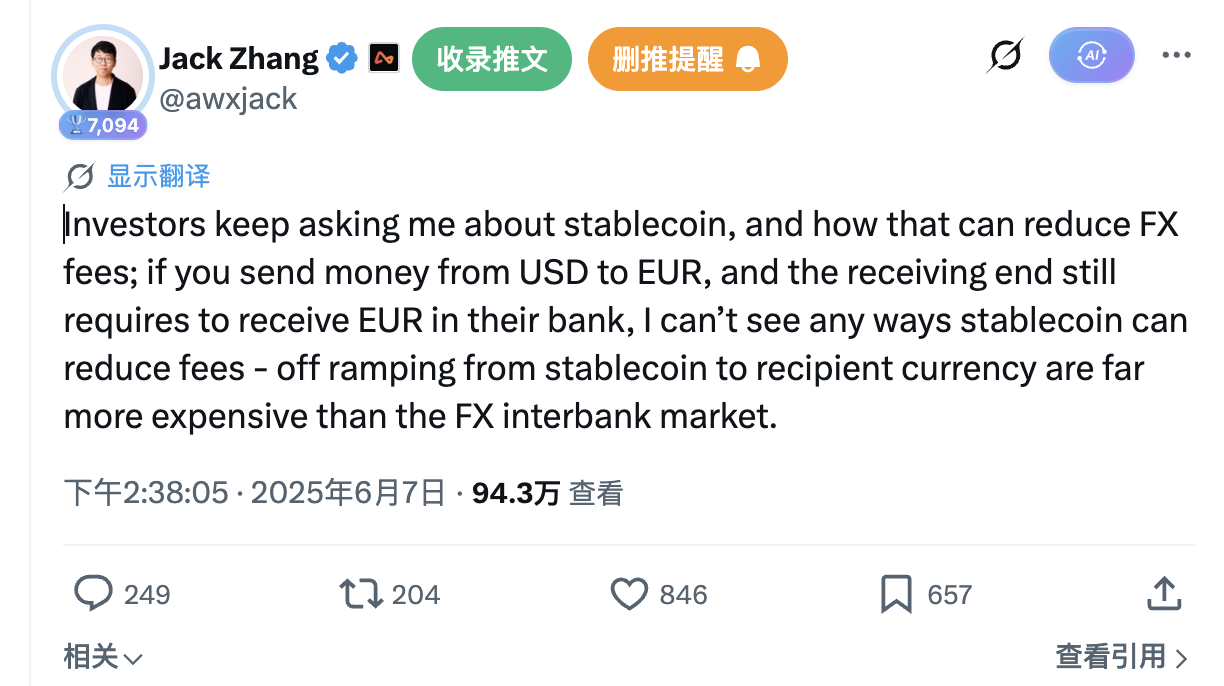
A year later, he publicly supported Metal and emphasized its ability to provide compliant global settlement for licensed financial institutions. The change here is not simply "from doubting stablecoins to being optimistic about stablecoins". What he supports now is an infrastructure solution that integrates stablecoins, compliance, deposits and withdrawals, local currencies, institutional settlement, and agent commerce.
In addition, Airwallex's T:0 and Airi, released on the same day, can also be observed together. T:0 is an AI-native financial platform aimed at undertaking financial functions such as bookkeeping, financial forecasting, tax processing, compliance control, and financial report generation from the first day of an enterprise's establishment. Airi is positioned as a wallet infrastructure for agent commerce. Early test data provided by Airwallex shows that its one-click settlement function can help merchants increase conversion rates by up to 14%, and will cover capabilities such as intelligent agent authorized payments, consumption limit control, permission management, and multi-currency balance management in the future.
This shows that Airwallex is not just observing AI Agents and on-chain finance from the sidelines. It is integrating enterprise finance and agent commerce into its product roadmap. Metal may become another piece of the puzzle: when agents need to complete payments and settlements across borders, currencies, and institutions, the underlying network must handle speed, cost, authorization, privacy, compliance, and deposits and withdrawals at the same time.
The Real Test Is Reconnecting On-Chain Assets to the Real World
Metal's public materials have not yet disclosed its financing amount, mainnet launch time, complete technical whitepaper, or actual customer list. Therefore, judging whether Metal can succeed now cannot rely solely on its vision.
What it really needs to prove are three things: Can compliance and privacy coexist in the same system? Are institutions willing to connect their real settlement processes? Can Airwallex's payment network and on-chain asset flow form a reusable product closed loop?
Whoever can integrate licenses, local payments, APIs, compliance, AI Agents, and tokenized assets into the same infrastructure will have the opportunity to make on-chain finance move from "faster U.S. dollars" to a truly usable global settlement system.