
We talked to three Crypto VC professionals and found: LPs value exit paths and investment management systems, GPs favor real financial processes, and projects need to prove real demand.
Written by: KarenZ, Foresight News
If we only look at top funds, Crypto VC in the first half of 2026 is not cold.
According to Foresight News statistics, among the new Crypto VC funds announced to have completed or launched in the first half of 2026, only two have reached or exceeded $1 billion: a16z crypto launched its $2.2 billion Crypto Fund 5, and Haun Ventures completed the raising of a $1 billion new fund.
Among the announced funds with more than $500 million but less than $1 billion, only Dragonfly's $650 million Fund IV exists. Further down are Variant's $222 million Variant 4 and ParaFi's $125 million new fund focused on stablecoins, tokenization, and institutional on-chain finance.
Almost every month, some Crypto VC secures new ammunition at the hundred-million-dollar level. The market isn't that cold.
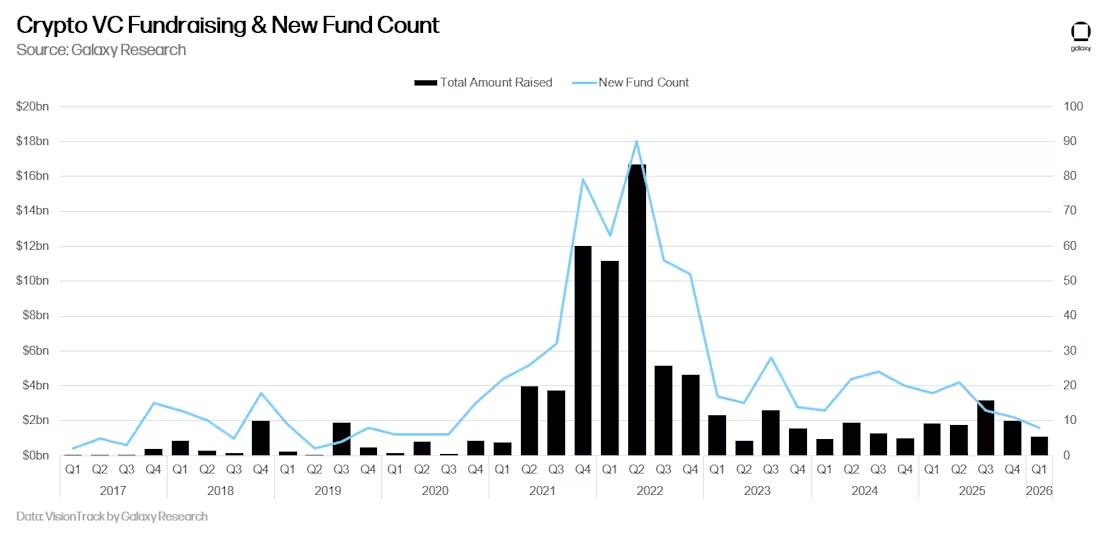
But another set of data paints a colder picture. The Galaxy Research report mentions that Crypto VC only had 8 new funds completed in Q1 2026, totaling about $1.1 billion, which is the lowest number of new funds in a single quarter since Q3 2020. Compared to Q1 2023, the number of new funds in Q1 2026 decreased by about 43%, the total fundraising amount was halved, the average fund size dropped by about 41%, and the median size also fell from $62.5 million to $55 million.
Source: Galaxy Research
This also makes the previous top fundraising more meaningful: the market hasn't completely cooled down, but the heat is mainly concentrated on a few funds. The emergence of large funds amplifies the feeling of recovery, but the number of new funds, average size, and annualized fundraising pace all remind us that the overall fundraising base of Crypto VC is much thinner than the previous round.
Combining public fundraising data and our interviews with Jocy Lin, founding partner of IOSG Ventures, Deng Chao, CEO of HashKey Capital, and Vivian, founder of Starbase, a clear signal is emerging:
Crypto VC in 2026 is not a full recovery, but a narrower one. The fundraising window is still open, but the door has narrowed. Those who can squeeze in are usually GPs with long-term performance, exit cases, clear strategies, and cross-cycle capabilities; projects that can get funding are also increasingly concentrated in directions that are easier to verify, such as stablecoins, RWA, institutional financial infrastructure, and Crypto x AI, as well as projects closer to real financial infrastructure.
From changes in LP questions to narrowing track preferences, and then to the restructuring of investment methods and exit paths, Crypto VC is entering a more stringent new cycle.
LP Requirements Change: AUM Is No Longer Enough, DPI Becomes Hard Currency
From 2021 to the first half of 2022, the primary market was like a high-speed financing machine. Funds were raising money, projects were financing, ecological funds were subsidizing, and exchanges and market makers were undertaking liquidity.
At that time, Crypto VC had a default consensus: as long as the industry Beta continued to expand, early investments would always be picked up by the next round of liquidity. But now, this default consensus has failed.
Jocy Lin, founding partner of IOSG Ventures, summarizes this change as shifting from "narrative-driven" to "DPI-driven." He believes, "In the past narrative-driven cycle, the gap between top and mid-tier funds was not fully opened; but in the current DPI-driven era, funds that can make real exits and clarify exit paths will take more LP funds, and the remaining money will be competed for among a large number of mid-tier funds."
Deng Chao emphasizes, "Crypto is highly cyclical, so funds cannot rely on a single exit path. They must have cross-cycle allocation capabilities. In terms of fund allocation, HashKey Capital emphasizes portfolio structure more: which are long-term infrastructure, which are cash flow projects, which are early projects with high volatility but high upside, and which can enhance liquidity through secondary or liquidity strategies."
This is why it is difficult to judge the real status of a Crypto VC by looking at AUM alone.
A report by Fortune magazine in April based on SEC documents provides a detail: during the market downturn in 2025, the asset under management (AUM) of top institutions such as Paradigm, Pantera, a16z crypto, and Multicoin were affected. The total AUM of a16z crypto's four funds dropped by nearly 40% from 2024 to 2025 to $9.5 billion, partly because its first three funds began distributing funds to LPs.
Notably, Fortune magazine cited Newcomer data that the net DPI (ratio of distributed capital to paid-in capital) of a16z's first crypto fund reached 5.4. Pantera also distributed capital to LPs in 2025 due to the listing of five portfolio companies including Circle and BitGo. Multicoin was more affected by market cycles, with its AUM halved to nearly $2.7 billion from 2024 to 2025. Haun Ventures was one of the few top institutions with AUM growth, with a year-on-year increase of over 30% to nearly $2.5 billion.
These details together point to a change: the scale narrative of Crypto VC is giving way to distribution capabilities. What LPs really care about is whether GPs can turn paper gains into cash returns.
This dissatisfaction has also started to appear in more public discussions. Akshat, co-founder of Maelstrom (a fund under Arthur Hayes), mentioned on Twitter in November 2025 that his $100,000 investment as an LP in an early Token fund was only about $56,000 after 4 years (3% management fee +30% profit share); Bitcoin doubled during the same period, and many seed-stage projects also had 20 to 75 times returns.
His conclusion is that many early Crypto funds have exceeded the carrying capacity of the real high-quality project pool, and LPs need opportunities more suitable for large-scale allocation. Akshat顺带 promoted the Maelstrom Equity Fund I product. This fund will focus on off-chain "shovel" businesses with positive cash flow, provide founders with cleaner cash exits through control acquisitions, and polish these businesses into targets that can be acquired by new entrants such as Robinhood, Charles Schwab, X, and Wealthfront in the future.
For LPs, such products try to provide a path that does not directly bear Token volatility but can allocate to Crypto industry cash flow assets at the nine-figure scale.
Beyond exit assessment, LPs are also asking more about fund governance and risk control details.
Deng Chao told Foresight News, "LPs no longer only ask about tracks and projects, but also care about asset protection, compliance risks, exit capabilities, and real landing value. What institutional LPs ultimately pay for is a reviewable, executable, and sustainable investment and risk control process."
The tightening of LP standards will eventually be reflected in the fundraising data of Crypto VC. The Galaxy Research data mentioned earlier has shown that the number of new funds and total fundraising are shrinking, but a few top GPs can still open the window.
Dragonfly is one of the typical samples of this cross-cycle fundraising capability. In February 2026, Haseeb Qureshi, managing partner of Dragonfly, announced that Fund IV was oversubscribed and completed with $650 million. Bets on popular projects such as Polymarket, Ethena, Rain, and Mesh became growth cases for Dragonfly to convince LPs.
Some GPs are also trying to respond to LPs' new questions with the fund products themselves. Jocy Lin mentioned that IOSG plans to launch new fund products this year, hoping to gain LP recognition through more differentiated product design and continue to output new investment cases to the market.
In other words, the competition of Crypto VC is not only about investing in projects but also about whether the product structure can answer the requirements of liquidity, DPI, and cross-cycle allocation. A few GPs with brand, performance records, and exit cases can still get money, while more GPs face longer fundraising cycles and stricter LP questionnaires.
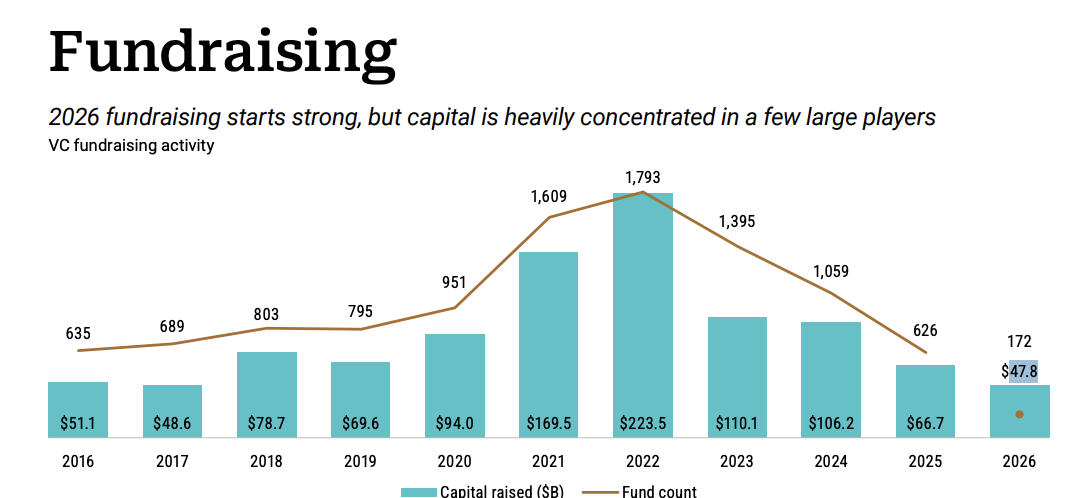
This is not a phenomenon unique to Crypto. The larger venture capital market is also concentrating on a few large managers. The 2026 Q1 Capital Market Report jointly released by PitchBook and the National Venture Capital Association (NVCA) shows that U.S. VC raised a total of $47.8 billion in the first quarter of 2026.
It sounds quite strong, but capital is highly concentrated in a few large managers. Experienced managers took 90.9% of the fundraising amount, a new high in this dataset. At the same time, the median size of VC funds dropped from $25 million in 2025 to $15.3 million in the first quarter of 2026. Large funds seem larger, and the living space for small funds is narrower.
Source: 2026 Q1 Capital Market Report jointly released by PitchBook and NVCA
In the Asian market, this pressure will be further amplified. Jocy Lin's judgment on Asian Crypto VC is sharper. He believes that U.S. funds have a more mature LP system and could still get returns from investments in large currencies like Bitcoin in the previous round; Asian funds have a much thinner LP base and limited bullets, so they must hit more certain opportunities with less money.
Therefore, the way out for mid-tier funds has shifted from "keeping up with all hot spots" to "proving that they have unique capabilities." Vivian, founder of Starbase, has a more direct judgment. She believes, "Pure Crypto VC has basically died out, and funds will continue to concentrate on the top. If mid-tier institutions cannot find vertical segmented tracks or switch to incubation and accelerator models, it will be difficult to survive with the pure financial investment approach of the previous round."
Track Preferences Change: New Money Bets on Crypto That Can Be Embedded in Finance
As LP questions change, GP fundraising narratives will also change.
What's really interesting in this round is not that the keywords in fundraising materials have changed from L1, NFT, DAO, SocialFi, and chain games to stablecoins, RWA, prediction markets, and AI; but that Crypto VC has begun to admit that the growth most understandable to LPs is happening at the interface of the financial system.
From the new fund narratives of a16z crypto, ParaFi, Haun Ventures, and Dragonfly, stablecoins, tokenization, prediction markets, institutional DeFi, and proxy finance appear repeatedly.
They sound different, but their common point is clear: they all try to turn Crypto into part of financial processes, information pricing, or machine economy.
These directions can be broken down into four more core lines: Crypto x AI, stablecoins and payments, RWA and on-chain capital markets, and prediction markets.
The first line is Crypto x AI.
AI Agents are new variables.
Many VCs are putting AI agents into their focus tracks, but what they care about is not the simple "AI + Crypto" concept.
In IOSG's framework, the weight and evaluation method of Crypto x AI are more specific. Jocy Lin told Foresight News, IOSG will invest 30% of its funds in the intersection of Crypto and AI, especially decentralized data services, DePIN, data collection, and B2B scenarios. His judgment is that AI demand is strong, but if Crypto x AI projects want to find business scenarios, they should first do B2B because revenue is easier to achieve.
This means that IOSG is not concerned with sticking an AI label on projects. What it really wants to verify is whether the AI era will generate new needs for trusted data, machine payments, decentralized computing power, automated collaboration, and verifiable execution.
Haun Ventures lists the Agentic Economy as one of the three focus directions of Fund II, believing that AI agents will represent humans to complete more tasks in the future: they will pay, trade, subscribe to software, purchase services, collaborate automatically between different applications, and create new paradigms of coordination, trust, and value exchange.
a16z crypto also mentioned that software Agents will make decisions, act, and trade on behalf of users, and acquire computing power, data, and services in the process. What blockchain can provide for AI agents is exactly wallet identity, on-chain credentials, stablecoin settlement, smart contract constraints, and verifiable execution logs.
Agent economy and payments also appear in the new fund themes of Dragonfly and ParaFi, which shows that more and more Crypto VCs are looking for the new financial execution layer in the AI era: who will provide identity, wallets, payments, transactions, data calls, and automatic settlement for agents.
Notably, Jocy Lin said that tracks such as social, games, and NFT have experienced large-scale falsification, but Jocy did not completely eliminate them. His judgment is that if these directions can be changed in production methods, IP gameplay, or distribution logic by AI, new opportunities may still emerge. In addition, IOSG will be more cautious about investing in new public chains, because the pattern of top public chains is relatively stable, the investment in new public chains is huge, and the migration cost for developers is also high. Therefore, IOSG has basically stopped investing in new public chain projects.
The second line is stablecoins and payments.
The attractiveness of stablecoins comes not only from the circulation scale already formed by USDT and USDC but also from their entry into scenarios such as cross-border payments, corporate settlement, treasury management, and merchant collection. This means that stablecoins have begun to have a commercialization path for financial infrastructure.
In the official announcement of its $2.2 billion Fund 5, a16z crypto regards stablecoins as one of the clearest use cases in this cycle, believing that their usage continues to grow in the downturn cycle and is being used for savings, cross-border transfers, and payments.
Analysis by McKinsey and Artemis estimates that based on the annualized activity in December 2025, excluding activities mainly driven by transactions, internal rebalancing, and automatic contract cycles, the real stablecoin payment scale is about $390 billion, more than doubling from 2024.
Compared to the global payment market, this volume is still small, but the growth rate and application scenarios are clear enough.
Acquisitions of such infrastructure by traditional fintech companies are also verifying the same